Pasqal put the optical bench on a chip. It held four atoms
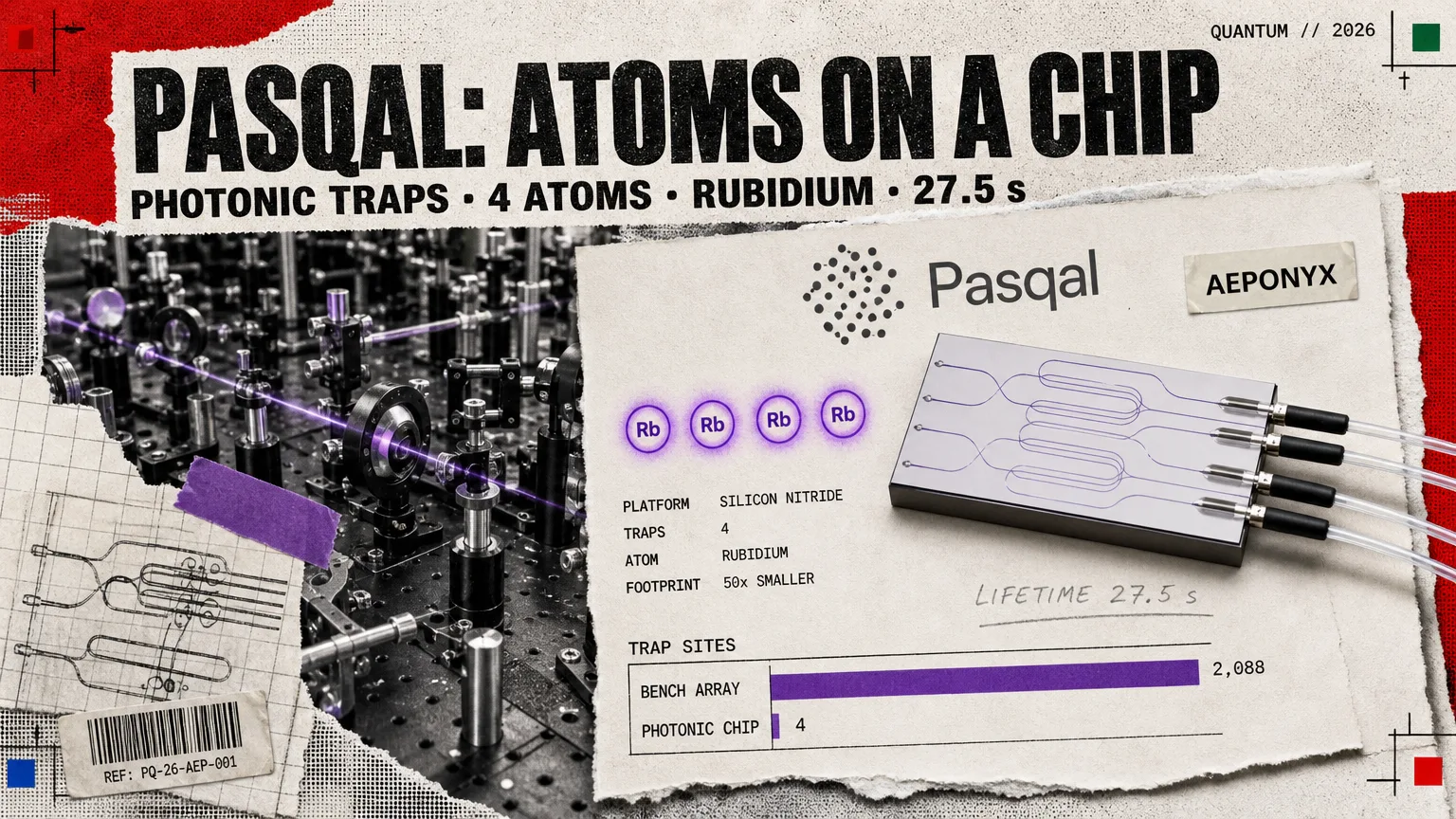
Pasqal says it is the first to trap atoms on a quantum computer using light generated by a photonic chip rather than a bench of free-space optics. Four traps, four rubidium atoms, and an atom lifetime of about 27.5 seconds.
Listen to this podcastListen
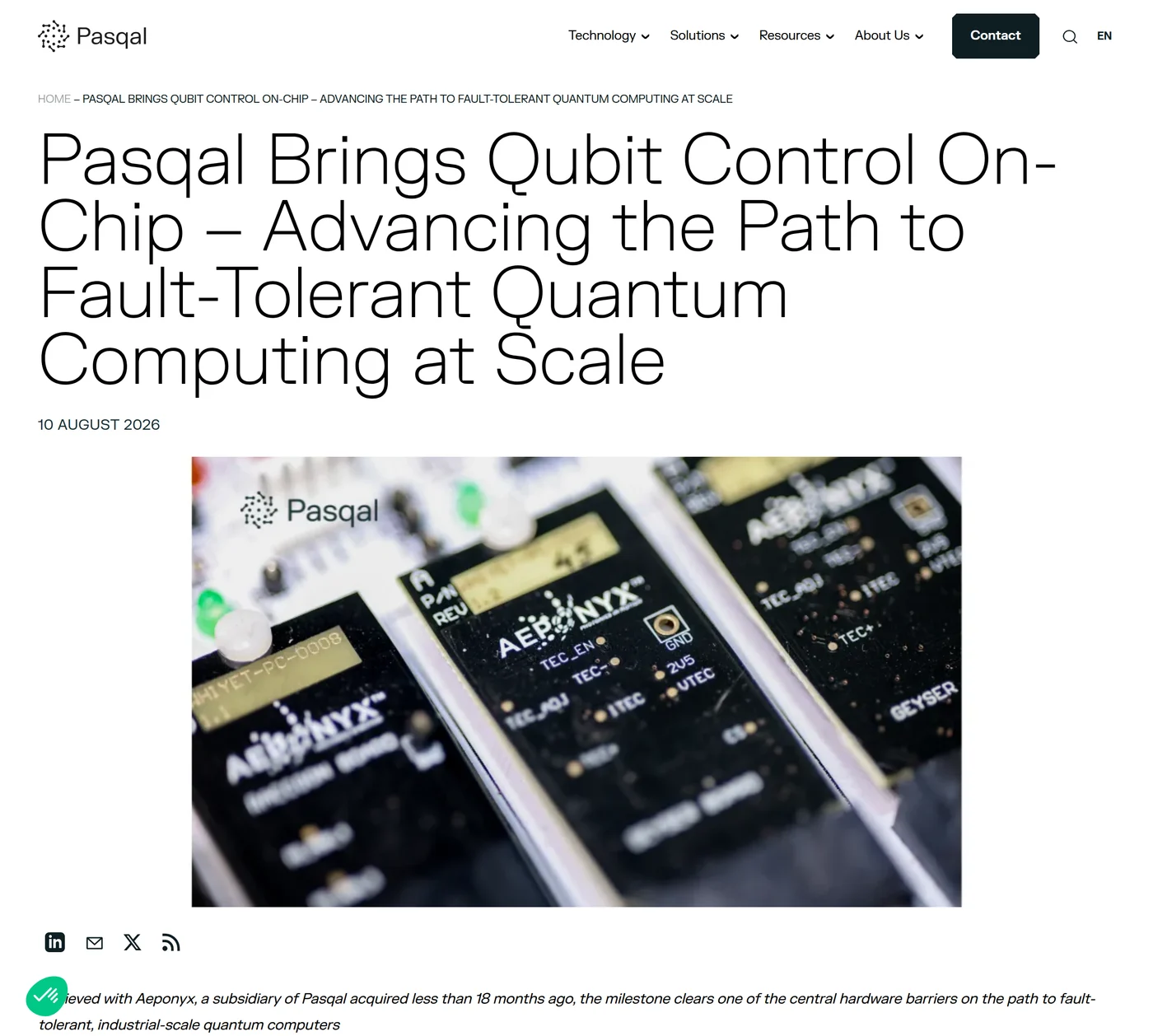
Pasqal said on Monday that it has held individual atoms in place using laser light generated on a photonic chip instead of light delivered from a bench of free-space optics. Four traps came off one silicon-nitride circuit and held four rubidium atoms inside a quantum processing unit. The French company calls it a world-first, with a qualifier bolted on: “what it, to its knowledge, believes to be a world-first”.
The work was done with Aeponyx, the Montreal photonics firm Pasqal bought in June 2025, and the release makes a point of the clock: the result arrived “within 18 months of acquiring Aeponyx”.
Why put the lasers on a chip at all?
Because the optics are what stop these machines growing. A neutral-atom processor parks each atom in a tightly focused laser beam called an optical tweezer. Every extra atom needs another beam, aimed to a fraction of a micron and held there while the computation runs. Pasqal states the problem in its own release: as it pursues “more than 10,000 atoms and 100 logical qubits”, the obstacle is “the growing complexity of optical hardware, which today often requires large free-space optical benches”.
That bench is not a packaging detail. It is lenses, mirrors and acousto-optic deflectors bolted to a vibration-isolated table and aligned by hand, and it does not shrink as the atom count climbs. Pasqal is not alone in going after it. A group from MIT and MIT Lincoln Laboratory published a sixteen-channel integrated photonic controller in Nature Communications in January 2025, though that one addressed silicon-vacancy centres in diamond rather than trapped atoms.
Four atoms, and the number they have to catch
Pasqal’s own published work sets the scale of what is left to do. In Physical Review Applied in 2024, a team including co-founders Antoine Browaeys and Thierry Lahaye reported trapping single rubidium atoms across an array of up to 2,088 sites at 6 K, and rearranged an 828-atom target array using moving tweezers driven by an FPGA.
That is the bench-based machine, and it is theirs. The chip did four.
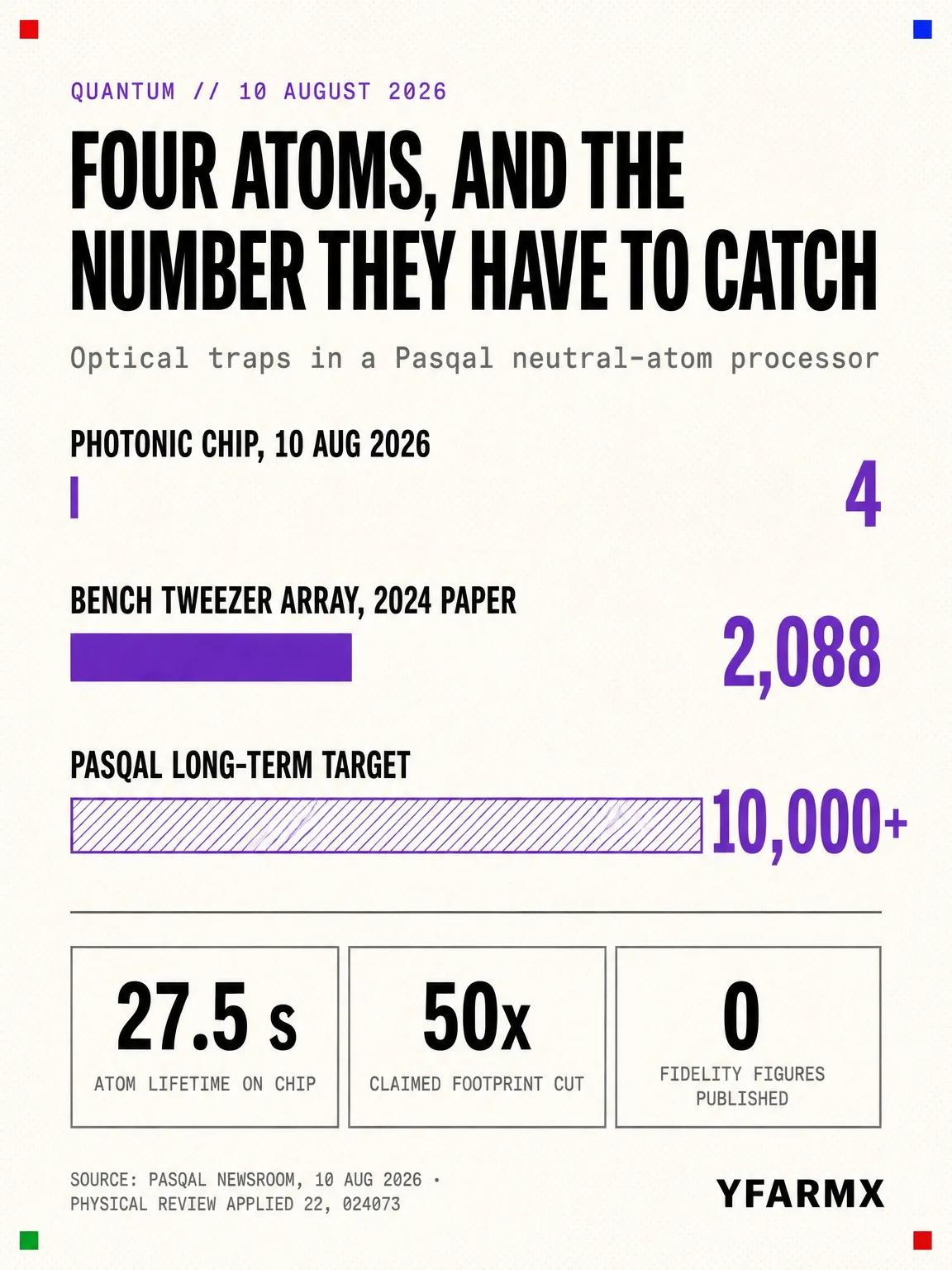
The single performance figure in the announcement is atom lifetime, at roughly 27.5 seconds, which Pasqal describes as “in line with” its existing bulk-optics systems. Beyond that the release carries no gate fidelity, no crosstalk, no atom-loss rate and no wavelength, and it is a company announcement rather than a preprint or a peer-reviewed paper. What was shown is that a chip can make a trap that holds. Whether a chip can make a trap good enough to compute in is a different measurement, and it has not been published.
“By moving qubit control onto a photonic chip, we removed what we believe to be one of the biggest barriers to scale, and we did it within 18 months of acquiring Aeponyx.”
Wasiq Bokhari, Chief Executive Officer, Pasqal
What the chip is meant to buy
Two things, on Pasqal’s account. The optical footprint of a future processor shrinks by “as much as 50 times”, and the optics stop being a bench somebody builds and become a part somebody orders. Silicon nitride runs through commercial photonics foundries already, which is the argument for choosing it over more exotic materials: a chip that a foundry can print in volume is a different industrial proposition from a table that a physicist has to align.
The roadmap it feeds is public. Pasqal’s 2025 plan puts a 200-plus-qubit platform called Vela in 2027, an early fault-tolerant machine called Centaurus in 2028, and 100 high-fidelity logical qubits in 2029. Fidelity is where neutral atoms have ground to make up: Pasqal reported a combined gate fidelity of 99.4 per cent on a small error-detecting code in May, against the 99.914 per cent Quantinuum reports for two-qubit gates on its trapped-ion machines and the 99.88 per cent Google published for Willow. Error correction eats the difference, and the number of physical atoms per logical qubit is the bill.
The announcement has an audience beyond physicists
Pasqal is in the middle of going public. Its Form F-4 was declared effective by the SEC on 5 August, the proxy went to Bleichroeder Acquisition Corp. II shareholders of record dated 4 August, and the merger that puts Pasqal on Nasdaq under BBCQ goes to a vote. The trapping announcement landed five days later, wrapped in several pages of forward-looking-statement language and the words “Pasqal believes” three times.
That does not make the result less real. It does explain why a four-atom demonstration got a press release with a fault-tolerance headline on it, and it is the reason to read the figure rather than the framing.
A component worked, and the bench is still on the table
The honest description of 10 August is that one part of a neutral-atom machine, the part that makes and delivers the trapping light, has been shown working in a form that can be manufactured. That is a real piece of engineering and it is the sort of thing that decides which of these companies is still building hardware in 2030.
It is also four atoms against their own 2,088, with no fidelity attached. The next number worth waiting for is not a bigger atom count. It is the first two-qubit gate fidelity measured on chip-generated light, because that is the figure that says whether the bench can actually go.
Sources
- Pasqal, 'Pasqal Brings Qubit Control On-Chip: Advancing the Path to Fault-Tolerant Quantum Computing at Scale' (10 August 2026)pasqal.com
- Pasqal, 'Pasqal Acquires Photonics Innovator AEPONYX' (3 June 2025)pasqal.com
- Pichard, Lim, Bloch et al., 'Rearrangement of single atoms in a 2000-site optical tweezers array at cryogenic temperatures', Physical Review Applied 22, 024073 (arXiv:2405.19503, submitted 29 May 2024)arxiv.org
- Christen, Sutula, Propson et al., 'An integrated photonic engine for programmable atomic control' (arXiv:2208.06732, v2 23 October 2024)arxiv.org
- Pasqal, 'Pasqal F-4 Declared Effective by SEC in Connection with Proposed Business Combination with Bleichroeder Acquisition Corp. II' (6 August 2026)pasqal.com
- Pasqal, 'Pasqal Releases 2025 Roadmap' (12 June 2025)pasqal.com
- Pasqal, 'Pasqal Demonstrates Logical Qubits Outperform Physical Qubits Solving Differential Equations' (21 May 2026)pasqal.com
- Pasqal, our history and founderspasqal.com