DOE opens a $215m quantum competition with $2.5m appropriated
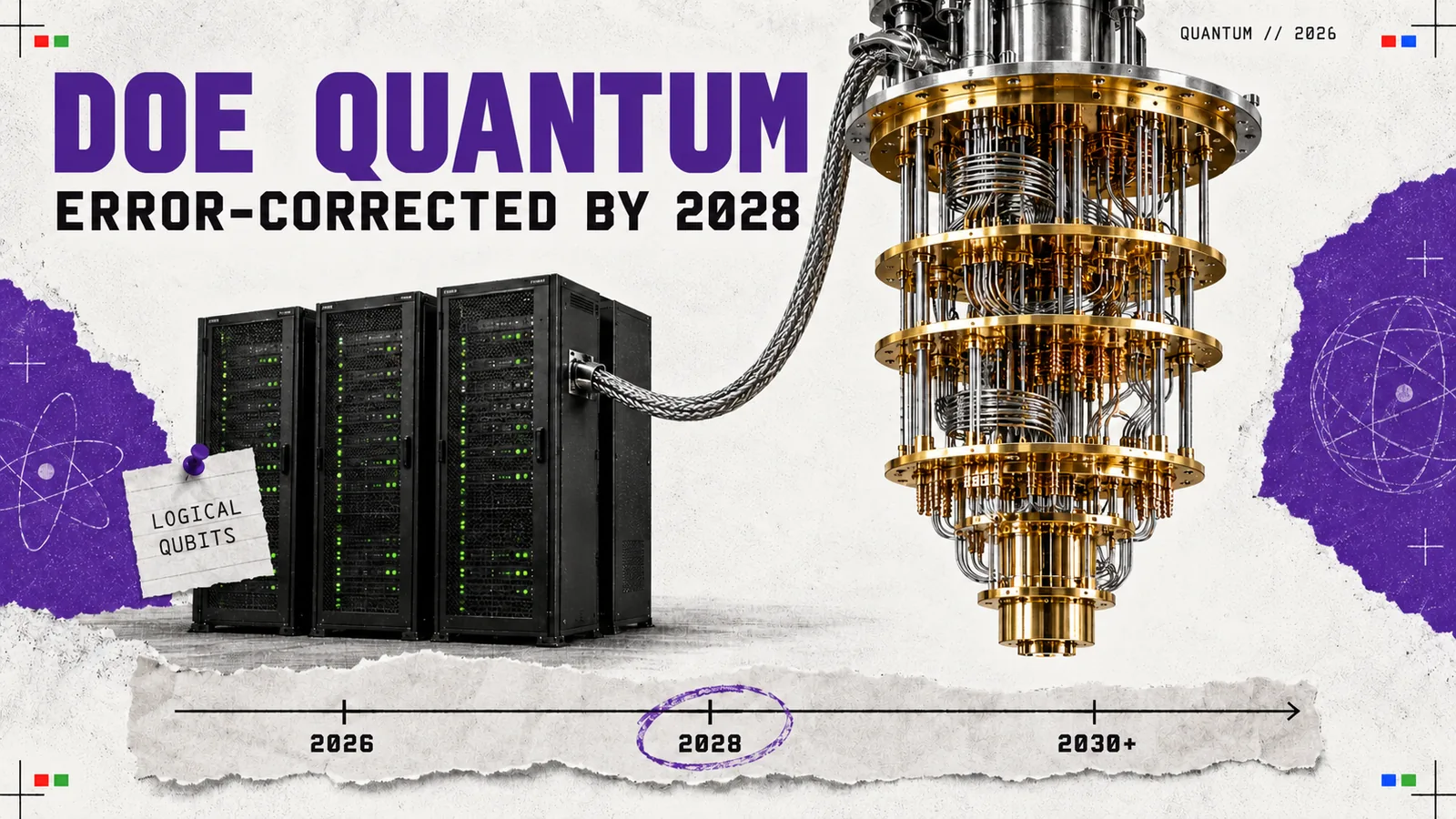
The Energy Department opened its Quantum Genesis Q Competition on 17 September 2026. It plans up to $215 million for a fault-tolerant machine of at least 100 logical qubits by 2028. DOE's own announcement says $2.5 million of that is Fiscal Year 2026 money.
The Department of Energy opened its Quantum Genesis Q Competition to applications on Thursday 17 September 2026, under request for applications DE-FOA-0003657. The headline number is up to $215 million. The number that is appropriated is $2.5 million.
Both figures come from DOE’s own announcement, in the same paragraph: “Total planned funding is up to $215 million, with $2.5 million in Fiscal Year 2026 dollars and outyear funding contingent on congressional appropriations.”
The structure explains the distance between the two. Almost every dollar in the Q Competition is prize money that exists only once a company has built something and DOE has verified it works.
DOE wants a hundred logical qubits by 2028
The competition has one final milestone, and the RFA defines it precisely. A first-generation scientifically relevant quantum computer, which the document shortens to SRQC, is a machine “possessing at least a hundred logical qubits and capable of performing thousands of hard fault-tolerant operations in service of a specific scientific workflow.”
A logical qubit is the RFA’s own term of art, defined there as “an effective qubit spread across multiple subsystems that can be operated under a quantum error correction regime to suppress errors or environmental noise.” Our explainer on quantum error correction covers why one logical qubit costs so many physical ones.
The second metric is the one to watch, because it is the harder of the two. A “hard operation” is defined as an operation “which are difficult in the participant’s error correction scheme (e.g., non-Clifford operations in stabilizer QEC) but necessary to realize computational universality.” The RFA calls these “the scarce resource in a fault-tolerant computation.”
DOE sets targets for three generations of device in a single table:
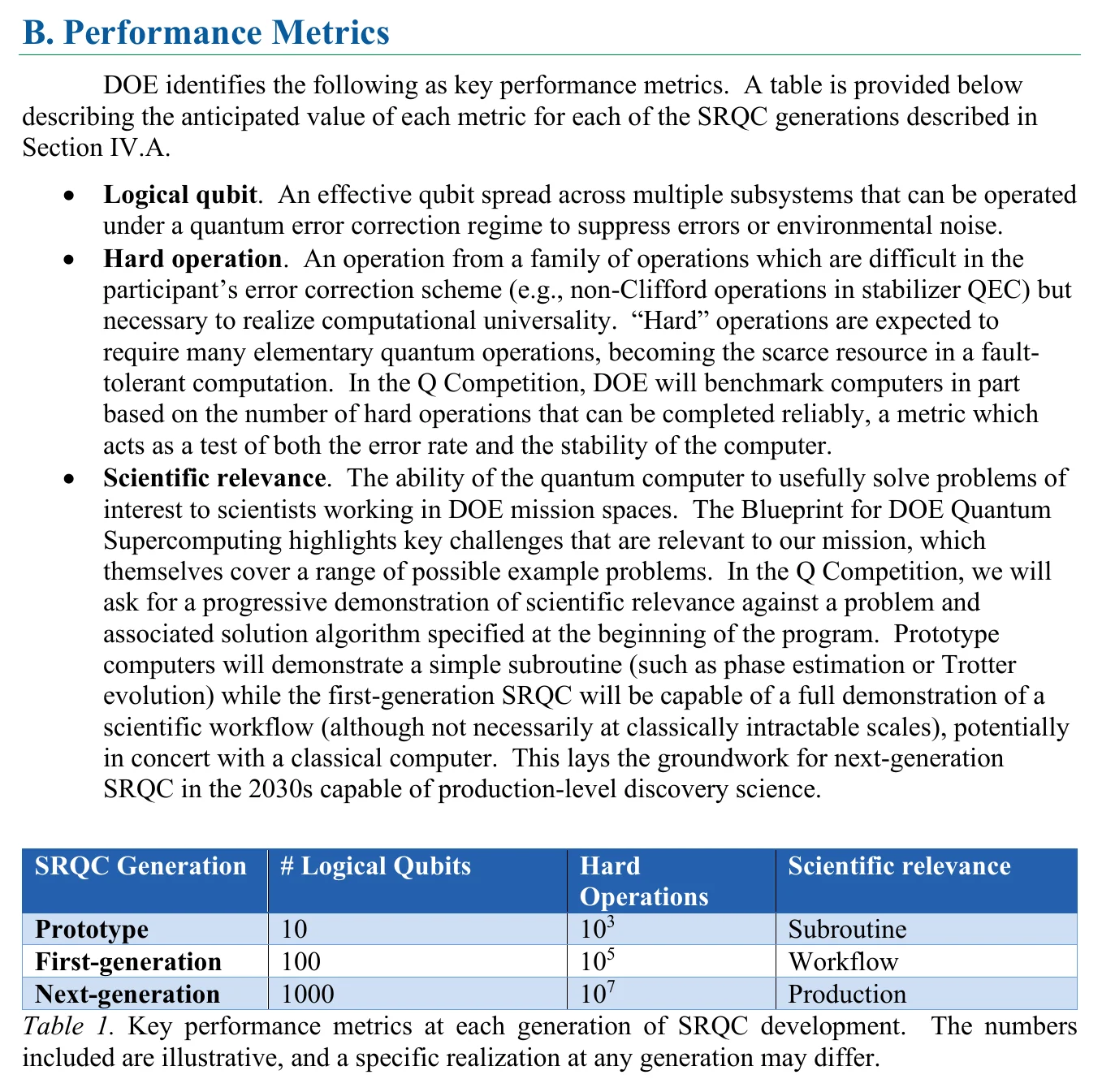
The prototype sits at ten logical qubits and a thousand hard operations, and is expected about a year into the programme. The first generation is the competition’s finish line. The thousand-qubit next generation is explicitly outside it, though DOE says first-generation machines “will be evaluated for the feasibility of future scaling towards this goal.”
DOE also leaves the door open past its own deadline. The programme’s goal is delivery by 2028, but the RFA says DOE “will consider applications from entities that propose to reach that point by no later than 2030”, with a warning attached: applicants on longer timelines “accept the risk that other performers may claim the available milestone payments prior to completion of their own negotiated milestones.”
The money is a prize, paid on delivery

The award structure splits in two, and the split is where the $215 million headline comes apart.
Phase I is fixed money, and there is not much of it. An awardee receives $250,000 once DOE approves its verification and validation plan, expected six months after the project starts. It receives $1,250,000 for a validated prototype, expected at one year. That is $1.5 million per company, for two milestones, over roughly a year.
Phase II is everything else. A $100 million general incentive pool is split evenly among all awardees who demonstrate a first-generation SRQC, after a final evaluation DOE anticipates for September 2028. On top of that sit two bonus pools of $50 million each: one shared among awardees reaching 150 or more total logical qubits, the second among those reaching 200 or more.
Ten awardees at $1.5 million each is $15 million. Add the $100 million pool and the two $50 million pools and you reach $215 million exactly.
The RFA works the arithmetic itself, with four named hypothetical performers. Alice reaches 200 logical qubits, Bob 150, Charlie and Deborah 100 each. Alice takes the whole 200-qubit pool, splits the 150-qubit pool with Bob, and takes a quarter of the general pool: $100 million. Bob gets $50 million. Charlie and Deborah get $25 million each.
Read the other way, the same table says a company that enters, builds a prototype and then misses 2028 walks away with $1.5 million, having spent two years on it. DOE is explicit that this is the deal: “Development of the application is the financial responsibility of the applicant.”
DOE can stop before the prize money
The appropriations language in the RFA is unusually direct:
Moving from Phase I to Phase II and the funds available in Phase II, including the specific funding amounts available in the general incentive pool and bonus pool(s), are each subject to future appropriations, and absent of said appropriations, DOE reserves the right to end the awards prior to proceeding to Phase II and modify any funding available in Phase II.
So the $200 million that makes this competition worth entering is the part that Congress has yet to appropriate, and DOE has written down in advance what happens if it does not.
There is a second contingency, for the case where the money arrives and the machines do not. If nobody demonstrates a first-generation SRQC by September 2028, DOE says it will assess how far the awardees got, and where progress is “deemed sufficient” it will notify them of its intent to modify the agreement for an extended duration. DOE also reserves the right to let new entities join a competition that runs long.
Only companies can enter
The RFA restricts applications to “for-profit domestic entities as defined herein”, and DOE’s own announcement puts it more briefly: “Applications are open to private sector companies.”
That is narrower than the way the initiative was described in June. When DOE announced Quantum Genesis on 23 June 2026, Energy Secretary Chris Wright framed it as a coalition: “Through Quantum Genesis, we are bringing together America’s National Laboratories, universities, and private sector innovators to develop and deploy the world’s first scientifically relevant fault-tolerant quantum computing capability.”
Both descriptions hold, because the laboratories arrive through a different door. Alongside the Q Competition, DOE opened a Quantum High-Performance Computing Validation and Verification Testbed Lab Call, with planned funding of $45 million and $14 million in Fiscal Year 2026 dollars. Applications to that one are open to DOE National Laboratories, and its job is to build the tools that will judge the competition. Laboratory staff are the referees: the RFA says DOE intends to use them to verify and validate the machines, with “both physical and virtual access to the quantum computers”, and their findings determine whether a milestone has been met.
Foreign firms are addressed directly. A foreign entity may apply as recipient or subrecipient, but “the application must be accompanied by an explicit written waiver”, and DOE will approve one only “in limited circumstances”. The build stays onshore: “All capabilities must be built in the U.S. and all work under the award must be performed in the U.S.”, with a partial waiver available on request.

These are other transaction agreements
The Grants.gov listing records the funding instrument type as Other, and the RFA confirms what that means: awardees enter into Other Transaction Agreements, and DOE posted a sample OTA to the listing on 17 September, the day after the RFA itself went up.
An OTA sits outside the standard federal grant and contract rules, which is what lets DOE pay on a negotiated milestone rather than against a cost proposal, and what lets it write terms like the Phase II exit above. It also means the specifics are negotiated per awardee. The RFA says the prototype milestone and “what constitutes an acceptable prototype” will be “based off of Table 1 but negotiated with selected applicants”, along with the methodology used to evaluate the metrics.
That negotiation extends to the headline qubit count. For companies whose architecture “is not naturally measurable in total logical qubits”, DOE says it will work with them “to identify equivalent technical metrics during negotiation”, and that judging whether an alternative metric is acceptable is “at the sole discretion of DOE”. Those substitute metrics cover eligibility for the bonus pools too, so the 150 and 200 thresholds are not necessarily counted the same way for every entrant.
DOE intends to waive cost sharing, under the Energy Policy Act of 2005. The Grants.gov listing shows no cost sharing or matching requirement.
One clause reads as reassurance to companies weighing whether to show their roadmap to the government: “Failure to participate or complete the milestones does not disqualify an entity or vendor from future DOE collaborations or procurements.”
DOE will only back fault-tolerant machines
The RFA carries a short list of applications it calls not of interest, and the first item on it draws a hard line around the word fault-tolerant. DOE will not consider proposals to build quantum computers “that are not fault-tolerant, or cannot be made fault-tolerant, or are only capable of error mitigation or detection and not correction.”
The sentence that follows closes the obvious escape route: “Such proposals are not of interest even if the applicant believes that error rates can be reduced to a point of scientific relevance without fault-tolerance.”
That rules out a large share of what the industry currently ships and demonstrates.
The dates
DOE holds a virtual informational webinar on 25 September 2026 at 1:00 pm Eastern Time. Attendance is optional and registration closes at 5:00 pm Eastern on 23 September.
Questions go to [email protected], and must be in by 6 October 2026 at 5:00 pm Eastern for a guaranteed answer. Applications must be submitted by 19 October 2026. DOE anticipates announcing initial selections no earlier than 13 November 2026.
Three documents sit behind this competition
Three instruments stack up behind this competition, and they are separate documents.
Executive Order 14413, “Ushering in the Next Frontier of Quantum Innovation”, was signed on 22 June 2026 and published in the Federal Register on 25 June. It states the policy: “It is the policy of my Administration to ensure that the United States maintains a strategic technical advantage in QIST and leads the development of a robust and trusted quantum ecosystem across QIST research, manufacturing, commercialization, and application.” It establishes the Quantum Computer for Application Development and Discovery Science effort, QC-ADDS, to “pursue development of a quantum computer at a scale intended to initiate the era of quantum-enabled scientific discovery, with the intent to deliver at least one such computer to a Department of Energy facility”.
The phrase “Quantum Genesis” appears nowhere in that order. It is DOE’s own name for the programme it built to deliver the order, announced the following day, and described in the RFA as “a foundational pillar of the broader Genesis Mission”.
The Q Competition is one of three priorities under Quantum Genesis. The other two are a National Quantum Supercomputing User Facility and a focused research effort on quantum applications. Our page on US quantum policy tracks how these fit together.
The bar an applicant has to clear
The public record sets out exactly what an entrant is signing up to deliver: at least a hundred logical qubits, roughly a hundred thousand hard operations, running a scientific workflow end to end, verified by staff from the national laboratories with hands on the machine, by September 2028. Our explainer on quantum advantage sets out how far today’s demonstrations sit from that.
Who is prepared to try stays private until DOE says so. Applications close on 19 October, and the department expects to name its initial selections from 13 November onwards.
DOE has priced the answer at $215 million and funded the question at $2.5 million. The rest is a bet that the machines will exist and that Congress will pay for them when they do.
Sources
- DOE Launches Competition to Accelerate Development of World's First Fault-Tolerant Quantum Computer (DOE Office of Science, 17 September 2026)energy.gov
- The DOE Quantum Genesis Q Competition, opportunity listing (Grants.gov)simpler.grants.gov
- Request for Application DE-FOA-0003657, The DOE Quantum Genesis Q Competition (DOE Office of Science, version 1.0)files.simpler.grants.gov
- Energy Department Announces Initiative to Create and Deploy the World's First Scientifically Relevant, Fault-Tolerant Quantum Computers (DOE Office of Science, 23 June 2026)energy.gov
- Executive Order 14413, Ushering in the Next Frontier of Quantum Innovation (Federal Register, 25 June 2026)federalregister.gov