OpenAI releases 722 AI-generated maths manuscripts for scrutiny
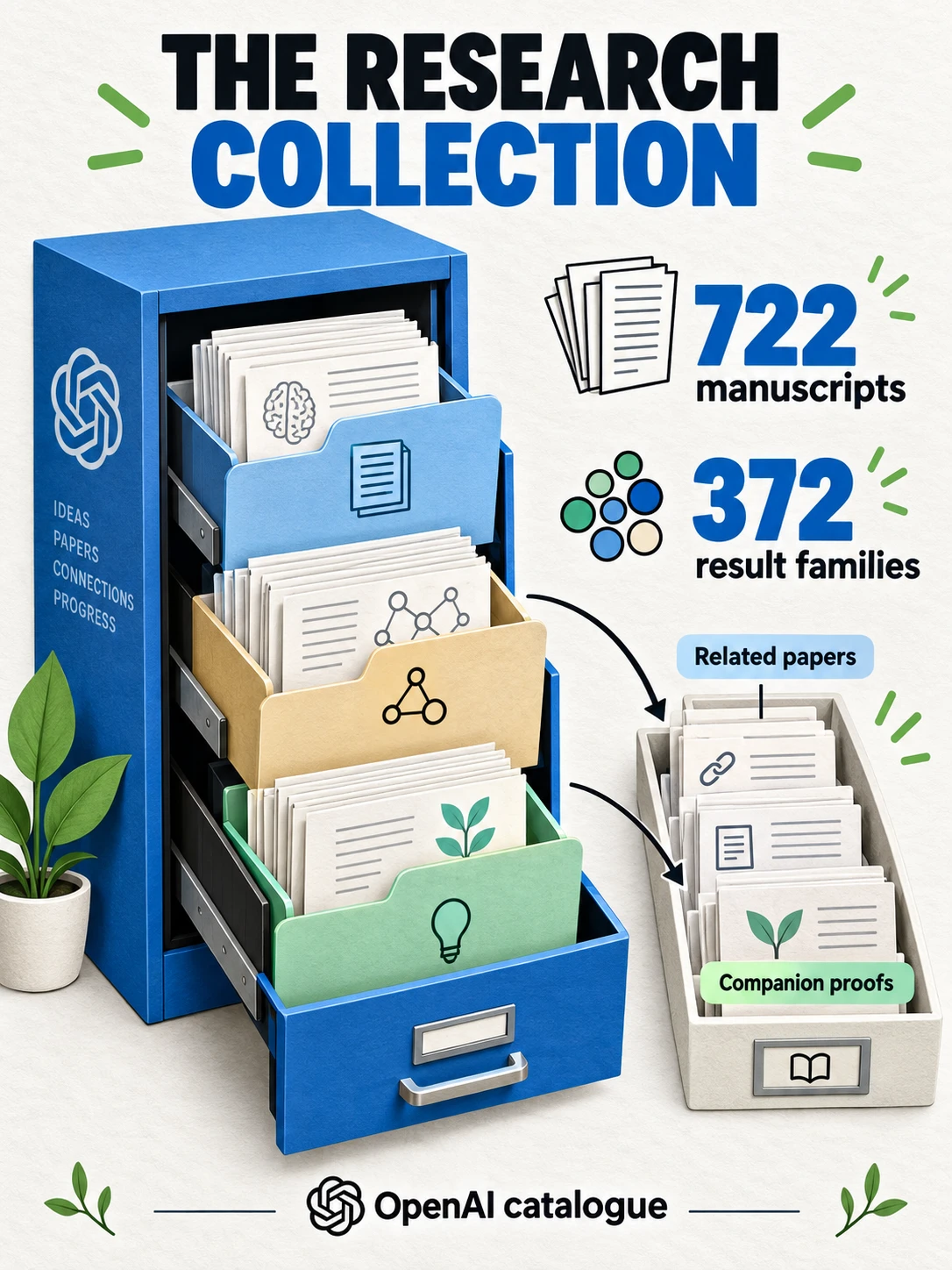
OpenAI's GitHub release groups 722 manuscripts into 372 result families. An internal model generated the work, which spans different stages of verification.
Listen to this articleListen
OpenAI has released 722 AI-generated mathematical manuscripts on GitHub, presenting claimed advances across long-standing research questions. The collection, published on 6 October 2026, groups the papers into 372 families of related results.
An unreleased internal model produced the work. OpenAI’s repository places the results at different stages of verification and says some unformalised arguments could contain issues. The papers are preprints now available for researchers to examine.
Why are there 722 papers and 372 families?
OpenAI’s 372 result families group papers that belong together: a main argument, companion work, consequences or an alternative proof can all sit within one family. The 722 manuscripts are the individual documents in those groups.
The research catalogue covers number theory, geometry, analysis, algebra, theoretical computer science and other fields. Each entry links to its underlying manuscripts, giving researchers a route from a headline claim to the argument itself.
What is the quasi-Riemann claim?
OpenAI’s catalogue includes a claimed zero-free region for Dirichlet L-functions, mathematical functions used in number theory, under the name quasi-Riemann hypothesis.
The principal entry claims those functions, including the Riemann zeta function, have no zeros where the real part of the input is greater than 7/8. A companion manuscript offers a different argument for a region above 11/12. Those boundaries describe the specific claims being submitted for scrutiny.
The catalogue also lists claimed results concerning the irrationality of Catalan’s constant and Hilbert’s tenth problem over the rational numbers. Each remains an argument to assess against its stated assumptions and proof.
Lean checks the steps in a formal proof
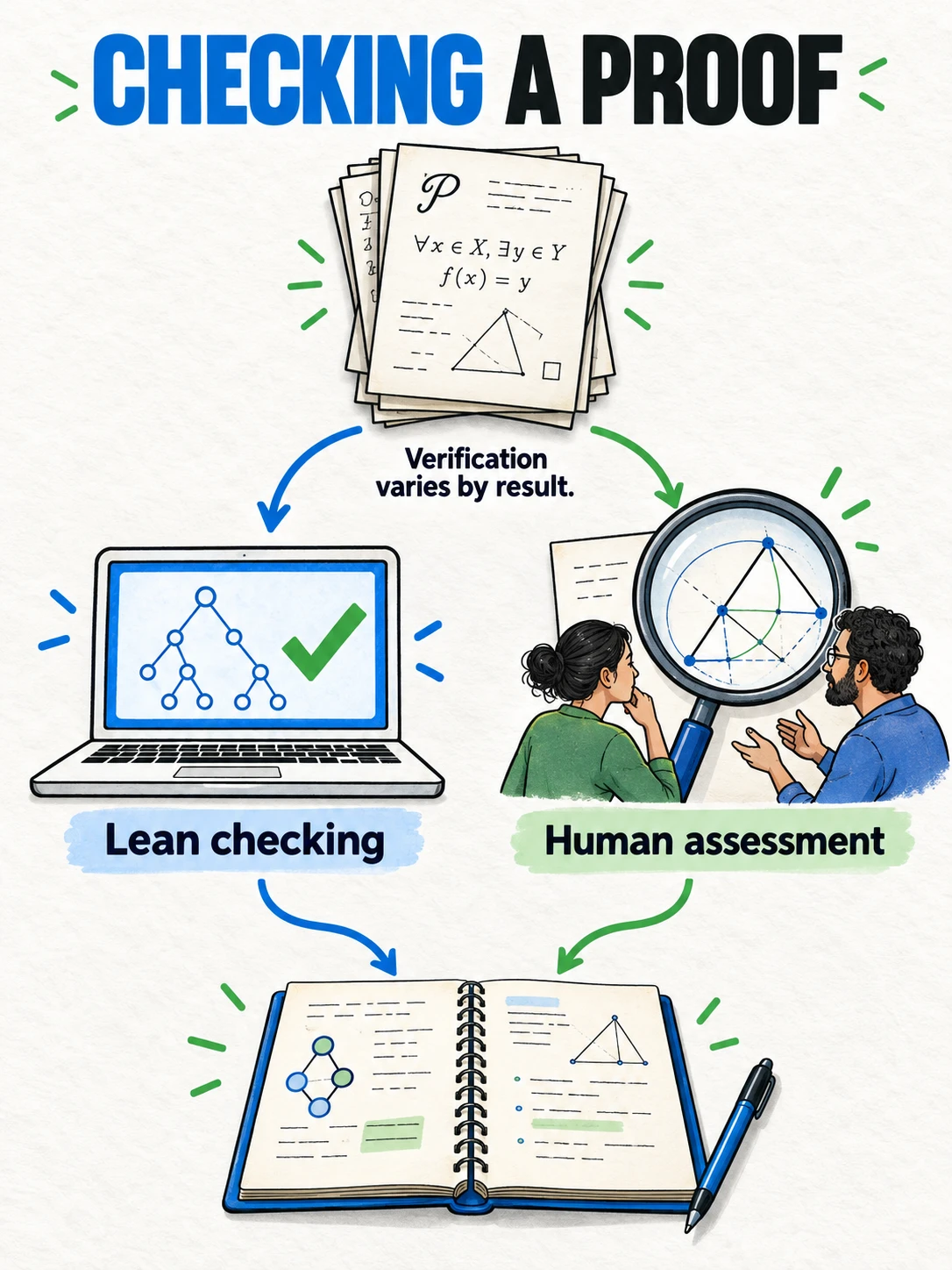
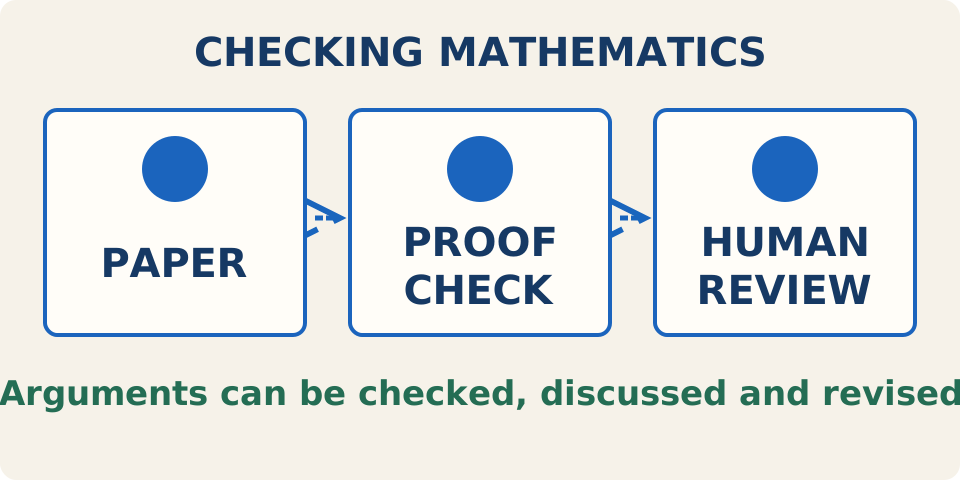
Many manuscripts have accompanying proofs in Lean, software that checks mathematical arguments expressed in a formal language. A formal proof makes the logical dependencies explicit so a computer can verify the steps.
OpenAI is adding further formalisations and has published instructions for checking the existing ones. Human assessment also establishes whether a formal statement captures the intended research question, how it connects to earlier work and how the result can be used.
OpenAI reports three hours of compute per result
OpenAI says the model was posed approximately 4,000 problems during evaluation. The vast majority of results used a common procedure, averaging the equivalent of three hours of ChatGPT Pro thinking compute per result with that internal model.
The company identifies exceptions involving a zeta-function zero-free region and the Hodge conjecture for CM abelian varieties. It has also released ten abridged reasoning summaries, alongside the compute estimates, to help researchers understand how selected results were reached.
Mathematicians begin assessing the collection
The independent Advisory Group on Mathematics and Artificial Intelligence, based at the Institute for Advanced Study, responded to the release on 6 October. Its members say the mathematical community must undertake the assessment needed to incorporate the work into established knowledge.
The group also calls for equitable access to research tools and computational resources, so mathematicians can pursue questions of their own. OpenAI says it will support workshops and other activities to help researchers understand the results. The public repository will retain earlier versions as corrections and revisions arrive.
Sources
- OpenAI: sharing AI progress in mathematics, 6 October 2026openai.com
- OpenAI mathematics repository: collection, verification and generation proceduregithub.com
- OpenAI research catalogue: claimed results and manuscript linksgithub.com
- Independent Advisory Group on Mathematics and Artificial Intelligence: response, 6 October 2026agmai.org
- Lean: proof assistant and mathematical formalisationlean-lang.org