BCG: quantum could eventually cut nearly 10% of global emissions
Quantum computing could eventually cut 3 to 7 gigatonnes of CO2-equivalent a year, the BCG Institute estimated on 17 September 2026. Its own footprint would be about 0.09 gigatonnes in 2040, against 1.31 for data centres at BCG's midpoint, and only 10% to 15% of the savings would arrive by 2040.
Listen to this articleListen
Quantum computing could eventually cut 3 to 7 gigatonnes of carbon dioxide equivalent a year, the BCG Institute estimated in an analysis published on 17 September 2026. At the 5-gigatonne midpoint, that is nearly a tenth of today’s global emissions, and BCG puts the machines’ own footprint at about 0.09 gigatonnes in 2040.
The savings would come from simulating molecules and materials that today’s computers struggle to model: catalysts for ammonia and hydrogen, materials that capture carbon dioxide, and new battery chemistries. They would also arrive slowly. BCG expects only 10% to 15% of the potential by 2040, because many of the plants that would use the new materials run for 20 to 40 years.
How much could quantum computing save?
BCG puts quantum computing’s full potential at 3 to 7 gigatonnes of CO2-equivalent a year once quantum-enabled solutions are fully deployed, with about 80% of it in hard-to-abate sectors such as steel, cement, chemicals, trucking, aviation and shipping. The seven authors, including Maurice Berns and Matt Langione, started from about 50 known quantum computing applications. Sixteen could plausibly cut emissions. In seven of those, existing technologies could deliver the same savings, as with solar cells and electric cars, or more computing power would add little, which left nine.

| Use case, BCG estimate | Average saving a year | Range |
|---|---|---|
| Carbon capture | 1.4 Gt | 0.6 to 2.1 Gt |
| Methane vaccines for livestock | 0.9 Gt | 0.2 to 1.6 Gt |
| Green hydrogen and ammonia | 0.9 Gt | 0.7 to 1.1 Gt |
| Cement | 0.8 Gt | 0.5 to 1.1 Gt |
| Electric truck batteries | 0.5 Gt | 0.3 to 0.6 Gt |
| Steel | 0.4 Gt | 0.2 to 0.5 Gt |
| Curtailment: storing surplus renewable power | 0.1 Gt | under 0.1 to 0.2 Gt |
| Aluminium | 0.04 Gt | 0.03 to 0.05 Gt |
| Aviation materials | 0.04 Gt | 0.03 to 0.05 Gt |
| All nine use cases | 5.0 Gt | 2.8 to 7.2 Gt |
Every use case comes down to simulating molecules
All nine of BCG’s use cases depend on simulating how molecules and materials behave and interact, which the analysis says quantum computers model far better than classical ones. Designing a catalyst, a battery electrode or a carbon-capture material means modelling the interactions between electrons, and BCG says accurately modelling a small molecule would take even the largest supercomputers thousands of years. QC Ware and IonQ reported on 1 September that they had modelled an enzyme’s active site with a quantum part of eight qubits.
Carbon capture is the biggest prize at 1.4 gigatonnes a year on average. Direct air capture costs about $600 to $1,000 a tonne today, BCG says, against the roughly $100 a tonne often cited for adoption at scale. Part of that cost is the sorbent, which has to bind carbon dioxide tightly enough to capture it but loosely enough to release it without large amounts of energy.
Producing ammonia, the basis of fertilisers that feed roughly half the world’s population, accounts for about 1% to 2% of global emissions, according to BCG. A better catalyst could cut the energy the reaction needs, and the same advances would make green hydrogen cheaper, improving the case for making steel with hydrogen. For batteries, quantum computers could simulate new electrodes and electrolytes without building them, BCG says, pointing research at chemistries that store more energy or cost less.
Quantum computers would emit far less than data centres
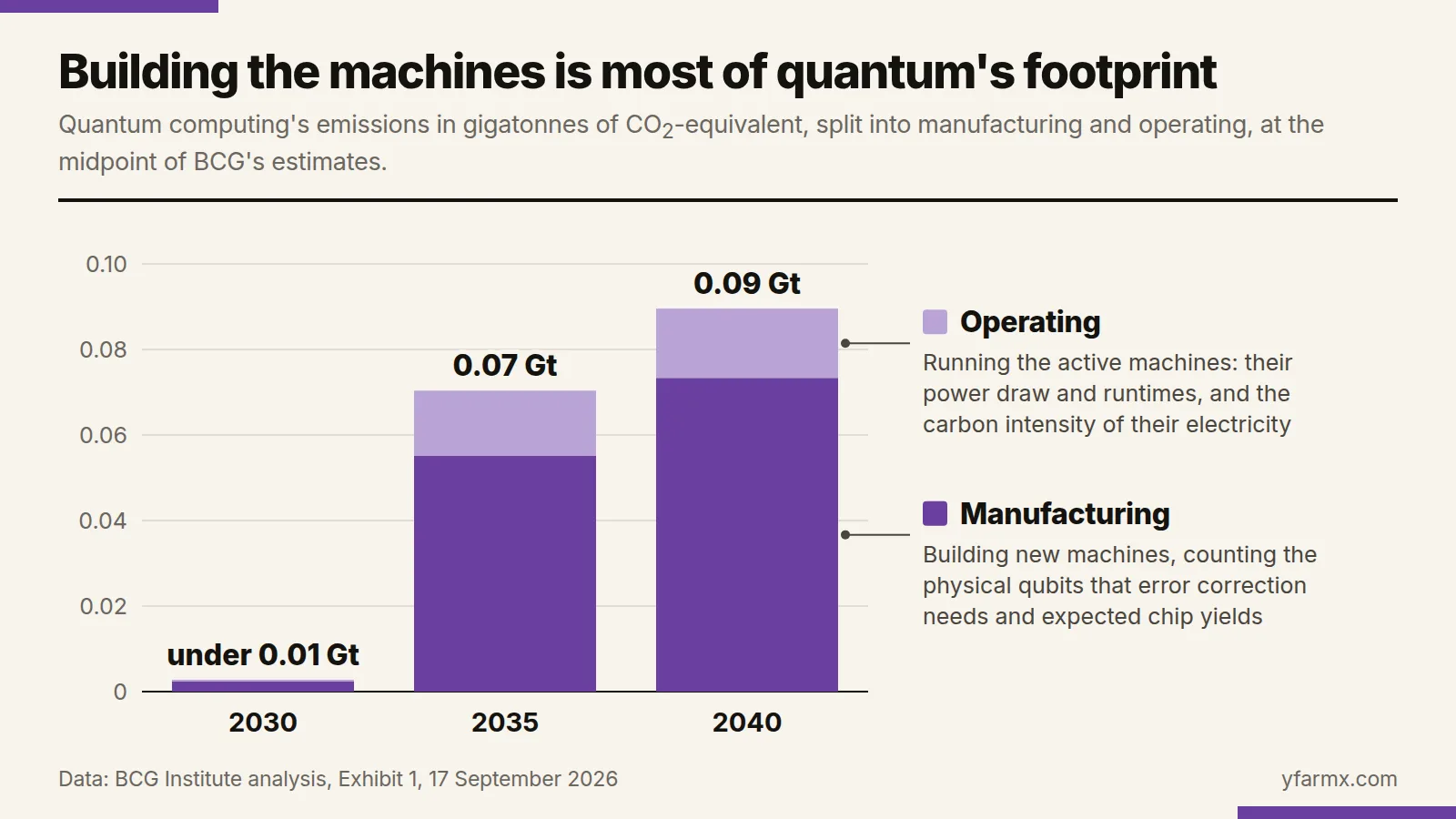
BCG expects quantum computing to emit about 0.09 gigatonnes of CO2-equivalent in 2040, less than 0.2% of the 50 gigatonnes the world is expected to emit that year, and about 7% of what data centres would emit at the midpoint of its estimates. Most of that footprint comes from manufacturing the machines, with the rest from running them, and BCG’s manufacturing estimate counts the extra physical qubits needed for error correction and expected chip yields.
| Year | Quantum computing | Data centres, at BCG’s midpoint |
|---|---|---|
| 2030 | under 0.01 Gt | 0.45 Gt |
| 2035 | 0.07 Gt | 0.73 Gt |
| 2040 | 0.09 Gt | 1.31 Gt |
The machines themselves are power-hungry: a full-scale quantum computer could draw roughly 1 megawatt, comparable to a small data centre, BCG says. The difference is the size of the fleet. BCG estimates that 230 to 1,400 machines could serve global quantum computing demand by 2040, against more than 11,000 data centres running AI and other high-performance computing today, some of them approaching a gigawatt. A single AI campus can need far more: Georgia Power expects OpenAI’s Project Camellia site in Georgia to need about 3,200 megawatts.
Set against roughly 5 gigatonnes of potential annual savings, BCG puts the climate benefit at about 60 to 1. The analysis expects quantum to leave generative AI’s emissions largely unchanged, because its advantage lies in “solving different types of problems rather than in making general-purpose computing cheaper”.
Why most of the savings come after 2040
BCG estimates that only 10% to 15% of quantum computing’s potential savings could be realised by 2040, because steel mills, cement kilns, chemical plants and carbon-capture facilities may be refurbished or replaced only every 20 to 40 years. A better material or process often has to wait until a company rebuilds the plant that would use it. If commercially viable quantum solutions emerge around 2035, as the analysis supposes, companies still have to turn them into industrial processes, build or retrofit the plants to make them and deploy them across existing assets.
Steel, cement, chemicals, aluminium, oil and gas, aviation, shipping and trucking are likely to produce roughly 30% of global emissions in 2040, and BCG says quantum could eventually abate 20% to 40% of those sectors’ emissions. Its chart for 2040 sets about 0.7 gigatonnes saved against the 0.09 gigatonnes quantum computing emits, a net cut of 1.3% in that year’s emissions, and puts 87% of the full savings after 2040. BCG calls the climate impact “heavily back-weighted”.
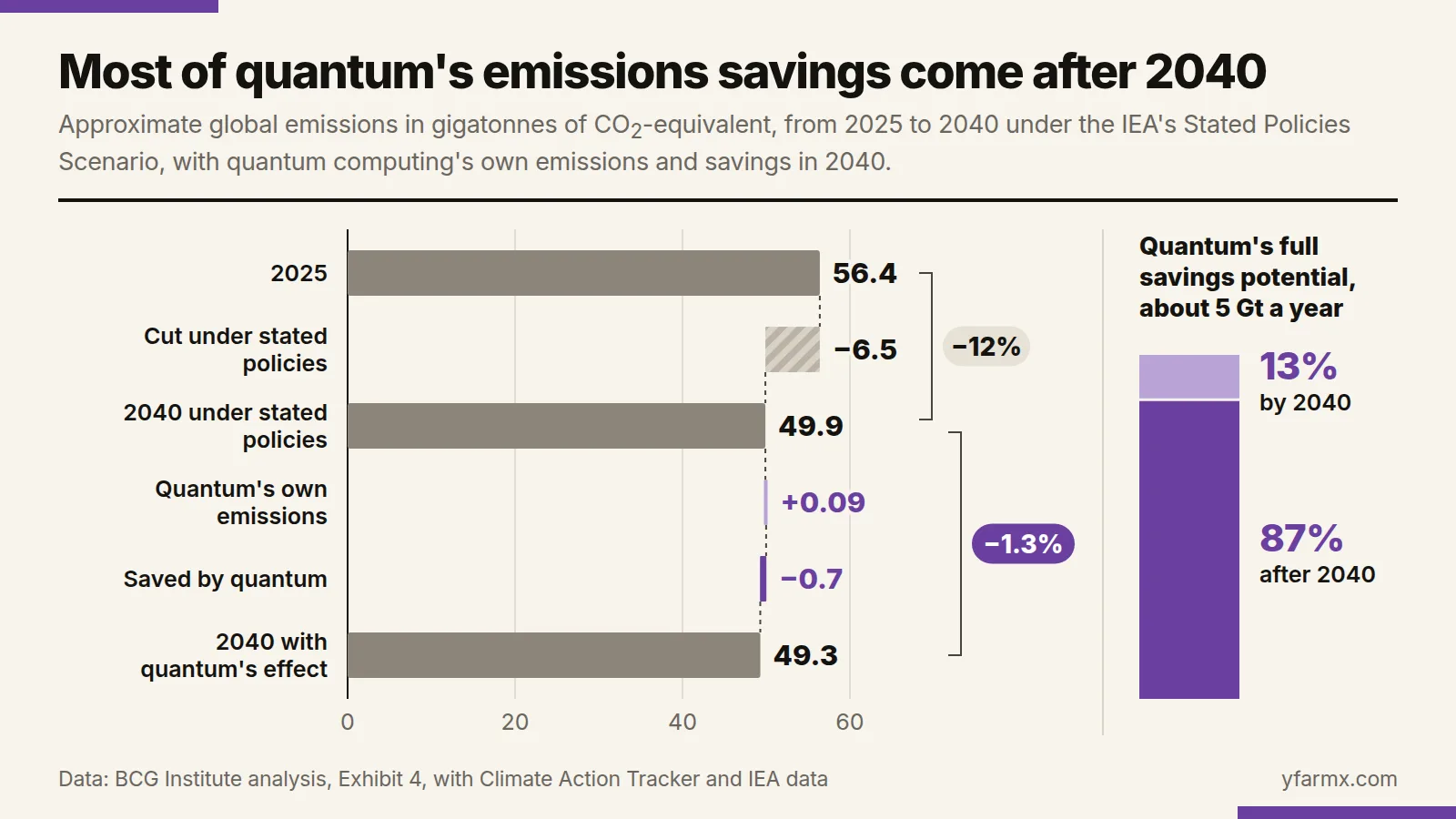
That 10% to 15% could rise. Compelling economics, government mandates, coordinated industry standards and subsidies for retrofits could all push deployment faster than normal replacement cycles, the analysis says.
BCG says companies should plan now
BCG’s analysis argues that long-lived industrial assets make quantum a question for capital plans being drawn up today, well before the technology matures. “Many of the industrial assets that we’re going to need or deploy are being built now,” Maurice Berns, one of the report’s authors, told Semafor, which published his comments on 17 September.
BCG advises business leaders to draw up capital plans, asset replacement strategies and technology partnerships now, and investors to back both start-ups developing the technology and the established industrial companies that would deploy it. It names steelmakers, cement producers and chemical companies among the biggest potential beneficiaries, because they already own the plants, engineering skills and operating infrastructure that turn a new material into lower emissions.
Questions people ask
- How much could quantum computing cut emissions, according to BCG?
- The BCG Institute estimated on 17 September 2026 that quantum computing could eventually cut 3 to 7 gigatonnes of carbon dioxide equivalent a year, once quantum-enabled solutions are fully deployed. At the 5-gigatonne midpoint, that is nearly a tenth of global emissions. About 80% of the potential sits in hard-to-abate sectors such as steel, cement and shipping, and carbon capture is the largest single use case at 1.4 gigatonnes a year on average.
- How big is quantum computing's own carbon footprint?
- BCG expects quantum computing to emit about 0.09 gigatonnes of CO2-equivalent in 2040, less than 0.2% of the 50 gigatonnes the world is expected to emit that year. Data centres would emit about 1.31 gigatonnes in 2040 at the midpoint of BCG's estimates. Most of quantum's footprint comes from manufacturing the machines, and BCG estimates that 230 to 1,400 of them could serve global demand by 2040.
- Why would most of quantum's climate savings arrive after 2040?
- Steel mills, cement kilns and chemical plants may be refurbished or replaced only every 20 to 40 years, so a better material or process often has to wait for the next rebuild. BCG works on the basis that commercially viable quantum solutions emerge around 2035, and it estimates that only 10% to 15% of the full savings could be realised by 2040 under normal replacement cycles. Mandates, standards and subsidies could raise that share, it says.
Sources
- BCG Institute: What if quantum could crack the energy transition's toughest problems?, 17 September 2026bcg.com
- Georgia Power: Georgia Power to serve OpenAI project in Effingham County, 22 July 2026prnewswire.com
- Effingham County: Project Camellia press release, 22 July 2026effinghamcounty.org
- QC Ware: QC Ware and IonQ demonstrate high-precision hybrid quantum workflow for drug discovery, 1 September 2026prnewswire.com
- Semafor: Quantum has major emissions savings potential, report finds, 17 September 2026semafor.com