Tether says USDT is returning to Bitcoin, where it began
Tether chief executive Paolo Ardoino wrote on 24 September 2026 that USDT on Bitcoin is 'coming home'. Tether's sister exchange Bitfinex said the relaunch runs on Utexo and the RGB protocol, which keeps payment details off Bitcoin's public ledger. USDT first launched on Bitcoin on 6 October 2014.
Listen to this articleListen
Paolo Ardoino, Tether’s chief executive, wrote on X on 24 September 2026: “USDT on Bitcoin. It’s coming home”. The next day Bitfinex, Tether’s sister exchange, said the relaunch runs on infrastructure built by Utexo and the RGB project: “RGB is the settlement layer making it possible.” Bitfinex developers build RGB’s Lightning node and wallet software, Utexo says.
USDT is the largest stablecoin, with $183.97 billion in net circulation across Tether’s supported networks on 1 October, according to Tether’s transparency page. It began on Bitcoin: Tether issued the first tokens on 6 October 2014 on the Omni Layer, which runs on top of Bitcoin. On RGB, Bitcoin’s chain carries only a cryptographic commitment to each transfer, and “only the counterparties hold the proofs”, in the words of Utexo’s documentation.
Tether’s chief executive says USDT is coming home
Ardoino posted “USDT on Bitcoin. It’s coming home” at 13:56 UTC on 24 September 2026, quoting a post by Viktor Ihnatiuk, a co-founder of Utexo. Ihnatiuk had written that morning that he had spent an evening in Washington talking about USDT on Bitcoin with Morgan Stanley. Within the half-hour Utexo’s own account answered Ardoino: “USDT is coming home to Bitcoin, more private than ever.” Ihnatiuk added: “We’re almost there.”
Utexo has used the homecoming line since its funding announcement in March, when Ihnatiuk said: “The divorce between the two most important digital assets is finally over. After more than a decade, we’re bringing USDT back home.” UniSat, a Bitcoin wallet, said on 3 September that it had joined Utexo as a launch partner, “bringing USDT directly to Bitcoin users through UniSat Wallet”.
USDT started out on Bitcoin in 2014
Tether issued the first USDT on 6 October 2014 on the Omni Layer, a protocol that runs on top of Bitcoin. “Tether USD₮ was initially issued in one place – the Omni Layer on top of Bitcoin,” Tether wrote in 2022. Within a year of the first issue, Tether said, slightly over 450,000 USDT, about $450,000, was in circulation.
| Date | What happened |
|---|---|
| 6 October 2014 | Tether issues the first USDT, on the Omni Layer on Bitcoin |
| August 2023 | Tether stops minting USDT on Omni and says it is helping to develop RGB |
| 30 January 2025 | Tether announces USDT on Bitcoin and Lightning through Taproot Assets |
| 28 August 2025 | Tether announces plans to launch USDT on RGB |
| 1 September 2025 | Tether ends redemptions of USDT on Omni |
| 6 March 2026 | Utexo raises $7.5m in a seed round Tether co-led |
| 24 September 2026 | Ardoino: “USDT on Bitcoin. It’s coming home” |
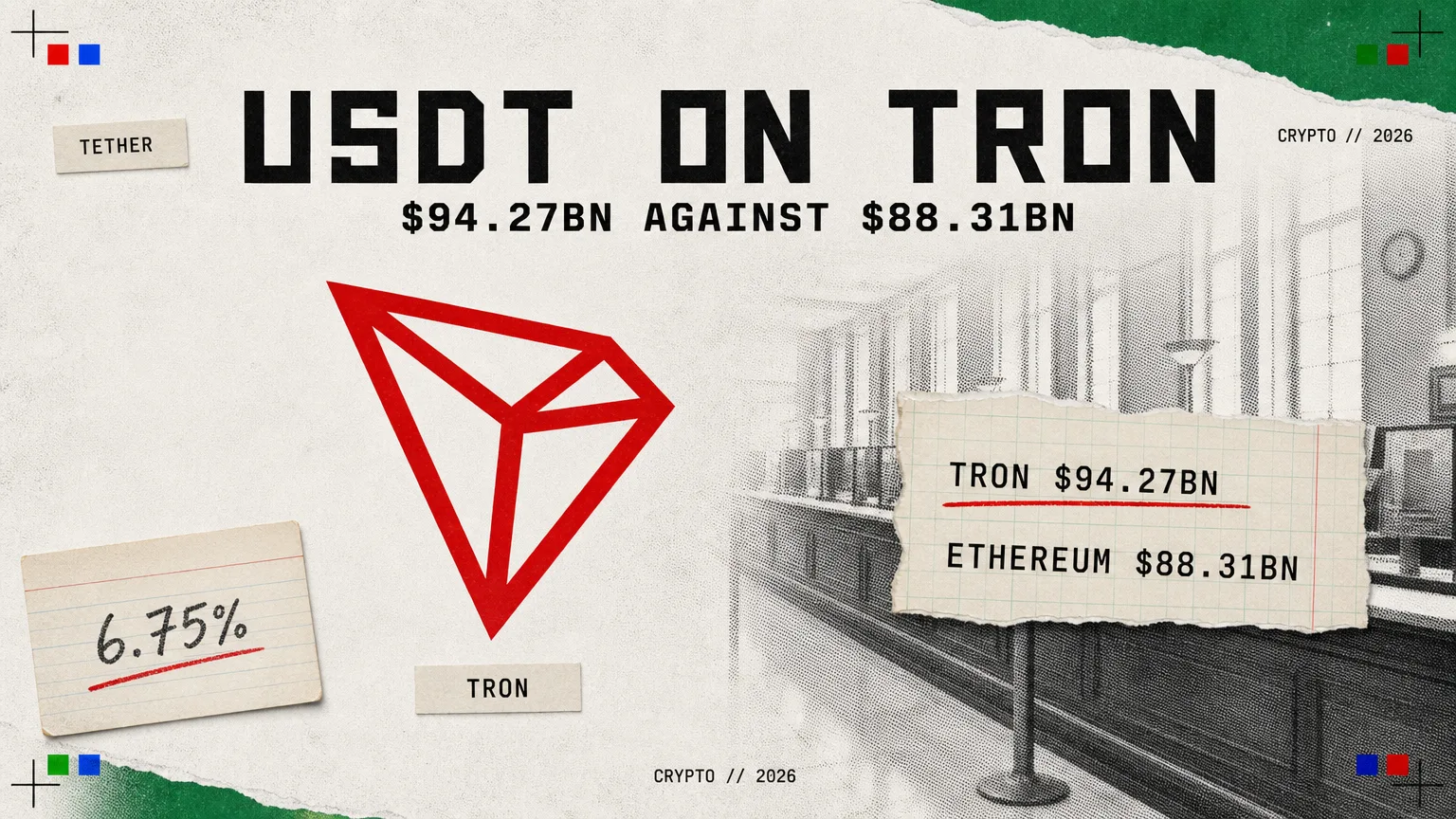
Many exchanges had moved to other networks, Tether said when it stopped minting on Omni in August 2023, and the same notice said it was “actively contributing to developing RGB”. It ended redemptions on Omni on 1 September 2025, as its notice of 11 July 2025 set out, and in a revision of 29 August 2025 chose to leave the remaining tokens free to move between wallets. Tether’s transparency data still showed about $80 million of USDT circulating on Omni on 1 October 2026, net of tokens Tether holds unissued or has quarantined. Almost all the rest sits on Tron and Ethereum, with $92.45 billion and $86.82 billion in net circulation; the gross supplies of $94.27 billion and $88.31 billion read off the two contracts on 4 September also count the tokens Tether holds unissued.
How does RGB keep payments private?
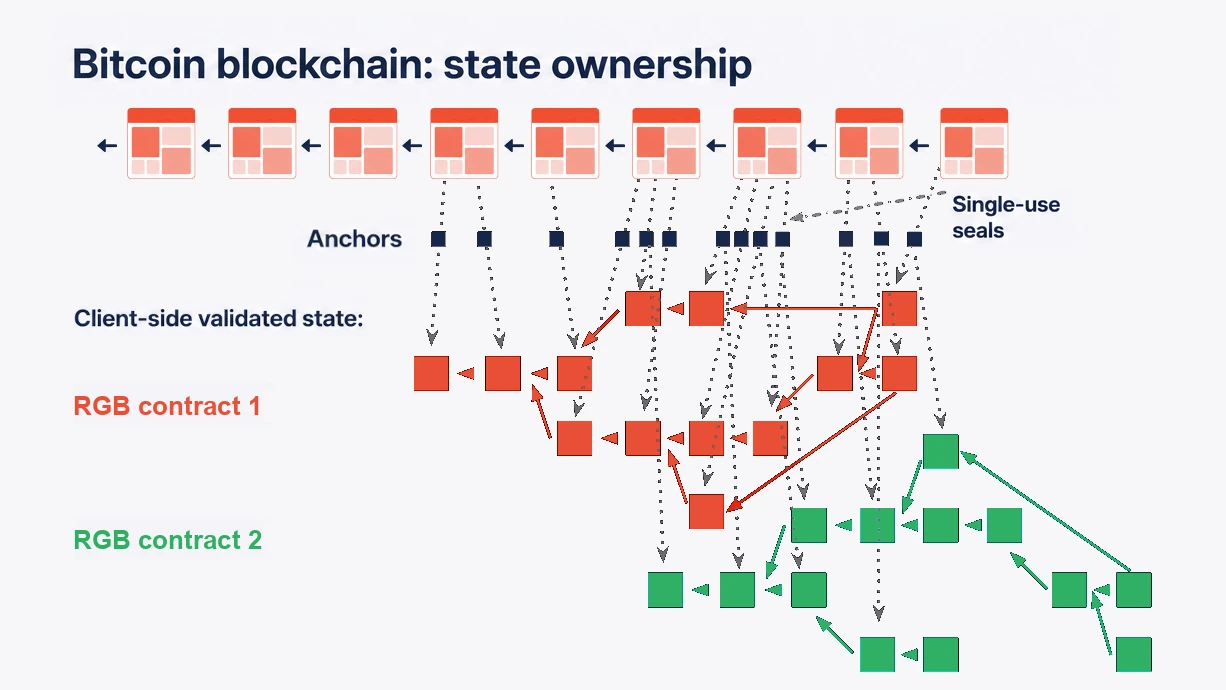
On RGB, the details of a USDT transfer travel between the sender’s and the receiver’s wallets, and Bitcoin’s chain records only a commitment to it, according to Utexo’s documentation. Every RGB balance is tied to a Bitcoin output. To pay, the sender’s wallet broadcasts a Bitcoin transaction that anchors the transfer and hands the receiver a consignment, the data that proves it. The receiver’s wallet then checks the asset’s history itself, which RGB calls client-side validation.

That commitment is small. It takes tens of bytes, or nothing beyond an ordinary transaction under some schemes, according to the RGB protocol documentation, and it is a one-way hash, so the data behind it stays with the two parties. When Tether announced the RGB plan on 28 August 2025, it said users would be able to hold USDT “alongside their Bitcoin in the same wallet”. Ardoino said then: “Bitcoin deserves a stablecoin that feels truly native, lightweight, private, and scalable.”
Tether co-led Utexo’s $7.5m funding round
Utexo announced a $7.5 million seed round on 6 March 2026, co-led by Tether, Big Brain Holdings and Portal Ventures, with Franklin Templeton among the other investors. “We built Utexo so that USDT could move on Bitcoin the way money is supposed to move: instantly, privately, with no surprises on costs,” said Chris Hutchinson, a co-founder. Ardoino said: “What has been missing is production-ready infrastructure that makes Bitcoin-native stablecoin settlement viable at scale. Utexo provides that layer.” Utexo said in March that its fees are paid in USDT and fixed in advance for every transaction, whatever the demand for space on Bitcoin.
Federico Tenga, who leads development of the RGB protocol implementation within the Bitfinex and Tether ecosystem, joined Utexo’s advisory board in May 2026. Utexo says his Bitfinex team develops the RGB Lightning node and the Iris Wallet app and created rgb-lib, a library for building on RGB, and that his work “sits at the core of the infrastructure Utexo is built upon”.

Utexo’s Mint is built to take in USDT from Ethereum, Tron and other networks, route it through a hub on Arbitrum and issue USDT on Bitcoin’s RGB layer for a current fee of 0.03%. Utexo lists the Mint’s tested route as Arbitrum to its own signet, a Bitcoin test network, and its documentation also describes a swap service across Bitcoin, Ethereum, Tron and Solana. On 30 September the company invited payment operators, exchanges and wallets looking to integrate USDT on Bitcoin to meet its team at the Token2049 conference in Singapore.
What runs on Bitcoin’s main network today?
On 2 October 2026 Utexo’s documentation listed on-chain RGB transfers as supported on Bitcoin’s main network, with RGB payments over Lightning in a beta on test networks only.
| Utexo service | Where it runs, per Utexo’s documentation |
|---|---|
| On-chain RGB transfers | Bitcoin’s main network |
| RGB payments over Lightning | Test networks, in beta |
| Mint, USDT from other networks | Tested from Arbitrum to Utexo’s signet, a Bitcoin test network |
USDT bridged in through the Mint arrives on RGB as TUSDT, and Utexo calls the native token USDT (RGB), “Tether’s USDT stablecoin issued natively on Bitcoin”. A bridged version has existed since 12 August 2025, when Utexo said it had moved USDT from Ethereum to RGB for the first time.
Tuesday, 6 October, is 12 years to the day since Tether issued the first USDT on Bitcoin.
Questions people ask
- What is RGB, the protocol Tether is using for USDT on Bitcoin?
- RGB is a protocol for issuing assets such as stablecoins on Bitcoin. The details of each transfer stay with the sender and the receiver, whose wallets check the asset's history themselves, while Bitcoin's chain carries only a cryptographic commitment to the transfer. Tether announced plans to launch USDT on RGB on 28 August 2025, and Bitfinex, Tether's sister exchange, said on 25 September 2026 that USDT's relaunch on Bitcoin runs on RGB and on infrastructure built by Utexo.
- Was USDT on Bitcoin before?
- Yes. Tether issued the first USDT on 6 October 2014 on the Omni Layer, which runs on top of Bitcoin. Tether stopped minting USDT on Omni in August 2023 and ended redemptions there on 1 September 2025, although the tokens can still move between wallets. Tether's transparency data still showed about $80 million of USDT circulating on Omni on 1 October 2026, net of tokens Tether holds unissued or has quarantined.
- Who is Utexo?
- Utexo is a company building payment infrastructure for USDT on Bitcoin, combining the RGB protocol with the Lightning Network. Tether co-led its $7.5 million seed round, announced on 6 March 2026, with Big Brain Holdings and Portal Ventures. Its co-founders include Chris Hutchinson and Viktor Ihnatiuk. Utexo's documentation lists on-chain RGB transfers as supported on Bitcoin's main network, with Lightning payments in a beta on test networks.
Sources
- Paolo Ardoino on X: USDT on Bitcoin. It's coming home, 24 September 2026x.com
- Bitfinex on X: USDt's relaunch on Bitcoin runs on Utexo and RGB, 25 September 2026x.com
- Viktor Ihnatiuk on X: talking USDT on Bitcoin in Washington, 24 September 2026x.com
- Viktor Ihnatiuk on X: We're almost there, 24 September 2026x.com
- Utexo on X: USDT is coming home to Bitcoin, 24 September 2026x.com
- UniSat Wallet on X: launch partner for USDT on Bitcoin, 3 September 2026x.com
- Utexo on X: integrating USDT on Bitcoin, Token2049 Singapore, 30 September 2026x.com
- Utexo on X: first RGB bridge live on Bitcoin, 12 August 2025x.com
- Tether: Tether to launch USD₮ on RGB, expanding native Bitcoin stablecoin support, 28 August 2025tether.io
- Tether: Eight years of stability and innovation, 7 October 2022tether.io
- Tether: Tether makes strategic transition, to meet community demands and foster innovation, August 2023tether.io
- Tether: Tether brings USDt to Bitcoin's Lightning Network, 30 January 2025tether.io
- Tether: Tether to wind down USD₮ support for five legacy blockchains, 11 July 2025tether.io
- Tether: Tether provides update on transition plan for legacy blockchains, 29 August 2025tether.io
- Tether: transparency, USD₮ in circulation, updated 1 October 2026tether.to
- Tether: transparency data by network, updated 1 October 2026app.tether.to
- New York Attorney General: Attorney General James ends virtual currency trading platform Bitfinex's illegal activities in New York, 23 February 2021ag.ny.gov
- EQS News (Utexo): Utexo raises $7.5M led by Tether to launch native USDT settlements on Bitcoin, 6 March 2026eqs-news.com
- EQS News (Utexo): Federico Tenga joins Utexo's advisory board, 1 May 2026eqs-news.com
- Utexo docs: Getting started with RGBdocs.utexo.com
- Utexo docs: Node overviewdocs.utexo.com
- Utexo docs: Mintdocs.utexo.com
- Utexo docs: Mint, getting starteddocs.utexo.com
- Utexo docs: Swap overviewdocs.utexo.com
- Utexo docs: Glossarydocs.utexo.com
- RGB protocol documentation: Client-side validationdocs.rgb.info
- Utexo: homepageutexo.com