Alice & Bob uses 1.1 microvolts to remove photons in pairs
Alice & Bob and ENS Lyon made a superconducting memory lose its photons in pairs with a steady bias of about 1.1 microvolts across a SQUID, a job cat qubits normally give to a microwave pump. Alice & Bob announced the result on 30 September 2026.
Listen to this articleListen
Alice & Bob and physicists at ENS Lyon made a superconducting memory lose its photons in pairs using a steady voltage of about 1.1 microvolts, a job cat qubits normally give to a carefully engineered microwave signal. Alice & Bob, a quantum computing company based in Paris and Boston, announced the result on 30 September 2026.
Losing photons strictly two at a time is what holds a cat qubit stable. The team’s paper on arXiv shows the same chip swapping one, two or four memory photons for one photon of a lossy buffer, chosen by the voltage, and imaging the memory as the pairs drained away within about 50 nanoseconds.
Why do cat qubits need photons to leave in pairs?
A cat qubit stores its information in a microwave resonator and is held stable by a process that removes photons from it strictly in pairs, Alice & Bob’s release of 30 September 2026 explains. That process runs in a component called a coupler. In the company’s current cat qubits, a carefully engineered microwave signal drives the coupler, an approach Alice & Bob says it has refined over many years. The company was founded in 2020 and specialises in cat qubits, a technology its founders developed.
Pumping a coupler with microwaves has a cost. Multi-photon dissipation “is usually realized by parametrically pumping a Josephson coupler at the cost of spurious nonlinear terms”, the paper’s abstract says. One of those terms makes the memory’s frequency shift with the number of photons it holds, which the release calls harmful to cat codes.
With a voltage-biased SQUID instead, “these parasitic terms average out”, the authors write, and the release says the new approach suppresses the frequency shift. Dropping the pump also suppresses harmonics that could excite unwanted modes, and a steady voltage is easier to scale than a microwave drive, the authors add.
How does a steady voltage do the pump’s job?
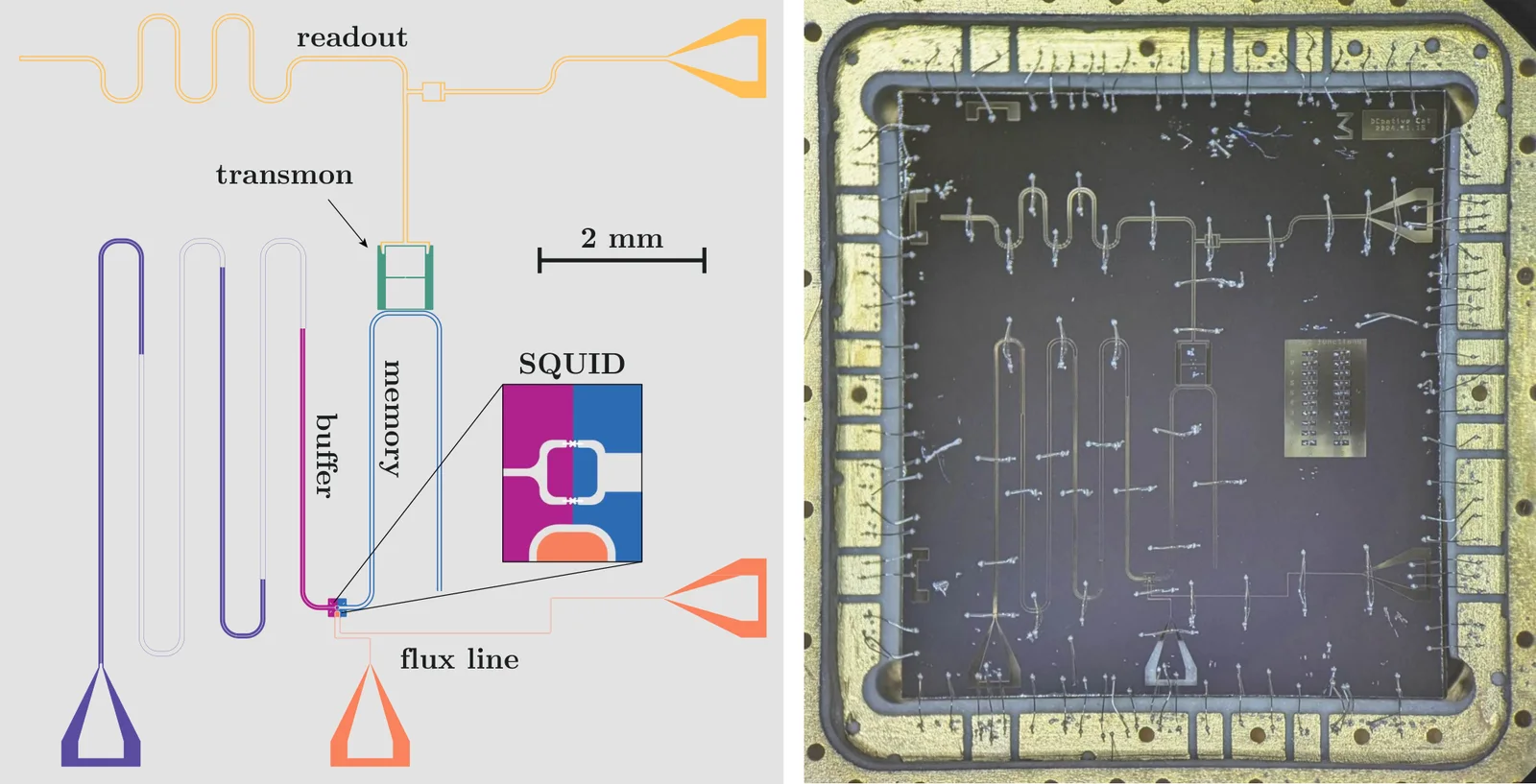
The coupler on the new chip is a SQUID, a loop of two Josephson junctions, held at about 1.1 microvolts so that each Cooper pair tunnelling across it turns two memory photons into one buffer photon, Alice & Bob said on 30 September 2026. A Cooper pair is the pair of electrons that carries current in a superconductor. When one tunnels across the biased SQUID it exchanges an energy of 2eV with the circuit, so it may only cross if the circuit can absorb or supply exactly that energy.
The memory resonates at 4.043 GHz and the buffer at 7.56 GHz, so two memory photons carry 0.53 GHz more energy, in frequency terms, than one buffer photon. The team set the bias so that 2eV equals that difference, which is the bias of about 1.1 microvolts. Each tunnelling event then converts a pair of memory photons into one buffer photon, and the buffer is built to lose its photons quickly. Alice & Bob puts the resulting two-photon loss of the memory at a rate of up to 1.3 MHz.

Alice & Bob puts the two-photon exchange rate at 3 MHz, which it says is faster than any earlier pumped coupler for cat qubits, and says the data suggests the design could go considerably higher. The chip itself is patterned in tantalum on sapphire with aluminium junctions and runs at 8 millikelvin in a dilution refrigerator, the paper says.
The voltage chooses one, two or four photons
Changing only the voltage switched the same chip between swapping one, two or four memory photons for a single buffer photon, Alice & Bob said on 30 September 2026, and the team’s paper measures each swap at its own bias. Each swap switches on when 2eV equals the energy gap between that number of memory photons and one buffer photon, so each needs its own bias.
| Bias across the SQUID, calculated from the mode frequencies | Swap it switches on | What it gives |
|---|---|---|
| About 7.3 microvolts | One memory photon for one buffer photon | Single-photon loss |
| About 1.1 microvolts | Two memory photons for one | The two-photon loss cat qubits rely on |
| About 18 microvolts | Four memory photons for one | A route to four-component cat qubits |
The four-for-one swap illustrates “the ability of the dc-bias approach to reach high-order processes that are difficult to isolate with pumped couplers”, the paper says. “This new approach could support the development of four-component cat qubits, which encode information across four coherent states. Four-to-one photon processes are very difficult to achieve with sufficient strength, but dc-biasing junctions seem to be a viable approach to that goal,” said Benjamin Huard, a professor at ENS Lyon and scientific adviser to Alice & Bob.
The team watched photons leave in pairs
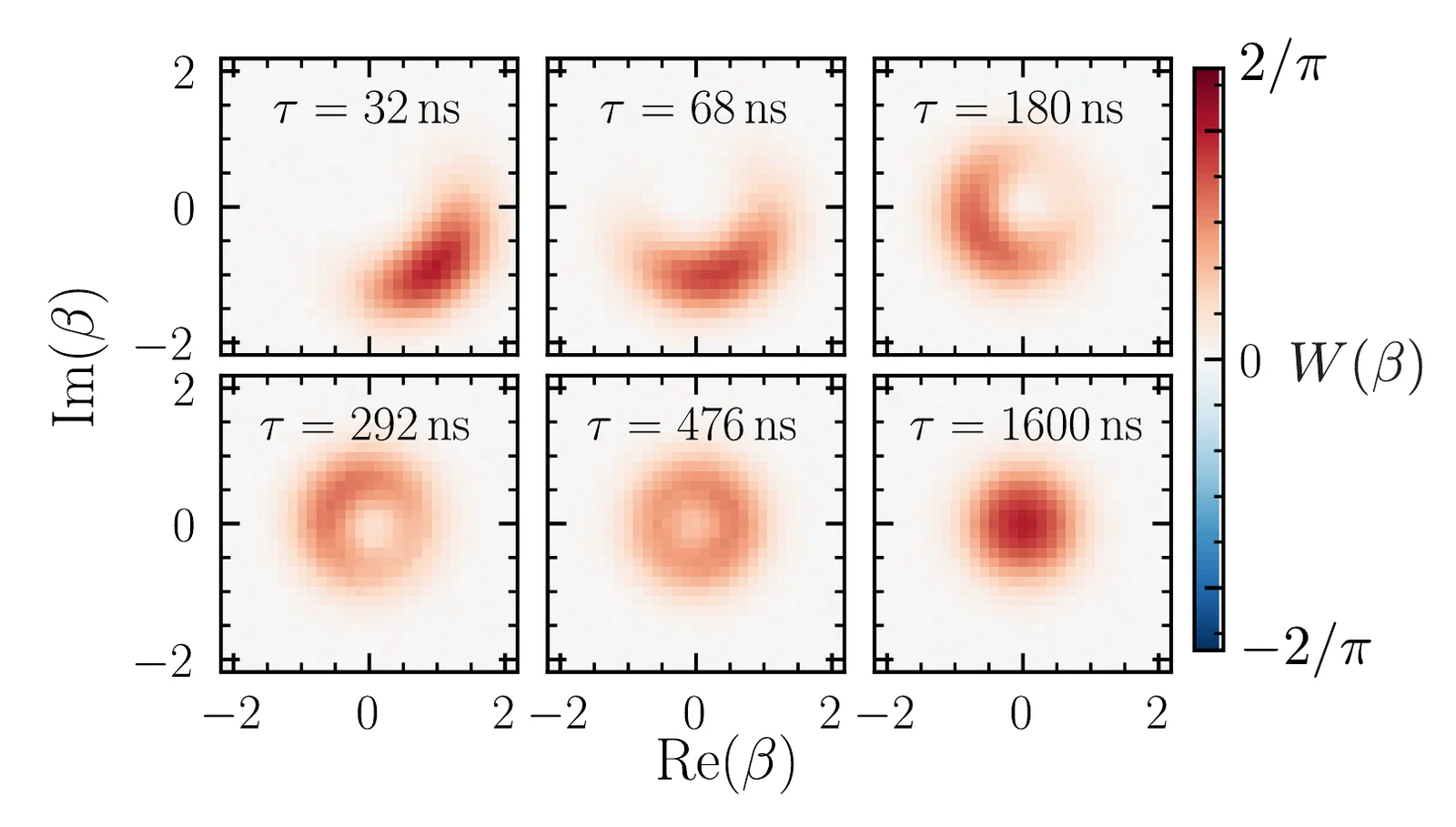
Alice & Bob and ENS Lyon imaged the memory with Wigner tomography, a way of picturing the quantum state of light in a resonator, and saw a state of about four photons collapse within about 50 nanoseconds once the two-for-one swap was on, their paper of 25 September 2026 reports. The pairs drained until the memory held at most one photon. The remaining single-photon loss then emptied it over several microseconds. A single photon lasts about 3.1 microseconds in this memory, a limit the paper puts down mainly to leakage into the chip’s flux line.
| Measure | Figure | Source |
|---|---|---|
| Bias for the two-for-one swap | About 1.1 microvolts | Alice & Bob; paper |
| Time for photon pairs to drain | About 50 nanoseconds | Paper |
| Lifetime of a single photon in the memory | 3.1 microseconds | Paper |
| Two-photon exchange rate | 3 MHz | Alice & Bob |
| Two-photon loss rate of the memory | Up to 1.3 MHz | Alice & Bob |
| Chip temperature | 8 millikelvin | Paper |
A two-photon drive is the next step
Adding a two-photon drive, either through the voltage-biased junction or a separately pumped coupler, “would stabilize the memory state and turn it into a cat qubit”, the team’s paper, revised on 25 September 2026, concludes. Better bias circuitry would suppress a spurious resonance that currently limits the memory’s coherence at large swap rates, the authors write, and adding three periods to the chip’s filter should cut an extra photon loss by at least three orders of magnitude.
Marco Paradina, the paper’s first author and an Alice & Bob researcher, was scheduled to present the work at the APS Global Physics Summit on 19 March 2026. The paper went on arXiv on 31 August 2026 and was revised on 25 September, with work funded in part by the French government’s France 2030 programme. The authors used Anthropic’s Claude Sonnet 4.6 and Claude Opus 5 to improve the readability of the text, and Claude Sonnet 4.6 to work out one of the formulas in the supplement.
Alice & Bob presents the voltage method as an addition to its toolbox for building cat qubits, alongside the microwave-driven couplers in its current machines, with access to higher-order processes such as four-photon swaps. “Voltage lines are compact, easy to wire, and produce little heat inside the ultra-cold refrigerators that quantum computers need,” the company says.
Questions people ask
- What is a cat qubit?
- A cat qubit stores quantum information in the microwave light held by a superconducting resonator, and it is the design Alice & Bob builds its machines on. It is held stable by a process that removes photons from the resonator strictly in pairs, which runs in a component called a coupler. In Alice & Bob's current cat qubits, a carefully engineered microwave signal drives that coupler, an approach the company says it has refined over many years.
- How did Alice & Bob and ENS Lyon make photons leave in pairs with a voltage?
- The team joined a high-quality memory resonator to a lossy buffer resonator through a SQUID, a loop of two Josephson junctions, and held it at a steady bias of about 1.1 microvolts. A Cooper pair tunnelling across the SQUID exchanges an energy of 2eV with the circuit. At that bias the energy matches two memory photons minus one buffer photon, so each crossing turns a pair of memory photons into one buffer photon, which then leaks away.
- What is the next step for the voltage-driven coupler?
- The paper by Paradina and colleagues, revised on arXiv on 25 September 2026, says adding a two-photon drive, either through the voltage-biased junction or a separately pumped coupler, would stabilise the memory and turn it into a cat qubit. Better bias circuitry would suppress a spurious resonance that limits the memory's coherence at large swap rates. Benjamin Huard of ENS Lyon says the method could also support four-component cat qubits.
Sources
- Alice & Bob: new approach to stabilising cat qubits with DC voltage bias, 30 September 2026einpresswire.com
- Paradina et al.: Engineering multi-photon dissipation with a dc-voltage-biased Josephson junction, arXiv:2608.31154arxiv.org
- Paradina et al.: arXiv:2608.31154v2, full text with figures and supplement, 25 September 2026arxiv.org
- APS Global Physics Summit 2026: Cat qubit stabilization with a DC-biased Josephson junction, 19 March 2026meetings-archive.aps.org