
Superconducting qubits
the fast, cold, industry-standard approach
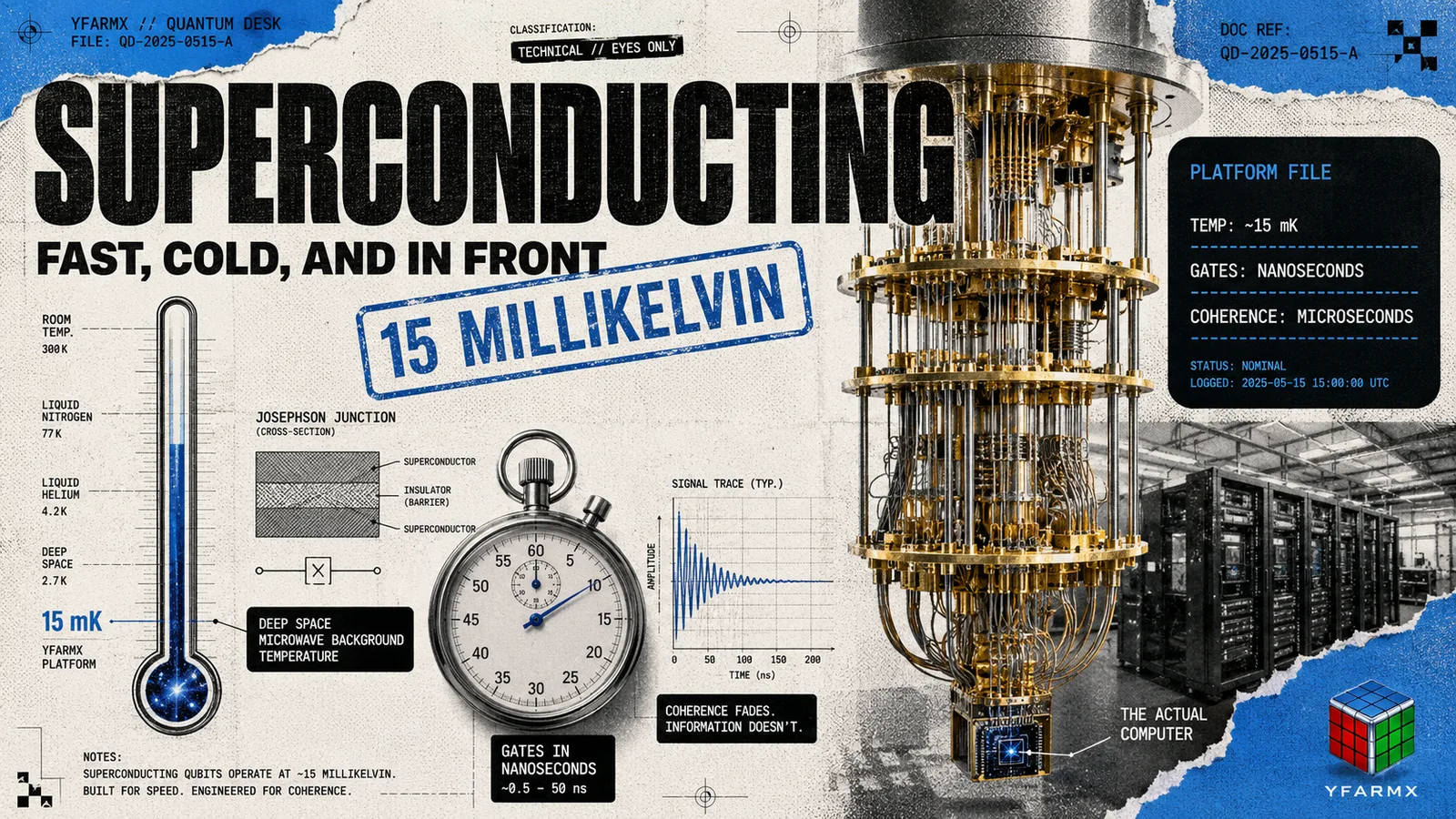
Key facts
- ~15 mKcolder than deep space
- Temperature
- Nanosecondsfastest in the field
- Gate speed
- Microsecondsshort, the main weakness
- Coherence
- IBM, GoogleRigetti, IQM and more
- Used by
The approach that got there first and still leads. Circuits printed like computer chips, then chilled colder than deep space so electricity flows with no resistance at all, with controlled operations taking tens of nanoseconds.
Superconducting qubits are the incumbent. They are what IBM, Google, Rigetti and IQM build, they hold most of the qubit-count records, and when a photograph of a quantum computer shows a gold chandelier of wiring, it is almost always this technology underneath.
What they are
A superconducting qubit is an electrical circuit, printed on a chip much as a conventional processor is, and cooled until its metal becomes superconducting: electricity flows through it with no resistance whatsoever. In that state, the circuit stops behaving like ordinary wiring and starts behaving like a single quantum object with distinct energy levels. Two of those levels are used as the 0 and 1 of a qubit.
The key ingredient is the Josephson junction, a deliberate sliver of insulator between two superconductors. It makes the circuit’s energy levels unevenly spaced, which lets a control pulse address the lowest two without accidentally exciting the qubit further up the ladder.
Why they lead
Two advantages explain the field’s position. The first is speed: operations run in tens of nanoseconds, far faster than trapped ions or neutral atoms, so more can be squeezed into the short window before the qubit loses its quantum state. The second is manufacturing. These chips are made with lithography, the same broad approach used for conventional semiconductors, which means an established industrial base and a credible path to making more of them.
The cost
The temperature is the obvious price. Superconducting processors run at around 15 millikelvin, a fraction of a degree above absolute zero and colder than the deep space background, inside a dilution refrigerator the size of a small car. That is the chandelier in the photographs: not the computer, but the plumbing and wiring needed to keep it cold and talk to it.
The deeper problem is coherence. Superconducting qubits hold their quantum state for microseconds, which is short compared with trapped ions that manage seconds. Speed compensates in part, since what counts is how many operations fit inside the window, but it leaves little margin. They are also physically large compared with atomic qubits, and each needs its own control wiring, so scaling to millions of qubits raises an unresolved cabling and control problem.
Where it stands
This is the most industrialised approach and the one with the most published error-correction progress, including demonstrations that adding more physical qubits to a logical qubit reduces the error rate rather than increasing it, which is the crossing point the whole field was waiting for. The rivals are not beaten: trapped ions hold the fidelity records and neutral atoms scale more cheaply. But superconducting hardware remains the one to beat.