
Photonic qubits
computing with particles of light
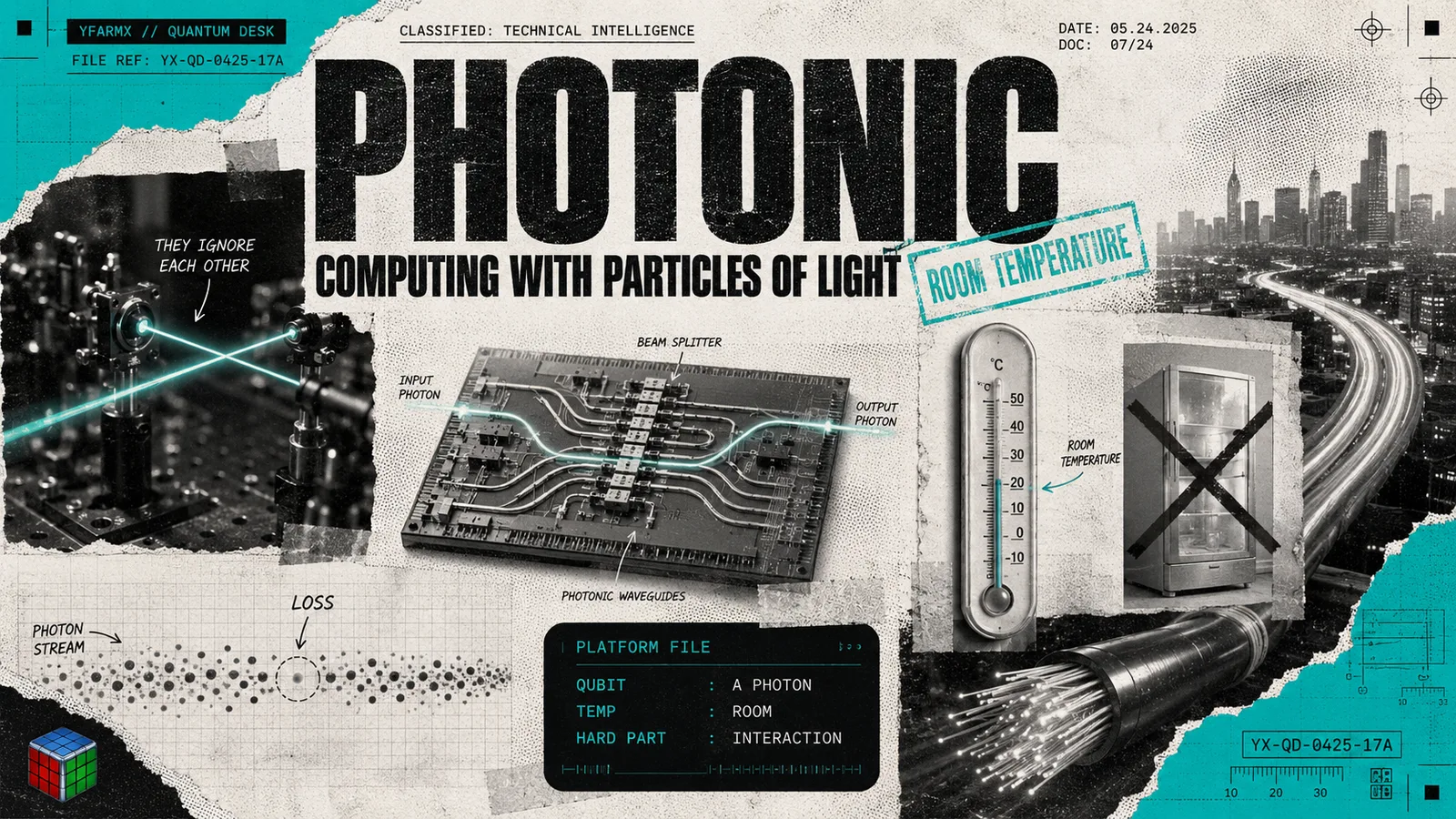
Key facts
- A photona particle of light
- The qubit
- Roommostly, detectors excepted
- Temperature
- Nativetravels down fibre
- Networking
- Interactionphotons ignore each other
- Hard part
Every other approach fights to keep its qubits still and cold. This one uses particles of light that move at, well, the speed of light, need no refrigeration, and can be sent down the same fibre that carries the internet.
Photonic quantum computing encodes information in individual particles of light. It is the approach with the most attractive properties on paper and the most awkward central problem, and it is the bet PsiQuantum and Xanadu have made.
How it works
A photon can carry quantum information in several ways: its polarisation, its timing, or which of two paths it takes through a circuit. Those states serve as 0 and 1. The computer itself is an optical circuit, increasingly one printed onto a silicon chip, containing beam splitters, phase shifters and detectors that route and combine photons.
Because photons barely interact with their surroundings, they resist the decoherence that plagues every other platform. Nothing needs to be held motionless, because the qubits are meant to move.
The attractions
Three stand out. Most of the machine runs at room temperature, avoiding the dilution refrigerators superconducting processors demand, although the single-photon detectors still need cooling. The components can be manufactured in existing semiconductor foundries, which is why PsiQuantum’s strategy rests on conventional chip fabrication rather than bespoke laboratory assembly. And photons are what optical fibre already carries, so linking two photonic processors, or building a quantum network between cities, is natural rather than an afterthought.
The problem
Photons ignore each other. Two beams of light pass straight through one another without interacting, which is excellent for communication and terrible for computing, because a two-qubit gate requires exactly the interaction photons refuse to have.
The workaround is measurement-based computing. Rather than forcing photons to interact directly, the machine prepares a large entangled state and then performs a carefully chosen sequence of measurements, with each result determining what to measure next. It works, and it is well understood theoretically, but it demands a great many photons and near-perfect detectors, and photons are easily lost. Loss, rather than error, is the dominant failure mode: a photon that vanishes takes its information with it.
Where it stands
The photonic companies have made a distinctive strategic bet. Rather than growing qubit counts incrementally in public, PsiQuantum has aimed straight at a large fault-tolerant machine built in conventional foundries, which means fewer intermediate demonstrations and a longer wait before the approach can be judged. Xanadu has pursued a more visible path with cloud-accessible hardware and published sampling results.
The approach remains credible and unproven at scale. Its strongest near-term role may be less as a standalone computer than as the connective tissue between other machines, since any future quantum network will almost certainly move information as light.