
New York and Wyoming could fast-track each other's crypto firms
New York's Department of Financial Services and Wyoming's Division of Banking announced a pact on 1 October 2026 to coordinate crypto oversight. A firm licensed in one state for three years, with no enforcement action and a similar business, can seek a faster review in the other.

Listen to this articleListen
New York’s Department of Financial Services and Wyoming’s Division of Banking announced on 1 October 2026 a memorandum of understanding to coordinate their oversight of crypto firms. Under the signed agreement, a firm that one regulator has licensed or chartered for at least three years, and that faces no enforcement action, can apply to the other for an expedited review, with a decision targeted within six months.
Acting Superintendent Kaitlin Asrow signed for New York on 18 September and Banking Commissioner Jeremiah Bishop for Wyoming on 23 September, the day the agreement took effect. “Interstate collaboration is essential for the virtual currency space,” Asrow said in the NYDFS announcement. The agreement covers, among other things, virtual currency as New York’s rules define it and digital assets as Wyoming law defines them, for any firm working in either state or seeking to.
How does the fast track work?
A crypto firm qualifies for the fast track when one of the two regulators has licensed or chartered it, it has operated under that regulator’s oversight for at least three years, and it faces no enforcement action. When such a firm applies to the other state, its current regulator contacts the new one, and the two meet as soon as practicable to compare the business models and operations the firm proposes in each state. If they are “sufficiently similar”, the second regulator expedites its review, relying on the first to hand over all the examination history it asks for.
The second regulator then aims to make a final decision within six months of the application, or of the day the home regulator sends the examination history, if that is later. Each state still makes its own call: the regulators “will confer to align their licensing decisions to the extent possible”, within their own laws and regulations. The memorandum sets out how the two intend to cooperate, and each regulator keeps full discretion over its own decisions. A firm applying to both states at once gets coordinated reviews, with each regulator sharing a written summary of its analysis of the application.

What changes for firms licensed in both states?
For a firm licensed or chartered in both New York and Wyoming, the two regulators will try to align their examination schedules and, “to the greatest extent practicable”, examine it jointly, and neither has to join examinations more often than its own law requires. They decide each time whether to issue one joint examination report or separate, coordinated reports, and they share examination reports, supervisory reports and other relevant information.
On enforcement, each regulator will try to tell the other when it believes a firm licensed in both states may face an enforcement action, and they will periodically share investigative information and updates on the case. They can act “jointly, in coordination, or separately”. Beyond individual firms, the agreement lets the two regulators train together, exchange staff and develop their supervisory approaches to crypto jointly, and NYDFS says they will also share market trend data.
Information they exchange is treated as non-public unless the provider marks it public. The receiving regulator uses it only for the purpose stated in its written request, keeps it from third parties unless the provider agrees in writing, and tries to resist subpoenas and public records requests for it. Either side can end the agreement on 30 days’ written notice, and the information stays confidential afterwards. The agreement needed the Wyoming Attorney General’s office to approve its form, which Senior Assistant Attorney General Jodi A. Darrough did on 11 September.
| Area | Which firms | What the regulators do |
|---|---|---|
| Licensing | Licensed in one state for three years or more, with no enforcement action | Expedited review, with a six-month target |
| Applications to both states | Firms applying in New York and Wyoming at once | Share their analyses and coordinate reviews |
| Examinations | Licensed in both states | Align schedules and examine jointly where practicable |
| Enforcement | Licensed in both states | Warn each other and share investigative information |
| Information | Everything exchanged | Kept confidential as non-public information |
How many firms could qualify?
Of the 39 entries on New York’s register of virtual currency businesses on 2 October 2026, 26 were licensed or chartered in 2023 or earlier, so at most 26 meet the three-year test. The register mixes BitLicenses, the virtual currency licence New York introduced in 2015, with 13 limited purpose trust charters, which let a firm act as a fiduciary. Its oldest entries are Circle’s BitLicense of September 2015 and Gemini’s trust charter of October 2015. The 13 entries added since 2024 include Anchorage Digital, two MoonPay companies and, in May 2026, Mastercard’s transaction services arm, and the newest is Circle’s New York trust company, chartered in July 2026.
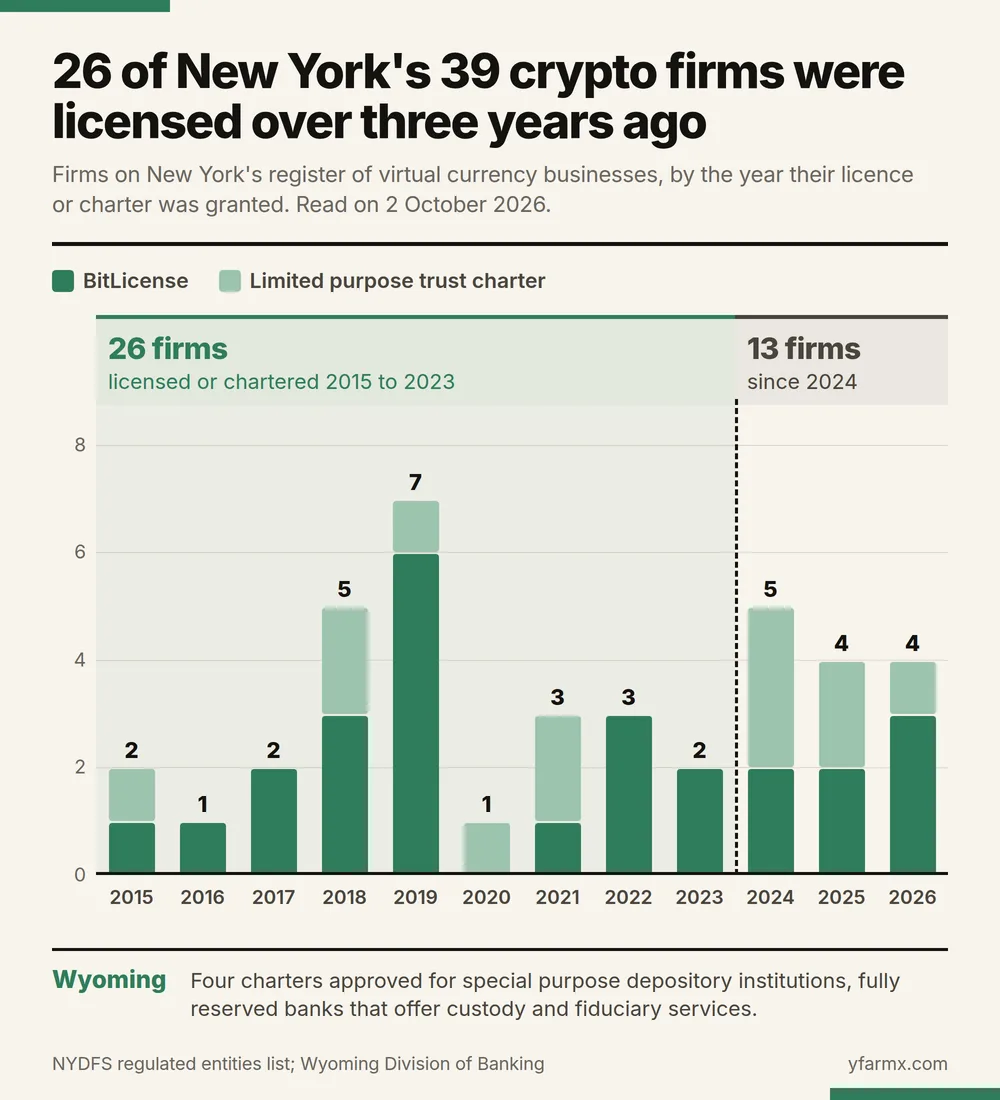
For any of those 26 firms, the fast track into Wyoming also needs a clean enforcement record and a Wyoming business model similar to its New York one. Wyoming has taken applications for special purpose depository institutions since 1 October 2019, and its Banking Board has approved four charters. The Division of Banking describes them as fully reserved banks that take deposits and offer custody, asset servicing and fiduciary asset management.
Both states feature in the SEC’s custody plan
The SEC proposed on 1 October 2026, the day of the announcement, to let investment advisers keep client crypto at state trust companies, and its proposing release names both states’ regimes. It cites New York’s BitLicense and its limited purpose trust companies, chartered under the state’s banking law, and Wyoming’s conditions for banks and the supervised trust companies it charters to provide custody of digital assets. SEC staff estimate that about 19 state trust companies specialise in crypto custody.
Crypto firms also have a federal route, the national trust bank charter. The Office of the Comptroller of the Currency conditionally approved five applications on 12 December 2025 and has conditionally approved more since, including World Liberty’s on 14 August 2026.
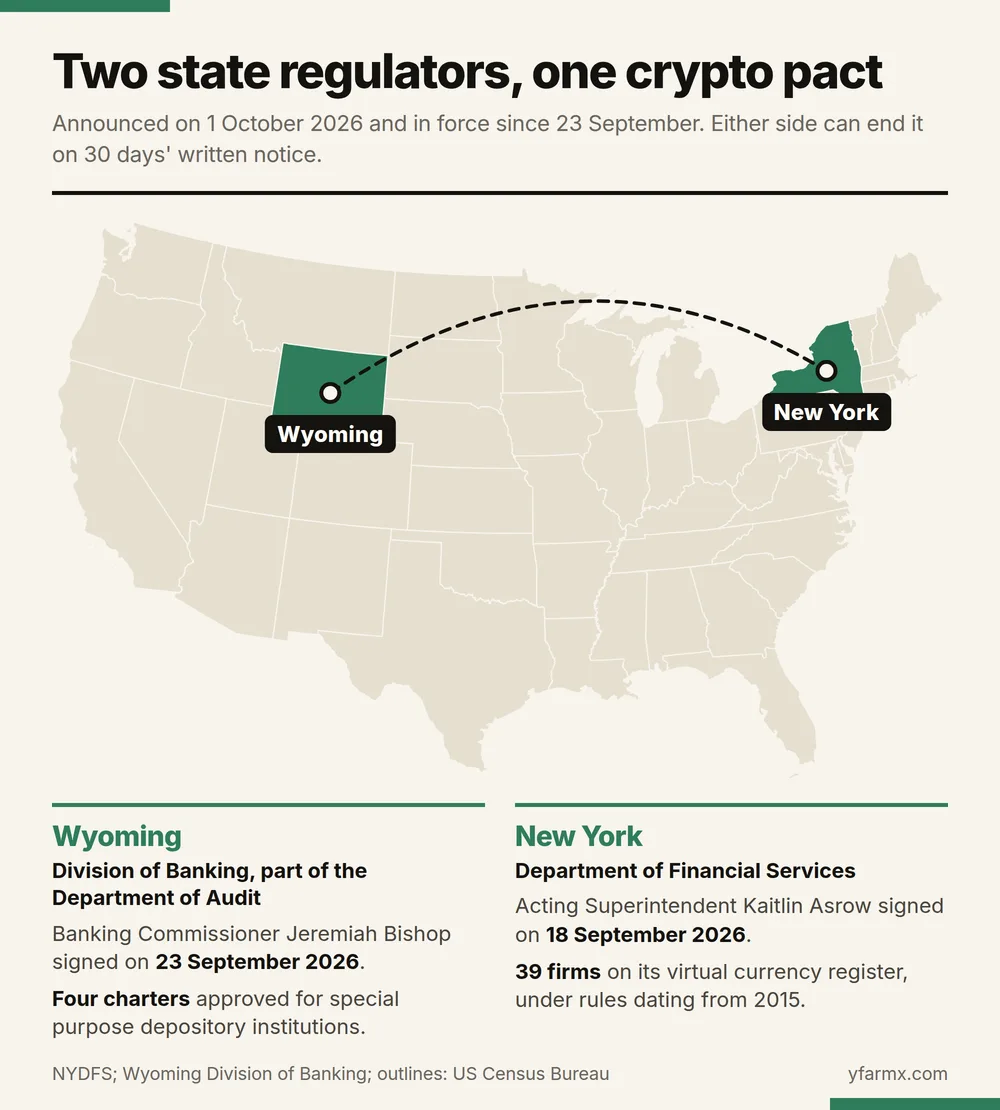
“This MOU shows the strength of the state regulatory system as an example of two leading regulators in this space working together to better the effectiveness in supervision,” Bishop said.
Questions people ask
- What did New York and Wyoming announce on 1 October 2026?
- New York's Department of Financial Services and Wyoming's Division of Banking announced a memorandum of understanding on 1 October 2026 to coordinate their oversight of crypto firms. Acting Superintendent Kaitlin Asrow signed for New York on 18 September and Banking Commissioner Jeremiah Bishop for Wyoming on 23 September, the day it took effect. It covers licensing, examinations, enforcement and the sharing of confidential supervisory information.
- Which crypto firms can use the New York and Wyoming fast track?
- A firm qualifies when one of the two regulators has licensed or chartered it, it has operated under that regulator's oversight for at least three years, and it faces no enforcement action. When it applies to the other state, the regulators meet to compare its business models, and if they are sufficiently similar the second regulator expedites its review, aiming to decide within six months of the application or of the home regulator sending the firm's examination history.
- Who makes the final licensing decision under the New York and Wyoming agreement?
- Each state makes its own licensing decision. Under the memorandum of understanding announced on 1 October 2026, the two regulators confer to align their decisions as far as their own laws and regulations allow. Either regulator can end the agreement on 30 days' written notice, and information shared under it stays confidential after it ends.
Sources
- NYDFS: New York State Department of Financial Services and Wyoming Division of Banking sign MOU to enable coordinated oversight of virtual currency and digital asset activities, 1 October 2026dfs.ny.gov
- Memorandum of understanding between the Wyoming Department of Audit, Division of Banking and the New York State Department of Financial Services, signed 18 and 23 September 2026dfs.ny.gov
- NYDFS: Virtual currency businesses and regulated entities, read 2 October 2026dfs.ny.gov
- Wyoming Division of Banking: Special purpose depository institutionswyomingbankingdivision.wyo.gov
- SEC proposing release IA-7023: Adviser and Regulated Fund Custody Rules; Crypto Custody Rules, 1 October 2026sec.gov
- Office of the Comptroller of the Currency: Corporate Decision #1385, World Liberty Trust Company, 14 August 2026occ.gov