World Liberty clears its first bank hurdle before a Washington crypto week
The OCC gave World Liberty Trust Company preliminary conditional approval on 14 August. A White House meeting with crypto chief executives is expected on 19 August, and Bank Leumi signed Galaxy the same Friday.
Listen to this articleListen
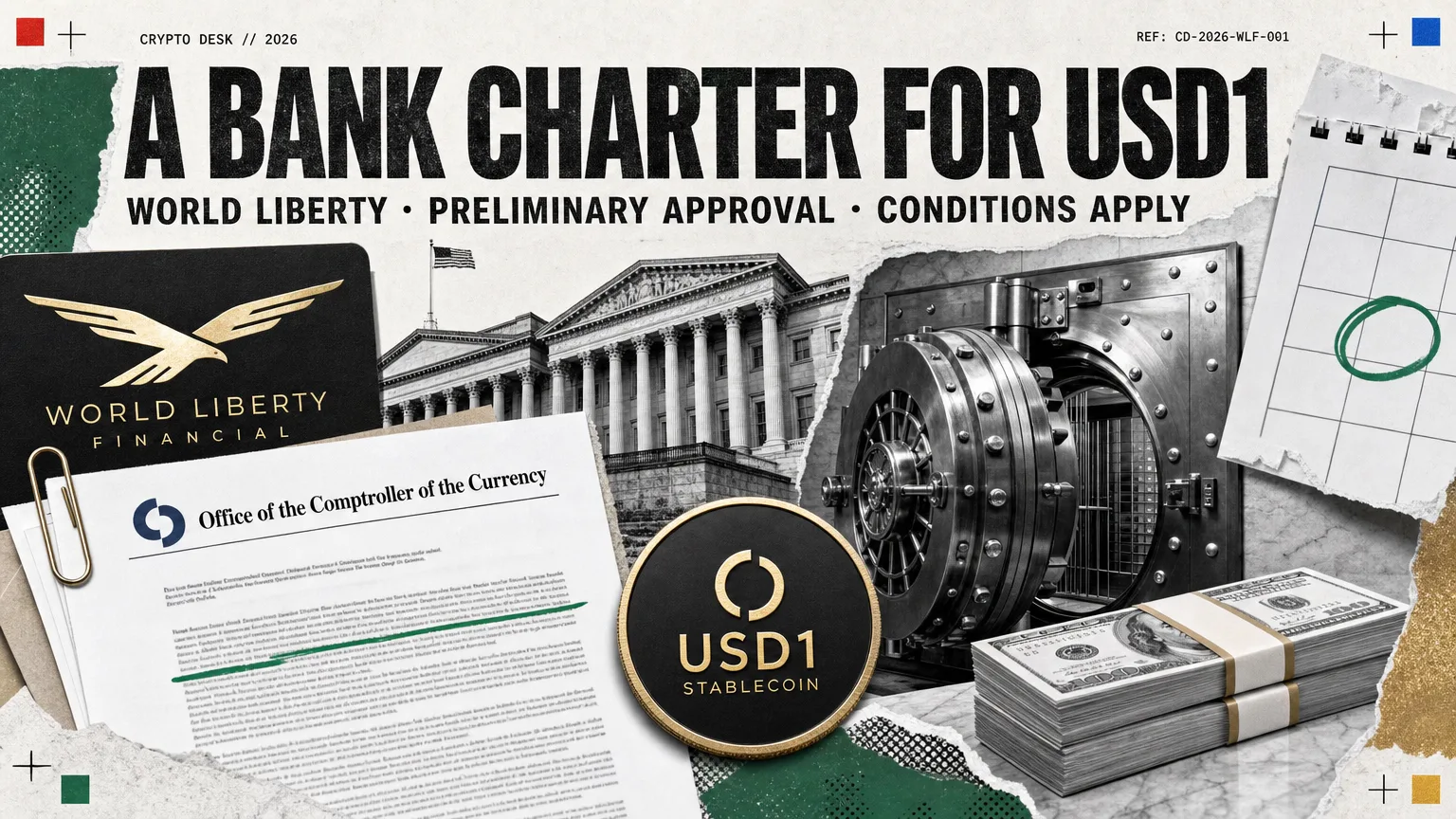
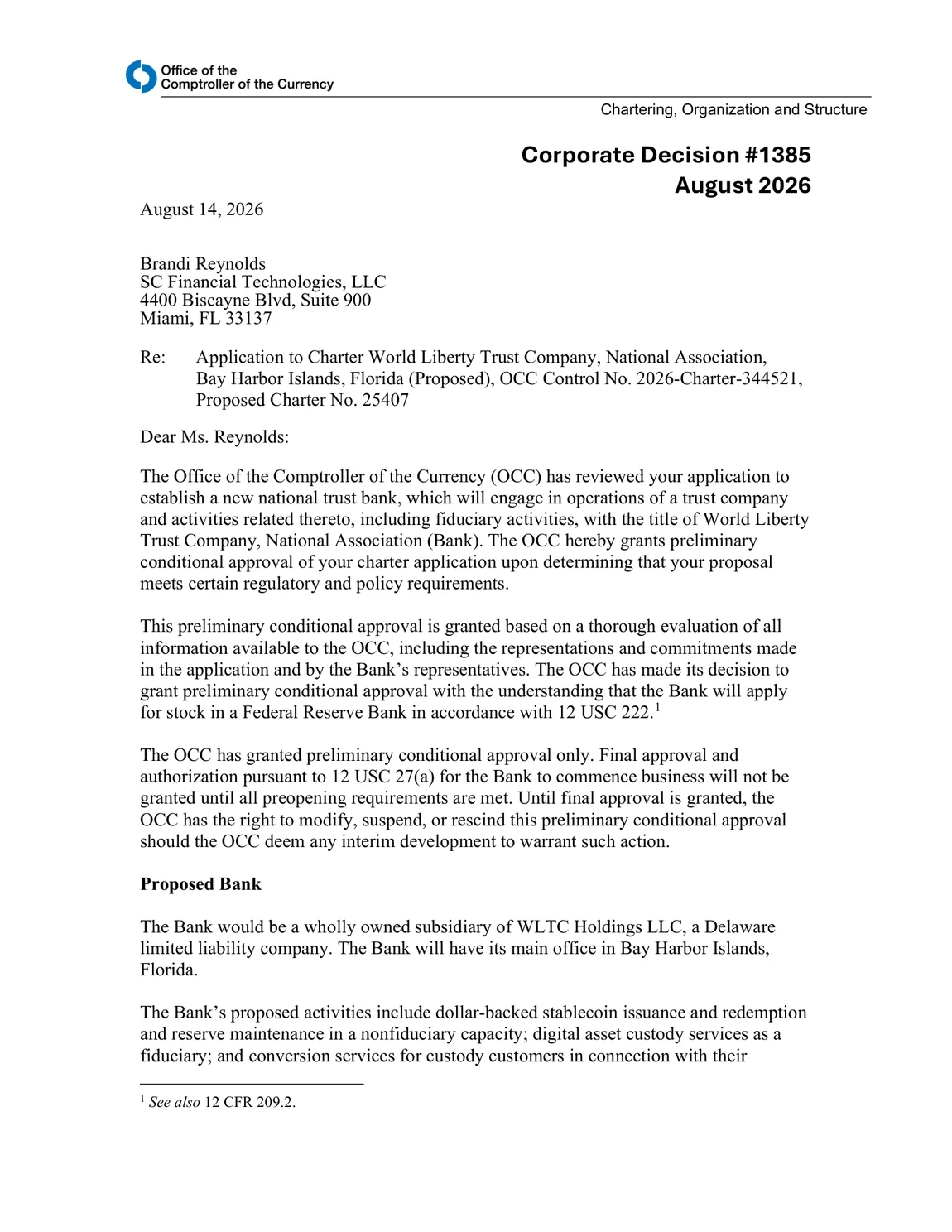
The Office of the Comptroller of the Currency gave World Liberty Trust Company preliminary conditional approval on Friday to organise as a national trust bank. The letter is dated 14 August 2026, runs to nineteen pages, and is published as OCC Corporate Decision #1385 against control number 2026-Charter-344521 and proposed charter number 25407. The bank would sit in Bay Harbor Islands, Florida, as a wholly owned subsidiary of WLTC Holdings LLC, a Delaware company.
Preliminary conditional approval is the first of two gates, not the charter itself. The OCC states the position in the letter: final approval and authorisation to commence business will not be granted until all preopening requirements are met, and until then the agency may modify, suspend or rescind the approval if any interim development warrants it.
What the trust bank would be allowed to do
Three things, in the OCC’s own description of the business plan: issue and redeem USD1 and maintain its reserve in a nonfiduciary capacity; provide digital asset custody as a fiduciary, primarily to USD1 customers and other institutional clients; and run conversion services letting custody customers swap approved stablecoins for USD1.
The first of those is a handover rather than a launch. USD1’s current exclusive issuer and custodian is BitGo Bank & Trust, National Association, and the letter records that the new bank would assume that role. So the change is where the token is issued from, not whether it exists.
A national trust bank is a narrow charter by design, and the conditions make the boundary explicit. The bank must limit itself to trust company operations and must not meet the definition of a “bank” under the Bank Holding Company Act. Stablecoins are not deposits under the Federal Deposit Insurance Act, the bank would not be an insured depository institution, and it is unlawful to represent that payment stablecoins carry federal deposit insurance.
The seven conditions
| Condition | What it requires |
|---|---|
| Scope | Trust company operations only, per the business plan |
| GENIUS Act | Conform, cease or divest activities to comply, as the OCC alone judges |
| Business plan | 60 days’ notice and OCC no-objection before any significant change |
| Capital | $20m tier 1, half of it or $10m, whichever is greater, in eligible liquid assets |
| Liquidity | 180 days of operating expenses held in eligible liquid assets, on top of the capital condition |
| People | OCC written no-objection before appointing any senior executive officer or director |
| Audit | An independent internal audit manager, designated from the start |
The capital and business-plan conditions each run through the bank’s first three years of operation. “Eligible liquid assets” is defined tightly in the letter: unencumbered cash, insured-bank deposits maturing within 90 days, and US government obligations maturing within 90 days, and only to the extent they exceed everything the bank owes anyone.
Was this a favour?
Americans for Financial Reform, a coalition that campaigns on banking policy, published a statement the same day objecting that a regulator inside the current administration had cleared a bank tied to the president’s family. It is the obvious question, and the decision document answers part of it directly by citing its own precedents.
The OCC has been granting this charter to crypto firms for eight months. The letter’s footnotes point to preliminary conditional approvals for BitGo Bank & Trust, Ripple National Trust Bank, First National Digital Currency Bank, Paxos and Fidelity Digital Assets, all dated 12 December 2025, then Bridge National Trust Bank on 12 February 2026 and Foris DAX National Trust Bank on 20 February. World Liberty is the eighth name on a list, holding a charter type its own USD1 issuer already has, on conditions the agency has been applying since last winter.
That does not settle whether the applicant should have been treated at arm’s length by this administration. It does mean the terms are the standard ones, and they are published, which is a harder thing to argue with than a press release.
The Washington week around it
Two events follow immediately, and they are not equally certain.
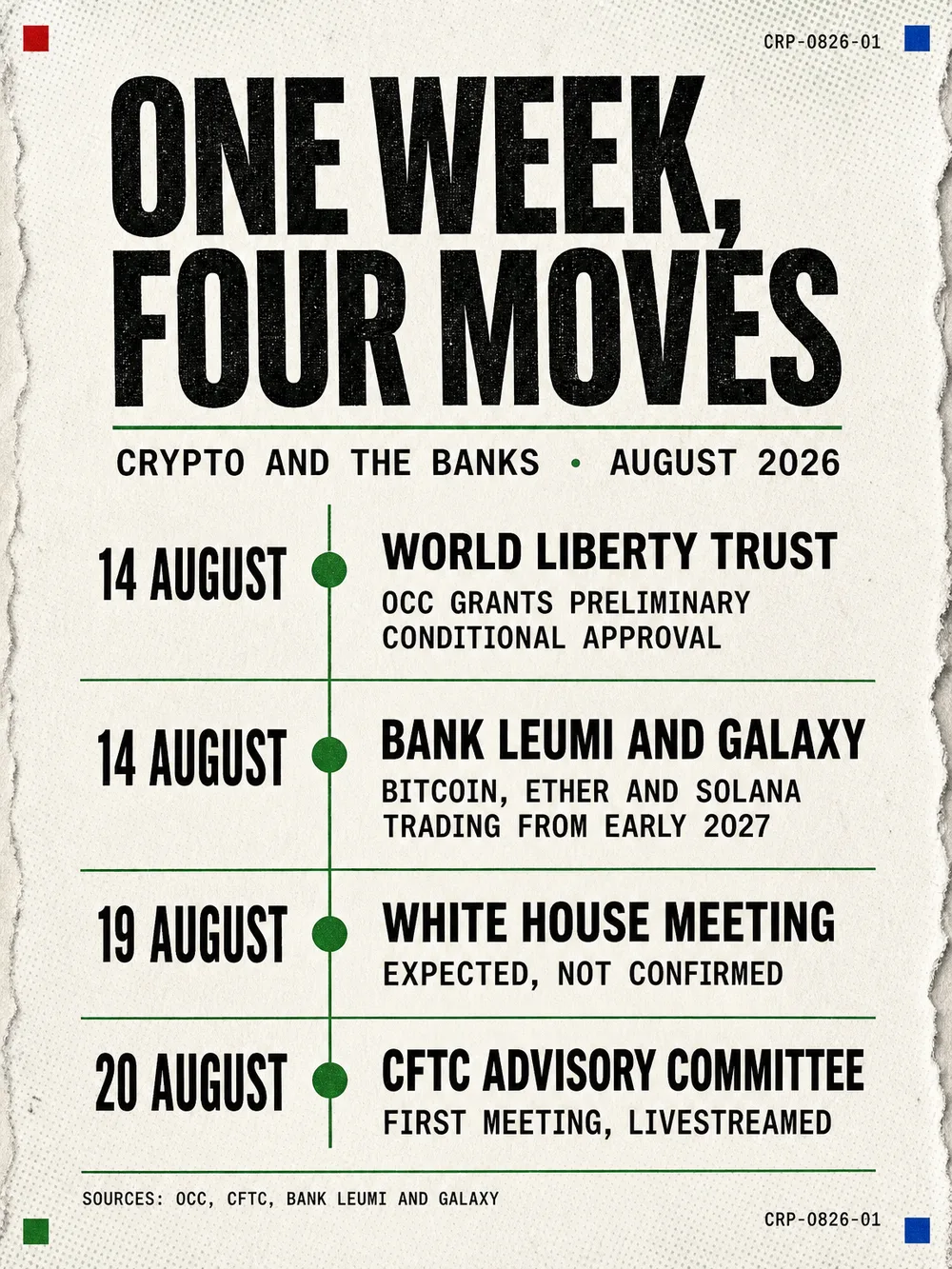
| Event | Date | Status |
|---|---|---|
| OCC preliminary approval, World Liberty Trust | 14 August | Granted, published |
| White House meeting with crypto executives | 19 August | Expected, not confirmed |
| CFTC Innovation Advisory Committee, first meeting | 20 August | Confirmed, livestreamed |
| Bank Leumi and Galaxy agreement | 14 August | Announced by both parties |
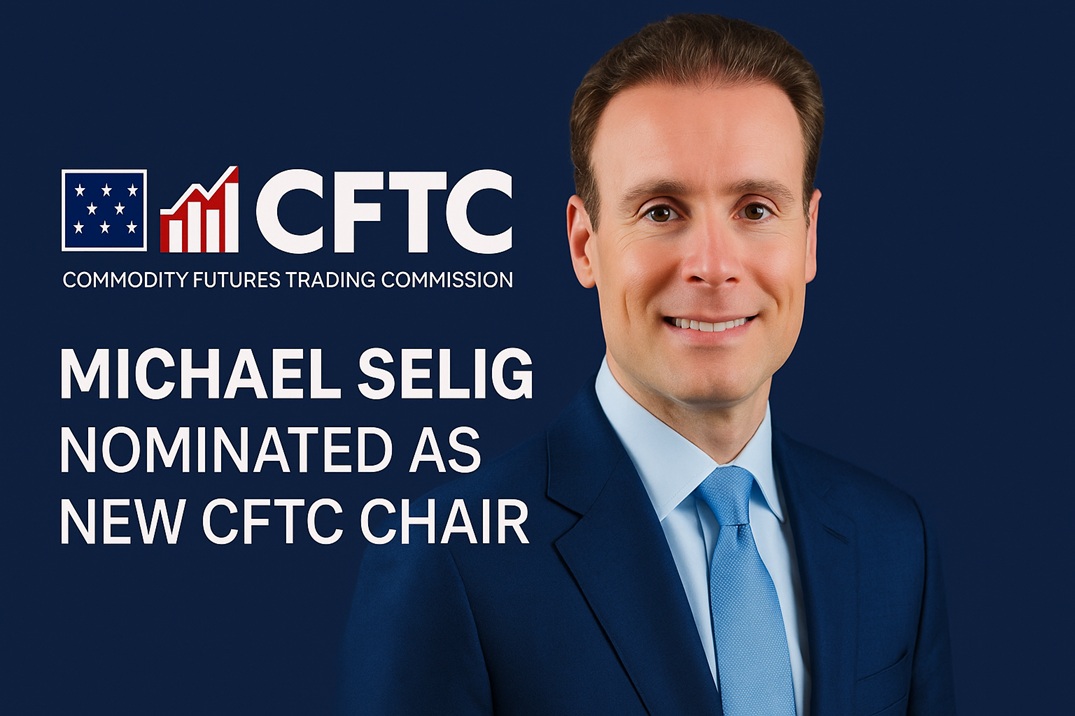
The 19 August meeting is the one to hold loosely. President Trump is expected to attend a gathering at the Eisenhower Executive Office Building with chief executives from exchanges, prediction markets and crypto firms, with Coinbase, Ripple, Gemini, Robinhood, Kraken, Polymarket and Kalshi among the names reported by CNBC, alongside SEC chairman Paul Atkins and the CFTC’s Mike Selig. The White House has published no attendee list and no agenda, and the president’s own attendance is expected rather than announced.
The next day’s meeting is documented. The CFTC’s Innovation Advisory Committee holds its first session on Thursday 20 August from 1pm to 4pm Eastern time in Washington, livestreamed on the commission’s site, covering crypto assets, artificial intelligence and prediction markets. The committee was created in January to replace the Technology Advisory Committee, and written statements from the public are open until 27 August.
Both sit in the space left by Congress. The Senate went into a five-week recess without moving the CLARITY Act forward, so the market-structure question the industry wants settled by statute is being worked through in meetings and agency processes instead.
Israel’s largest bank picked the same Friday
Bank Leumi and Galaxy announced on 14 August that Leumi will offer bitcoin, ether and Solana trading to its customers, which would make it the first Israeli bank to do so. The service is planned for early 2027 inside the Leumi Trade capital markets app and PEPPER, the bank’s mobile arm, in a dedicated section where customers can buy, hold and sell.
The plumbing sits with Galaxy: GalaxyOne Institutional for trading and related services, and Galaxy’s Custody Infrastructure business, formerly GK8, for holding the assets. Maya Ravia, Leumi’s head of strategy, framed it as extending the range of services the bank offers. Lior Lamesh, who runs Galaxy Israel, put it more broadly: “The future of finance will run on open, programmable rails, and we believe the banks that move first will define the era that follows.”
Leumi has been here before. In March 2022 it prepared a bitcoin and ether service through Paxos, with trades from as little as 50 shekels, and the plan was stopped before it launched. The eighteen-month gap between this announcement and the planned launch is doing real work: it leaves room for the technical build and for the Bank of Israel.
The common thread
Three announcements, three jurisdictions of authority, and one direction. A stablecoin issuer applying to be examined by a bank regulator; a bank buying institutional crypto infrastructure rather than building it; a commodities regulator convening an advisory committee because the legislature has not produced a statute. In each case the asset is moving into an institution that is already supervised, and the supervision is arriving through charters, custody agreements and advisory committees rather than through a law.
What none of it settles is the market-structure question underneath: which agency governs which asset. That answer still sits with Congress, and Congress is away until September.
Sources
- Office of the Comptroller of the Currency, Corporate Decision #1385, August 2026 (World Liberty Trust Company, N.A.)occ.gov
- CFTC, 'Chairman Selig Announces Inaugural CFTC Innovation Advisory Committee Meeting on August 20 in Washington' (press release 9279-26)cftc.gov
- CFTC, 'Chairman Selig Announces Agenda for August 20 Innovation Advisory Committee Meeting in Washington' (press release 9283-26)cftc.gov
- Federal Register, 'Innovation Advisory Committee' meeting notice (11 August 2026)federalregister.gov
- Bank Leumi and Galaxy, 'Bank Leumi Partners with Galaxy to be the First Bank in Israel to Offer Digital Asset Trading' (14 August 2026)prnewswire.com
- CNBC, 'Trump family-backed crypto firm World Liberty gets conditional bank charter approval' (14 August 2026)cnbc.com
- Americans for Financial Reform, statement on the World Liberty Financial conditional charter approvalourfinancialsecurity.org