Nine firms form alliance for quantum-resistant crypto standards
Hacken, Midnight Foundation and seven other organisations formed the Quantum Alliance to develop shared migration standards for blockchains, wallets and proof systems.

Listen to this articleListen
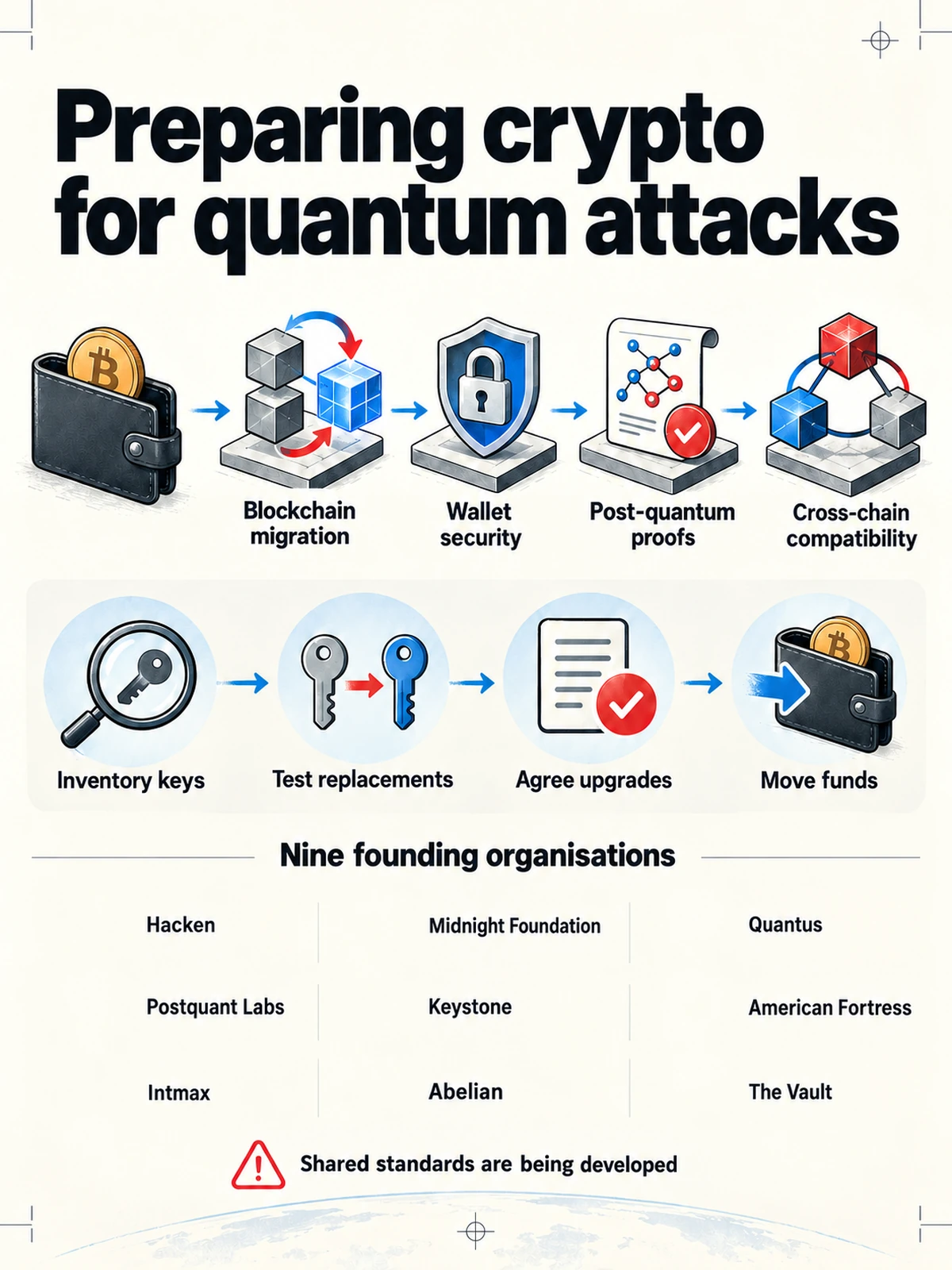
Nine organisations have formed the Quantum Alliance to develop common standards for protecting blockchains against future quantum attacks. The founding group includes Hacken, Midnight Foundation, Quantus and Postquant Labs, alongside Keystone, American Fortress, Intmax, Abelian and The Vault.
The initiative will produce open migration guidance, tests and reference designs, according to Hacken’s announcement. Its four working groups cover blockchain migration, post-quantum proof systems, wallet security and cross-chain compatibility.
Wallets and networks have to change together
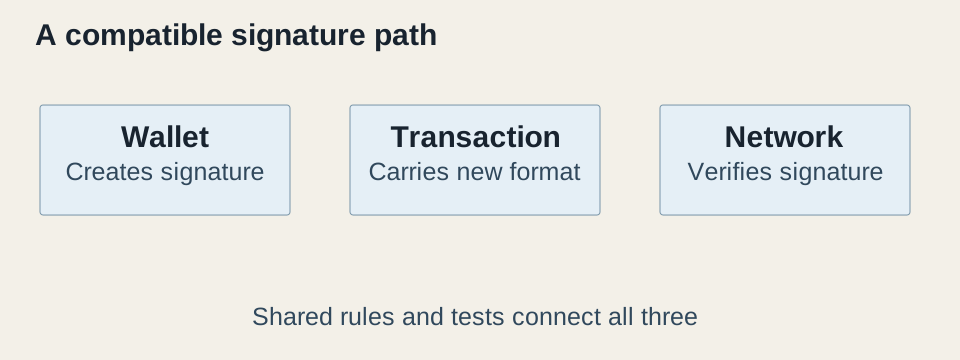
A blockchain migration has to coordinate signing software, transaction rules and the people holding existing assets. A wallet can create a new kind of signature only when the network receiving it can verify and accept that signature.
The alliance’s programme includes exposed public keys, dormant accounts and the larger signatures used by some replacement schemes. Shared test cases could let wallet makers, network developers and auditors check the same behaviour before upgrades reach users. These are proposed standards and implementation work; adoption will depend on each network’s own upgrade process.
Hacken cites an estimate of about six million BTC already held behind exposed public keys. That represents a paper valuation of roughly $489 billion, using Coinbase’s $81,543.02 quote read on 17 October 2026. The estimate describes coins whose public keys would be available to a sufficiently capable quantum attacker.
Researchers are revising the resources an attack would need
A Google Quantum AI-led white paper dated 30 March 2026 estimates that a scaled superconducting machine could attack a 256-bit elliptic-curve key using fewer than half a million physical qubits under its stated assumptions. Its resource analysis includes error correction, circuit costs and the speed of the hardware.
The paper separates attacks on keys exposed for long periods from attacks during a pending transaction. Faster quantum architectures could make the second case relevant because a transaction reveals information before the network confirms it. The authors recommend migration work across cryptocurrency communities.
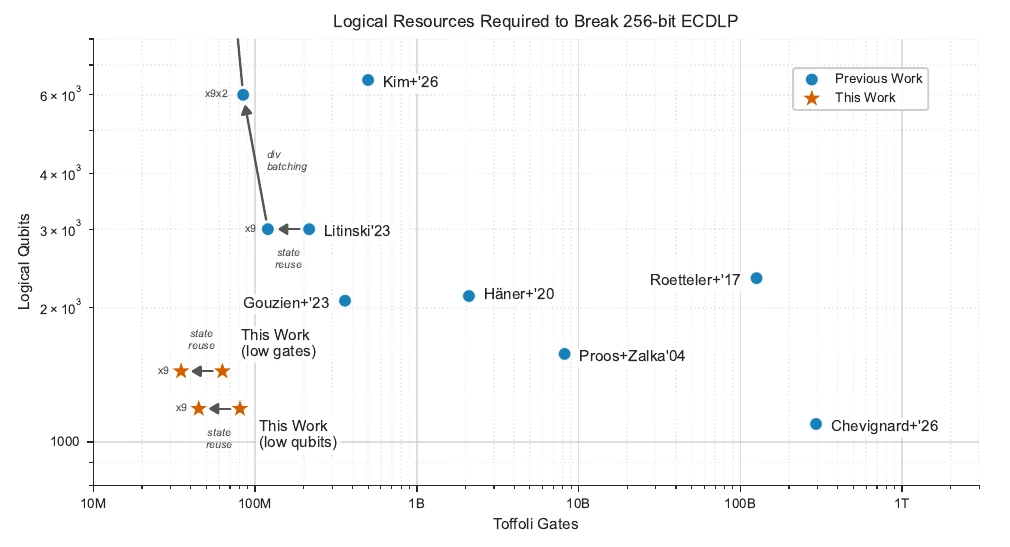
These are engineering estimates for future cryptographically relevant machines. Their practical consequence today is a clearer set of requirements for testing replacements and planning how existing assets move.
Signature standards already provide a starting point
NIST finalised ML-DSA and SLH-DSA for digital signatures in August 2024. The standards announcement also introduced ML-KEM for establishing encryption keys, a different job from authorising a blockchain transaction.
Selecting an algorithm is one part of a migration. Implementers also have to handle message formats, key storage, verification costs and compatibility with existing applications. For an asset owner, the important connection is between a replacement key and the funds that the old key currently controls.
Open tests and shared migration designs give the alliance a concrete task: turn those dependencies into changes that separate wallets and networks can implement consistently.