
The CLARITY Act
the bill the whole market is waiting on
Key facts
- 3token buckets
- Categories
- Jul 2025first chamber
- House vote
- 14 May 2026committee
- Senate advance
- 49-50rejected 15 Sep 2026
- Senate cloture
- 60three-fifths of the Senate
- Threshold
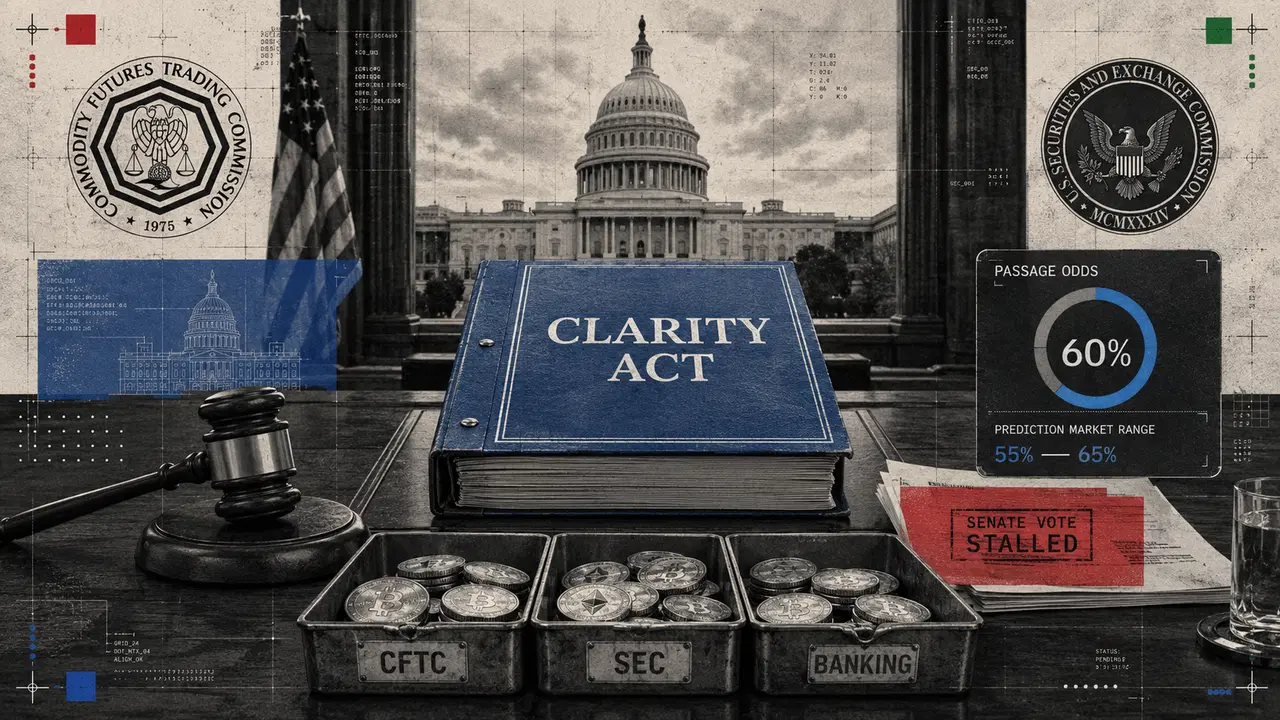
The bill the whole market is waiting on. The Digital Asset Market CLARITY Act sorts tokens into three buckets: digital commodities such as Bitcoin and Ether under the CFTC, fundraising tokens under the SEC, and payment stablecoins under banking regulators.
What the bill does
The CLARITY Act is the piece of United States legislation the digital asset industry has spent two years waiting on, because it would finally settle which regulator governs which token. Its full name is the Digital Asset Market CLARITY Act, and its central move is to sort tokens into three buckets. Digital commodities, the category that covers Bitcoin and Ether, would fall under the Commodity Futures Trading Commission. Tokens sold to raise money for a project would fall under the Securities and Exchange Commission. Payment stablecoins would sit with the banking regulators.
Those distinctions sound technical, but they decide practical questions with real weight. Whether a regulated bank can custody a given asset depends on how that asset is classified, as does which disclosure regime a token issuer must follow and which agency can bring an enforcement action. A token treated as a security carries one set of obligations around registration and disclosure; the same token treated as a commodity carries a different, lighter set, so the classification changes the economics of issuing and listing it. By codifying the boundaries in statute rather than leaving them to case-by-case rulings, the CLARITY Act would replace years of uncertainty with a fixed map, and that is why so much of the market is watching a single bill.
Where it stands
The bill has moved, though slowly. The House of Representatives passed its version in July 2025. The Senate Banking Committee advanced its own version on 14 May 2026. Momentum then stalled, first over stablecoin yield: the rules governing whether stablecoins may pay interest to the people who hold them. By late July the live blocker had shifted to an ethics provision, a ban on federal officials issuing digital assets with the Justice Department as its sole enforcer, which Democrats object to; a revised draft on 23 July sunsets that provision in 2029, but the Democrats’ demand on ethics held, and the Senate shelved the bill without a vote before the 7 August recess. Majority Leader Thune filed cloture on the motion to proceed on 8 August, and the Senate voted on it at 2.19pm on 15 September 2026, rejecting cloture by 49 votes to 50 with all 49 yeas coming from the Republican conference. Senator Tillis then entered a motion to reconsider, which keeps a second cloture vote available. For the bill to become law, both chambers have to pass matching text and the President has to sign it, so the House vote in 2025 was only the first of several gates, and the Senate remains the harder one to clear.
The stablecoin yield snag
That the CLARITY Act keeps snagging on stablecoin yield reflects how far the question reaches. Whether a stablecoin can pay a return touches directly on where deposits sit in the financial system, which pulls banks and their regulators into what might look like a narrow crypto provision. It has proved the hardest point to agree, and until it is resolved the broader bill cannot advance.
The odds of passage
The odds of passage this year have slipped as the calendar has tightened. Galaxy Research cut its 2026 passage estimate to 60% from 75% on 5 June, then cut again to 50% in July as the calendar tightened. On the prediction market Polymarket, contracts on passage touched a record low of 31% earlier in July, recovered to trade between 37% and 47%, and slipped to about 28% in early August once the bill was shelved, the last price this page recorded. Stifel’s Brian Gardner had argued that the bill needed to clear the Senate by the end of July, and that without it the prospects for the year deteriorate materially. That deadline has now passed unmet.
What to watch
The market is in a holding pattern until the Senate returns on 9 November 2026. Passage would give the United States its first comprehensive rulebook for digital assets, telling banks, issuers and exchanges which regulator to answer to and on what terms. Failure would leave the boundaries to be drawn by enforcement actions and the courts, one case at a time, which is the very uncertainty the CLARITY Act was written to end. The Senate rejected cloture on the motion to proceed by 49 votes to 50 on 15 September 2026, eleven short of the 60 required, with the Democrats’ demand over the ethics provision still the sticking point. Senator Tillis’s motion to reconsider sits on the table, and the Senate adjourned on 30 September 2026 until 3pm on 9 November, holding pro forma sessions only, with its floor record carrying no CLARITY business between 23 September and 1 October (Senate Press Gallery). So the thing to watch is whether the sponsors come back in November, with the 3 November midterm elections behind them, holding the 60 votes: the four Republicans who voted no plus seven Democrats. Our explainer on stablecoins and the GENIUS Act covers the yield dispute holding it up.
More Crypto
All Crypto →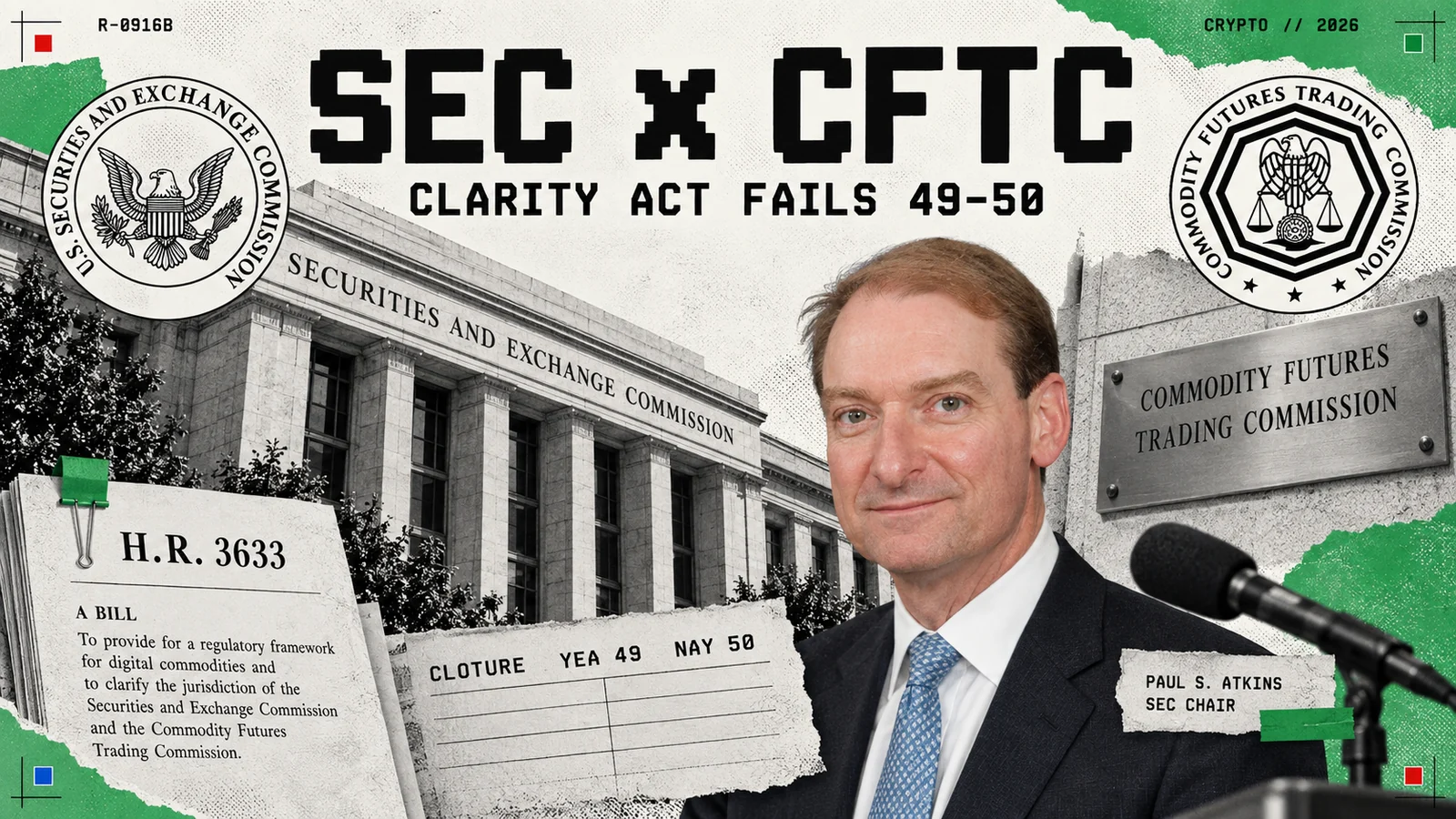
The SEC and CFTC will write crypto rules now the CLARITY Act has stalled
The Senate rejected cloture on the CLARITY Act 49 to 50 on 15 September 2026. Within a day the SEC chairman said the agency would act with or without legislation, and the CFTC chairman had already said the same thing nearly four weeks earlier.
The CLARITY Act fell eleven votes short, and every yea was Republican
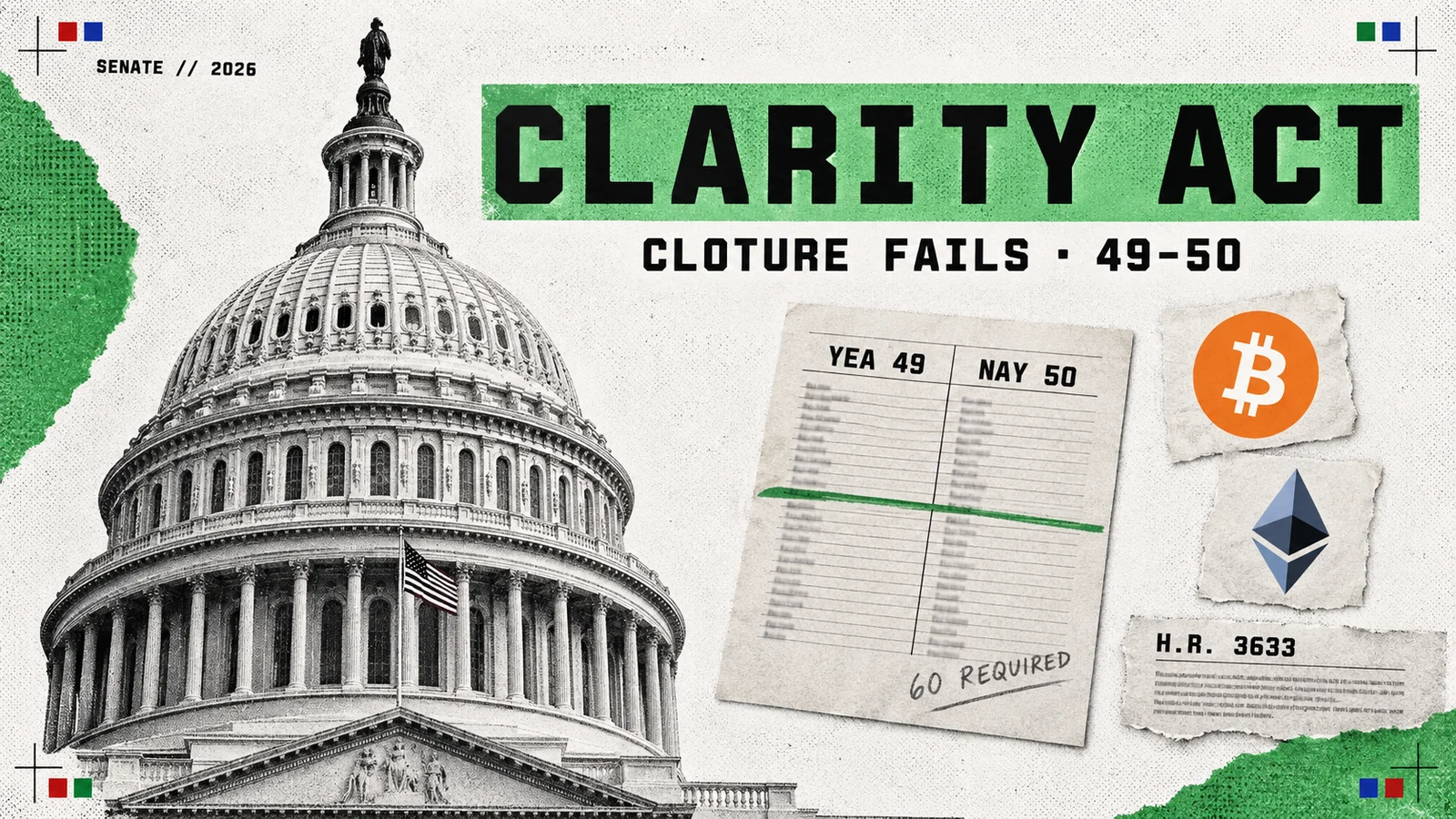
The Senate rejected cloture on H.R. 3633 by 49 to 50 on 15 September 2026. All 49 yeas were Republican, four Republicans voted nay, and Senator Tillis entered a motion to reconsider one minute later.
CLARITY Act Senate vote: Federal Hall theatre and a deadline that is suddenly real
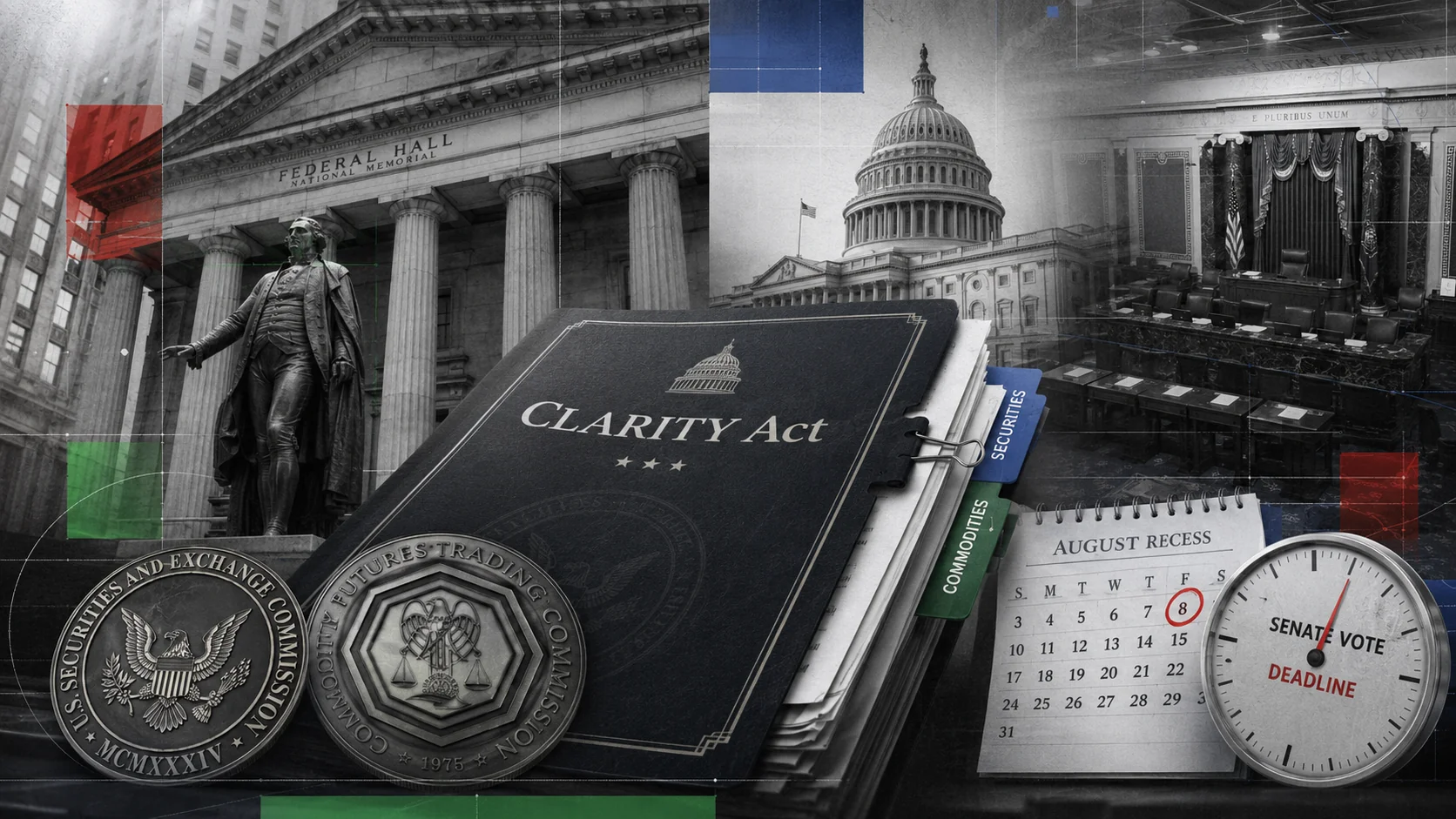
The push for a CLARITY Act Senate vote reached its most theatrical moment yet on 17 July, when the House Financial Services Committee decamped to Federal Hall in New York, the building where the first Congress once sat, for a field hearing titled Building the Future of Finance: How the CLARITY Act U