
What is a digital commodity?
the joint release that named sixteen tokens
Key facts
- 17 Mar 2026effective 23 March
- Issued
- 33-11412and 34-105020
- Release
- 16plus two in a footnote
- Tokens named
- 3-0Atkins, Peirce, Uyeda
- Vote
- 5of crypto asset
- Categories
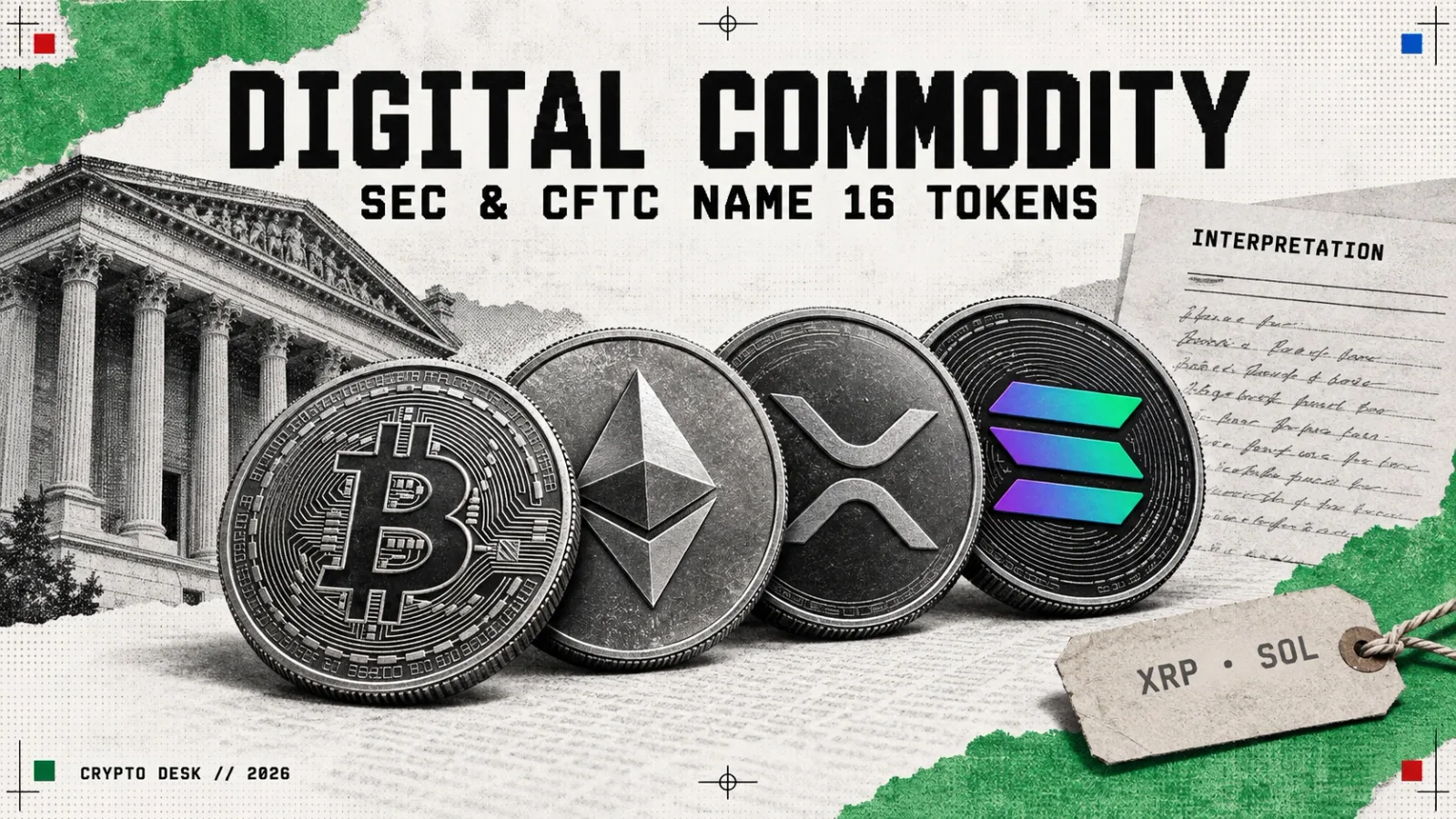
Since 17 March 2026 the US regulators have a shared answer to crypto's oldest question. A digital commodity is an asset drawing its value from a functional network rather than from a promoter's efforts, sixteen tokens including XRP, Solana and Dogecoin are named as examples, and the sale of one can still be a security even though the asset is not.
For most of crypto’s history, “is this token a security?” had no answer an American regulator would put in writing. Since 17 March 2026 it has one. The SEC’s interpretive release 33-11412, issued with guidance from the CFTC and effective 23 March, defines a “digital commodity”, names sixteen tokens as examples, and sets out when the securities laws still reach a sale of one. It passed the Commission 3-0 and runs to 68 pages; every claim here is checked against that document.
Sixteen tokens are named, and XRP is one of them
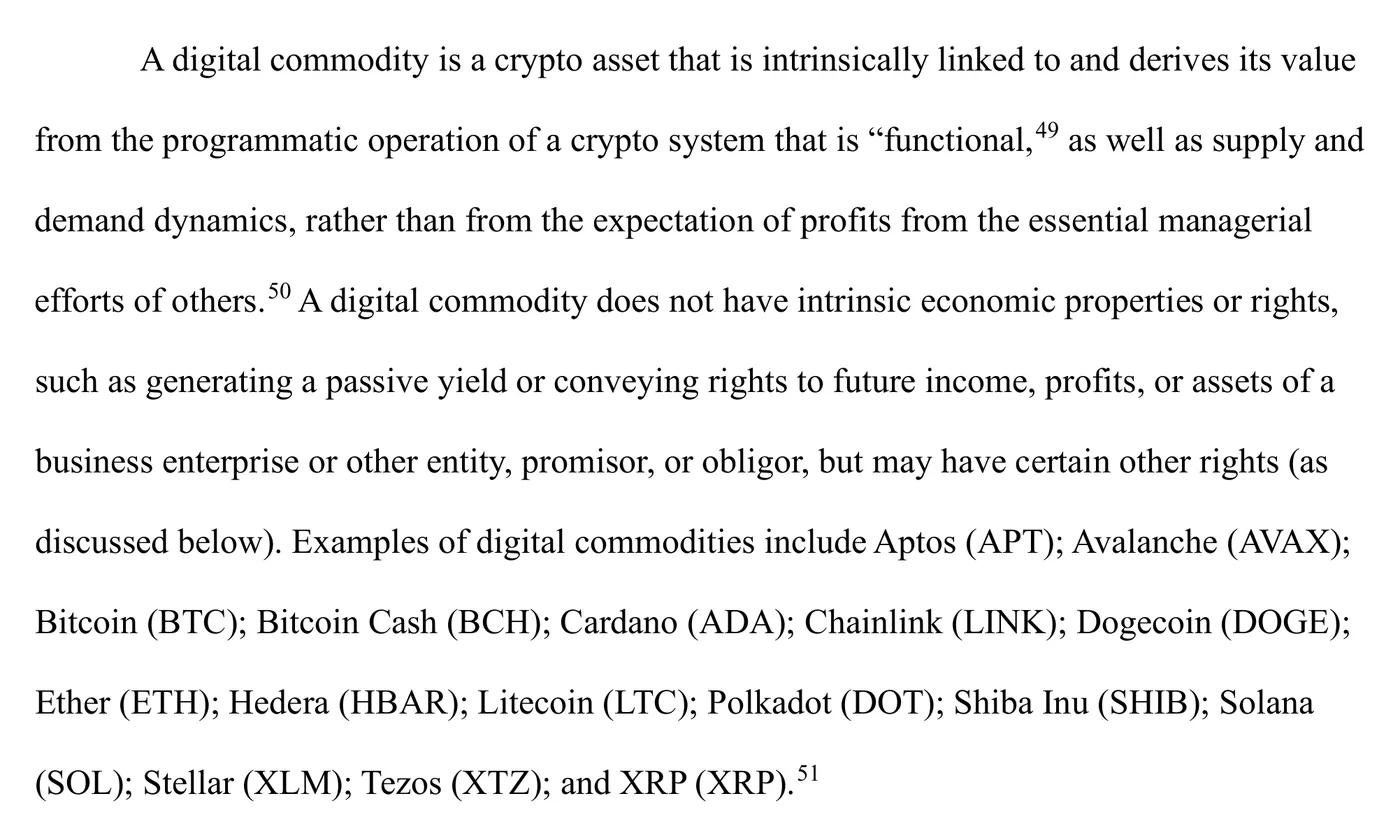
Page 14 of the release carries the sentence the market waited years for: “Examples of digital commodities include Aptos (APT); Avalanche (AVAX); Bitcoin (BTC); Bitcoin Cash (BCH); Cardano (ADA); Chainlink (LINK); Dogecoin (DOGE); Ether (ETH); Hedera (HBAR); Litecoin (LTC); Polkadot (DOT); Shiba Inu (SHIB); Solana (SOL); Stellar (XLM); Tezos (XTZ); and XRP (XRP).”
Three things about that list are worth reading as carefully as the list itself. The sixteen were chosen because each underlies a futures contract on a regulated US market, and the release says that test is illustrative rather than required: a footnote adds Algorand and LBRY Credits as digital commodities with no futures contract at all, taking the named total to eighteen. The classifications are dated, “based on our understanding of their characteristics, terms, and functions as of the date of this release”, so they describe the assets as they stood in March 2026 rather than granting a permanent status. And the list is expressly non-exhaustive: an unnamed token can qualify by meeting the definition.
The definition, in the regulators’ own words
“A digital commodity is a crypto asset that is intrinsically linked to and derives its value from the programmatic operation of a crypto system that is functional, as well as supply and demand dynamics, rather than from the expectation of profits from the essential managerial efforts of others.”
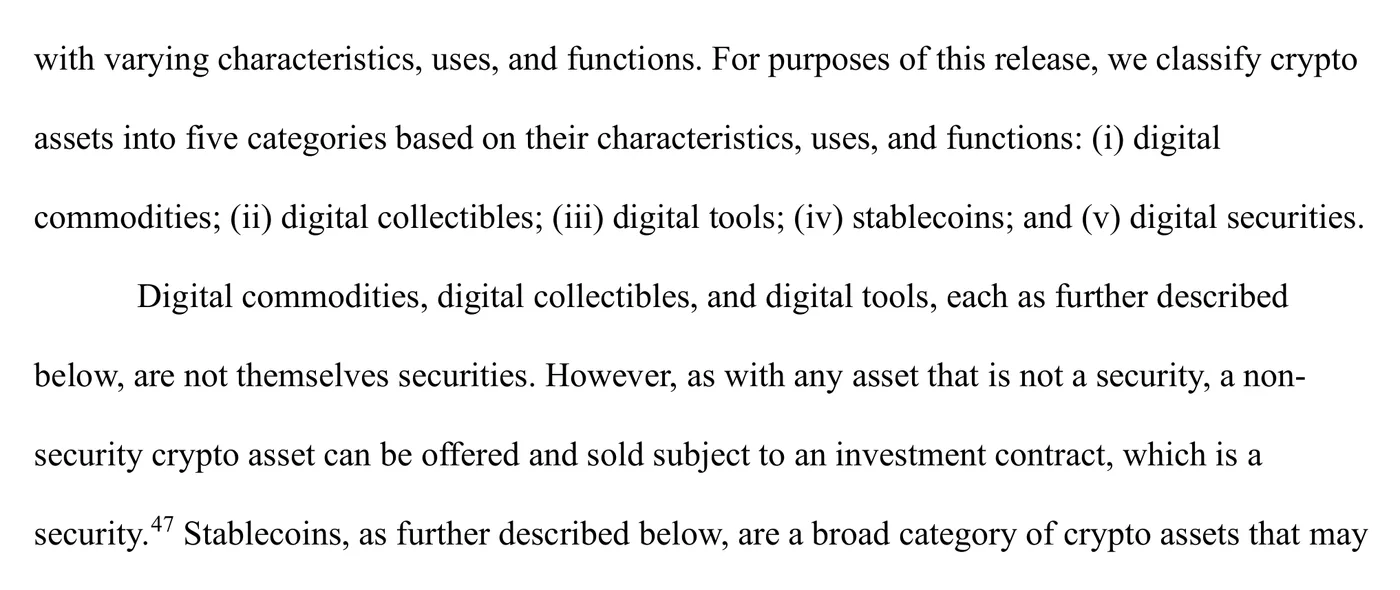
The last clause is the Howey test’s echo, and the release is explicit that the old law still governs: “The interpretation in this release does not supersede or replace the Howey test, which is binding legal precedent.” What the document adds is a sorting of crypto assets into five categories: digital commodities, digital collectibles, digital tools, stablecoins and digital securities. The first three “are not themselves securities”; the conclusion the release draws for the commodity category is that such an asset lacks “the economic characteristics of a security”.
The sale of a commodity can still be a security
The release’s central legal move separates the asset from the transaction. A non-security crypto asset can be “offered and sold subject to an investment contract, which is a security”, and doing so leaves the asset itself unchanged: “The fact that a non-security crypto asset is subject to an investment contract does not transform the non-security crypto asset itself into a security.”
The release then describes how the two come apart, a doctrine the lawyers now call separation: once the issuer has delivered the “essential managerial efforts” it promised, or has publicly abandoned them, secondary trading of the asset proceeds outside the investment contract. Later sections apply the same analysis to protocol mining, protocol staking including liquid staking, wrapping and airdrops, concluding that each, in the circumstances described, involves no offer or sale of a security. Those staking pages underwrite, among other things, the staking features inside the new Solana ETFs.
So is XRP a security?
The release’s answer for the asset is no: XRP appears in the digital commodity list with no separate analysis, treated identically to the other fifteen, which under the release’s reasoning means it “does not have the economic characteristics of a security” as of March 2026. The litigation that made this the most-asked question in crypto had already closed. On 7 August 2025 the SEC and Ripple jointly dismissed their cross-appeals, ending the five-year enforcement action; the final judgment stands, including a $125,035,150 civil penalty against Ripple over its institutional sales and an injunction on future registration violations. The two documents read together give XRP its current legal shape: the historical institutional sales were unregistered securities offerings and were paid for, and the asset in secondary trading is a digital commodity on the regulators’ stated view.
The honest limit: an interpretation is the Commission’s view of existing law, has no force of statute, and creates no new legal obligations, as the release itself says. A court could disagree. Congress could still write the classification into law, which is exactly what the stalled CLARITY Act would do.
How the two agencies split the job
The document is structurally an SEC interpretation with CFTC guidance appended, and it insists that “nothing in this release should be construed as altering the respective statutory authorities of the SEC or CFTC”. It is also one output of a wider merger of effort. The two agencies’ staff said in September 2025 that existing law does not stop registered exchanges facilitating spot crypto trading; on 29 January 2026 Chairmen Paul Atkins and Michael Selig announced that Project Crypto would run as a joint SEC-CFTC effort, with a memorandum of understanding signed on 11 March 2026, six days before this release.
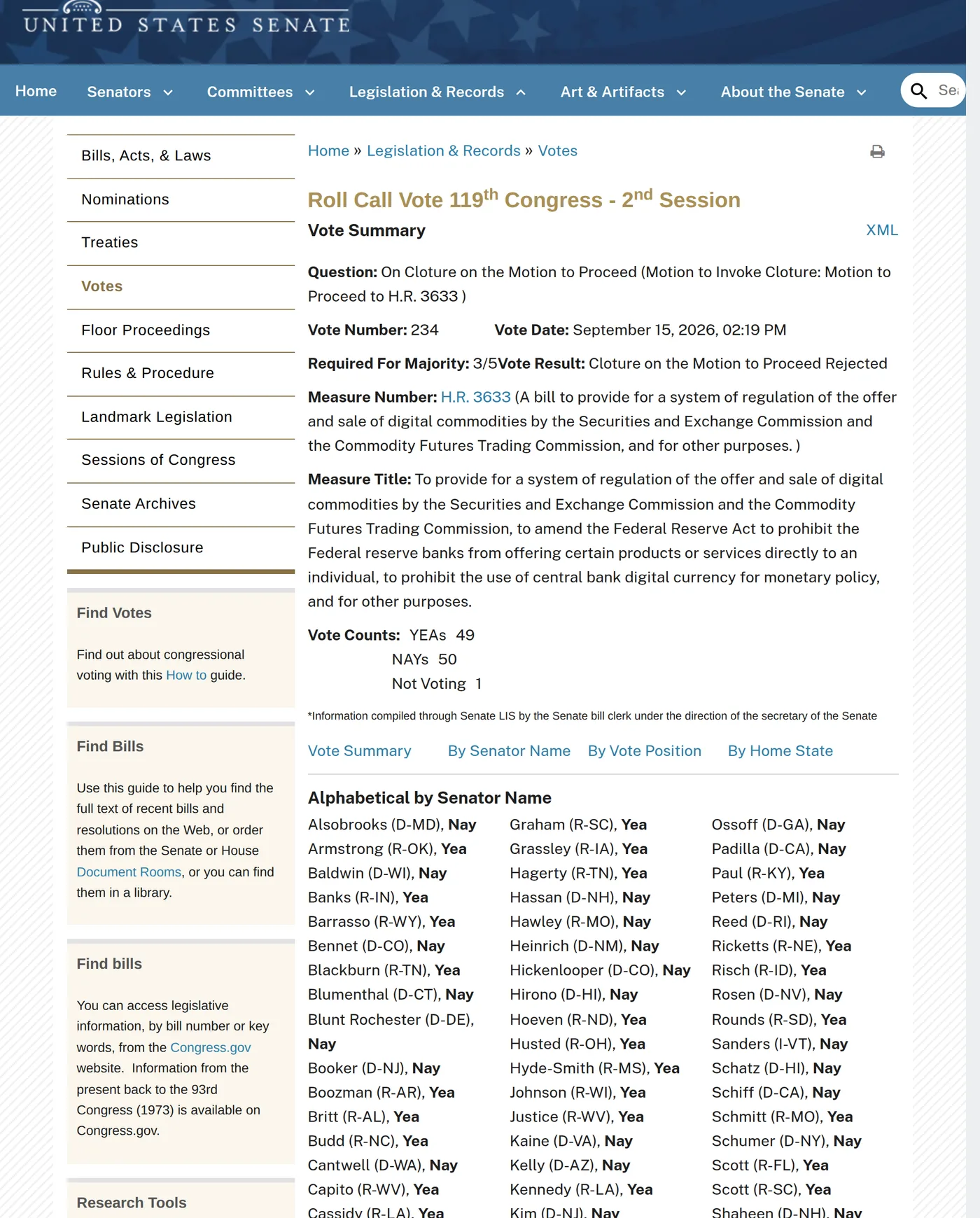
The legislative backdrop explains the urgency. The CLARITY Act, which would hand digital commodities to the CFTC by statute, passed the House in 2025 and failed a Senate cloture vote 49-50 on 15 September 2026. The agencies wrote their shared answer while Congress argued, and the follow-on rulemaking is already moving: the SEC’s proposed Regulation Crypto Assets, out for comment since August 2026, builds its exemptions directly on this release’s framework.
What to check before relying on the list
The release rewards precision. A token’s place on the list is a dated observation, so a network that has since changed its economics needs fresh analysis. The list answers what the ASSET is, so a fundraising sale wrapped in promises can still put a seller inside the securities laws, whatever the token’s category. And the interpretation binds nobody but the agencies’ own view of the law: the courts stay open, and Congress may yet overwrite the whole map. What it ends is the era in which the United States’ two market regulators disagreed in public about what the biggest tokens in the market are.
Related pages
All Regulation & Policy →- The CLARITY Actthe bill the whole market is waiting on
- SEC Regulation Crypto and the $75m exemption
- Solana and XRP ETFshow they list without individual approval
- UK crypto regulationthe FSMA regime, the dates and the rules
- Travel Rule & AMLthe rule that follows the money
- MiCA and the non-US regulatory map