
SEC Regulation Crypto and the $75m exemption
Key facts
- 18 Aug 2026402 pages, 3-0
- Proposed
- $20m / $75meach per 12 months
- Fundraising tiers
- $5mone-time, four years
- Startup exemption
- 20 Oct 2026Federal Register
- Comment closes
- CLARITY Actstatutory backstop
- Legislation
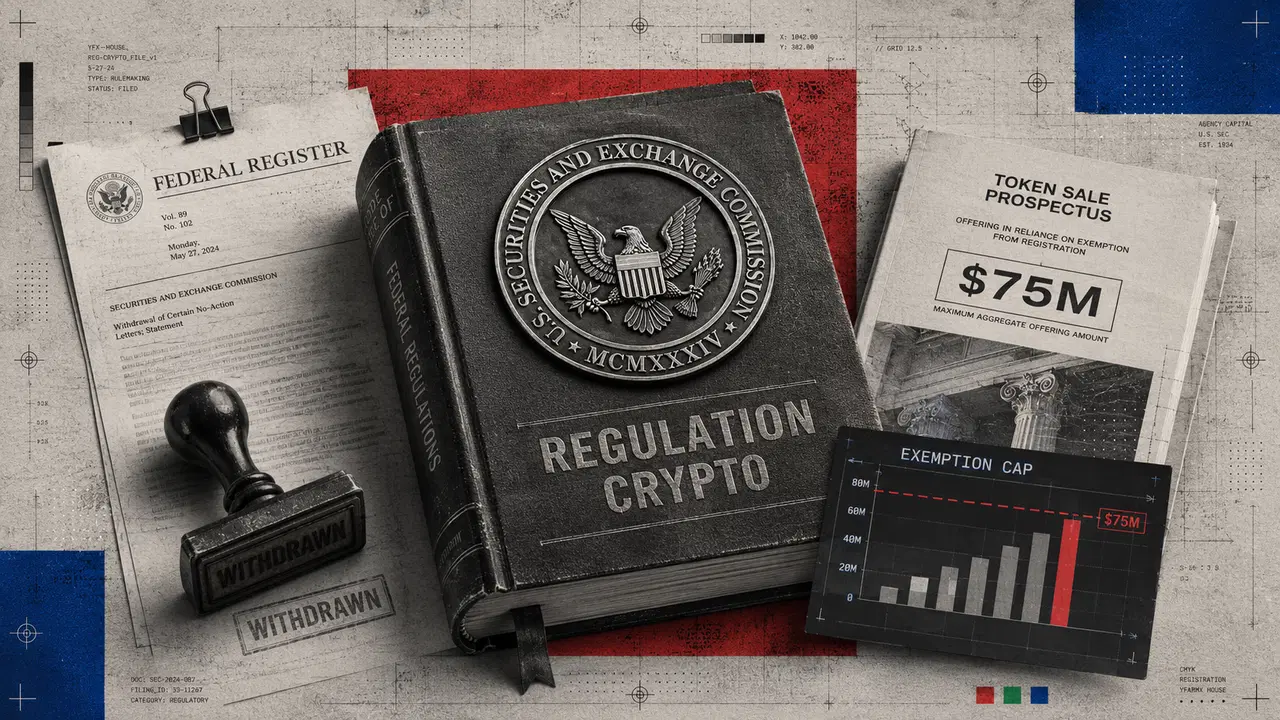
The SEC proposed Regulation Crypto Assets on 18 August 2026: a 402-page framework with two annual fundraising tiers at $20m and $75m, a one-time $5m startup exemption, and a proposed exemption path designed to operate with or without the CLARITY Act. Comments close 20 October 2026.
What it is
SEC Regulation Crypto Assets is the Securities and Exchange Commission’s attempt to give digital-asset issuers a workable path to market through its own rulemaking, without waiting for Congress. The Commission formally proposed it on 18 August 2026, when the Commission voted 3-0 to propose it: Chairman Atkins and Commissioners Peirce and Uyeda, the agency’s full current roster, all published statements in support. The proposing release runs to 402 pages, and its publication in the Federal Register on 21 August 2026 set the deadline: comments close on 20 October 2026. At the centre of the package is a tiered fundraising exemption, a bounded, lighter-touch route to raising money before fuller registration obligations apply. The important design feature is that the proposed Regulation Crypto Assets would operate with or without the CLARITY Act, the legislation that would put similar arrangements on a statutory footing. It is, in effect, the administrative road to the same destination the lawmakers have been arguing over.
What the tiered exemption does
The tiers do the practical work. For a token issuer, the gap between raising capital under a tailored exemption and attempting full securities registration is the gap between a viable launch and an abandoned one. The proposal sets two annual fundraising tiers: Tier 1 would allow up to $20m in any 12-month period, with no more than $6m of that sold by affiliated securityholders, and Tier 2 would allow up to $75m, with an affiliate cap of $22.5m. A separate proposed startup exemption would let the earliest projects raise up to $5m, once, across a four-year period, and alongside the tiers sits a conditional safe harbour from the definition of an investment contract. Above the ceilings the heavier requirements return, which keeps the route aimed at earlier-stage issuance rather than at large, mature offerings. Issuers can comment on the proposed conditions until 20 October 2026. These routes would become available only after the Commission adopts and brings final rules into effect.
Rules while Congress stalls
The strategic point of Regulation Crypto Assets is about who is driving US crypto policy. Through 2026 the defining pattern has been regulators moving through rulemaking while Congress stalls. The CLARITY Act would settle the questions in statute, but legislation is slow and contested, so the Commission is using the tools it already holds to build something usable without them. This is a recurring feature of American financial regulation: when the legislature cannot agree, the agencies fill the gap with rules of their own, and the market adapts to those rules because it cannot wait for a better answer. The tiers are a case study in that habit, built to function on their own terms whether or not the CLARITY Act ever reaches the president’s desk.
The reversibility risk
That approach carries an obvious fragility. Rules made by an agency can be unmade by an agency. Because Regulation Crypto Assets rests on the Commission’s own rulemaking rather than on an act of Congress, a future administration with a different disposition can revise or withdraw it through the same process that created it. Statute is durable in a way that a rule is not. Issuers planning around the tiers would therefore be building on ground that a change of leadership at the Commission could shift, and prudent legal advice will treat the framework as proposed policy rather than as settled law.
What to watch
For anyone following the mechanics, the near-term milestones are fixed: comments close on 20 October 2026, after which the Commission weighs the responses and votes on whether to adopt a final rule. The deeper thing to watch is the interaction between the rule and the bill. If the CLARITY Act passes, it may ratify and stabilise what Regulation Crypto Assets proposes, converting an administrative plan into a statutory one and removing the reversibility risk. If it does not, the exemption, once adopted, would stand as the operative regime, useful but provisional. Either way, the habit of 2026, regulators acting while legislators debate, is likely to define how digital-asset rules are made in the United States for some time. Our crypto explainers track how these frameworks develop and how they compare with the rules taking shape elsewhere.
More Crypto
All Crypto →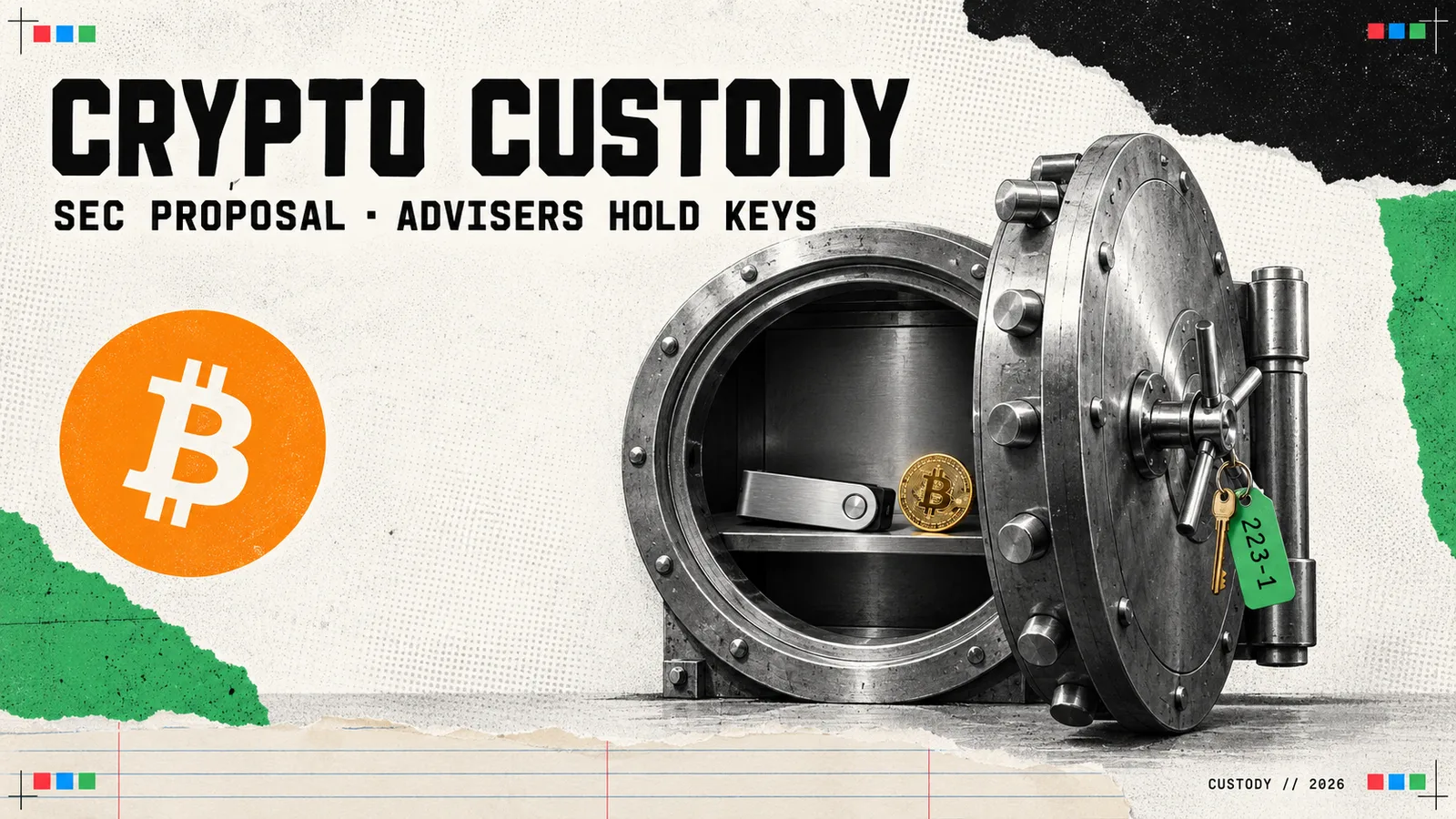
SEC proposes letting advisers hold crypto when no custodian will
The SEC voted 3-0 on 1 October 2026 to propose rules letting registered investment advisers hold a client's crypto themselves when no qualified custodian will, and keep it at state trust companies. SEC staff put self-custody at $433,833 a year per adviser, mostly for an accountant's report.

SEC staff clear token buybacks on blockchains that already work
The SEC's Division of Corporation Finance published nine staff answers on crypto on 25 September 2026. On a working network, announcing a buyback or paying for upgrades sits outside the managerial effort the Howey test looks for; before launch, a buyback sold as a return could count.
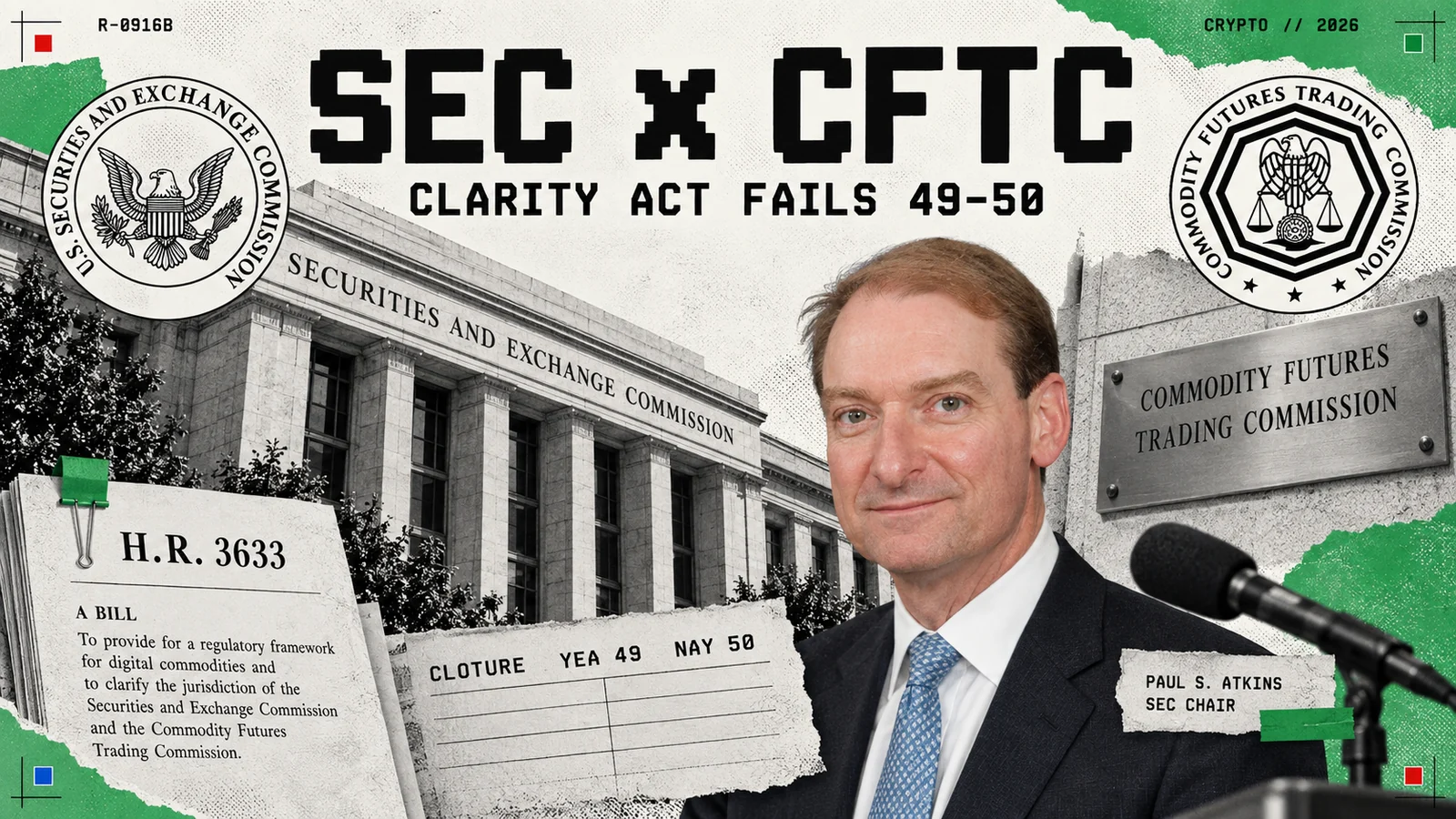
The SEC and CFTC will write crypto rules now the CLARITY Act has stalled
The Senate rejected cloture on the CLARITY Act 49 to 50 on 15 September 2026. Within a day the SEC chairman said the agency would act with or without legislation, and the CFTC chairman had already said the same thing nearly four weeks earlier.