SEC proposes letting advisers hold crypto when no custodian will
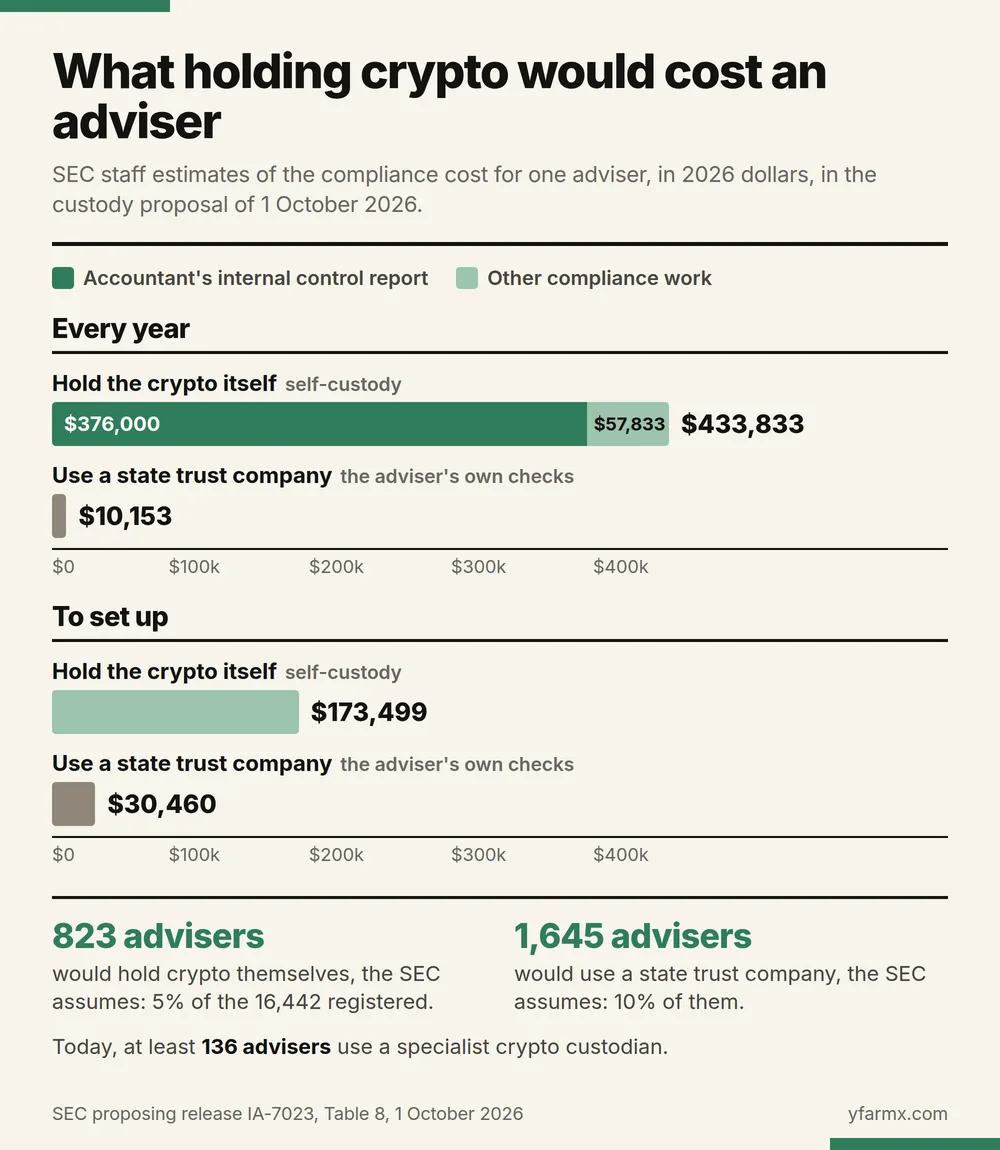
The SEC voted 3-0 on 1 October 2026 to propose rules letting registered investment advisers hold a client's crypto themselves when no qualified custodian will, and keep it at state trust companies. SEC staff put self-custody at $433,833 a year per adviser, mostly for an accountant's report.
Listen to this articleListen
The US Securities and Exchange Commission voted 3-0 on 1 October 2026 to propose rules under which a registered investment adviser could hold a client’s crypto itself when no qualified custodian will hold that asset. The proposal, release IA-7023, would also let advisers and funds keep crypto at state trust companies, which count as custodians today only after a case-by-case test of whether they are banks.
Chairman Paul Atkins said in the SEC’s announcement that the package gives investment advisers and funds “a compliant pathway where none existed before”. It covers SEC-registered advisers, registered investment companies and business development companies, and it follows Regulation Crypto Assets in August and the SEC’s transfer agent rewrite of 1 September, which would let a blockchain hold a company’s share register.
When could an adviser hold the crypto itself?
Under the proposal of 1 October 2026, an adviser could hold a crypto asset only after deciding in writing, after due inquiry, that no qualified custodian will hold it, and it would repeat that check every quarter. Qualified custodians today are banks and savings associations, registered broker-dealers, registered futures commission merchants and certain foreign financial institutions. The check runs one asset at a time: the release bars “a blanket QC determination covering all types of crypto assets”, QC being its shorthand for qualified custodian, and any decision “based on the costs associated with engaging a qualified custodian”. Its own example is a nascent token that no qualified custodian has yet built the systems and safeguards to hold. Once a custodian can take it, the adviser must move the asset there “as soon as reasonably practicable”.
Holding the asset brings conditions under proposed rule 223-1.
| Condition | What the adviser must do |
|---|---|
| Safeguarding | Document its expertise in safeguarding each asset, run systems for private key management and review them every year |
| Two-person approval | At least two people authorise every transfer, one of them a management person |
| Separate addresses | Keep each client’s crypto in addresses that hold only that client’s assets |
| Cybersecurity | Manage cyber risks and review the controls at least every year |
| Accountant’s report | Obtain an independent accountant’s internal control report within six months, then every year |
| Client statements | Send each client an account statement at least every quarter |
| Legal status | Agree in writing with the client to treat each asset as a “financial asset” under state law |
A registered fund would hold its crypto through its adviser, under a new Investment Company Act rule, 17f-9. The fund’s board would review the adviser’s written finding at the start and every quarter, and decide before custody begins, and every year after, that the asset would receive reasonable care with the adviser.

Who holds advisers’ crypto today?
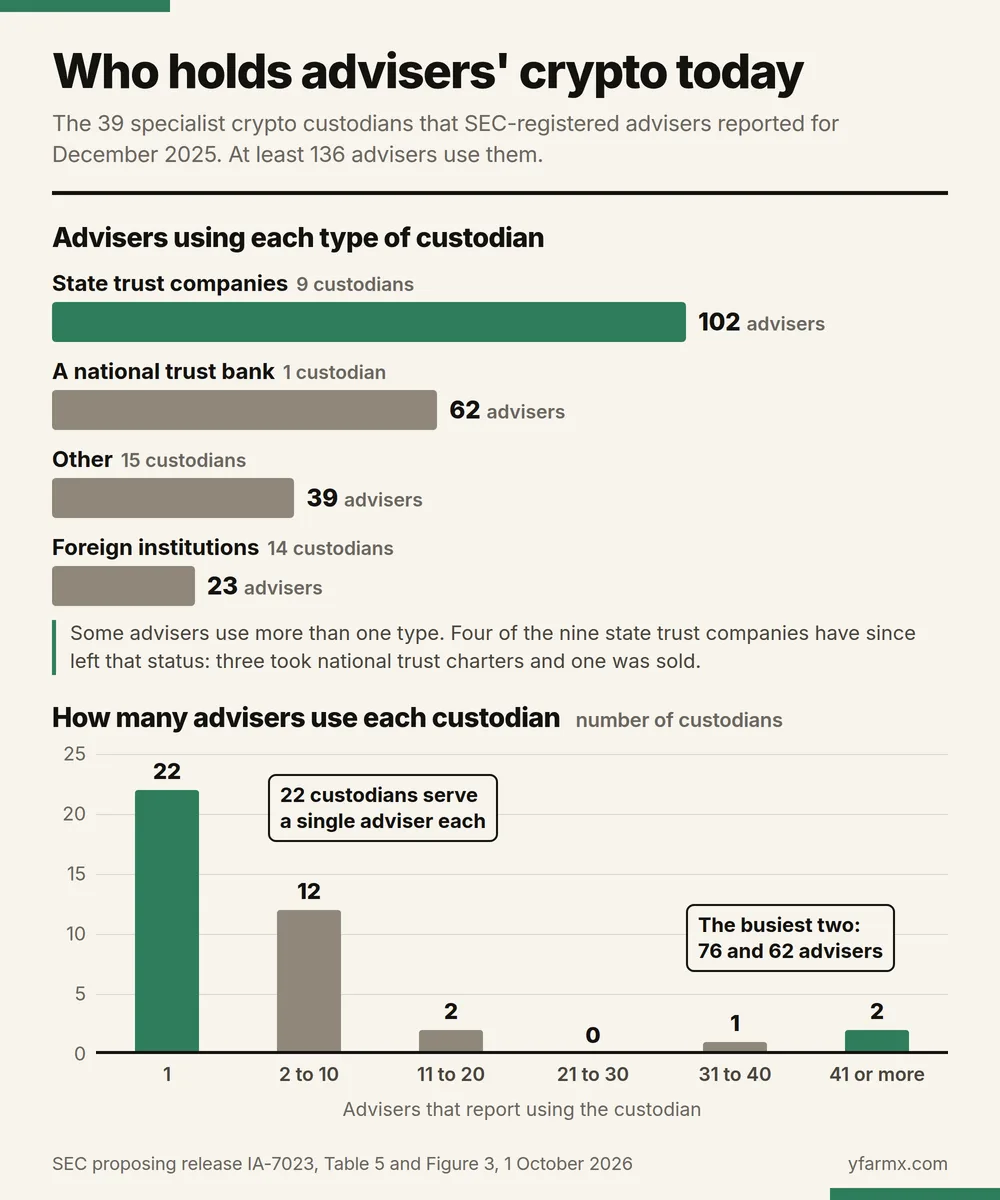
At least 136 SEC-registered advisers held crypto through 39 specialist custodians at the end of 2025, SEC staff found in Form ADV filings received up to 31 March 2026. The market has a few large players: one custodian is named by 76 advisers and another by 62, while 22 of the 39 are named by a single adviser each. State trust companies serve the most advisers, nine of them used by 102. Four of those nine have since left that status: three took national trust charters, the federal route the Office of the Comptroller of the Currency has been granting to crypto firms, and one was sold.
SEC staff found a wider group by having an AI model read advisers’ brochures. Anthropic’s Sonnet 5 read the latest brochures of 15,964 advisers, 97% of the 16,442 registered with the SEC, and after two rounds of checks the staff count 1,498 that give or plan to give advice involving crypto. In the first round, a second pass by the same model removed 334 false positives and restored one adviser it had missed. In the second, a manual review found a false positive rate below 3% in what remained. The staff treat 1,498 as a possible lower bound.
Crypto mutual funds and ETFs generally track futures prices, the release says, and only one registered fund reported using a specialist crypto custodian. The 72 crypto exchange-traded products, which typically hold spot crypto, are commodity trusts whose shares are registered under the Securities Act of 1933, while the new fund rules apply to registered investment companies such as mutual funds and ETFs.
| SEC staff count | Number | As of |
|---|---|---|
| SEC-registered advisers | 16,442 | December 2025 |
| Advisers giving or planning crypto advice | 1,498 | Brochures filed 1 January 2025 to 30 June 2026 |
| Advisers using a specialist crypto custodian | At least 136 | December 2025 |
| Crypto mutual funds | 10, about $432.5m of net assets | 20 April 2026 |
| Crypto ETFs | 122, about $8.7bn of net assets | 20 April 2026 |
| Crypto exchange-traded products | 72, about $117.7bn of net assets | 20 April 2026 |
State trust companies could hold the crypto too
The proposal would let advisers and funds keep crypto at state trust companies, and SEC staff estimate about 19 of them specialise in crypto custody, from a review of 484 trust companies in May 2026. A state trust company is a firm organised under state law, supervised and examined by the state’s banking regulator and allowed to act as a fiduciary. Today it serves as a custodian only if it meets the legal definition of a bank, which usually takes a case-by-case analysis. SEC staff eased that in a no-action letter on 30 September 2025, and the proposal would write the route into the rules themselves.
Before using one, and every year after, an adviser or fund would need a reasonable basis to believe the trust company is authorised by its state banking regulator to hold crypto, and that it keeps written policies to protect that crypto from theft, loss, misuse and misappropriation. The adviser or fund would also review the trust company’s latest audited financial statements and internal control report, and the trust company would keep clients’ crypto apart from its own assets.
What would it cost?
SEC staff estimate the self-custody route’s compliance cost at $173,499 to set up and $433,833 a year for each adviser, in 2026 dollars, and $376,000 of the yearly figure is the accountant’s internal control report. The check on a state trust company comes to $30,460 up front and $10,153 a year for each adviser or fund, priced as 60 hours of compliance work and then 20 hours a year, and a fund adds $6,966 and then $2,322 a year for its custody agreement with the trust company. A fund whose adviser holds its crypto adds the cost of its board reviewing the adviser’s reports.
| Route | Set-up cost | Yearly cost | Users the SEC assumes |
|---|---|---|---|
| Adviser holds the crypto | $173,499 | $433,833 | 823 advisers |
| Fund holds it through its adviser | $53,037 | $21,660 | 715 funds |
| Adviser uses a state trust company | $30,460 | $10,153 | 1,645 advisers |
| Fund uses a state trust company | $30,460 | $10,153 | 1,430 funds |
| Fund’s custody agreement with that trust company | $6,966 | $2,322 | 1,430 funds |
The user counts are SEC assumptions: 5% of the 16,442 registered advisers and of 14,301 regulated funds for self-custody, and 10% for state trust companies, set against the 136 advisers seen using a specialist crypto custodian today. Across all the crypto custody rules, the SEC puts the cost at $284.3m up front and $407.1m a year. “We were unable to quantify the main benefits of the proposal,” the release says, naming access to state trust companies and self-custody for investors who seek out crypto.
Comments close 60 days after publication
The comment period closes 60 days after the proposal is published in the Federal Register, under file number S7-2026-35. Atkins and Commissioners Hester Peirce and Mark Uyeda all approved it, the SEC’s vote record shows. Peirce’s resignation took effect on 2 October 2026, the day after the vote, leaving two commissioners. Two commissioners in office make a quorum under the SEC’s quorum rule, and a final rule published the same day added that a single commissioner can act when all the others are disqualified.
Peirce opposed the SEC’s 2023 custody proposal, writing in February 2023 that “I cannot support today’s proposal”, and the Commission withdrew it on 12 June 2025. In her statement on this one, titled “Roller Coaster Ride”, she wrote that under the 2023 plan “compliant crypto custody looked impossible”. She backed the new version, and wrote that she “would have preferred the term ‘shelf-custody’ to distinguish adviser custody from situations in which investors custody their own assets without intermediation.”
“For novel crypto assets, self-custody by an adviser or fund may be the only available option when no qualified custodian is willing or able to hold those assets,” Uyeda wrote in his statement.
Questions people ask
- What did the SEC propose on 1 October 2026?
- The SEC voted 3-0 on 1 October 2026 to propose rules, release IA-7023, on how registered investment advisers and regulated funds hold crypto. An adviser could hold a client's crypto itself when no qualified custodian will take that asset, under conditions that include two-person approval of every transfer and an accountant's control report. Advisers and funds could also use state trust companies as custodians. Comments run for 60 days from publication in the Federal Register.
- When could an investment adviser hold a client's crypto itself?
- Under the SEC's proposal of 1 October 2026, an adviser must first decide in writing, after due inquiry, that no qualified custodian will hold that specific crypto asset, and repeat the check every quarter. Cost is never a valid reason. The adviser then keeps each client's crypto in addresses holding only that client's assets, has two people approve every transfer, obtains an accountant's control report within six months and sends clients statements every quarter.
- How much would crypto self-custody cost an adviser under the SEC proposal?
- SEC staff estimate the compliance cost of the self-custody route at $173,499 to set up and $433,833 a year for each adviser, in 2026 dollars. Of the yearly figure, $376,000 is the independent accountant's internal control report. The checks an adviser runs on a state trust company come to an estimated $30,460 up front and $10,153 a year. The SEC assumes about 823 advisers would hold crypto themselves.
Sources
- SEC press release 2026-100: SEC proposal would address how investment advisers and funds can custody crypto assets, 1 October 2026sec.gov
- SEC proposing release IA-7023: Adviser and Regulated Fund Custody Rules; Crypto Custody Rules, 1 October 2026sec.gov
- SEC fact sheet: Investment Adviser and Regulated Fund Custody Rules; Crypto Custody Rules, 1 October 2026sec.gov
- SEC: rulemaking file S7-2026-35, Adviser and Regulated Fund Custody Rules; Crypto Custody Rulessec.gov
- SEC: Commission votes, October 2026sec.gov
- SEC Chairman Paul Atkins: statement on the proposal to address the custody of crypto assets, 1 October 2026sec.gov
- SEC Commissioner Hester Peirce: Roller Coaster Ride, statement on the custody proposal, 1 October 2026sec.gov
- SEC Commissioner Mark Uyeda: statement on proposed amendments to the custody rules, 1 October 2026sec.gov
- SEC Commissioner Hester Peirce: statement on the Safeguarding Advisory Client Assets proposal, 15 February 2023sec.gov
- Hester Peirce on X: resignation letter, effective 2 October 2026x.com
- Federal Register: SEC final rule, Commission Quorum Requirement, 2 October 2026federalregister.gov