Amazon could sell and rent back $8bn of Nvidia chips
Amazon has held talks with investors on selling about $8bn of Nvidia Grace Blackwell chips to a special-purpose vehicle and leasing them back, the Financial Times reported on 2 October 2026. Amazon plans to offer an equity stake of up to 10% in the vehicle.
Listen to this articleListen
Amazon has held talks with investors on selling about $8 billion of Nvidia Grace Blackwell chips to a special-purpose vehicle and then leasing them back, the Financial Times reported on 2 October 2026. The vehicle would raise money from outside investors by issuing debt, and Amazon plans to offer an equity stake of up to 10% in it, the FT said.
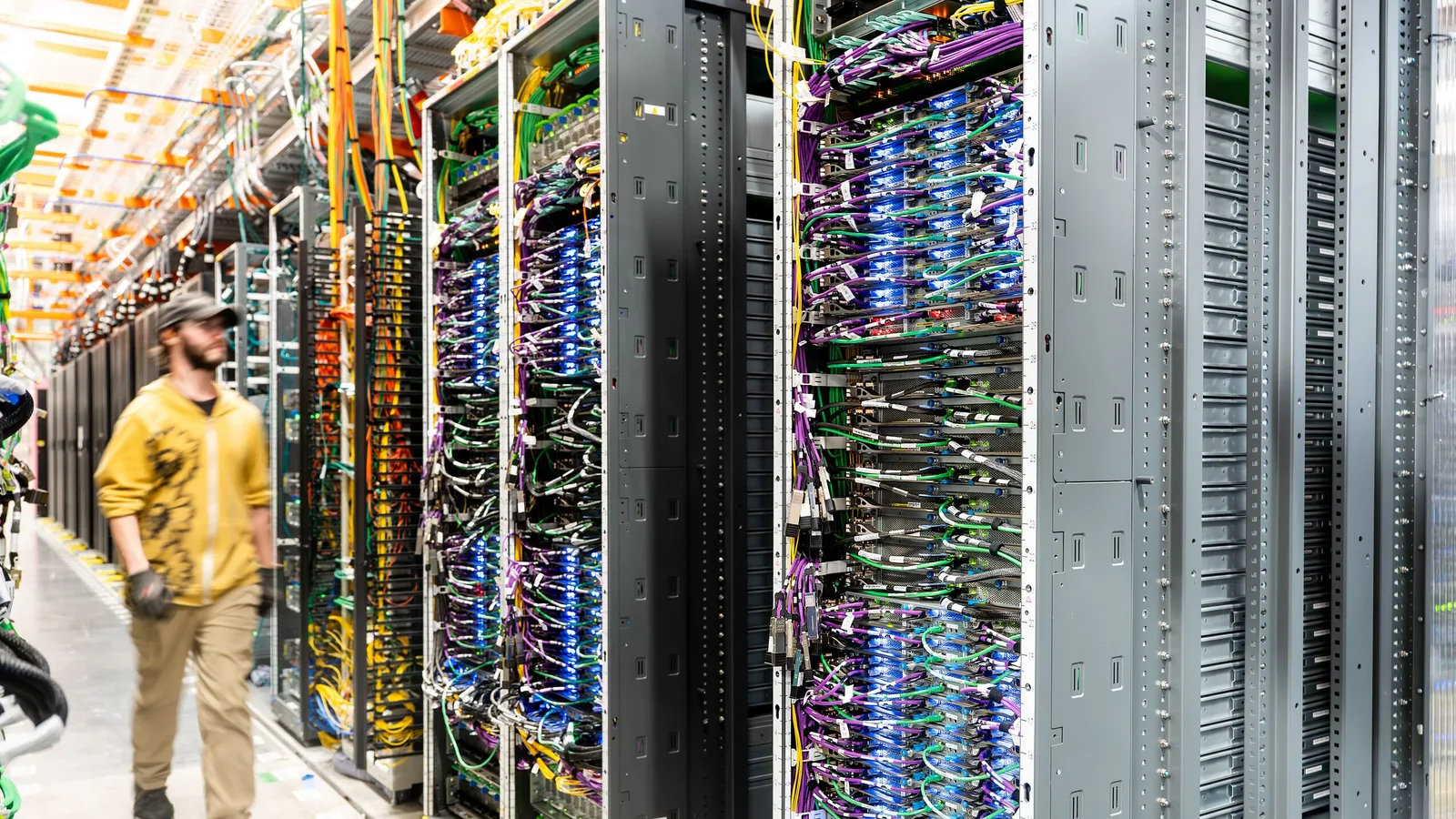
Amazon and Nvidia did not immediately respond to Reuters for comment. The chips were bought or leased by Amazon and are installed in more than a dozen US data centres across five states, including Nevada and Virginia, according to the report. Amazon expects to spend about $220 billion on capital projects this year.
How would the sale and leaseback work?
A special-purpose vehicle would buy the chips from Amazon with money borrowed from outside investors, and Amazon would then lease them back, the FT reported on 2 October 2026. Amazon has held talks with investors in recent weeks to gauge interest in a deal that would move thousands of Grace Blackwell chips it is installing in US data centres into the vehicle, Reuters said, citing the FT.
In a sale and leaseback, the seller turns an asset into cash and pays rent to keep using it. Amazon could take a more asset-light approach to its balance sheet by passing the expensive chips to investors, the FT said.

Grace Blackwell is Nvidia’s design that pairs two Blackwell GPUs with one Grace CPU on a single module. AWS, Amazon’s cloud arm, rents systems built from it to customers as EC2 P6e UltraServers, with up to 72 Blackwell GPUs in one NVLink domain on the GB200 version, according to AWS.
Amazon expects to spend about $220 billion this year
Amazon expects to spend about $220 billion on capital projects in 2026, chief executive Andy Jassy told investors on 30 July, up from an earlier estimate of $200 billion because memory costs more, Fortune reported. Jassy said demand would still outrun the capacity Amazon can add this year, and expected the same in 2027. AWS remains on pace to double its power capacity by the end of 2027 compared with 2025, he said. AWS, the business that rents out the computing, grew sales 37% to $42.2 billion in the second quarter, with operating income of $16.6 billion, and its AI business passed an annual revenue run rate of $25 billion, Amazon said.
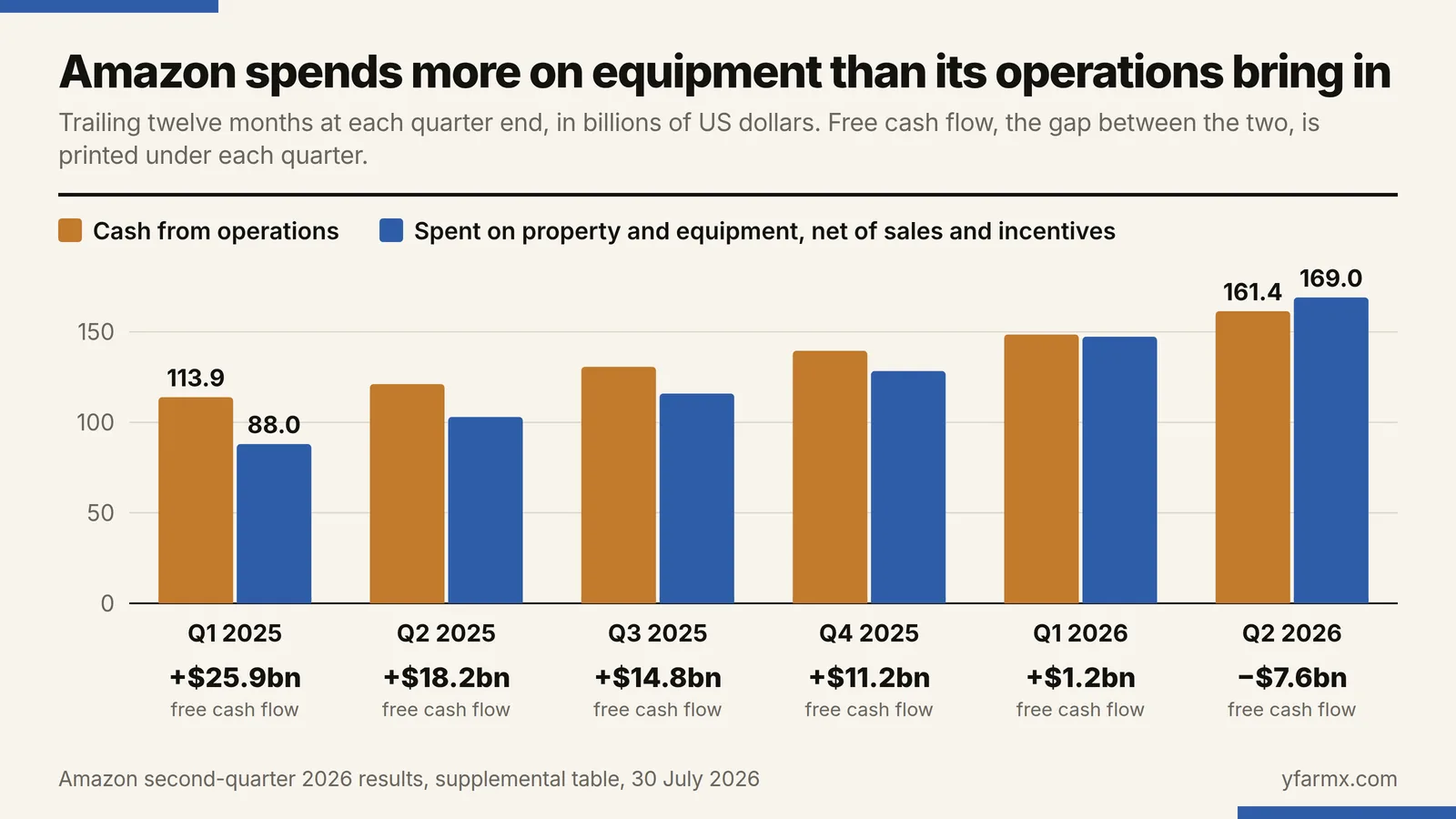
The spending has pushed Amazon’s free cash flow below zero. In the twelve months to 30 June 2026 its operations brought in $161.4 billion and it spent $169.0 billion on property and equipment, after proceeds from sales and incentives, leaving an outflow of $7.6 billion, its second-quarter results show. Amazon says the $66.1 billion rise in that spending over the year primarily reflects investment in artificial intelligence. Cash capital expenditure in the first half of 2026 was $96.3 billion, against $55.6 billion a year earlier, its quarterly filing shows.
| Twelve months to | Cash from operations | Spent on equipment, net | Free cash flow |
|---|---|---|---|
| 30 June 2025 | $121.1bn | $103.0bn | $18.2bn |
| 30 June 2026 | $161.4bn | $169.0bn | −$7.6bn |
Amazon’s long-term debt nearly doubled in six months
Amazon’s long-term debt rose from $68.8 billion at the end of 2025 to $133.0 billion on 30 June 2026, at face value, its quarterly filing shows. Amazon sold notes in dollars, euros, Swiss francs and Canadian dollars in the first half, including $37.0 billion of dollar notes in March, and agreed a $17.5 billion delayed-draw term loan in June, undrawn at 30 June.
Amazon has kept borrowing since. It sold $25.0 billion of dollar notes on 9 July and £4.25 billion of sterling notes on 14 September, about $5.63 billion at the Federal Reserve’s H.10 rate of $1.3250 to the pound for 25 September 2026. The vehicle the FT describes would carry its own debt, raised from outside investors.
| Date | What | Amount |
|---|---|---|
| 31 December 2025 | Long-term debt, face value | $68.8bn |
| 30 June 2026 | Long-term debt, face value | $133.0bn |
| 9 July 2026 | New dollar notes | $25.0bn |
| 14 September 2026 | New sterling notes | £4.25bn, about $5.63bn |
Who else rents AI hardware from investors?
xAI does: in January 2026 Apollo led a $3.5 billion financing for Valor Compute Infrastructure, a fund managed by Valor Equity Partners that acquires Nvidia GB200 chips and leases them to a subsidiary of Elon Musk’s xAI. The money supports the fund’s $5.4 billion acquisition and lease of computing equipment on a triple net lease, and Nvidia invested in the fund as an anchor limited partner, Apollo said. Musk put xAI’s Colossus 2 supercomputer at 550,000 Nvidia chips on 25 September.
Meta has used a venture for a whole campus. Funds managed by Blue Owl Capital own 80% of the venture developing Meta’s Hyperion data-centre campus in Louisiana, with Meta keeping 20% and receiving a one-time distribution of about $3 billion, Meta said on 21 October 2025. Meta’s leases on the campus start in 2029, it keeps the venture off its consolidated accounts, and its maximum exposure to loss was $46.03 billion on 30 June 2026, its quarterly filing shows.
| Deal | Who holds the asset | Size | What it holds |
|---|---|---|---|
| Amazon, reported talks, 2 October 2026 | A special-purpose vehicle | about $8bn | Grace Blackwell chips in Amazon’s US data centres |
| xAI, 7 January 2026 | Valor Compute Infrastructure | $5.4bn, with $3.5bn led by Apollo | Nvidia GB200 chips leased to an xAI subsidiary |
| Meta, 21 October 2025 | A venture 80% owned by Blue Owl funds | about $27bn of development costs | The Hyperion campus in Louisiana |
Chipmakers are putting money into their buyers too: AMD agreed on 22 July 2026 to make an equity investment of up to $5 billion in Anthropic, which will deploy up to 2 gigawatts of AMD chips.
AWS rents Grace Blackwell systems out by the hour
AWS sells time on Grace Blackwell hardware through its EC2 P6e UltraServers, built on Nvidia’s GB200 NVL72 and GB300 NVL72 systems, its product page shows. On 2 October 2026 AWS’s price list quoted $761.904 an hour, or $10.582 per accelerator, for a 72-GPU P6e-GB200 UltraServer reserved through EC2 Capacity Blocks in its Dallas Local Zone.
Questions people ask
- What is Amazon's reported chip sale and leaseback?
- Amazon has held talks with investors about moving about $8 billion of Nvidia Grace Blackwell chips into a special-purpose vehicle that would buy them and lease them back to Amazon, the Financial Times reported on 2 October 2026. The vehicle would raise money from outside investors by issuing debt, and Amazon plans to offer an equity stake of up to 10% in it. The chips sit in more than a dozen US data centres across five states.
- Why would Amazon sell chips it still uses?
- The FT said the aim is a stronger, more asset-light balance sheet. Amazon expects about $220 billion of capital spending in 2026, chief executive Andy Jassy told investors on 30 July, and its free cash flow for the twelve months to 30 June 2026 was an outflow of $7.6 billion, against an inflow of $18.2 billion a year earlier. Its long-term debt rose from $68.8 billion to $133.0 billion in the first half of 2026.
- Has anyone financed AI chips this way before?
- Similar structures exist. In January 2026 Apollo led a $3.5 billion financing for Valor Compute Infrastructure, a fund managed by Valor Equity Partners, to support its $5.4 billion acquisition and lease of computing equipment, including Nvidia GB200 chips, to a subsidiary of Elon Musk's xAI. That fund acquires chips to lease out, while Amazon would sell chips it is already installing. Meta uses a related structure for buildings: funds managed by Blue Owl Capital own 80% of the venture developing its Hyperion data-centre campus in Louisiana.
Sources
- Amazon: second quarter 2026 results, 30 July 2026sec.gov
- Amazon: Form 10-Q for the quarter ended 30 June 2026sec.gov
- Amazon: Form 8-K, sale of $25 billion of notes, 9 July 2026sec.gov
- Amazon: Form 8-K, sale of sterling notes, 14 September 2026sec.gov
- AWS: Amazon EC2 P6e UltraServers and P6 instancesaws.amazon.com
- AWS: Amazon EC2 Capacity Blocks for ML pricing, read 2 October 2026aws.amazon.com
- Amazon: Next-gen AI demands smarter cooling tech, 11 June 2025aboutamazon.com
- Apollo: Apollo backs $5.4 billion Valor and xAI data center compute infrastructure transaction, 7 January 2026ir.apollo.com
- Meta: Meta announces joint venture with funds managed by Blue Owl Capital to develop Hyperion data center, 21 October 2025investor.atmeta.com
- Meta: Form 10-Q for the quarter ended 30 June 2026sec.gov
- AMD: AMD and Anthropic announce strategic partnership, 22 July 2026newsroom.amd.com
- Elon Musk on X: Colossus 1 and Colossus 2 chip counts, 25 September 2026x.com
- Federal Reserve: H.10 foreign exchange rates, release of 28 September 2026federalreserve.gov
- KELO (Reuters): Amazon seeks to offload $8 billion of Nvidia chips to investors, FT reports, 2 October 2026kelo.com
- Fortune: Andy Jassy said Amazon will spend $220 billion this year, 30 July 2026fortune.com