The SEC's first transfer agent rewrite since the early 1980s would let a blockchain hold the share register
The SEC proposed a rewrite of its transfer agent rules on 1 September 2026. The amended definition of the master securityholder file would permit a blockchain to hold it, on one condition the proposal then asks the public how to enforce.
A transfer agent is the firm that keeps the list of who owns a company’s shares. It issues and cancels them, processes transfers, pays dividends and answers to the issuer for the accuracy of the register. The rules governing that work were written when the register was a book, and on 1 September 2026 the Securities and Exchange Commission proposed rewriting them.
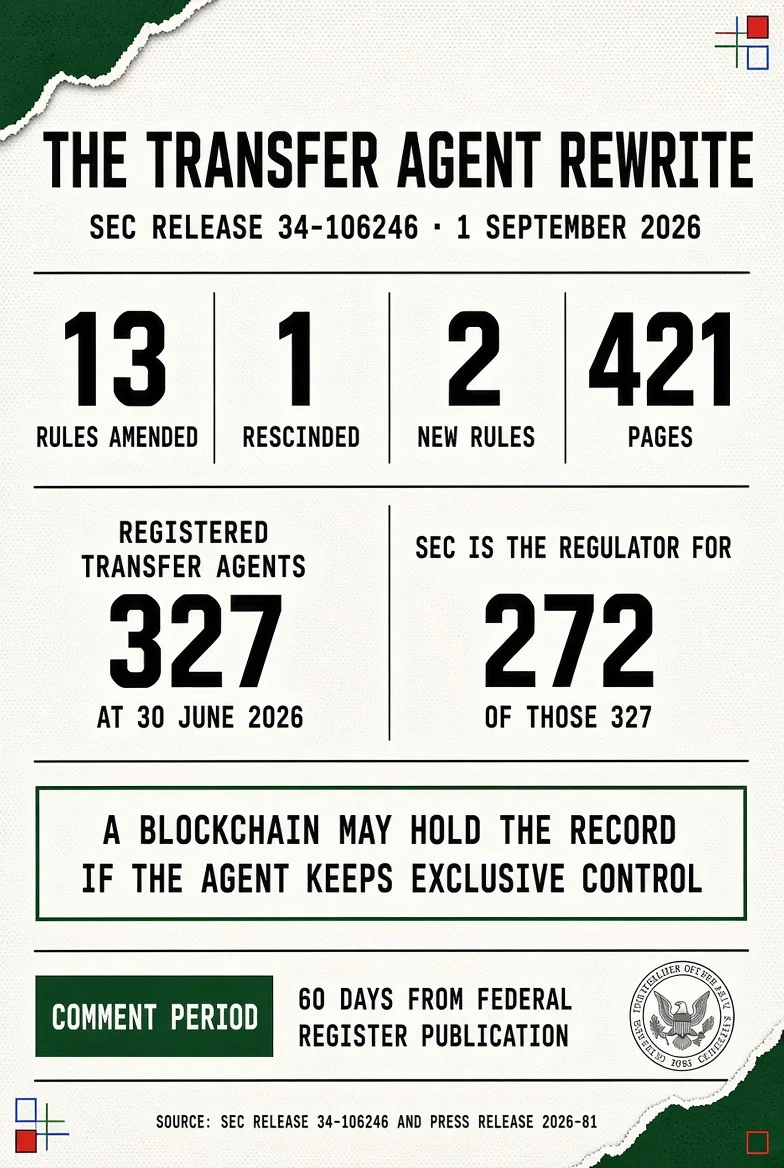
The proposal runs to 421 pages, carries Release No. 34-106246 and File No. S7-2026-30, and states its own starting point: the rules “have not been substantively updated since the first rules were adopted in the late 1970s and early 1980s”.
What the proposal changes
Thirteen existing rules and both registration forms are amended, one rule is rescinded, and two new rules are added.
| Action | Rules |
|---|---|
| Amended | 17ac2-1, 17ac2-2, 17ad-1, 17ad-2, 17ad-3, 17ad-6, 17ad-7, 17ad-9, 17ad-10, 17ad-11, 17ad-12, 17ad-13, 17ad-17, and Forms TA-1 and TA-2 |
| Rescinded | 17ad-4, the exemptions from turnaround, processing and recordkeeping |
| New | 17ad-30, written compliance policies; 17ad-31, restrictive legends |
Some of it is housekeeping. Registration would take effect 45 days after Form TA-1 is filed instead of 30. A transfer agent that finds its Form TA-2 was materially wrong would have 60 days to amend it. The threshold that triggers limits on taking new business rises from 75% to 95%. Turnaround standards get aligned to the current settlement cycle, and Rule 17ad-12 is rebuilt as a risk management rule requiring written policies, a separate bank account for issuer and securityholder funds, and a business continuity plan.
The part that will draw the comment letters is the definition of one record.
The master securityholder file, and the condition attached to it
The master securityholder file is the official list of who owns what. The proposal describes it as “the authoritative record of who owns an issuer’s securities”, synonymous with what state corporate law calls the stockholder ledger or stockholder register.
Today’s Rule 17ad-9(b) allows that record to be split across “multiple, but linked, automated files” only for uncertificated securities of registered investment companies. The proposed version drops that restriction, requires the record to be electronic, and hands the technology choice to the firm keeping it:
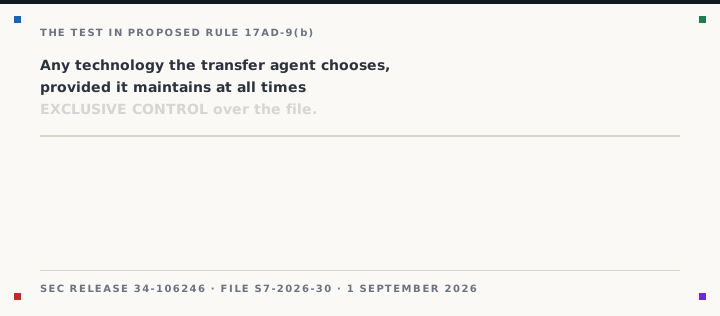
Master securityholder file is the official list of individual securityholder accounts maintained by a registered transfer agent. The master securityholder file shall be maintained in electronic form and may consist of multiple linked files or systems. The specific technology, systems, or files that compose the master securityholder file are within the transfer agent’s discretion, provided the transfer agent maintains at all times exclusive control over the master securityholder file.
The preamble then says what that permits, without leaving it to inference: “the amended definition would permit a transfer agent to utilize a blockchain or other distributed ledger technology as its master securityholder file, or a component thereof, but it would not mandate it.”
That is the sentence the tokenisation industry has been asking for since at least 2015. It arrives welded to five words: exclusive control at all times.
Where the condition bites
A ledger a transfer agent runs itself, or a permissioned chain whose validators it controls, meets the exclusive-control test without difficulty. A public permissionless chain is built so that no single party controls it, which is the property that makes it useful and the property the rule text does not accommodate.
The Commission does not resolve this. It asks. Question 84 of the release reads:
How should the Commission address situations where records exist solely on a blockchain or distributed ledger that is not exclusively controlled by the transfer agent? Should the Commission establish specific requirements for ensuring the integrity, accessibility, and immutability of such records for compliance purposes?
The question immediately before it goes at the same problem from the practical end, asking whether the proposed recordkeeping rules let a firm tie on-chain records such as a wallet address and a quantity held to off-chain records such as a holder’s name and address, “so that the transfer of a tokenized security on a blockchain results in a corresponding transfer of the security on the master securityholder file”.
So the proposal opens the door to on-chain registers and then asks the industry to explain how the register stays authoritative when the ledger underneath it belongs to nobody. Anyone with a view has 60 days from Federal Register publication to file it, and as of today the release still carries a placeholder where that publication date will go.
The Commission starts counting tokenised securities
Form TA-2 is the annual report every registered transfer agent files. The proposal adds a question to it, numbered 6(b), which asks for the number of issues serviced by tokenisation model, split into issuer-sponsored tokenised securities and third-party-sponsored ones, broken down by nine security types from small-cap corporate equity to municipal debt.
The split follows the staff statement on tokenised securities published on 28 January 2026, which drew the same line on the basis that the risks to investors differ between an issuer tokenising its own security and a third party wrapping someone else’s. Once the question is on the form, the Commission has an annual count of how much of the tokenisation market actually touches a registered transfer agent. There is no such count today.
Elsewhere in the drafting, the smaller change tells the same story: the contact details a transfer agent may hold for a securityholder would expressly include “an email address, a blockchain wallet address, or another form of communication”.
Eleven years between a question and a proposal
The Commission asked about this once before. Release 34-76743, published on 31 December 2015, was an advance notice of proposed rulemaking and concept release on transfer agent regulation, and the comment period on it closed on 14 April 2016. Nothing followed for a decade.
The item stayed on the regulatory agenda throughout, under RIN 3235-AL55. The version published in the Federal Register on 14 August 2026, two and a half weeks before the proposal landed, describes the Division of Trading and Markets as “considering recommending that the Commission propose updates and refinements to modernize the Commission’s existing regulatory regime for transfer agents, including rules relating to crypto assets and the use of distributed ledger technology by transfer agents”, and puts the proposal in October 2026. It came a month early.
Between the concept release and the proposal, the Commission’s crypto task force asked the industry the same question directly. Commissioner Hester M. Peirce’s request for information of 21 February 2025 included one on this: “How do the programmability and composability properties of blockchain technology… affect the role of a transfer agent? Are there provisions in the transfer agent rules that prevent transfer agents from using blockchain technology for this purpose…?”
The 421-page release never mentions the task force, and it frames itself as the successor to the 2015 concept release rather than as an answer to anyone.
Who this lands on
There were an estimated 327 registered transfer agents at 30 June 2026, and the Commission is the appropriate regulatory agency for 272 of them, roughly 83%. Every one of them would file the new Form TA-2 question, write the new compliance policies under Rule 17ad-30, and operate the restrictive-legend requirements of Rule 17ad-31, which would oblige a transfer agent to refrain from facilitating unregistered transactions without a reasonable basis to believe the transaction does not violate section 5(a) of the Securities Act of 1933.
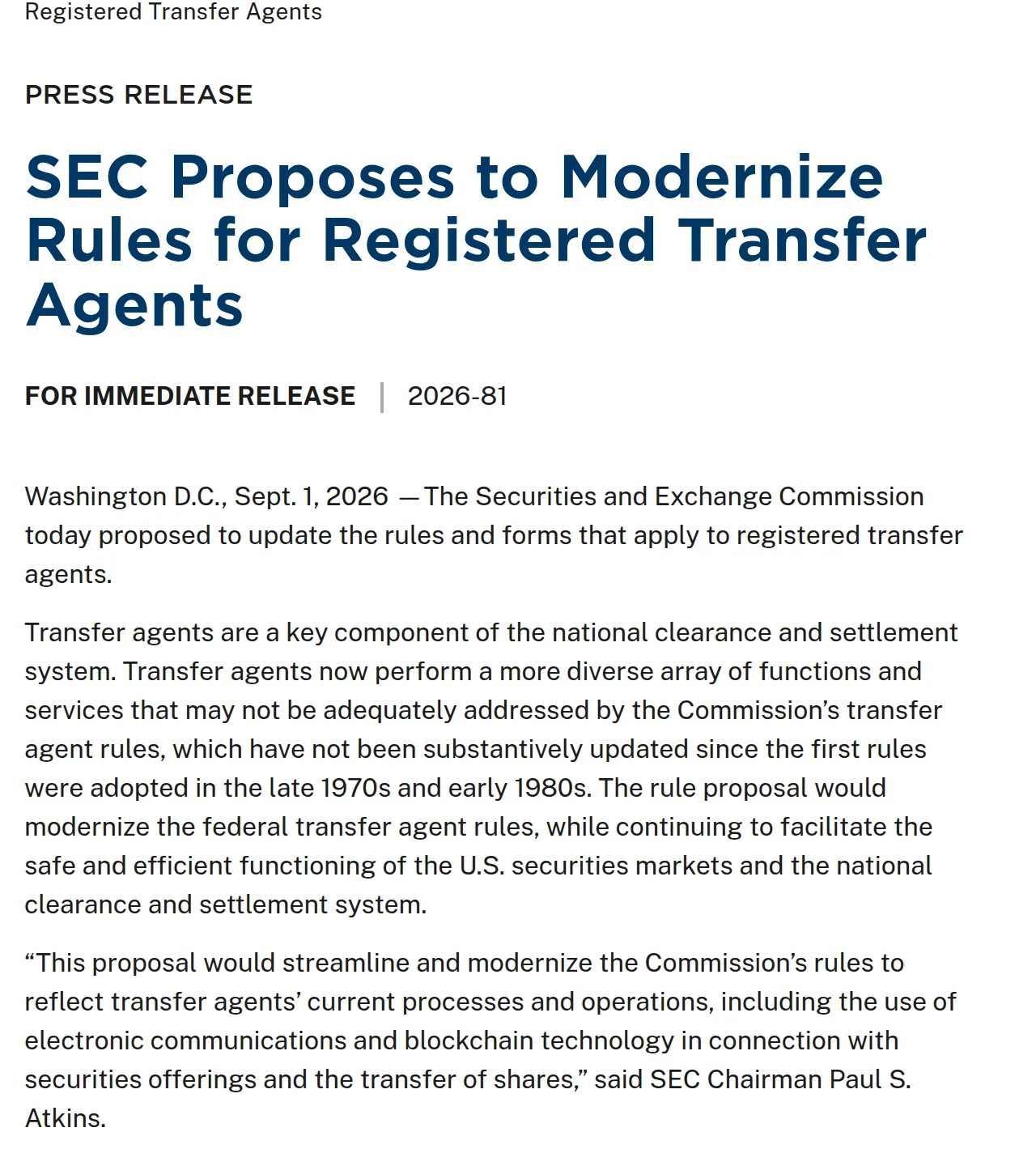
Chairman Paul S. Atkins put the purpose in one sentence: “This proposal would streamline and modernize the Commission’s rules to reflect transfer agents’ current processes and operations, including the use of electronic communications and blockchain technology in connection with securities offerings and the transfer of shares.”
Jamie Selway, director of the Division of Trading and Markets, added the framing: “As technology changes and the competitive marketplace evolves, good government requires revisiting legacy rules and regulations.”
A permission written as a condition
Read as a whole, the proposal does not bless blockchain recordkeeping and does not block it. It removes the format requirements that made on-chain registers awkward, keeps one requirement that public chains cannot satisfy as written, and asks 175 numbered questions, several of them aimed squarely at that requirement.
Whoever answers Question 84 persuasively will shape what a tokenised share register is allowed to look like in the United States. Our explainer on tokenised real-world assets covers what is already being issued on-chain while that is decided, and our page on SEC regulation of crypto tracks the rest of the Commission’s crypto rulemaking.
Sources
- SEC Proposes to Modernize Rules for Registered Transfer Agents (press release 2026-81, 1 September 2026)sec.gov
- Transfer Agent Rules, proposing release 34-106246, File No. S7-2026-30 (PDF, 421 pages)sec.gov
- Fact sheet: proposed transfer agent rule modernization (PDF)sec.gov
- SEC rulemaking activity page for File No. S7-2026-30sec.gov
- Transfer Agent Regulations, concept release 34-76743 (December 2015, PDF)sec.gov
- Federal Register record of the 2015 concept releasefederalregister.gov
- SEC regulatory agenda, RIN 3235-AL55, Federal Register 14 August 2026 (govinfo PDF)govinfo.gov
- Staff statement on tokenized securities, 28 January 2026sec.gov
- Commissioner Hester M. Peirce, request for information from the Crypto Task Force, 21 February 2025sec.gov