The SEC cancelled its first crypto rulemaking vote with a day's notice
The SEC pulled its 14 August open meeting the day before, cancelling a vote on proposing Regulation Crypto Assets. The tokenisation innovation exemption was reported delayed again on the same day.
Listen to this articleListen
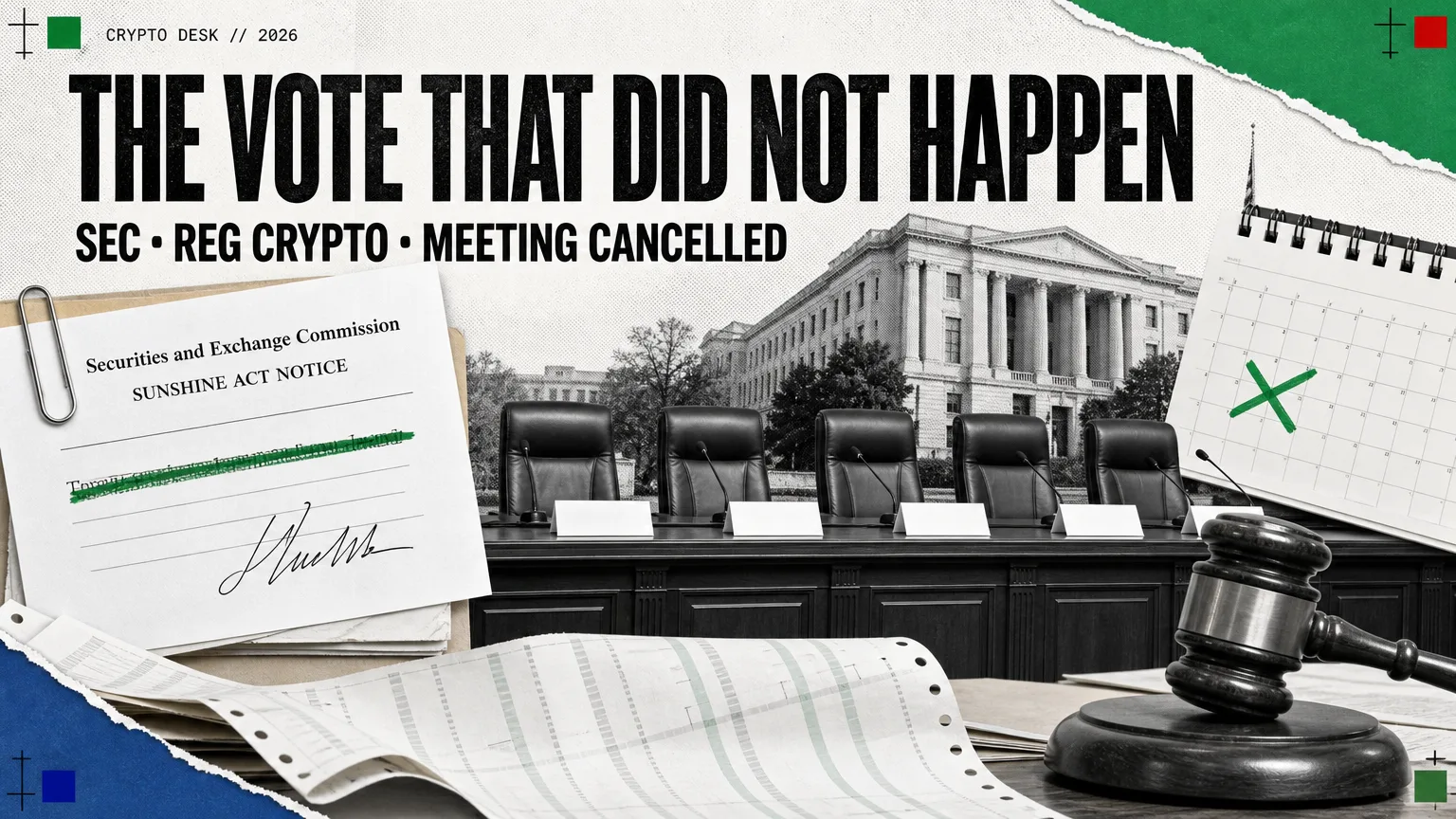
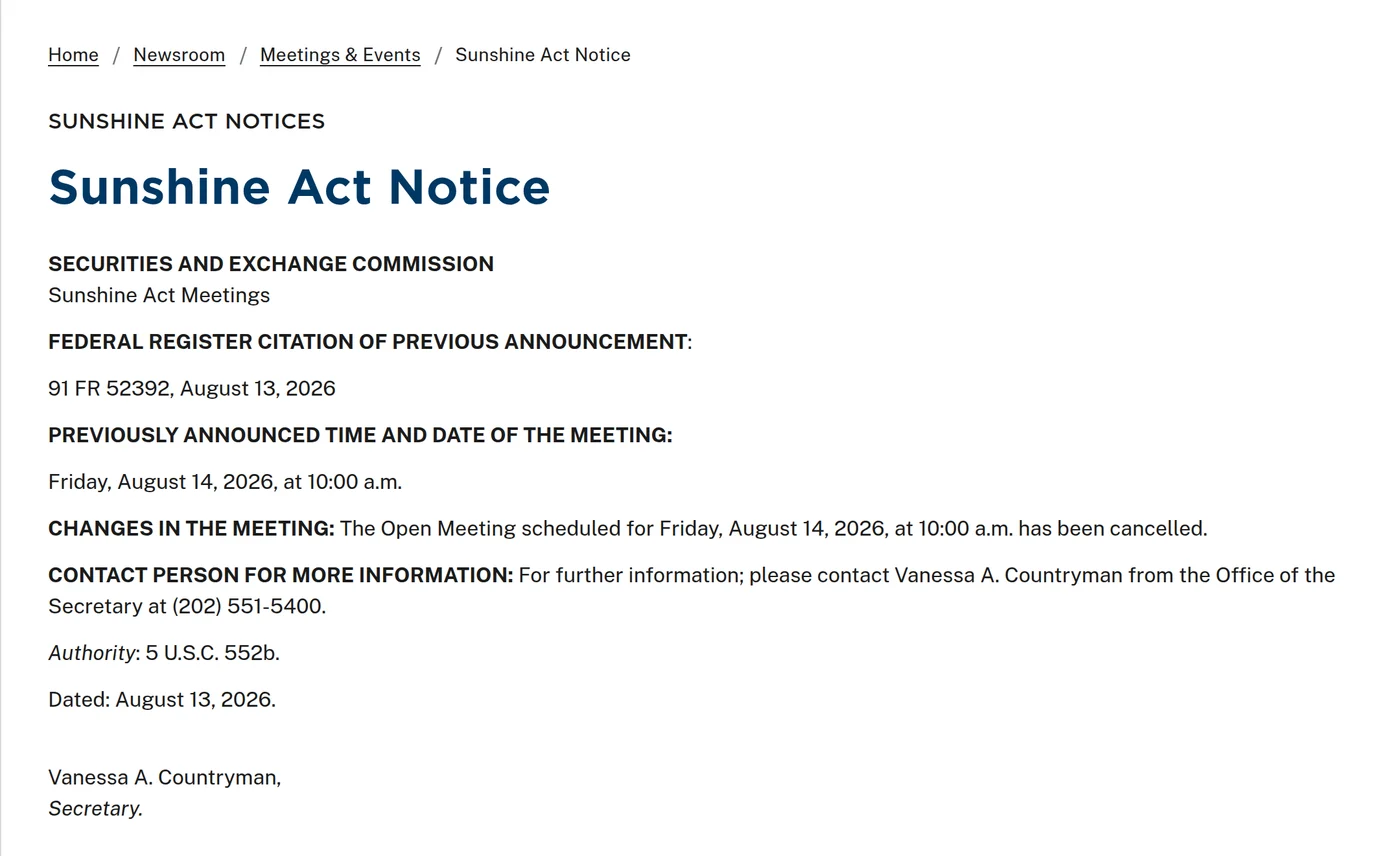
The Securities and Exchange Commission cancelled its open meeting of Friday 14 August the day before it was due to sit. The Sunshine Act notice, signed by commission secretary Vanessa A. Countryman on 13 August, records the fact and nothing else: under the heading “changes in the meeting”, it states that the open meeting scheduled for Friday, August 14, 2026, at 10:00 a.m. has been cancelled. It cites the previous announcement at 91 FR 52392, gives no reason and sets no new date.
What the commission was to consider was its first crypto-specific rulemaking. Regulation Crypto Assets, referred to around Washington as Reg Crypto, is a tailored offering regime for digital assets, and a vote would have been the first time the agency wrote rules for the asset class rather than applying the 1933 and 1934 Acts to it. Commission staff attributed the cancellation to a scheduling problem when asked; the published record says only that it will not happen.
What would the vote actually have done?
Opened a proposal to comment. A commission vote at this stage publishes a draft rule in the Federal Register and starts a comment period, usually of 30 to 90 days, after which the agency reads the responses and votes again on whether to adopt. Nothing would have bound anyone on 14 August. The step is procedural, and that is exactly why calling it off reads as significant: the cost of proposing a rule is low, so pulling the proposal suggests the disagreement is about whether to start at all.
The timing around it was already unusual. The meeting was noticed on Monday 10 August, four days ahead rather than the week the commission normally gives, which put it in the calendar immediately after the Senate left for a five-week recess without advancing the CLARITY Act. An agency moving quickly to fill a legislative gap, then stopping, is a different picture from an agency that never scheduled the vote.
The other delay, on the same day
A second measure slipped in parallel. The innovation exemption, which would let tokenised securities be issued and traded on blockchain infrastructure under relief from existing rules, was reported “further delayed” on 13 August by the journalist Eleanor Terrett, citing a source familiar with the deliberations. The reason in her account is sequencing: the tokenisation section of the CLARITY Act has been through long negotiation, and an exemption granted now could unsettle the compromise. The Securities Industry and Financial Markets Association, which speaks for the incumbent broker-dealers, has separately pushed back on the exemption’s scope.
There is also a question about the commission’s own authority. Exemptive relief on this scale needs a legal basis and an economic analysis that will survive review, which is a slower problem than a diary clash. For the shape of the regime and the $75m threshold at its centre, see our reference page on Regulation Crypto and the exemption.
The market the rule would govern is already large
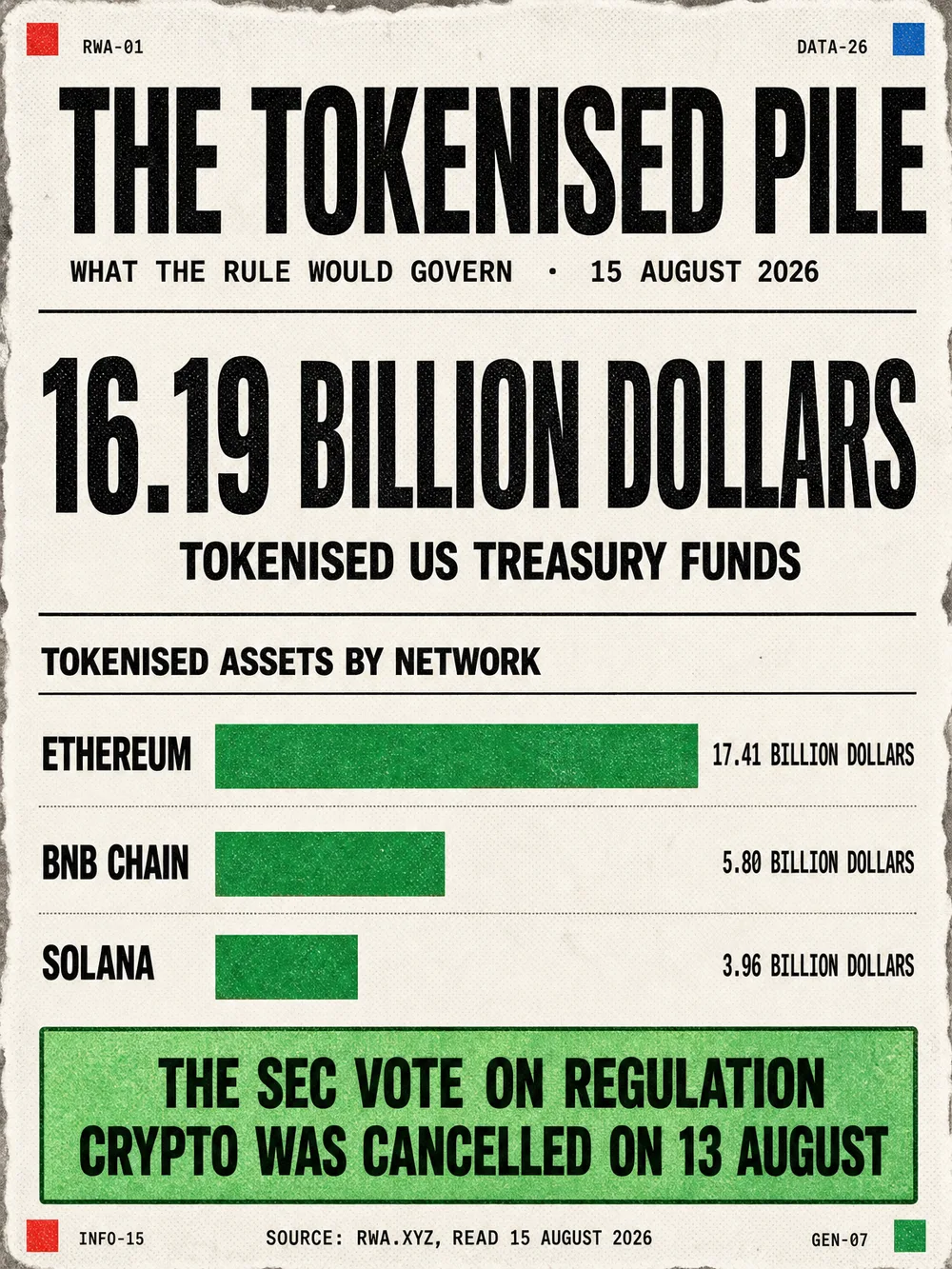
Tokenised US Treasury funds held $16.19bn on 15 August, spread across 87 products and 65,472 holding addresses, growing 1.53 per cent over the preceding thirty days. The largest funds are not crypto-native experiments. They are cash-management vehicles run by the biggest names in asset management, issued on public chains.
| Fund | Platform or issuer | Value |
|---|---|---|
| Circle USYC | Circle | $3.0bn |
| BlackRock BUIDL | Securitize | $2.71bn |
| Ondo US Dollar Yield | Ondo | $2.15bn |
| Franklin Templeton iBENJI | Franklin Templeton | $1.73bn |
| Janus Henderson JTRSY | Centrifuge | $882.9m |
Across all tokenised real-world assets, not just Treasuries, the distribution by chain is still lopsided.
Solana carries the third-largest book and the largest holder count of the three, with 338,792 addresses against Ethereum’s 262,247, which says something about who is using each chain rather than how much sits on it. Ethereum still holds more tokenised value than the next two combined.
Where this leaves the queue
Three things were meant to give the US a settled answer this year: a statute from Congress, a rule from the SEC, and exemptive relief to let the tokenised market operate while the first two arrived. The statute is in recess until September. The rule was pulled the day before the vote. The relief is delayed by a fight over its scope and a question about the authority to grant it.
Meanwhile $16.19bn of tokenised Treasuries continues to trade on infrastructure the rules do not yet describe, run by managers who are already regulated everywhere else. That is the position the commission was scheduled to start fixing on Friday morning.
Sources
- Eleanor Terrett on X, the innovation exemption 'further delayed' (13 August 2026)x.com
- SEC, Sunshine Act Notice: cancellation of the open meeting of 14 August 2026, signed by Vanessa A. Countryman, Secretary (13 August 2026)sec.gov
- Federal Register, 'Sunshine Act Meetings' notice for the SEC open meeting of 14 August 2026 (published 13 August 2026)federalregister.gov
- SEC, Meetings and eventssec.gov
- RWA.xyz, tokenised US Treasuries dashboard (read 15 August 2026)app.rwa.xyz
- RWA.xyz, tokenised real-world assets by network (read 15 August 2026)app.rwa.xyz
- Securities Industry and Financial Markets Association (SIFMA), comment letters and policy positionssifma.org