Ripple brings Stripe-owned Privy wallets to the XRP Ledger
Ripple and Stripe-owned Privy announced programmable XRPL wallets for fintechs and AI agents, supporting XRP, RLUSD, transaction signing and key export.
Listen to this articleListen
Ripple and Stripe-owned Privy have announced programmable wallet support for the XRP Ledger, giving developers another way to put blockchain payments inside apps and AI-agent services.
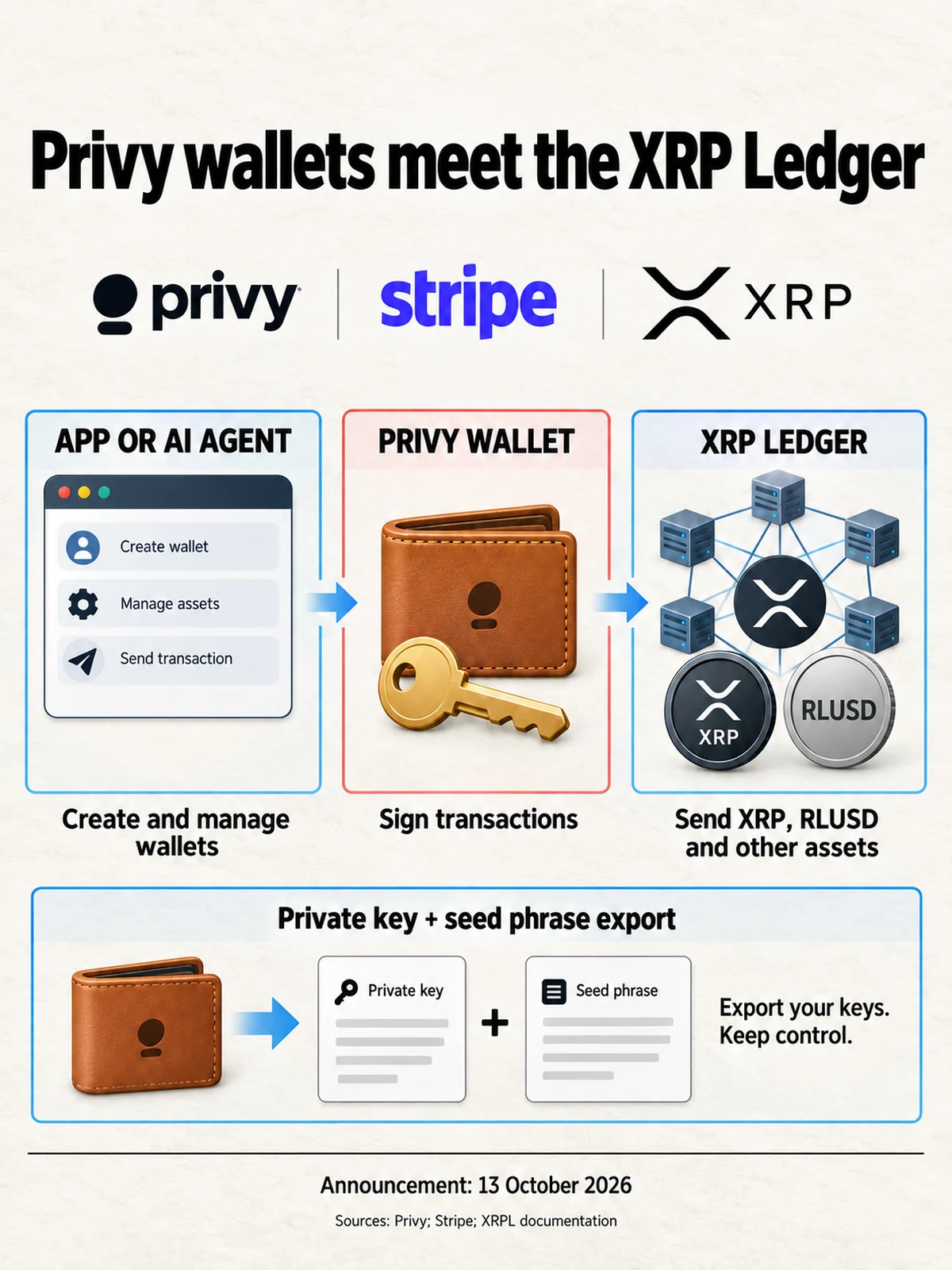
Privy’s announcement on 13 October covers creating wallets, managing them through software and signing transactions involving XRP, RLUSD and other XRPL assets. Embedded wallets can sit inside a fintech app, while server-side wallets can hold funds for an automated service.
Developers can create wallets and sign payments
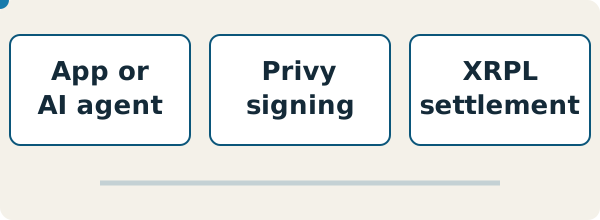
Privy’s XRPL documentation provides a transaction-signing route that applications can use to submit ledger payments. An app prepares the transaction, passes it to the wallet for signing and submits the resulting signed transaction to the XRP Ledger.
The developer documentation includes wallet creation and signing. It describes both a transaction-specific signing method and a lower-level route for developers controlling how a transaction is assembled.
That wallet layer handles the act of authorising a transaction. The XRP Ledger remains the network on which the payment is submitted and settled. For app users, the intended benefit is a payment flow integrated into the product they are already using.

The integration also targets AI-agent payments
Server-side wallets give AI agents a way to hold and transact with digital funds. Privy’s announcement specifically includes x402 payments, a mechanism for paying for an online request, among the XRPL integration’s intended uses.
For example, a service carrying out a task could encounter paid data or another paid service, authorise a transaction through its wallet and continue its work. The spending authority still comes from the wallet configuration and the application controlling it.
Stripe has already placed Privy in this market. In its 7 May announcement with AWS, Stripe described Privy as a Stripe company supplying wallet infrastructure for Amazon Bedrock AgentCore payments. That earlier partnership covered access to paid online resources and other agents.
The XRPL announcement adds another blockchain payment route to that wider agent-wallet business.
Wallet owners can export their keys
Privy’s XRPL wallets support private-key and seed-phrase export, according to the documentation. These provide portability for users who want to recover or move the keys controlling their wallet.
The documentation distinguishes its exported key formats from XRPL’s native family-seed format. The key format is relevant when a holder moves between wallet products: the receiving software must support the format being exported.
Privy Home, introduced in August 2025, provides a separate interface for managing and recovering embedded wallets across supported apps. It shows the broader product approach behind the new integration: familiar app access alongside controls for the assets a wallet holds.
Transaction controls will shape agent spending
The current XRPL documentation lists policies for transaction types, payment destinations and amounts. An application can use these constraints to define which signed actions are permitted.
Privy’s launch announcement says the companies will continue deepening the integration, including policy controls and gas sponsorship. Those plans extend the payment experience over time. For fintechs and agent developers, the immediate building blocks are wallet creation, transaction signing, supported XRPL assets and key portability.