The SEC proposed its first crypto rulebook five days after cancelling the vote
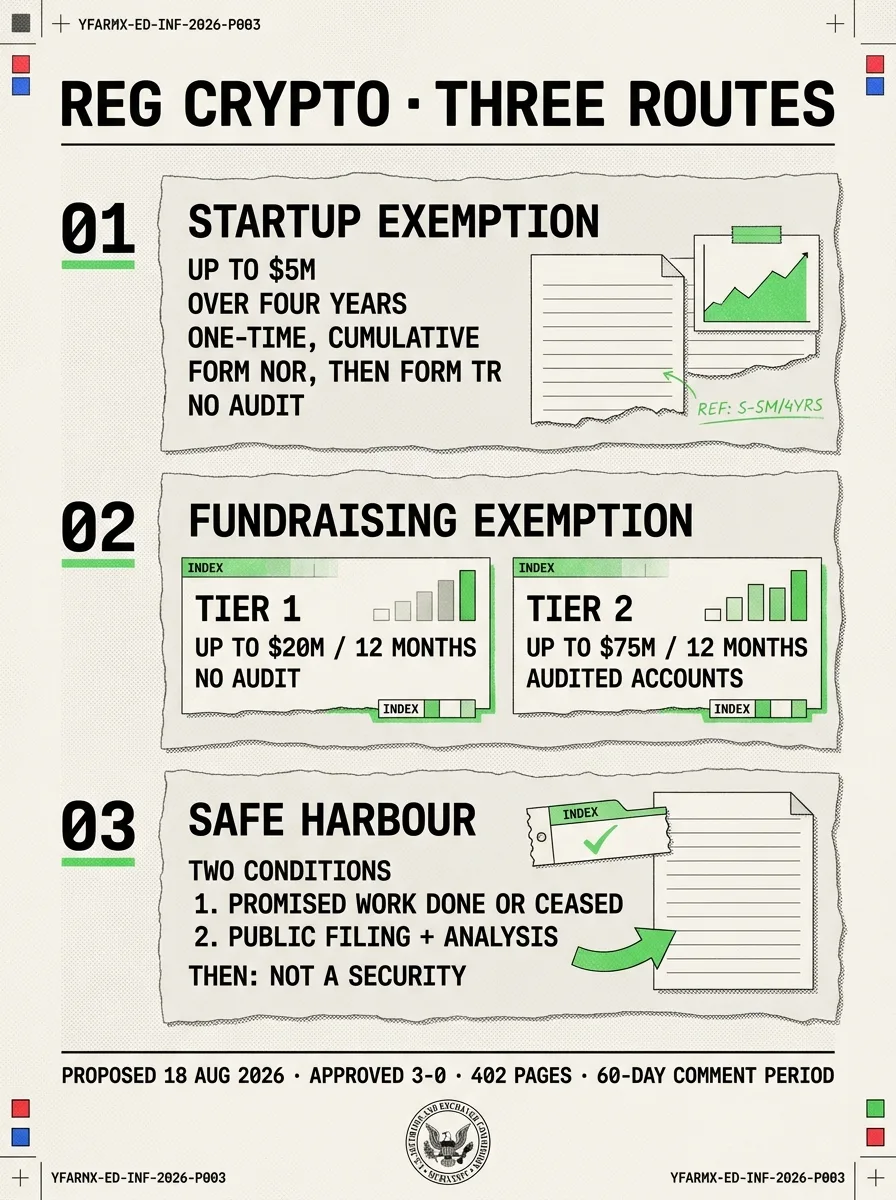
Regulation Crypto Assets runs to 402 pages and was approved three votes to nil on 18 August by the only three commissioners the SEC currently has, with no open meeting on the calendar.
Listen to this articleListen
The Securities and Exchange Commission proposed Regulation Crypto Assets on 18 August, five days after cancelling the open meeting it had called to vote on the same item. No replacement meeting was ever scheduled. The commission’s own vote record shows the proposal approved on 18 August by Paul Atkins, Hester Peirce and Mark Uyeda, three votes to nil, which is every commissioner on the agency’s published roster. The commission is authorised to seat five.
The document runs to 402 pages, carries release numbers 33-11434 and 34-106150 under File No. S7-2026-27, and is signed “By the Commission” and dated 18 August by secretary Vanessa A. Countryman. She is the same officer who signed the cancellation notice five days earlier. That notice gave no reason for calling the meeting off, and none has been published since.
Two exemptions, and the $75m everyone quoted is half of one
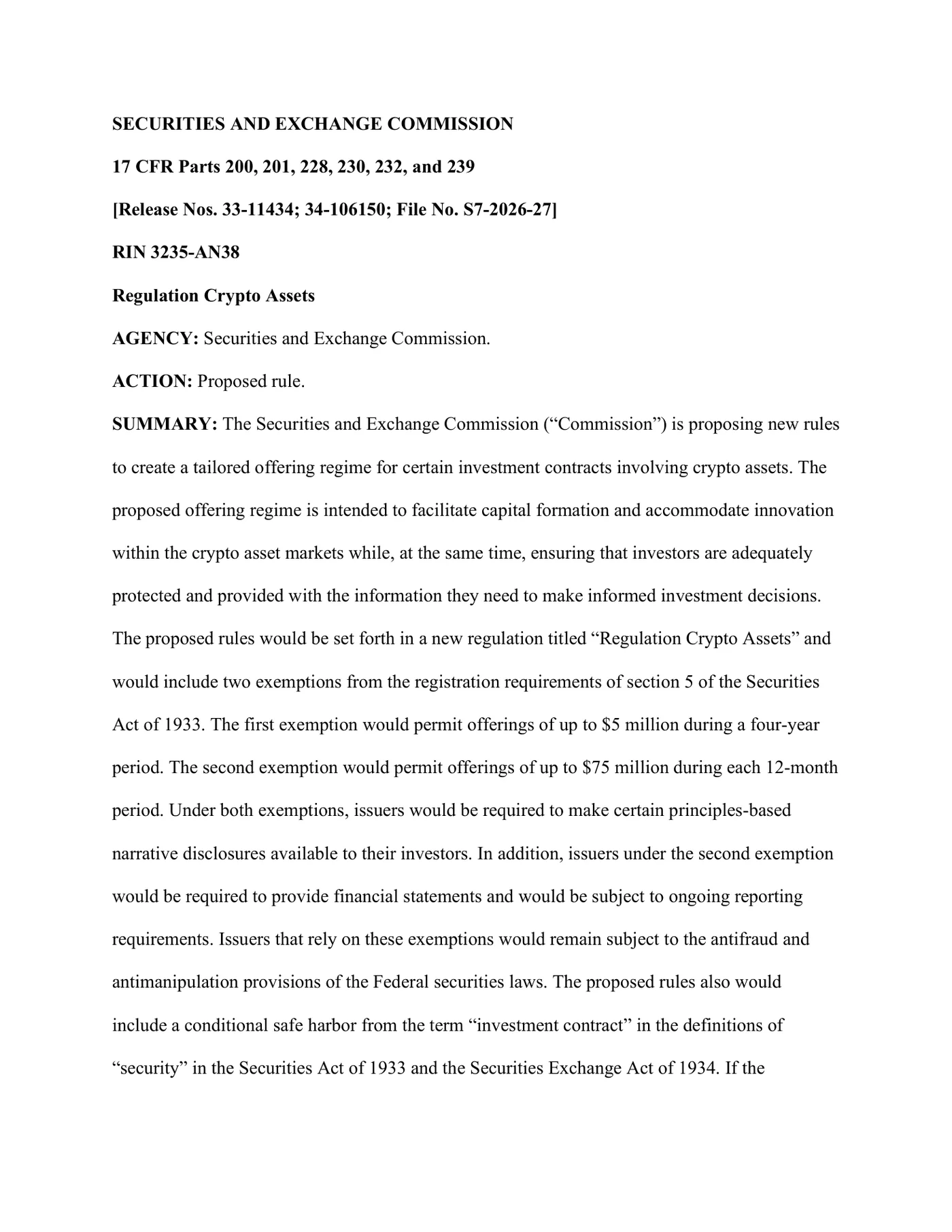
The proposal contains two exemptions from Securities Act registration, plus a safe harbour. Most coverage has described a single $75 million exemption. That figure is the ceiling of the upper tier of the second one.
The first is a startup exemption: a one-time, non-exclusive route to sell up to $5 million of what the rule calls “covered investment contracts”, over a period of up to four years. The cap is cumulative, so the offering in front of you plus the gross proceeds of every prior covered transaction has to stay under the $5m together. An issuer files a notice of reliance on a new Form NOR before it sells anything, then a transition report on Form TR no later than four years after that notice. Signing the NOR means certifying an intention to actually carry out the promised work inside those four years.
The second is a fundraising exemption modelled in part on Regulation A, and it is tiered. Tier 1 allows up to $20 million in any twelve-month period. Tier 2 allows up to $75 million. Both require publicly filed offering materials and ongoing reporting. Only Tier 2 requires audited financial statements, which is the difference most small issuers will care about, and it is the half that the reported figure leaves out.
Both routes are conditioned on the issuer and its associated people not being disqualified as bad actors under proposed Rule 104. The offering limits adjust for inflation automatically under proposed Rule 102, without a fresh notice-and-comment round each time.
How a token stops being a security
The safe harbour has the longest reach of anything in the document, and it turns on two conditions.
The issuer must have completed or permanently ceased all the essential managerial efforts it represented or promised it would take under the investment contract. It must then file publicly, certifying that the conditions are satisfied, with an analysis supporting the certification. The operative rule names the instrument: proposed 17 CFR 228.400(b) requires the issuer to file a transition report on Form TR.
Meet both and the proposal deems the covered investment contract to have ceased to exist, and deems the crypto asset itself not to constitute, represent or be subject to an investment contract for the purposes of the definition of a security in the Securities Act 1933 and the Securities Exchange Act 1934.
Atkins set out the logic in the press release: “In line with the Commission’s earlier interpretative guidance, this proposal would also allow for a safe harbor once an issuer has completed or permanently ceased all essential managerial efforts that it represented or promised it would take under an investment contract.”
Anyone relying on either exemption stays subject to the antifraud and antimanipulation provisions throughout. The proposal builds on the commission’s March interpretive release, 33-11412 of 17 March 2026, on how the securities laws apply to crypto assets in the first place. For the shape of the regime and the threshold at its centre, see our reference page on Regulation Crypto and the $75m exemption.
The commissioners on their own agency
All three published statements dated 18 August.
Peirce called hers “Filling the Regulatory Tank: Regulation Crypto Assets Proposing Release”, and used it to ask for responses:
This proposal is one step on a long road toward a clear, sensible, enforceable regulatory framework for crypto. The Commission cannot walk that road alone, so please send us your thoughts during the sixty-day comment period.
She also conceded the limits of the drafting: “The exemptions and safe harbor we are proposing today will not fit every model, and we want to hear your feedback.”
Uyeda was harder on the agency he sits on:
The historical treatment of crypto by the Commission is regrettable. Even when a crypto asset was properly treated as a security, prospective issuers were provided no realistic way to comply with the Commission’s registration process. Persons who sought to register their crypto offerings were often given a bureaucratic runaround with no resolution in sight.
Those who tried to engage in good faith, he added, “found themselves facing subpoenas and litigation rather than answers”.
Atkins described the old approach as forcing a “square peg in a round hole”, then went further on the record behind it:
In fact, in the past, it actively undermined capital formation with regard to this asset class in the form of regulation by enforcement and disingenuous offers to “come in and register.”
He also made it clear he does not think a rule is enough on its own: “legislation remains indispensable to enacting ‘future-proofed’ rules of the road that are durable enough to protect the work we are undertaking today from being unwound by a future rogue regulator.”
Nothing is in force and no date exists
This is a proposal, and it binds nobody. The comment period runs sixty days from publication in the Federal Register, and as of 19 August the release still carried bracketed placeholders where that publication date belongs, so the deadline has not started to exist. Every effective-date reference in the document reads “[INSERT EFFECTIVE DATE OF FINAL RULE, IF ADOPTED]”. Once comments close the commission reads them and votes again on whether to adopt anything.
The plumbing underneath is specific enough to be worth watching. The rules would sit in a new part 228 of 17 CFR and create six new EDGAR forms, 1-CRYPTO, 1-KC, 1-SC, 1-UC, TR and NOR, codified at 17 CFR 239.600 through 605. A new definition of “qualified purchaser” would preempt state registration and qualification requirements for offerings made under the regulation and for certain secondary trading, which lifts a layer of state regulators out of the path.
What the cancelled meeting turned out to mean
Our reading on 15 August was that pulling a proposal the day before the vote pointed to disagreement about whether to start at all, on the grounds that proposing a rule is cheap. The 3-0 record says otherwise. Whatever stopped the 14 August meeting, it was not a divided commission, and whatever it was had cleared within five days of the notice going out.
The commission has still not said why the meeting was called off, or why the vote then happened away from the calendar. It does not publish the mechanism it uses to approve items outside an open meeting, so the accurate description is the narrow one: three commissioners approved a 402-page proposal on 18 August without sitting in public to do it.
Sources
- SEC, press release 2026-76: SEC Proposes New Regulation Crypto Assets (18 August 2026)sec.gov
- SEC, Regulation Crypto Assets, proposing release Nos. 33-11434 and 34-106150, File No. S7-2026-27 (402pp, PDF)sec.gov
- SEC, Fact Sheet: Regulation Crypto Assets (PDF)sec.gov
- SEC, rulemaking index for File No. S7-2026-27sec.gov
- Chairman Paul S. Atkins, 'Statement on Regulation Crypto Assets: Fit-for-Purpose Exemptions for Crypto Market Innovation' (18 August 2026)sec.gov
- Commissioner Hester M. Peirce, 'Filling the Regulatory Tank: Regulation Crypto Assets Proposing Release' (18 August 2026)sec.gov
- Commissioner Mark T. Uyeda, statement on Regulation Crypto Assets (18 August 2026)sec.gov
- SEC, official commission vote record for August 2026 (XML)sec.gov
- SEC, Sunshine Act notice cancelling the open meeting of 14 August 2026sec.gov
- SEC, open meeting agenda for 14 August 2026, item 1: Regulation Crypto Assetssec.gov
- SEC, current commissionerssec.gov