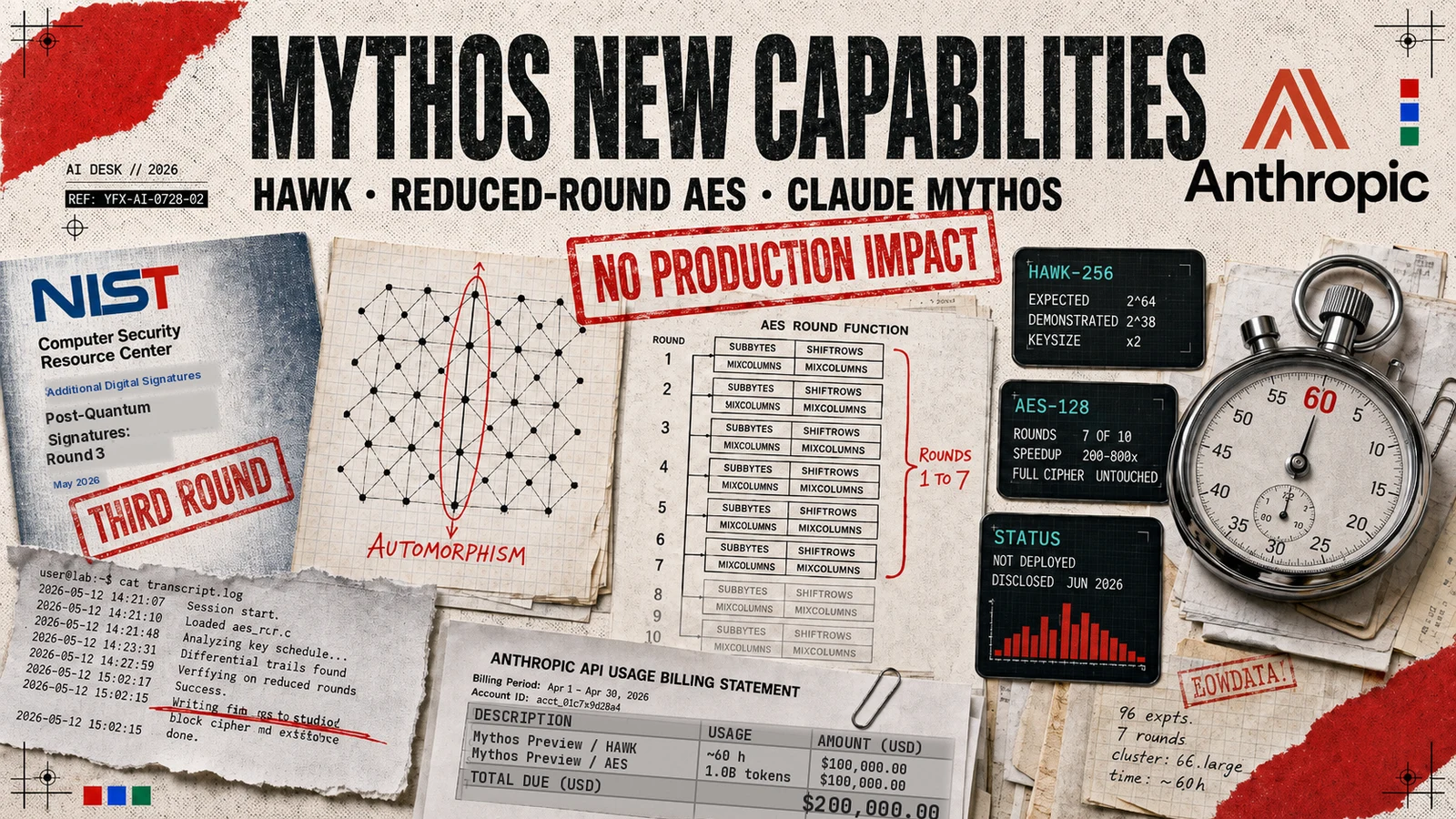
Claude traces NIST curve seeds to a 1990s generator
YFarmX reproduced all five recovered NIST prime-curve seeds against OpenSSL. The interesting security question concerns how candidates and base points were selected.
Listen to this articleListen
Anthropic says an internal Claude research model recovered the origin of five NIST elliptic-curve seeds in under half an hour. The 16 October account traces them to a timestamp-seeded C-library generator used in 1997 and 1998.
YFarmX reproduced all five published values against OpenSSL’s curve constants. The security angle concerns a separate step: the choice of a particular curve from the candidates produced by that generator. Anthropic itself identifies skipped candidates and unresolved base-point choices.
Public curve seeds define shared mathematics
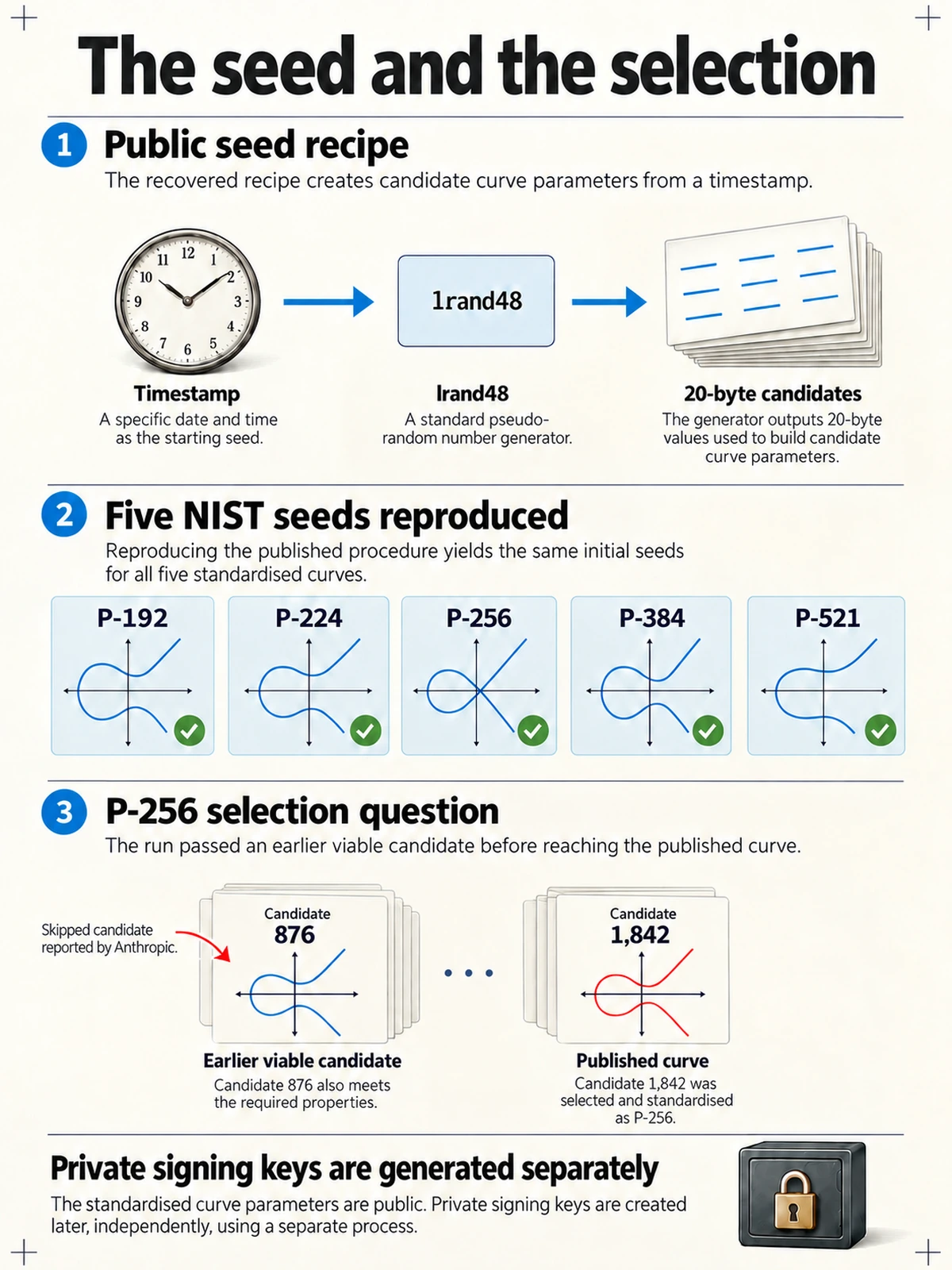
A curve seed helps derive mathematical parameters shared by everyone using that curve. A signing key belongs to an individual user; a public curve parameter belongs to the common specification against which signatures are checked.
Filippo Valsorda’s seed-recovery bounty documented the historical concern: the published constants could be checked, but their starting values had arrived without a transparent origin. A reproducible derivation helps narrow the choices available to whoever selected those parameters.
A clock is predictable. Predictability is compatible with this public-parameter task because everybody must be able to see and check the result. Secret signing keys require their own secure generation and handling. Recovering a standard’s public seed explains the standard’s construction.
All five published values reproduce exactly
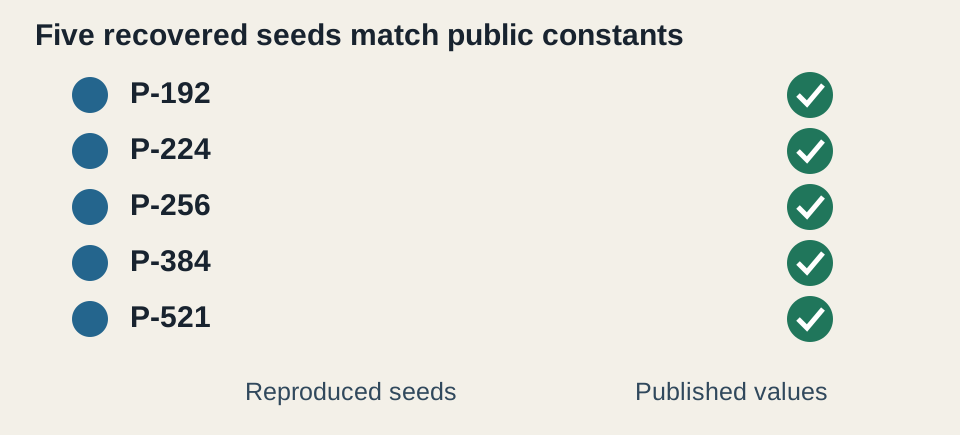
The recovered recipe starts lrand48 from a Unix timestamp and draws successive 20-byte candidates. Applying the published timestamps and candidate numbers produced exact matches to the independently published constants in OpenSSL.
| Curve | Generation date, UTC | Candidate | YFarmX check |
|---|---|---|---|
| P-192 | 18 May 1997 | 139 | Exact match |
| P-224 | 3 April 1998 | 7,026 | Exact match |
| P-256 | 16 August 1997 | 1,842 | Exact match |
| P-384 | 30 August 1997 | 2,688 | Exact match |
| P-521 | 8 August 1997 | 1,136 | Exact match |
P-256’s run passed an earlier viable candidate
Anthropic reports that candidate 876 in P-256’s run also produces a prime-order curve with the required size and parameter construction, while the standard uses candidate 1,842. The authors identify further skipped candidates in other runs and leave the later NIST prime-curve base-point selections open.
Those observations give the follow-up investigation a specific target: recover the acceptance criteria and original implementation. Knowing how a sequence was generated is one kind of evidence; knowing why a designer selected an entry from that sequence is another.
The seed reproduction establishes the first result. Anthropic interprets the small number of skipped candidates as supporting confidence in the curves, while recording the selection questions for further historical investigation.
Claude also reduced costs for quantum arithmetic
Separate research uses Claude to design cheaper reversible circuits, including arithmetic relevant to future cryptanalysis. Anthropic’s quantum-circuit account identifies Claude Mythos 5 for that work; the seed investigation describes an internal research model.
One elliptic-curve point-addition design uses 17 times fewer gates with 12% more qubits than the earlier smallest-qubit design, according to the researchers. That comparison concerns an arithmetic component. A complete attack also needs the surrounding algorithm, error correction and working hardware.
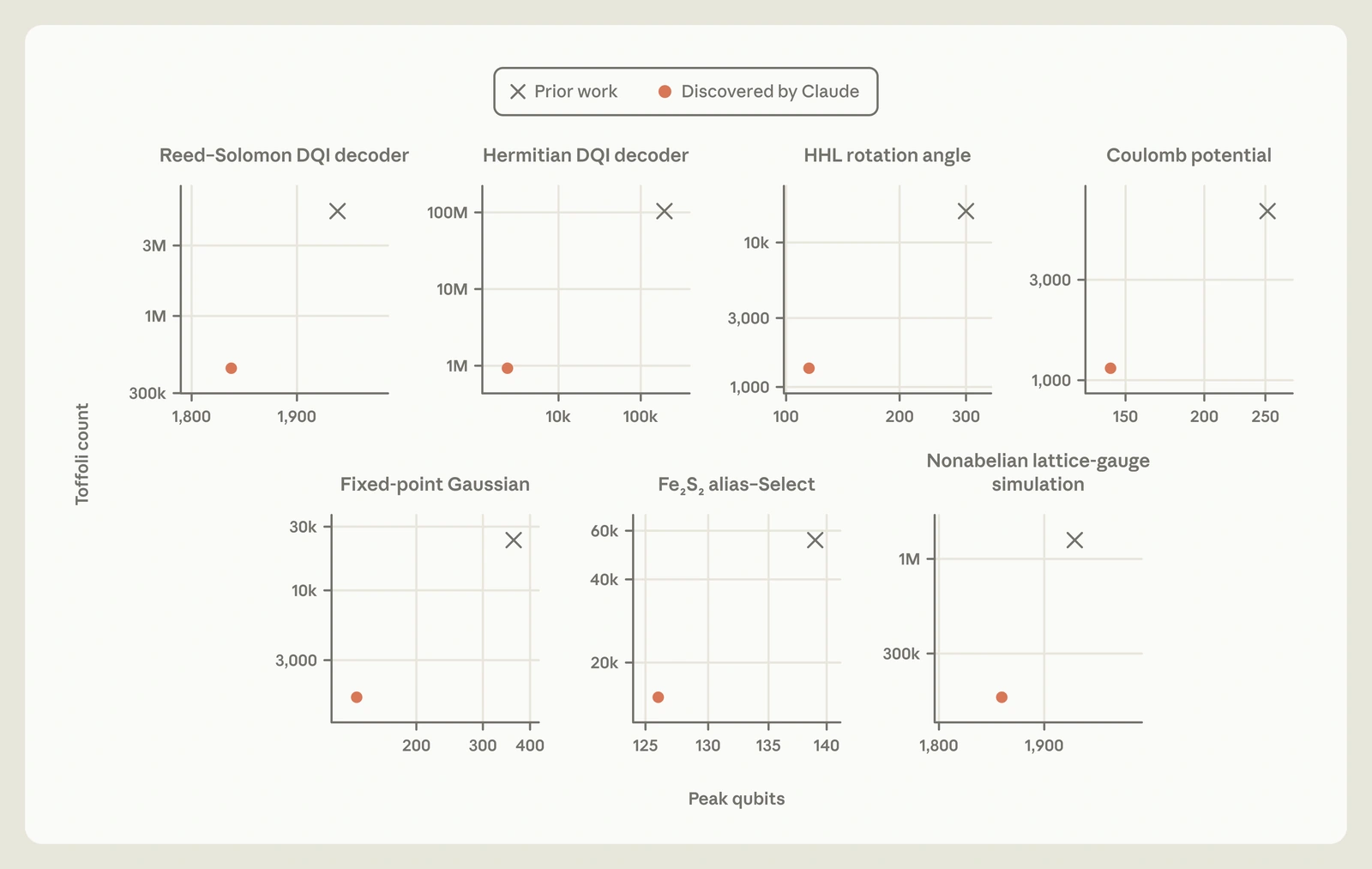
The research paper describes a search for improved circuits across several computational primitives. It illustrates a different contribution from AI: reducing the resources an algorithm requires. Historical parameter provenance and future attack engineering now have new, separately testable results.
Sources
- Anthropic: ECDSA curve origins and reproducible recipeanthropic.com
- OpenSSL: standard elliptic-curve constantsgithub.com
- Filippo Valsorda: NIST curve-seed bounty and historical questionwords.filippo.io
- Anthropic: designing efficient quantum circuitsanthropic.com
- Research paper: discovering quantum circuits with language modelsarxiv.org