Dared by a physicist, Claude broke a particle physics record
Two Anthropic physicists used Claude Fable 5.1 inside Claude Science to compute the six-particle amplitude in N=4 super Yang-Mills theory at nine loops. Lance Dixon of SLAC and Stanford, who reached eight loops in 2023, checked the answer.
Listen to this articleListen
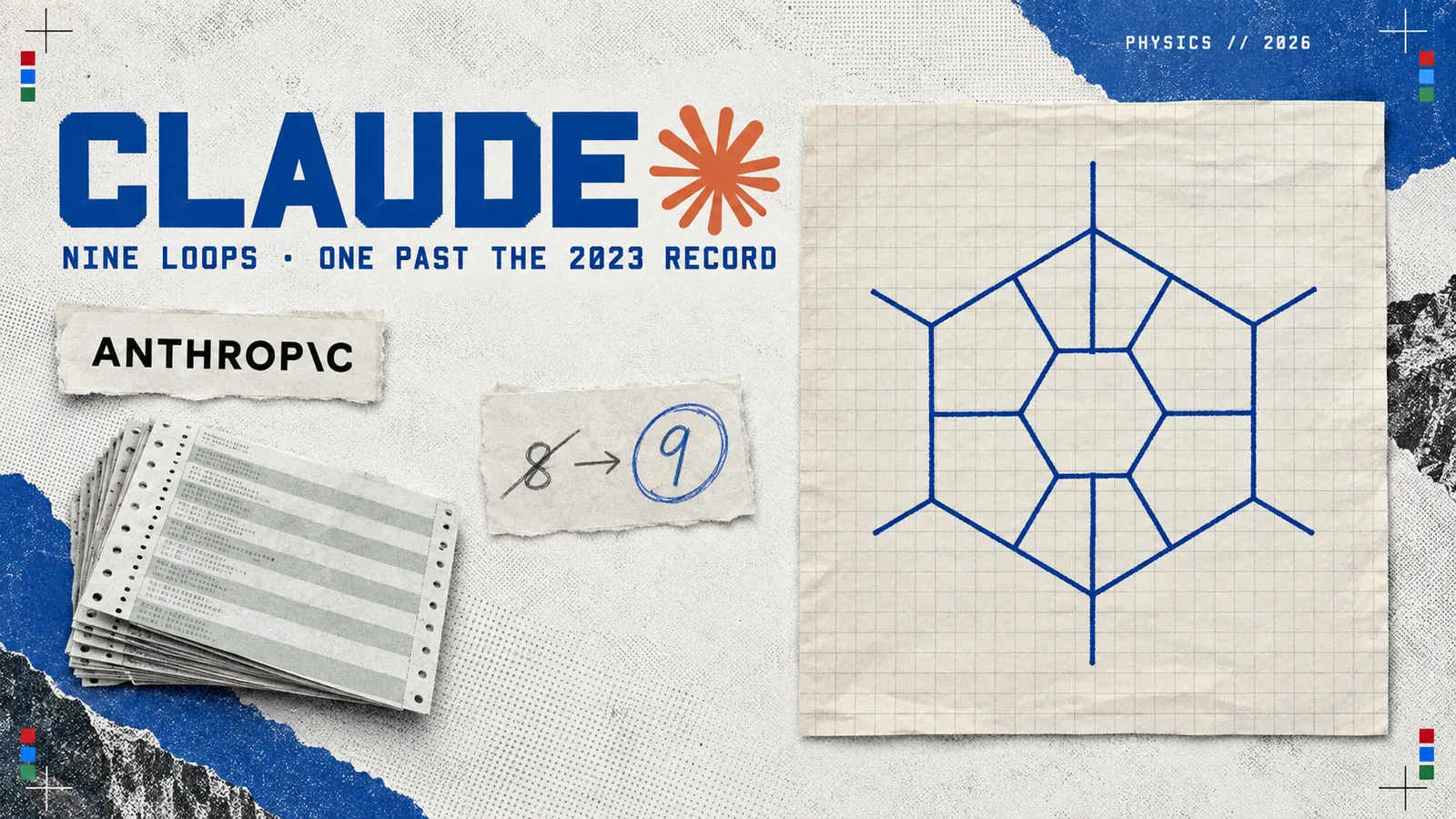
Claude has computed the six-particle scattering amplitude in planar N=4 super Yang-Mills theory at nine loops, one loop beyond the eight-loop result Lance Dixon and Yu-Ting Liu published in August 2023. Anthropic announced it on 25 September 2026 in a guest post by the physicist and science writer Matt von Hippel, with an addendum by Dixon, who checked the answer. Two Anthropic physicists, Liam Fitzpatrick and Siddharth Mishra-Sharma, ran the calculation on Claude Fable 5.1 inside Claude Science, Anthropic’s paid research workbench.
The problem was a public dare. On 7 August 2026 von Hippel, who worked on the three-, five- and seven-loop results before leaving research, wrote on his blog that AI companies should “take the kinds of computer resources an academic has access to, and solve one of the scattering amplitudes field’s big outstanding problems”, and named N=4 super Yang-Mills at nine loops as one of two targets. Claude answered it within a month. Anthropic invited von Hippel to write the post and paid him for his time, and Dixon received Claude usage credits.
What is a loop, and why is each one harder?
A loop is one layer of detail in a prediction of how particles collide. Physicists draw a collision as a diagram: particles come in, interact and fly out. Sharper predictions add the ways particles can briefly appear and vanish mid-collision, and each of those detours closes a loop in the drawing. Von Hippel describes loops as “a measure of how complicated interactions between particles are allowed to get”: the more loops a calculation includes, the closer it gets to the real answer.
Each extra loop multiplies the work. The particle running round a loop can carry any amount of energy, so the calculation has to account for every possibility at once, and every new loop adds another unknown to account for. Von Hippel’s challenge post says these calculations “typically scale exponentially or even factorially in the number of loops”. In von Hippel’s account, most scattering calculations for real particles reach two loops, and a few reach three.
N=4 super Yang-Mills is the test bench. Yang-Mills theories describe three of nature’s four forces; the N=4 version gives every particle four supersymmetric partners, which makes it unrealistic and, oddly, easier to calculate with. “Planar” keeps only the diagrams that can be drawn flat on a page. Physicists sharpen their methods here before turning them on real collisions.
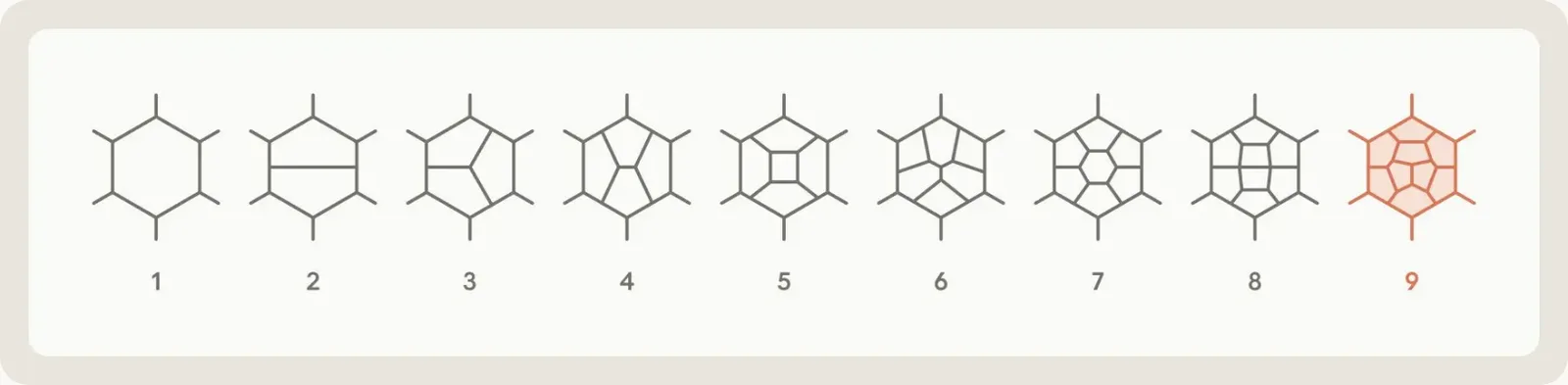
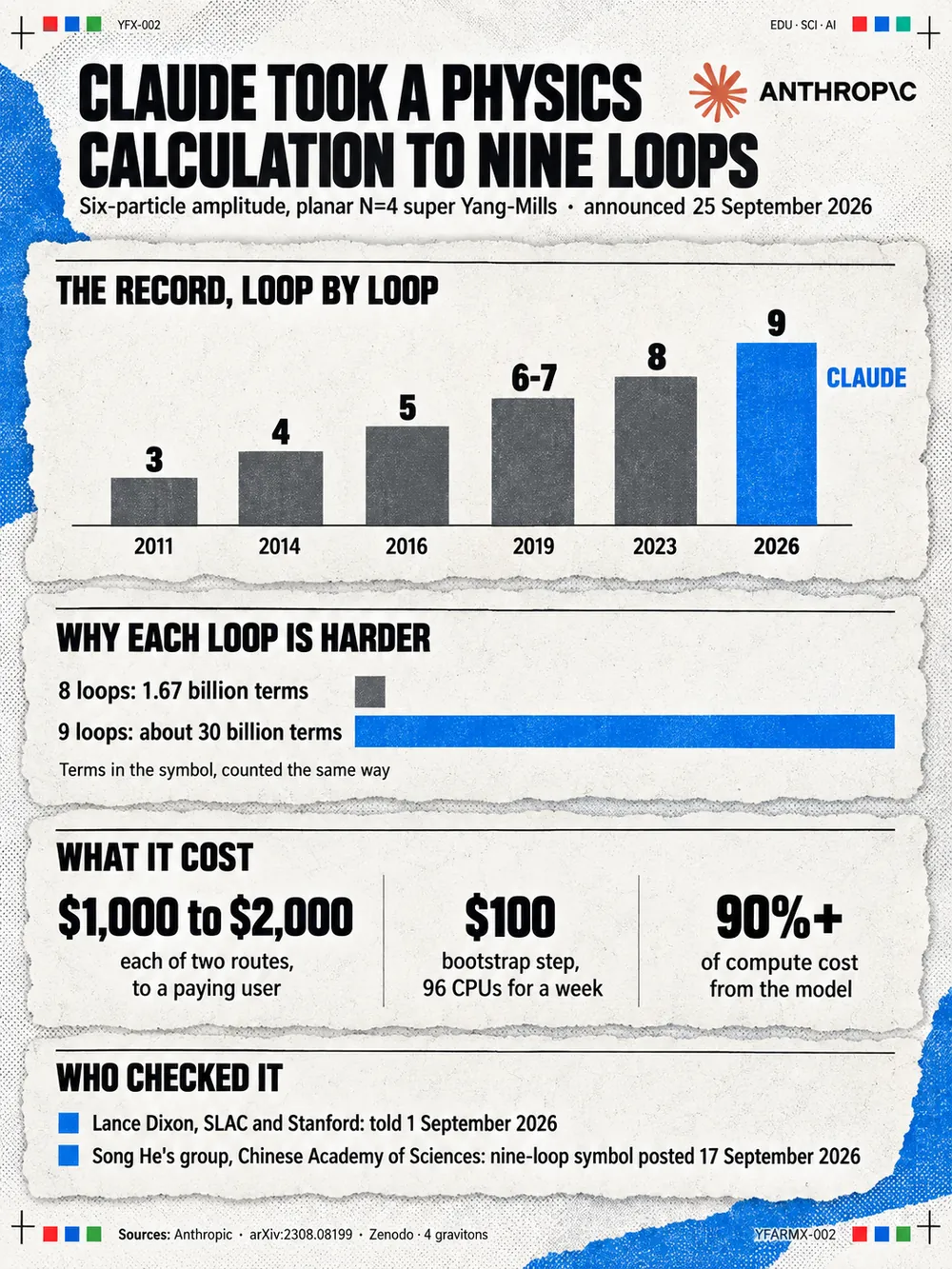
The size of the answer shows the climb. Its main piece is a mathematical object physicists call the symbol, and counted the same way, on the same two-dimensional slice of the problem, it grew about 18 times between eight loops and nine.
| Loop order | Terms in the symbol, same slice, same count | Source |
|---|---|---|
| 8 (2023) | 1,671,656,292 | Dixon and Liu, arXiv:2308.08199 |
| 9 (2026) | 30,024,320,034 | Claude’s result files, dated 16 September 2026 |
How the record climbed from three loops to nine

Physicists have pushed the six-particle amplitude forward a loop or two at a time since 2011, and Lance Dixon of SLAC and Stanford is an author on every paper in the run. The method is called the bootstrap. Physicists write down every form the answer could take, then cross out each candidate that breaks a known rule until one survives. Von Hippel compares it to Sudoku, “where you begin with a grid with all possible numbers, then cross them out as you go”.
| Loops | Year | Authors | Paper |
|---|---|---|---|
| 3 | 2011 (symbol), 2013 (full function) | Dixon, Drummond, Henn; then Dixon, Drummond, von Hippel, Pennington | 1108.4461, 1308.2276 |
| 4 | 2014 | Dixon, Drummond, Duhr, Pennington | 1402.3300 |
| 5 | 2016 | Caron-Huot, Dixon, McLeod, von Hippel | 1609.00669 |
| 6 and 7 | 2019 | Caron-Huot, Dixon, Dulat, von Hippel, McLeod, Papathanasiou | 1903.10890 |
| 8 | 2023 | Dixon, Liu | 2308.08199 |
| 9 | 2026 | Claude, checked by Dixon; symbol also by He, Jing, Li | Anthropic; Zenodo |
Eight loops came in by a side door. In 2022 Dixon and three colleagues bootstrapped a simpler relative of the amplitude, a three-particle quantity called a form factor, through eight loops. In August 2023 Dixon and Liu used a symmetry they call antipodal duality to turn it into the eight-loop amplitude. Dixon expected nine loops to arrive the same indirect way, and writes that he “thought it would be too hard to do the amplitude directly”.
Two physicists gave Claude one line and told it to keep going
Fitzpatrick and Mishra-Sharma asked Claude which of von Hippel’s two problems it was most likely to solve, then gave it a single-sentence prompt: “The problem is to compute the Six-particle (hexagon) amplitude in planar N=4 SYM at nine loops.” After that, von Hippel writes, they mostly told it to carry on, with messages such as “I’m going to sleep and won’t be available for another several hours. Keep working on this until I tell you to stop.”
Claude Science is a harness, a program that wraps the Claude model in structured rules and prompts for research work. It is the same workbench Novo agreed to test on drug discovery on 16 September. Claude ran the calculation twice: once as a direct bootstrap of the amplitude, and once by Dixon and Liu’s route through the form factor.
| Item | Figure |
|---|---|
| Model | Claude Fable 5.1, inside Claude Science |
| Cost to a paying user, each route | around $1,000 to $2,000 |
| Bootstrap computation, in Python with SymPy | about $100, equal to 96 CPUs for a week |
| Share of the compute cost from running the model | 90 per cent or more |
| Human guidance | a one-line prompt, then instructions to keep going |
Von Hippel put the model’s share of the bill at 90 per cent or more on his blog on 25 September. What impressed Dixon most was how fragile the setup is: “if you make any mistake at all in the computational recipe, it all crashes down like a failed soufflé”. Many details of the construction are too dull to document fully in a paper, he adds: “So Claude had to develop all that code from scratch.”
How do physicists know the answer is right?
Lance Dixon checked the nine-loop amplitude by converting it back into the form factor his team had been working towards for a couple of years. Anthropic’s physicists told him about it on 1 September 2026. He writes that Claude “presented the solution (maybe as a favor to us) in the same format we had already set up”, and that “Claude understands our 2019 and 2023 papers better than any human, aside from my co-authors.”
Claude’s two routes agree on every coefficient compared, all 107,053 of those that define one of the published files, according to the result files dated 16 September. The same programs, run one loop lower, match the published eight-loop answer on all 1,000 randomly chosen terms tested.
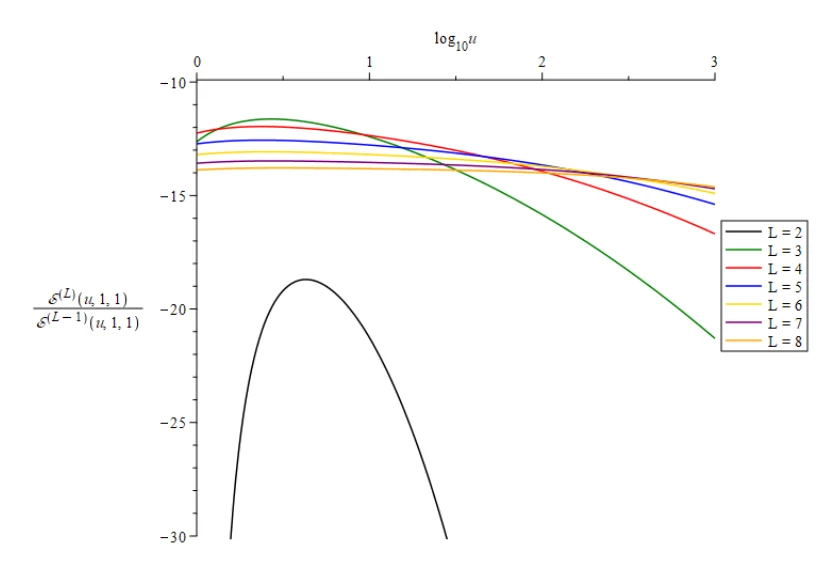
A third check is a pattern. At one standard reference point, each loop’s value is roughly 12 to 14 times the one before, with the sign flipping each time, and from four loops on the ratio has grown steadily. Claude’s nine-loop value carries it on.
| Loops | Ratio to the previous loop order | Source |
|---|---|---|
| 3 | −12.64 | Dixon and Liu, Table 5 |
| 4 | −12.25 | Dixon and Liu, Table 5 |
| 5 | −12.73 | Dixon and Liu, Table 5 |
| 6 | −13.20 | Dixon and Liu, Table 5 |
| 7 | −13.58 | Dixon and Liu, Table 5 |
| 8 | −13.88 | Dixon and Liu, Table 5 |
| 9 | −14.11 | Claude’s result files |
A Beijing team got most of the answer the same month
Song He’s group at the Chinese Academy of Sciences computed the nine-loop symbol with its own methods and posted it on Zenodo on 17 September 2026. The dataset, from He, Jirong Jing and Xiang Li of the Institute of Theoretical Physics and the University of Chinese Academy of Sciences, carries the six-particle symbols from two loops through nine.
He’s group used AI as well. Dixon writes that it used OpenAI’s GPT-6 to compute some of the constraints, and built the overall framework itself. Von Hippel says that when He got in touch, a few days after Anthropic did, the group “had already gotten the majority of the result”. Dixon’s summary: “So now I’ve been scooped by both a machine and by humans plus a machine, within two weeks.”
The recipe was known, and Claude ran all of it
Von Hippel’s verdict, in the Anthropic post, is that “Claude used known methods, with a bit more compute than people had tried to use before.” What impressed him was that Claude Science finished a long, finicky calculation in one shot, on little more guidance than “keep going”. His conclusion: “It can do this kind of thing reliably now.”
Dixon calls it “quite a triumph, in my opinion, for a large language model to execute all of the steps in the complicated recipe we laid out”. “So while I’m validating Claude’s result, Claude is validating all of our previous work,” he writes. The humans, Dixon, He and their collaborators, will write up and publish the nine-loop results. Von Hippel, on his blog: “This technology is clearly getting more effective over time.”
Questions people ask
- What did Claude calculate?
- Claude computed the six-particle scattering amplitude in planar N=4 super Yang-Mills theory at nine loops, according to a post Anthropic published on 25 September 2026. The amplitude gives the likelihood of a particular particle collision in a simplified test theory physicists use to develop methods. The previous published record for this quantity was eight loops, reached by Lance Dixon and Yu-Ting Liu in August 2023.
- How much did Claude's nine-loop calculation cost?
- Anthropic's guest post by the physicist Matt von Hippel, published on 25 September 2026, puts the cost to an end user at around $1,000 to $2,000 for each of the two routes Claude took, mostly the cost of running the model. The bootstrap computation itself, written in Python with SymPy, took about $100, which the post equates to 96 CPUs running for a week.
- Who checked Claude's nine-loop result?
- Lance Dixon, professor of particle physics and astrophysics at SLAC National Accelerator Laboratory and Stanford University, validated it after Anthropic's physicists told him on 1 September 2026, mostly by converting it back into a related quantity called a form factor. Song He's group at the Chinese Academy of Sciences computed the nine-loop symbol with its own methods and posted it on Zenodo on 17 September 2026.
Sources
- Anthropic: Yes, Claude can do Nine Loops, guest post by Matt von Hippel with an addendum by Lance Dixon, 25 September 2026anthropic.com
- Matt von Hippel, 4 gravitons: It Only Counts When AI Gets to My Field, the challenge, 7 August 20264gravitons.com
- Matt von Hippel, 4 gravitons: It Got to My Field, 25 September 20264gravitons.com
- Cosmic9: Claude's nine-loop six-gluon amplitude files and validation, 16 September 2026smsharma.io
- Song He, Jirong Jing and Xiang Li, Zenodo: The Symbols of Six-Gluon MHV Amplitudes through Nine Loops, 17 September 2026doi.org
- Lance Dixon and Yu-Ting Liu, arXiv:2308.08199: An Eight Loop Amplitude via Antipodal Duality, 16 August 2023arxiv.org
- Dixon, Gurdogan, McLeod and Wilhelm, arXiv:2204.11901: Bootstrapping a Stress-Tensor Form Factor through Eight Loops, 2022arxiv.org
- Caron-Huot, Dixon, Dulat, von Hippel, McLeod and Papathanasiou, arXiv:1903.10890: six-gluon amplitudes at six and seven loops, 2019arxiv.org
- Caron-Huot, Dixon, McLeod and von Hippel, arXiv:1609.00669: Bootstrapping a Five-Loop Amplitude Using Steinmann Relations, 2016arxiv.org
- Dixon, Drummond, Duhr and Pennington, arXiv:1402.3300: the four-loop remainder function, 2014arxiv.org
- Dixon, Drummond, von Hippel and Pennington, arXiv:1308.2276: Hexagon functions and the three-loop remainder function, 2013arxiv.org
- Dixon, Drummond and Henn, arXiv:1108.4461: Bootstrapping the three-loop hexagon, 2011arxiv.org