
Anthropic
Claude Fable 5.1
built for the API, hard on a subscription allowance
Key facts
- 1 Sept 2026Fable 5 was 9 June
- Released
- 1M / 128ktokens in / out
- Context
- $10 / $50per M, same as Fable 5
- Price
- $0.25per M, down 75%
- Cache read
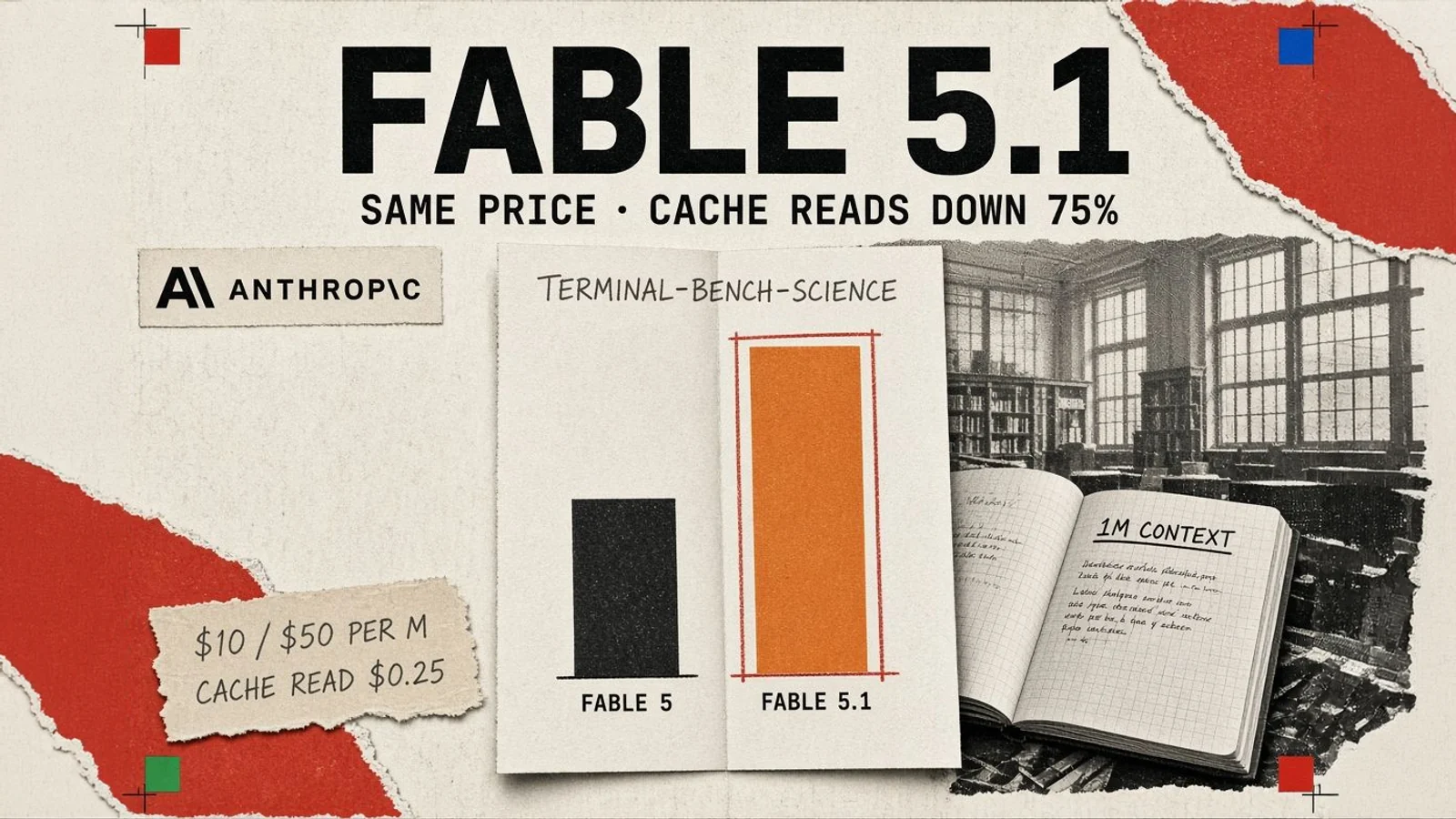
- 52.6%Fable 5 scored 24.7%
- Terminal-Bench-Science
- Jun 2026Fable 5.1 and Mythos 5.1
- Knowledge cutoff
A point release that leaves the headline price alone and moves the number underneath it: cache reads drop to a quarter, which is where the real cost of agent work sits. That saving lands on an API bill, not a subscription: on the 20x Max plan our own testing ran the five-hour session allowance down markedly faster than Opus 5, which reads as a model built for API and enterprise use rather than for chat. The benchmark that more than doubled is agentic scientific research, and it is the one to hold most lightly. Three API behaviours are breaking changes if you already call Fable 5.
What it is
Claude Fable 5.1 is Anthropic’s model for demanding reasoning and long-horizon agent work, released on 1 September 2026, just under three months after Claude Fable 5. Anthropic’s own guidance is not that everyone should move to it: the docs say start with Claude Opus 5.5 for most work, and reach for Fable 5.1 for demanding reasoning, long-horizon agentic tasks, or when Opus 5.5 at high effort still falls short.
Fable 5.1 ships alongside Claude Mythos 5.1, which Anthropic describes as the same model with different safeguards. The expanded Cyber Verification Program, launched on 6 October, brings qualifying users into tiered access for security work. The Life Sciences Verification Program covers approved biology work.
The price did not move; the cost did
Input and output are unchanged from Fable 5 at $10 and $50 per million tokens. The change sits in caching:
| Fable 5.1 | |
|---|---|
| Input / output | $10 / $50 per M |
| Cache read | $0.25 per M |
| 5-minute cache write | $12.50 per M |
| 1-hour cache write | $20 per M |
| Batch API | 50% off input and output |
Cache reads are 75% cheaper than Fable 5, at 2.5% of the base input price rather than the usual 10%. Anthropic puts the effect at roughly 25% off typical workloads and up to about 45% off highly agentic ones.
An agent loop re-reads a large, stable prompt on every turn, so cache reads are most of what it spends. Anyone operating agents pays nearly half as much to run the same work. Anyone sending one-off prompts pays exactly what they paid before.
The benchmarks, and the one that stands out
Anthropic’s published table, with Fable 5 and the nearest comparisons:
| Benchmark | Fable 5.1 | Fable 5 | Nearest rival |
|---|---|---|---|
| Terminal-Bench-Science 0.1 | 52.6% | 24.7% | Opus 5, 29.0% |
| Terminal-Bench 4.0 | 55.8% | 42.0% | Opus 5, 52.3% |
| GDPval-AA v2 | 1853 | 1723 | Opus 5, 1824 |
| AutomationBench | 31.4% | 17.1% | Opus 5, 26.9% |
| CursorBench 3.2.0 | 73.4% | 70.5% | Fable 5, 70.5% |
| Humanity’s Last Exam, no tools | 60.9% | 57.8% | Fable 5, 57.8% |
Opus 5 is the nearest rival on every row where it appears. GPT-5.6 Sol is in Anthropic’s published table too and trails on all five rows it is scored on, lowest at 22.4% on Terminal-Bench-Science against Fable 5.1’s 52.6%.
The row that does not look like the others is the first. Terminal-Bench-Science more than doubles, from 24.7% to 52.6%, on a benchmark for agentic scientific research. Every other gain is single or low double digits. A jump that size on one benchmark and not its neighbours usually means the benchmark is young, the training touched it directly, or both, and “0.1” in its name says how young. Anthropic frames the release around research capability, so it is the number the announcement rests on and the number to treat most carefully.
Mythos 5.1 scores 60.9% on Terminal-Bench 4.0, above Fable 5.1’s 55.8%, despite Anthropic describing them as the same model with different safeguards.
Anthropic also reports that its newest cybersecurity safeguards block 60% fewer false positives, which is a usability claim about refusals rather than a capability one.
On a subscription, it eats the session allowance
Everything above is API pricing, and on the API you pay for what you use. On a Claude subscription you are instead spending a fixed allowance inside a rolling five-hour session window, and that is where Fable 5.1 behaves differently from the model most people are used to.
In our own testing on the 20x Max plan, Fable 5.1 ran the five-hour session allowance down markedly faster than Opus 5 doing comparable work. Ours is not the only account seeing it; it is the common report from subscribers since release, though we have measured only our own.
The arithmetic is not mysterious. Against Opus 5, Fable 5.1 costs twice as
much per token in both directions: $10 and $50 per million against $5 and $25.
An allowance metered on usage therefore drains at roughly double the rate for the
same work, before the model has thought any harder. What it then does is think
harder: adaptive thinking is always on, and high is the default effort, so a
question that Opus 5 would answer briefly can return with a long reasoning pass
behind it.
The newer tokenizer, which Anthropic says produces “approximately 30% more tokens for the same text”, is not part of this particular comparison: it applies from Claude 4.7 onward, so Opus 5 carries it too. It bites when moving up from Sonnet 4.6 or earlier, not when moving across from Opus 5.
The cache read saving does not rescue a subscription user either. It is a price cut, and it lands on an API bill. A plan allowance is not billed per token at the door, so the workload that gains most from $0.25 cache reads is exactly the long-running agent job that a five-hour window is least able to hold.
Read together, this looks like a model aimed at API and enterprise deployment rather than at subscription chat. Anthropic’s own guidance points the same way: start with Opus 5.5, and reach for Fable 5.1 when Opus 5.5 at high effort is not enough. On a Max plan that guidance is also the economical advice.
Three things break if you already call Fable 5
The docs list these as breaking, not additive:
- Forced tool use returns an error. Code that pins the model to a specific tool will fail rather than degrade.
- Earlier models cannot read its thinking blocks. Thinking is tied to the model that produced it, so a pipeline that hands a transcript between models needs checking.
- Editing an earlier turn invalidates thinking blocks. Anything that rewrites conversation history mid-run is affected.
Five additions are optional: per-message effort, turn-scoped system messages, readable progress updates between tool calls (all in beta), the cache read price, and content provenance.
Specifications worth having to hand: context 1M tokens, max output 128K, adaptive thinking always on with high as the default effort, text and images in, text out, and a June 2026 knowledge cutoff. Retirement is committed to no sooner than 1 September 2027.
How far the evidence goes
The benchmark table is Anthropic’s own, published on release day, and the customer quotes in the announcement are named individuals at named companies rather than measurements. The first independent reading has since arrived. Artificial Analysis rebased its Intelligence Index to v4.3 on 7 September 2026, and the models table now labels it v4.3.2. Read on 2 October 2026, that index puts Claude Opus 5.5 top on 58 and Claude Sonnet 5.5 second on 56, with Fable 5.1, GPT-6 Astra and Gemini 4 Argon level on 53 behind them.
Anthropic gives no context-window or latency change against Fable 5; the docs list Fable 5.1 as “slower” than Opus 5 in comparative latency, which is unchanged in kind from its predecessor.
Related
- Claude Fable 5, the model this extends
- Claude Opus 5.5, which Anthropic recommends first for most work
- Gemini 3.8 Flash, whose cyber variant Google benchmarks against Fable 5 on patching
More in Large Language Models
All LLMs →- AnthropicClaude Fable 5the first model in Anthropic's Mythos class
- AnthropicClaude Opus 5frontier work with a dial on the bill
- AnthropicClaude Mythos 5restricted twin of Fable 5
- Google DeepMindGemini 4 Argonlonger reasoning, coding and cyber defence
- OpenAIGPT-5.6the flagship from 9 July to 3 September 2026
- OpenAIGPT-6 Astrathe new generation, rolling out from 3 September 2026