
Anthropic
Claude Sonnet 5.5
faster everyday coding and office work at Sonnet prices
Key facts
- 28 Sep 2026Claude and cloud platforms
- Released
- $2 / $10per M tokens in / out
- Price
- $0.10per M tokens
- Cache read
- 1Mtokens
- Context
- 128Ktokens, Messages API
- Max output
- highmedium in apps and Code
- API effort
Claude Sonnet 5.5 is Anthropic's AI model for writing, fixing code and making documents, slides and spreadsheets. Released on 28 September 2026, it keeps Sonnet 5's prices while using fewer tokens to finish work. Anthropic reports output more than 30% faster and task costs up to 30% lower in its testing.
What is Claude Sonnet 5.5?
Claude Sonnet 5.5 is an AI model from Anthropic that can write and fix code, answer questions, read images and produce office documents. It launched on 28 September 2026 as the second model in the Claude 5.5 family. Anthropic built it for clearly defined everyday jobs and quick rounds of feedback, including bug fixes, presentations and spreadsheets. Source: Anthropic’s launch announcement.
Sonnet sits alongside Claude Opus 5.5, which Anthropic recommends for complex, open-ended work that needs sustained judgement. Sonnet 5.5 replaces Sonnet 5 as the newest Sonnet, with the same token prices and higher scores across the launch evaluations. Its lower effort settings are intended to make routine work faster and cheaper.
How much does Sonnet 5.5 cost?
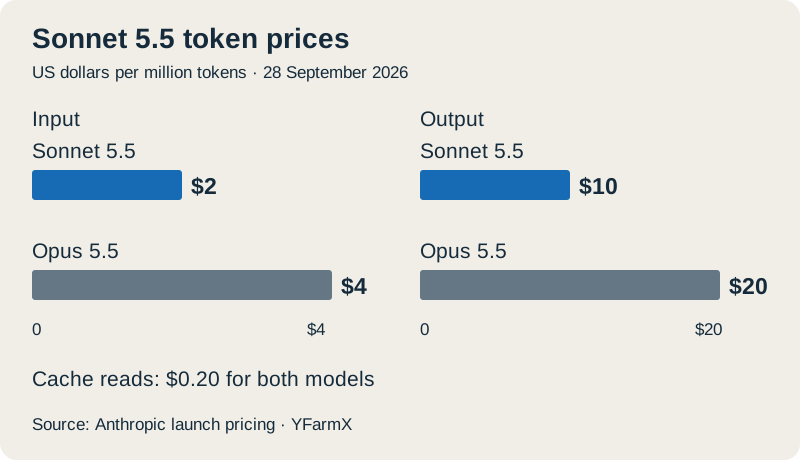
Claude Sonnet 5.5 costs $2 per million input tokens and $10 per million output tokens on the Claude API at launch. Tokens are the pieces of text a model reads and writes. From 7 October 2026, reusing stored prompt content costs $0.10 per million tokens; batch processing halves the standard input and output prices. Source: model specifications.
| Charge per million tokens | Sonnet 5.5 |
|---|---|
| Input | $2 |
| Output | $10 |
| Cache read | $0.10 |
| Cache write, five minutes | $2.50 |
| Cache write, one hour | $4 |
| Batch input | $1 |
| Batch output | $5 |
Anthropic reports task costs up to 30% lower than Sonnet 5 in its testing because Sonnet 5.5 needs fewer tokens to finish the work. It also reports output generation more than 30% faster. Both are vendor measurements: the saving on a particular job depends on how much reasoning, output and tool use it needs. Source: launch announcement.
How does it compare with Sonnet 5 and Opus 5.5?
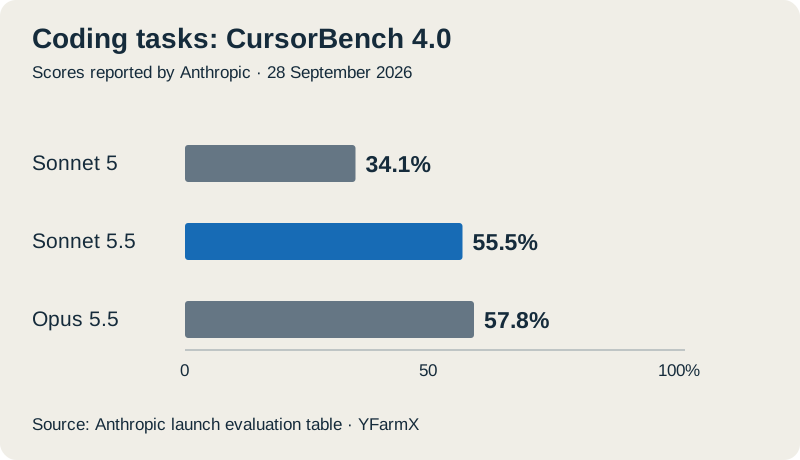
Sonnet 5.5 scores ahead of Sonnet 5 on every evaluation in Anthropic’s 28 September launch table. Its strongest headline result is Terminal-Bench 4.0, which tests multi-step work in a command-line environment. On the two office-work evaluations, its scores sit close to Opus 5.5. Source: Anthropic’s evaluation table and footnotes.
| Evaluation | Sonnet 5.5 | Sonnet 5 | Opus 5.5 |
|---|---|---|---|
| Terminal-Bench 4.0 | 70.6% | 10.3% | 66.4% |
| FrontierCode 1.1, main set | 46.2% | 42.4% | 54.4% |
| CursorBench 4.0 | 55.5% | 34.1% | 57.8% |
| GDPval-AA v2.1, Elo | 1844 | 1449 | 1846 |
| AA-Briefcase v1.1, Elo | 1811 | 1359 | 1822 |
| Humanity’s Last Exam, with tools | 64.5% | 54.9% | 67.7% |
| OSWorld 2.1, partial evaluation | 80.1% | 57.0% | 81.8% |
| Chartography, without tools | 61.6% | 15.6% | 64.4% |
The settings affect the comparison. Opus 5.5’s Terminal-Bench result uses xhigh effort. Sonnet 5.5’s FrontierCode figure above is its max-effort result; Anthropic reports that xhigh did better because max sometimes triggered extra reviews, timeouts or edits beyond the requested scope. Artificial Analysis ran the two office-work evaluations on a pre-release deployment with a structured-output bug, since fixed. Anthropic expects any effect on those scores to be small and downward.
Anthropic and its early testers still found Opus 5.5 stronger on complex, open-ended work. Sonnet 5.5’s practical role is fast implementation and iteration on a defined task, with effort adjusted to the job.
Where can you use it?
Sonnet 5.5 launched across Claude and its cloud partners on 28 September 2026. The Claude API model ID is claude-sonnet-5-5; Amazon Bedrock uses anthropic.claude-sonnet-5-5. Google Cloud independently lists the model as generally available, with text, image and PDF input and text output. Sources: Anthropic specifications and Google Cloud.
| Setting or limit | Sonnet 5.5 |
|---|---|
| Context window | 1,000,000 tokens |
| Maximum output, Messages API | 128,000 tokens |
| Maximum output, Batch API beta | 300,000 tokens |
| Reliable knowledge cut-off | June 2026 |
| Default effort, Claude Platform | high |
| Default effort, Claude apps and Claude Code | medium |
The larger batch output limit requires Anthropic’s output-300k-2026-03-24 beta header. The context window is the amount of material the model can work with in a request; the output limit governs how much it can generate. Source: specifications.
What must developers change?
Sonnet 5.5 runs adaptive thinking by default, and applications moving from Sonnet 5 should check their thinking and tool settings. The new between_tools setting turns off up-front thinking and works at high effort or below. Code that previously used thinking: {"type": "disabled"} must adopt that setting. Source: migration guide.
Applications should read response blocks by type and preserve thinking blocks unchanged through tool loops. Longer progress notes between tool calls now arrive in thinking blocks, while shorter remarks remain text blocks. Interfaces that display progress need to handle both. Thinking blocks are tied to their model and conversation. Forced tool choice also returns an error, and computer-use integrations on the Claude API and Google Cloud need to move on from the older computer_20251124 tool. The migration guide gives the changes for each starting model.
How do its safety checks work?
Sonnet 5.5 is the first Sonnet model to launch with Anthropic’s cybersecurity safeguards and model fallbacks. Anthropic says higher-risk cybersecurity requests visibly fall back to Sonnet 5, while routine development can continue using Sonnet 5.5. It retains Sonnet 5’s biology safeguards and adds classifiers intended to prevent extraction of its reasoning for model distillation. Source: launch announcement.
For everyday use, choose a specific task, set the effort to suit its difficulty and review the result. For related models and guides, visit the large language models hub.
More in Large Language Models
All LLMs →- AnthropicClaude Sonnet 5the speed and intelligence balance
- AnthropicClaude Opus 5.5the first Claude 5.5 model, cheaper and faster than Opus 5
- AnthropicClaude Haiku 4.5the fast cheap tier
- Google DeepMindGemini 4 Argonlonger reasoning, coding and cyber defence
- OpenAIGPT-5.6the flagship from 9 July to 3 September 2026
- OpenAIGPT-6 Astrathe new generation, rolling out from 3 September 2026