
Anthropic
Claude Sonnet 5
the speed and intelligence balance
Key facts
- Sonnetspeed + intelligence
- Tier
- 1Mtokens
- Context
- $2 / $10made permanent 10 Aug
- Price
- claude-sonnet-5Claude API
- Model ID
- 85.2%Verified (Anthropic)
- SWE-bench
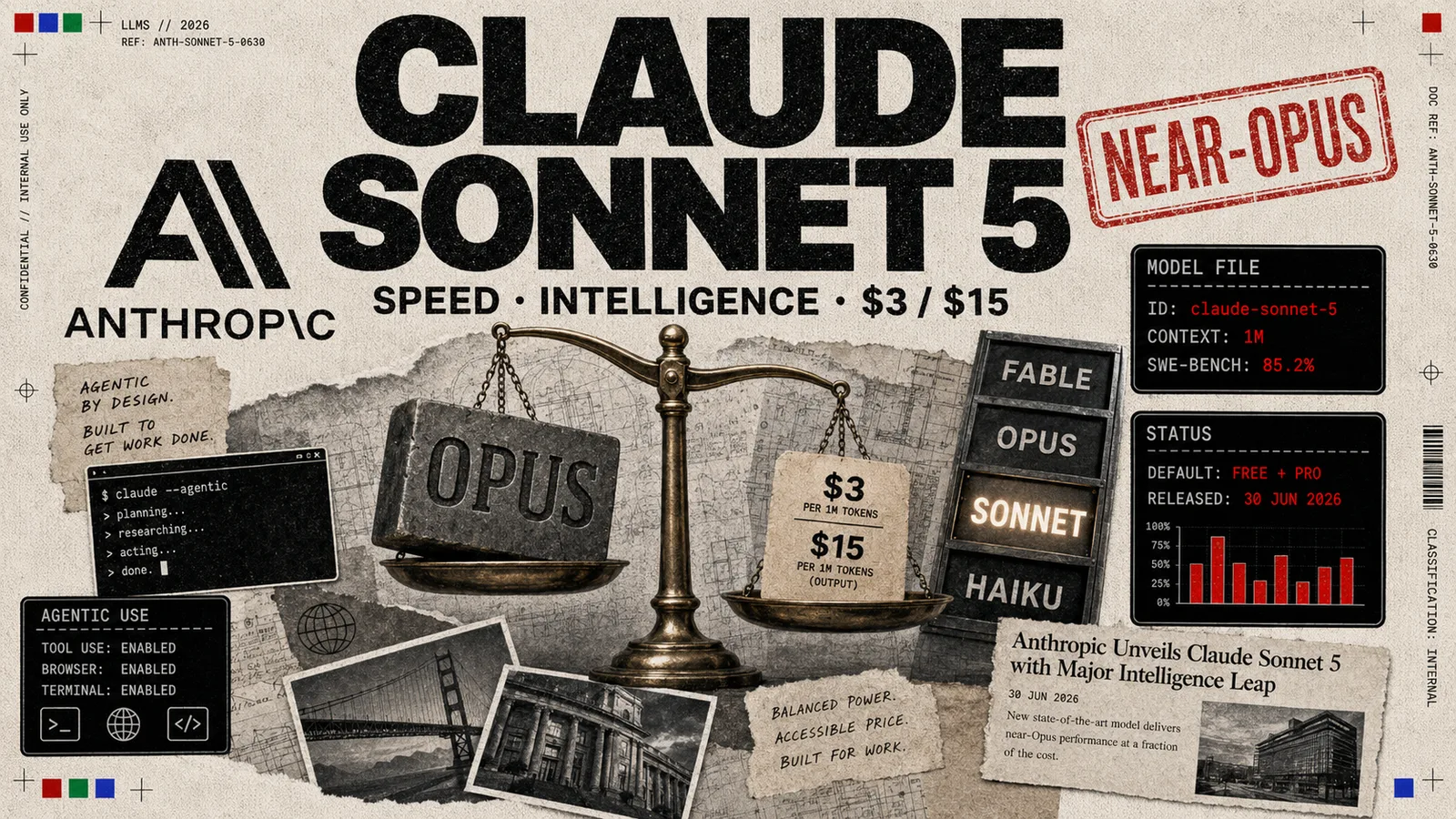
Anthropic's Sonnet-tier model, released 30 June 2026. It balances speed and intelligence, brings near-Opus performance at Sonnet pricing, and was described at launch as the most agentic Sonnet yet. The June 2026 Sonnet generation, followed by Sonnet 5.5 in September.
What it is
Claude Sonnet 5 is Anthropic’s Sonnet-tier large language model, released on 30 June 2026 and called on the Claude API as claude-sonnet-5. Anthropic describes it as “the best combination of speed and intelligence,” the balanced middle of its range, and pitches it on value: close to top-tier performance at a fraction of the top-tier price. It replaced Claude Sonnet 4.6, now listed as a legacy model, and Sonnet 5.5 succeeded it on 28 September 2026.
Where it sits in the range
Sonnet 5 costs $2 per million input tokens and $10 per million output tokens. Anthropic made that rate permanent on 10 August 2026. The current family includes Sonnet 5.5 for everyday work, Opus 5.5 for complex tasks and Haiku 5.5 for smaller jobs. Anthropic’s pricing page separates model rates from subscription access.
What it is built for
At its June 2026 launch, Anthropic called Sonnet 5 “the most agentic Sonnet model yet,” able to “make plans, use tools like browsers and terminals, and run autonomously at a level that, just a few months ago, required larger and more expensive models.” It carries a one-million-token context window, so it can hold a large codebase or document set in view at once. Adaptive thinking is built in, with the reasoning effort defaulting to high on the API and in Claude Code, and there is no separate extended-thinking switch to toggle. Its training knowledge runs to January 2026. Maximum output is 128,000 tokens on the standard Messages API, rising to 300,000 on the Batch API through a beta option.
How to read the numbers
Before the scores, a caution that applies to every model page. A benchmark is a fixed set of tasks run to produce a comparable figure, and the party publishing a launch benchmark has an interest in the result, so a single number should be weighed against independent testing rather than taken at face value. On Anthropic’s own figures, Sonnet 5 scores 85.2 per cent on SWE-bench Verified, the human-checked coding benchmark, 80.4 on Terminal-Bench 2.1, and 81.2 on OSWorld-Verified for computer use. On Humanity’s Last Exam it reaches 43.2 per cent without tools and 57.4 per cent with them. These are Anthropic’s published results; the sensible course is to read them alongside the company’s model documentation and independent evaluations.
Why it stands out
The Sonnet tier is where most day-to-day work runs, because it is the point where capability and cost meet. Sonnet 5’s significance is that a mid-tier model now does agentic work, planning, tool use and autonomous runs, that a few months earlier needed a flagship. That is the direction the field has been moving: capability sliding down the price range as it matures, so the balanced tier keeps absorbing jobs that once demanded the most expensive model. The Sonnet 5.5 successor provides the current release context. The launch figures above remain tied to Sonnet 5.
The current successor
Anthropic’s current model overview lists Fable 5.1, Opus 5.5, Sonnet 5.5 and Haiku 5.5. It recommends Opus 5.5 as a starting point for most work. See the successor guide for that release; the model-specific settings and dated observations above describe the earlier version.
More AI
All AI →
Claude Sonnet 5 puts Opus class agents on a mid tier budget
Anthropic released Claude Sonnet 5 on 30 June, describing it as its most agentic Sonnet to date and pricing it to make the flagship optional. The model plans, drives browsers and terminals and runs autonomously at a level that until recently required larger and more expensive systems.
More in Large Language Models
All LLMs →- Google DeepMindGemini 4 Argonlonger reasoning, coding and cyber defence
- OpenAIGPT-5.6the flagship from 9 July to 3 September 2026
- OpenAIGPT-6 Astrathe new generation, rolling out from 3 September 2026
- OpenAIGPT-6.1 Solthe upgraded mid-price GPT-6 model, released 29 September 2026
- OpenAIGPT-6 Sol and Lunathe mid-price and budget GPT-6 models, released 22 September 2026
- AnthropicClaude Opus 5.5the first Claude 5.5 model, cheaper and faster than Opus 5