
Google DeepMind
Gemini 4 Argon
longer reasoning, coding and cyber defence
Key facts
- 30 Sept 2026Google DeepMind
- Announced
- 65,536 tokensOpenRouter's Google endpoint
- Google route output
- 1M tokensOpenRouter: 1,048,576 tokens
- Context
- $2 / $10per million input / output tokens
- Introductory API price
- 77.9%Google's published evaluation
- DeepSWE v1.1
- 50 stable readings28 match earlier Gemini counts
- YFarmX fingerprint
Gemini 4 Argon is Google’s AI model for demanding coding, research and professional work. Google expanded access on 13 October. Input, reasoning and output share a 1,048,576-token window; prices depend on the service and date.
Gemini 4 Argon is Google DeepMind’s AI model for difficult software engineering, research and professional tasks that take many steps to complete. It is available through OpenRouter as google/gemini-4-argon, checked on 14 October 2026. The current listing gives a 1,048,576-token context window and standard prices of $2 per million input tokens and $10 per million output tokens.
Google announced Argon on 30 September 2026, with cyber defenders and trusted testers receiving the first access. Its public results cover coding, finance, legal work, science, visual understanding and vulnerability remediation. YFarmX’s new measurement adds a separate finding: Argon’s reported token counts form a distinct fingerprint in our dataset.
Who can use Argon?
Google’s API release notes date general availability to 13 October 2026. The Gemini app announcement gives Google AI Pro and Ultra subscribers access. Copilot is rolling it out to Pro+, Max, Business and Enterprise under its own access rules.
OpenRouter serves Gemini 4 Argon under google/gemini-4-argon on 14 October 2026. Its provider listing covers Google and Google AI Studio routes. The model accepts text, images, files, audio and video, and returns text. Listed reasoning settings are low, medium and high, alongside tools and structured output.
Google’s initial rollout on 30 September 2026 served trusted cyber defenders through the Fairwind Program and trusted testers. Google said those defenders and its internal teams would receive a configuration with cyber guardrails removed. That access programme has its own conditions. Google’s launch announcement explains the original rollout.
Our fingerprint shows different token counts
YFarmX measured Gemini 4 Argon on 14 October 2026 across 50 fixed text samples, covering languages, digits, code, whitespace and emoji. Each sample was measured twice. All 50 readings reproduced, and the fixed overhead stayed stable. Argon’s counts match the earlier Gemini 3.8 Flash record on 28 of 50 samples, or 56%.
| Text sample | Gemini 4 Argon | Earlier Gemini 3.8 Flash record |
|---|---|---|
| Family emoji | 5 tokens | 7 tokens |
| Three copies of that family emoji | 15 tokens | 21 tokens |
| Russian sentence | 9 tokens | 12 tokens |
| Repeated rare English word | 20 tokens | 25 tokens |
| Thirty consecutive digits | 30 tokens | 30 tokens |
The changes vary in size and direction, placing Argon in a distinct token-count group under our comparison method. The eighteen control-marker samples also reproduced across both measurements. Their counts give an inconclusive family attribution. These measurements describe the endpoint’s reported token accounting; claims about model weights or training lineage require additional evidence.
The Argon measurement record carries the full counts and comparisons. The AI Fingerprinting methodology explains how to interpret a shared or distinct fingerprint. The comparison above uses the earlier Gemini 3.8 Flash observation from 5 October 2026.
The output limit grows to one million tokens
Gemini 4 Argon’s announced output limit is 1M tokens, up from the previous 64K. A token is a piece of text handled by the model, such as part of a word. The larger limit gives an extended reasoning and generation run more room to continue through a complex problem.
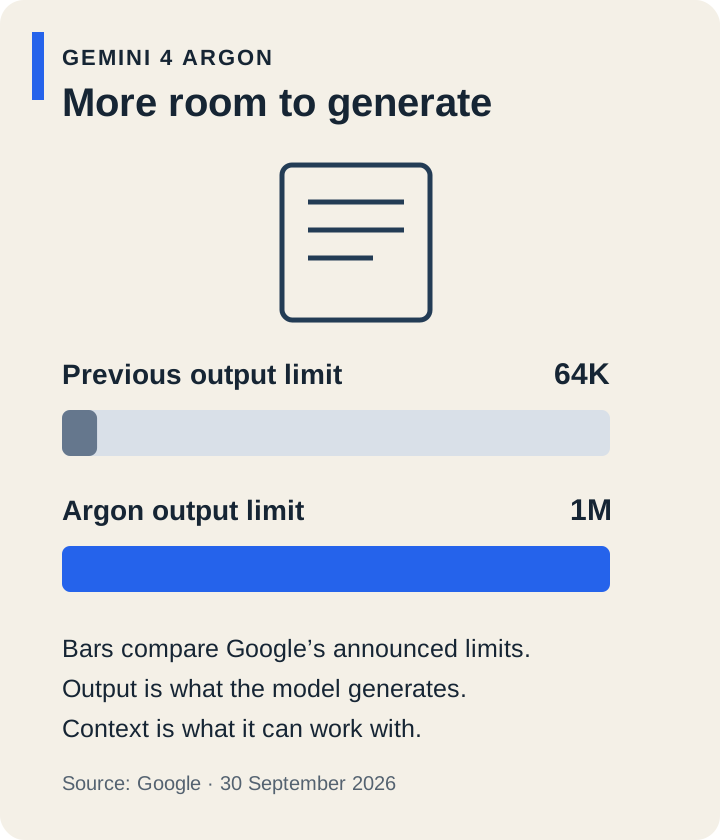
Google’s current developer guide specifies one 1,048,576-token window shared by input, thinking and output. The default output allowance is 65,536 tokens. Longer generation uses continuation or background execution and remains limited by the space left after the input.
For the current OpenRouter Google route, the provider listing on 14 October 2026 specifies 65,536 output tokens. Google’s one-million-token announcement describes its broader model capability. Choose a service and route whose declared allowance fits the length of the work you want to generate. OpenRouter’s provider settings
Introductory prices run through 30 November
Google’s current price schedule keeps the introductory rates through 30 November 2026. From 1 December, it lists $4 input, $20 output and $0.20 cached input per million tokens.
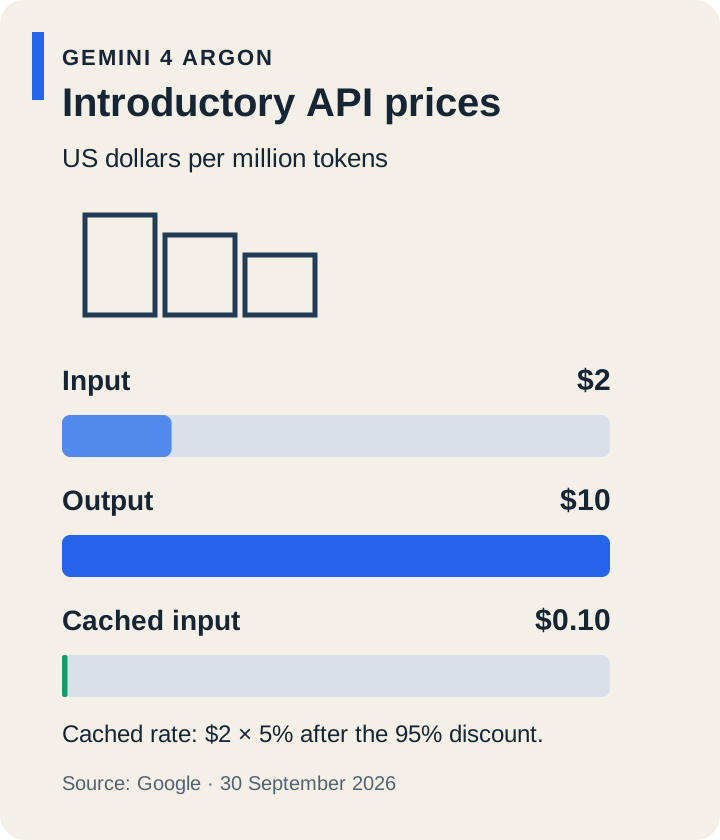
Google’s announced introductory Argon API prices on 30 September 2026 are $2 per million input tokens and $10 per million output tokens. Cached input receives a 95% discount on the input price, which makes the introductory cached rate $0.10 per million tokens. Caching lets eligible repeated input be reused at the discounted rate.
| Token type | Introductory price per million tokens |
|---|---|
| Input | $2 |
| Output | $10 |
| Cached input | $0.10, calculated from the 95% discount |
The launch announcement’s pricing footnote says the input and output rates become $4 and $20 per million tokens after the introductory period. These are announced API terms for the rollout. Google AI Ultra is a separate subscription route named in Google’s access plan. Google’s pricing terms
Coding results depend on the task
Google reports 77.9% on DeepSWE v1.1 for Argon at launch, ahead of GPT-6 Astra and Claude Opus 5.5 in its published comparison. DeepSWE tests long-horizon software engineering. Other coding tests reward different work, and the launch table gives a fuller view of the models’ strengths.
| Evaluation | Gemini 4 Argon | GPT-6 Astra | Claude Opus 5.5 |
|---|---|---|---|
| DeepSWE v1.1 | 77.9% | 74.1% | 74.2% |
| FrontierSWE v2 | 55.0% | 65.5% | 62.3% |
| Terminal-bench 4.0 | 57.4% | 58.2% | 66.4% |
| Vals Index | 68.9% | 63.1% | 67.0% |
| AutomationBench | 51.3% | 41.4% | 42.5% |
| LVBench | 91.7% | 87.5% | 83.7% |
| CWE-bench v1 | 68.0% | 68.0% | 67.0% |
Figures are from Google DeepMind’s launch table. Higher scores indicate better performance within each listed test. Vals Index measures professional work; AutomationBench tests end-to-end business tasks; LVBench tests long-video understanding; CWE-bench v1 tests vulnerability remediation.
Google’s evaluation methodology says Argon generally uses the highest thinking setting and single-attempt scoring, with exceptions explained for individual tests. Google computes its own DeepSWE result using a mini-swe agent harness. Several comparison scores come from providers’ system cards or the benchmark operators’ leaderboards. The table therefore combines results from those stated evaluation sources.
The independent Artificial Analysis listing, checked on 30 September 2026, scores Gemini 4 Argon (High) at 53 on its Intelligence Index. That index is a separate assessment with its own test mix and scale. It gives readers an additional view alongside Google’s task-specific launch results.
Google is using Argon to rewrite and optimise code
Google’s 30 September 2026 announcement describes Argon agents working on C and C++ migrations to Rust, from core libraries to more than 800,000 lines in the Fuchsia Zircon kernel. Google says these critical-system rewrites undergo automated and manual audits, emulation testing and review before production deployment.
For libgav1, Google’s video decoder, agents replaced 32,000 lines of SIMD code in an existing Rust port through repeated profiling and compiler analysis. Google reports that the resulting memory-safe decoder runs 2.7 times faster than that Rust port, with identical video output. The comparison uses the earlier Rust port as its baseline.
Google also reports more than 300 TiB of freed memory from optimisations applied across its data centres. Separately, its quantum researchers used Argon to improve a subroutine’s spacetime-resource requirement by 40% against a published baseline in one example. These are Google’s internal engineering and research results. Google’s announcement
Cyber defenders get the first rollout
Google says Argon can find, validate and patch software vulnerabilities. Its launch table gives the model 68.0% on CWE-bench v1, equal to GPT-6 Astra in that table. Google’s methodology identifies CWE-bench as a public-leaderboard result, scored by single-attempt success, with ties ranked using four-attempt success.
Wiz is already using Argon through Scan for Good, its initiative to find and remediate high-risk exposures affecting public infrastructure. Google reports that Argon identified a critical vulnerability exposing personal information in healthcare software used by hospitals worldwide. The announcement also describes internal vulnerability tests spanning 20 programming languages and Wiz’s tests against web applications with source code withheld from the model. Google
Google is strengthening safeguards before wider access
Google’s Argon rollout pairs tester feedback with work on misuse prevention, prompt-injection resistance, monitoring for misalignment and secure execution environments. Google describes safeguards that monitor internal activations for misuse and systems that monitor the model’s reasoning and actions, stopping execution when needed. Its announcement also describes isolating environments used for high-risk training and evaluations.
For developers choosing a model, the current provider’s price and output allowance are practical starting points. Argon’s published coding results, broad input support and the new YFarmX measurement provide further evidence to compare alongside the demands of the job. OpenRouter’s current listing gives its available settings.
Questions people ask
- Who can use Gemini 4 Argon?
- Google made Argon generally available through the Gemini API on 13 October 2026. Google AI Pro and Ultra subscribers can use it in the Gemini app. OpenRouter also serves it; each route has its own settings and access rules.
- How much will Gemini 4 Argon cost?
- Google lists introductory API rates of $2 input, $10 output and $0.10 cached input per million tokens through 30 November 2026. From 1 December, the listed rates are $4, $20 and $0.20. Other providers and service tiers can have separate rates.
- What does the one-million-token output limit mean?
- Google’s current developer guide specifies a unified 1,048,576-token window shared by input, thinking and output. The default output allowance is 65,536 tokens; longer runs use continuation or background execution and remain within the shared budget.
- How does Gemini 4 Argon perform in coding tests?
- Google reports 77.9% on DeepSWE v1.1, compared with 74.1% for GPT-6 Astra and 74.2% for Claude Opus 5.5 in its launch table. The same table gives Argon 55.0% on FrontierSWE v2 and 57.4% on Terminal-bench 4.0. Google's methodology explains the evaluation settings and the sources of each comparison.
Related pages
All LLMs →- Google DeepMindGemini 3.8 Flashthe workhorse again, plus a cyber variant behind a gate
- OpenAIGPT-6 Astrathe new generation, rolling out from 3 September 2026
- AnthropicClaude Opus 5.5the first Claude 5.5 model, cheaper and faster than Opus 5
- AnthropicClaude Fable 5.1built for the API, hard on a subscription allowance
- Anthropic, OpenAI, Google, MetaModel safeguardsthe refusal contract, the fallback and the programmes
- OpenAIGPT-5.6the flagship from 9 July to 3 September 2026