
Anthropic
Claude Opus 5.5
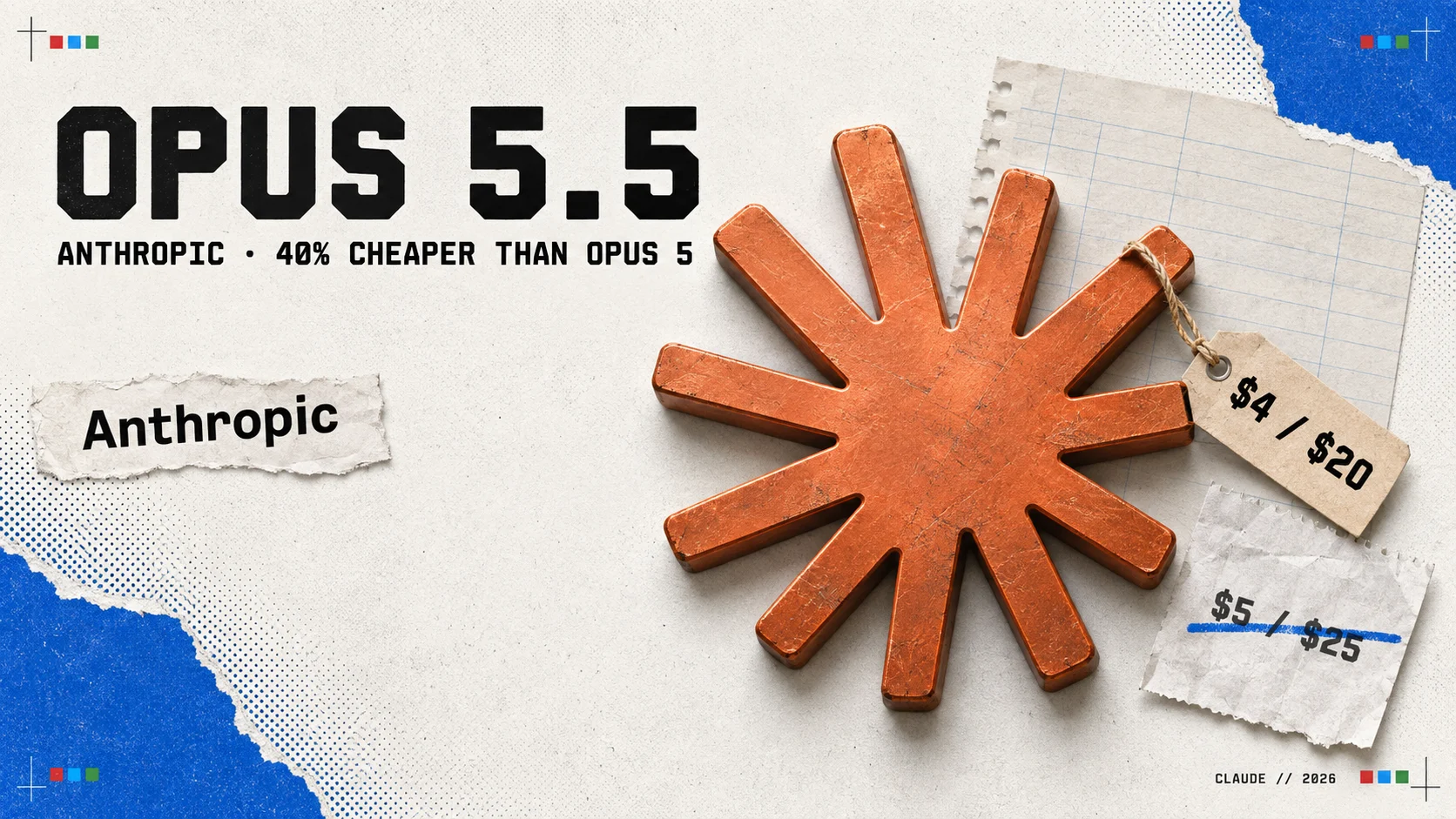
the first Claude 5.5 model, cheaper and faster than Opus 5
Key facts
- 22 Sep 2026all platforms
- Released
- $4 / $20per M tokens in / out
- Price
- $0.20per M tokens
- Cache read
- 1Mtokens
- Context
- 128Ktokens, Messages API
- Max output
- mediumthinking always on
- Default effort
Claude Opus 5.5 is a large language model from Anthropic, released on 22 September 2026. It is built for long coding jobs and office work such as reports, spreadsheets and research. Anthropic says it does most work as well as Claude Fable 5.1, its most expensive model, while costing 40% less to run than Opus 5, the model it replaces as Anthropic's recommended starting point.
What Claude Opus 5.5 is
Claude Opus 5.5 is a large language model made by Anthropic, released on 22 September 2026 and called on the Claude API as claude-opus-5-5. It is the first model in what Anthropic calls its Claude 5.5 family: Claude Sonnet 5.5 followed on 28 September 2026 at $2 and $10 per million tokens, and Claude Haiku 5.5 followed on 7 October.
Anthropic built it for long coding jobs and for knowledge work: research reports, financial models, spreadsheets and presentations. Its launch post puts the pitch in one line: “It performs at the level of Claude Fable 5.1 on most work and costs 40% less to run than Opus 5.”
Anthropic’s documentation now names it the default choice: “If you’re unsure which model to use, start with Claude Opus 5.5 for most workloads.” Claude Fable 5.1, at $10 and $50 per million tokens, stays the model Anthropic reserves for the hardest reasoning and the longest agent runs.
How much it costs
Claude Opus 5.5 costs $4 per million input tokens and $20 per million output tokens, 20% less than Claude Opus 5. The bigger cut is on cache reads, the re-used context that makes up most of the bill in coding agents: $0.20 per million tokens, 60% below Opus 5. The figures come from Anthropic’s launch post and its API pricing page, both dated 22 September 2026.
| Per million tokens | Claude Opus 5.5 | Claude Opus 5 |
|---|---|---|
| Input | $4 | $5 |
| Output | $20 | $25 |
| Cache read | $0.20 | $0.50 |
| Cache write, 5 minutes | $5 | $6.25 |
| Cache write, 1 hour | $8 | $10 |
| Batch input / output | $2 / $10 | $2.50 / $12.50 |
| Fast mode input / output | $8 / $40 | $10 / $50 |
The cache read rate is the unusual line. Anthropic’s pricing page charges cache reads at a tenth of the input price on almost every model; Opus 5.5 gets a twentieth. Fast mode, a research preview in Claude Code and on Anthropic’s own Claude API, runs at up to 2.5 times the normal speed for double the price.
Anthropic says the saving is larger in practice than the price cut alone, because the model also uses fewer tokens per task: “at default settings it will cost 40% less than Opus 5 on typical workloads.” It also says Opus 5.5 “generates output more than 30% faster than Opus 5”. Our own measurement on release night found Opus 5.5 splits text into exactly the same number of tokens as Opus 5 across 49 test strings, so the 20% list-price cut is a 20% cut on identical input.
Subscribers got a change too. Anthropic is “increasing five-hour usage limits on Pro, Max, Team, and seat-based Enterprise plans”, and giving subscription users a rate limit reset they can save and use when they choose.
Where to use it
Claude Opus 5.5 went live on 22 September 2026 on the Claude apps, Claude Code, Claude Cowork and the Claude Platform, and on Amazon Bedrock, Google Cloud and Microsoft Foundry. The model ID is claude-opus-5-5 everywhere except Amazon Bedrock, which uses anthropic.claude-opus-5-5.
| Specification | Claude Opus 5.5 |
|---|---|
| Context window | 1,000,000 tokens |
| Maximum output | 128,000 tokens (Messages API) |
| Thinking | Adaptive, always on |
| Default effort | medium |
| Reliable knowledge cut-off | June 2026 |
| Input | Text and images |
| Retirement | Not sooner than 22 September 2027 |
Two settings behave differently from Opus 5. Thinking can no longer be switched off: our release-night probe got an error back when it tried, and Anthropic’s launch post confirms that Opus 5.5 runs with thinking on in every mode. And the default effort level is medium, where Opus 5 defaults to high, so a call that sets no effort gets a lighter, cheaper run.
Opus 5 stays on sale. Anthropic’s deprecation table lists it as active, with retirement not sooner than 24 July 2027.
How it scores against Fable 5.1 and GPT-6 Astra
Claude Opus 5.5 leads Anthropic’s own benchmark table on seven of nine rows, and loses the other two to OpenAI’s GPT-6 Astra. Every figure below is from Anthropic’s launch post of 22 September 2026, with Opus 5.5 run at max effort unless noted; the table sets it against the best score from Claude Fable 5.1, GPT-6 Astra or GPT-5.6 Sol on each row, with most OpenAI figures as OpenAI reported them.
| Benchmark | Opus 5.5 | Opus 5 | Best rival, and whose |
|---|---|---|---|
| Terminal-Bench 4.0 (agentic coding) | 66.4% | 52.3% | 57.9%, GPT-6 Astra |
| FrontierCode v1.1, main set | 54.4% | 48.0% | 53.3%, GPT-6 Astra |
| CursorBench 4.0 | 57.8% | 46.6% | 51.8%, Fable 5.1 |
| GDPval-AA v2.1 (knowledge work, Elo) | 1846 | 1708 | 1735, Fable 5.1 |
| AutomationBench (business workflows) | 40.0% | 26.9% | 41.4%, GPT-6 Astra |
| Humanity’s Last Exam, with tools | 67.7% | 63.6% | 65.6%, Fable 5.1 |
| Terminal-Bench-Science 0.1 | 58.7% | 29.0% | 64.6%, GPT-6 Astra |
| OSWorld 2.0 (computer use) | 81.8% | 74.0% | 80.7%, Fable 5.1 |
| Chartography (chart reading), with tools | 89.0% | 83.4% | 88.4%, Fable 5.1 |
Anthropic adds its own warning to the table: “at these levels of capability we’ve found that benchmark margins have become a less reliable guide to real-world differences. In our own use, the gap between Opus 5.5 and Claude Fable 5.1 is narrower than these scores suggest.”
The cost charts carry the sharper claim. On FrontierCode, Anthropic says Opus 5.5 at its default medium effort scores 54.6%, beating GPT-6 Astra’s best of 53.3% “for about a fifth of the cost per task”. On CursorBench, medium effort scores 52.5% and beats GPT-5.6 Sol’s top score of 41.7% by 11 points for about a third of the cost.
Two footnotes shape the numbers. Terminal-Bench 4.0 was run with Opus 5.5 at xhigh effort, with a standard error of plus or minus 2.6 points. And Anthropic ran the tests with its production safeguards on, so where a safeguard stepped in, an older model finished the task, which Anthropic says “likely reduces Claude Opus 5.5’s performance on these benchmarks”.
The first independent reading landed on launch day. Artificial Analysis put Opus 5.5 at the top of its Intelligence Index (v4.3.2) on 22 September 2026 with a score of 58, run at maximum effort with default fallback. That is five points clear of Claude Fable 5.1 and GPT-6 Astra, level on 53.
What early testers reported
Anthropic’s launch post quotes more than a dozen companies that tested Claude Opus 5.5 before release, and most of them report the same thing: the same quality of work in fewer steps and fewer tokens.
- Optiver, the trading firm: Noyan Tokgozoglu, Global Head of AI Engineering, said Opus 5.5 “matched Opus 5’s quality in about half the turns, time and output tokens, cutting the cost of that workload by 40 to 50%”.
- Deloitte Consulting: Carl Bennett, CIO, said “Even at its lowest effort setting, Claude Opus 5.5 caught 72% of known bugs in our code reviews to Opus 5’s 56% at high effort, with fewer false alarms”.
- Quantium: Harley Barnes said “A complex coding task that previously took 38 prompts over four days came in at 11 prompts over three hours”.
- Clio: Sean Heintz said Opus 5.5 “stayed on task for over 18 hours” on an overnight job across six repositories, adding “I’m struggling to find anything negative to say.”
- GitHub: Mario Rodriguez, Chief Product Officer, said that in VS Code “it solved more terminal tasks than Opus 5 in less than half the steps.”
Anthropic’s own tests point the same way. It says one early tester “completed a 680,000-line code migration in less than a day”, and that in an internal test translating HAProxy, widely used software that spreads web traffic across servers, from C into Rust, Opus 5.5 finished in 9.5 hours against 12 for Fable 5.1 “and cost 51% less”.
Anthropic also says the writing changed. “Early testers found its writing clearer and easier to follow, which addresses some of the common feedback we heard about Opus 5,” the launch post says, and it puts “the most important information up front”.
The safety checks Anthropic ran
Anthropic says Claude Opus 5.5 scored better than any recent Claude model on nearly every measure of misaligned behaviour in its automated audit of nearly 2,000 scenarios. The model was tested before release by two outside evaluators, METR and Frontier Design, and it is the first model Anthropic has shipped since calling for AI progress to be paced so that safety work keeps ahead.
In a new test of whether a model tries to get past the limits it is given, Anthropic says Opus 5.5 “attempted to circumvent boundaries around 85% less often than Opus 5 or Claude Mythos 5.1, and every attempt it made was low severity and self-reported”. On prompt injection, it “ties Fable 5.1 for the lowest prompt injection success rate of any model tested” on a benchmark run by the security firm Gray Swan.
Anthropic also flags a limit on its own testing: “We see signs that Opus 5.5 often suspects it is being evaluated, which challenges our ability to assess how it will act in the vast variety of real-world settings it is deployed in.”
Security and biology requests go to other models
Claude Opus 5.5 hands most cybersecurity work to Claude Opus 4.8, because Anthropic rates its cyber skills close to Claude Mythos 5.1, the security model available through approved access programmes. It is the first Opus model to launch with Fable 5.1’s class of safeguards on cybersecurity, biology and distillation, and each one falls back to another model without the user needing to do anything.
Anthropic expanded its Cyber Verification Program on 6 October 2026. Defense, Red Team and Specialized Access provide different permissions for approved security work. The current programme covers Opus 5.5, Sonnet 5.5 and Mythos 5.1; eligibility and safeguards depend on the tier.
- Biology. Anthropic says Opus 5.5 matches or beats Claude Mythos 5.1 across many areas of biology, so it carries Fable 5.1’s biology safeguards. Academic labs, start-ups and drug companies can apply to a new Life Sciences Verification Program for fuller access.
- Distillation. Opus 5.5 launches with preserved thinking, which stops API users editing Claude’s earlier context to pull out its reasoning. It applies to API accounts created on or after 31 August 2026.
What to watch
Sonnet 5.5 costs $2 input and $10 output per million tokens, with cache reads reduced to $0.10 on 7 October. Haiku 5.5 launched that day for smaller tasks, with rates depending on prompt length.
The medium default. Integrations that relied on Opus 5’s high default will get lighter runs on Opus 5.5 unless they set effort themselves, which lowers the bill and can change the answers.
Outside benchmarks. Every score in the table above is Anthropic’s run or a figure reported by the model’s maker. Independent leaderboards will show how much of the lead over Fable 5.1 and GPT-6 Astra holds.
For the model it replaces as Anthropic’s default, see Claude Opus 5; for the flagship it is measured against, Claude Fable 5.1; and for OpenAI’s rival, GPT-6 Astra.
More in Large Language Models
All LLMs →- AnthropicClaude Opus 5frontier work with a dial on the bill
- AnthropicClaude Fable 5.1built for the API, hard on a subscription allowance
- OpenAIGPT-6 Astrathe new generation, rolling out from 3 September 2026
- AnthropicClaude Sonnet 5the speed and intelligence balance
- AnthropicClaude Mythos 5restricted twin of Fable 5
- Google DeepMindGemini 4 Argonlonger reasoning, coding and cyber defence