
Anthropic
Claude Opus 5
frontier work with a dial on the bill
Key facts
- Opusagentic coding
- Tier
- 1Mtokens
- Context
- $5 / $25per M in / out
- Price
- claude-opus-5Claude API
- Model ID
- 5low to max
- Effort levels
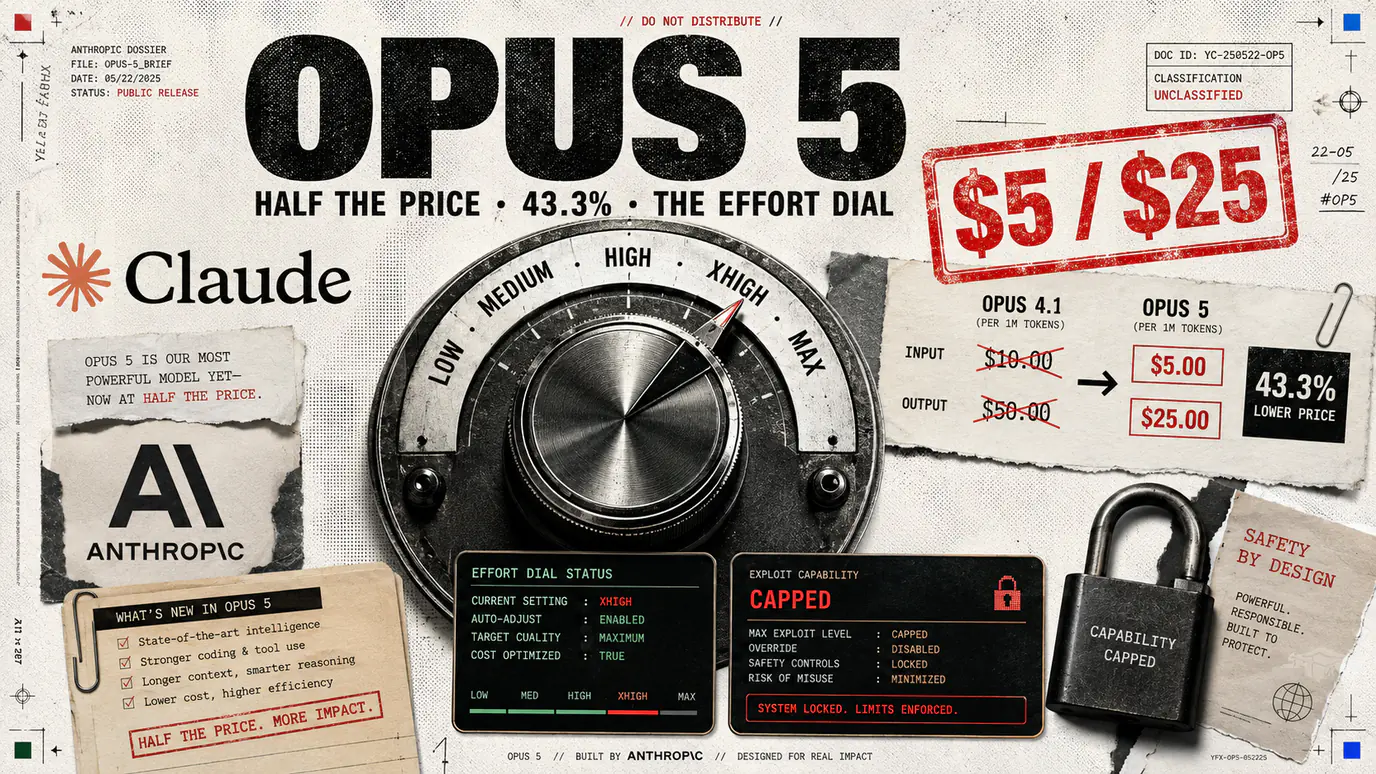
Anthropic's agentic coding and enterprise model, released 24 July 2026 at $5 and $25 per million tokens, half what Claude Fable 5 costs. It ships an effort dial from low to max, and independent testers rate it highly while finding it verbose and slow to start.
What it is
Claude Opus 5 is Anthropic’s model for complex agentic coding and enterprise work, released on 24 July 2026 and called on the Claude API as claude-opus-5. It was Anthropic’s recommended starting point at launch. The current model overview recommends Opus 5.5, released on 22 September, with Fable 5.1 reserved for the hardest work. It carries a one-million-token context window, a maximum output of 128,000 tokens on the Messages API and 300,000 on the Batch API through a beta header, and a training data cut-off of May 2026.
It runs on Claude.ai, the Claude API, Claude Code and Claude Cowork, plus Amazon Bedrock, Google Cloud Vertex AI and Microsoft Foundry. At launch it was the default model on Claude Max and the strongest available on Claude Pro. A Fast mode runs at roughly 2.5 times the default speed for twice the price.
How it compared at launch
The price is the story. Opus 5 lists at $5 per million input tokens and $25 per million output tokens. That is exactly what Claude Opus 4.8 cost, and half the $10 and $50 Anthropic charges for Fable 5, the flagship it launched in June. On the company’s own comparison table the cheaper model leads the more expensive one on most rows, which is a lab undercutting its own frontier product on price. At launch, Anthropic reserved Fable 5 for workloads that need the highest capability available, and it kept narrow leads on Humanity’s Last Exam without tools and on FrontierCode.
Opus 4.8 moved to the legacy list in Anthropic’s documentation on the same day. The launch range also included Claude Sonnet 5, at $2 and $10, pricing Anthropic made permanent on 10 August 2026 in place of a planned rise to $3 and $15, for balanced work and Claude Haiku 4.5 at the fast end. Claude Mythos 5, the defensive security model, shared Fable 5’s specification and used restricted access.
The effort dial
The feature that separates this release from a normal version bump is the effort parameter, which runs low, medium, high, xhigh and max. High is the default on the Claude API and in Claude Code. The setting governs how much the model thinks its way through a request, including the reasoning wrapped around tool calls, so a developer buys more capability on a hard task and spends less on a routine one without switching models.
That changes the shape of the decision. For years the question has been which model to call. The question now is how hard to make one model work, and every chart Anthropic published plots score against cost rather than score alone. The honest reading of those charts is that the top of each curve is expensive.
How to read the numbers
A caution that applies to every model page here. A benchmark is a fixed set of tasks run to produce a comparable figure, and the party publishing a launch benchmark has an interest in the result, so a single number belongs alongside independent testing rather than in front of it.
On Anthropic’s own figures, Opus 5 scores 43.3 per cent on Frontier-Bench v0.1, a terminal coding evaluation, against 33.7 for Fable 5 and 21.1 for Opus 4.8. It reached 70.6 per cent on OSWorld 2.0 for computer use against Fable 5’s 66.1 at launch; Anthropic’s Opus 5.5 system card of 22 September 2026 re-ran OSWorld 2.0 on a revised task set and harness, puts Opus 5 at 74.0 per cent, and says those results supersede the launch figures. It scored 26.0 per cent on AutomationBench for business workflows against 17.4 for Fable 5 and 18.1 for OpenAI’s GPT-5.6 Sol. On ARC-AGI-3, built to resist memorisation, it scores 30.2 per cent where Opus 4.8 managed 1.5 and GPT-5.6 Sol 7.8.
The table concedes as much as it claims, which is unusual for launch material. Fable 5 stays ahead on Humanity’s Last Exam without tools (56.5 against 56.3 per cent), on the FrontierCode set (53.5 against 53.4) and more clearly on the held-out Legal Agent Benchmark (13.3 against 11.7). GPT-5.6 Sol leads DeepSWE v1.1 on 72.7 against 68.8. Anthropic’s own Mythos 5 tops the professional health set on 66.0 against 59.8.
The independent measurement reads differently. Artificial Analysis scores Opus 5 at max effort on 51 on the v4.3 rebase of its Intelligence Index of 7 September 2026, and at our 2 October 2026 read that board puts Claude Opus 5.5 at the top on 58 and Claude Sonnet 5.5 second on 56, Claude Fable 5.1, GPT-6 Astra and Gemini 4 Argon level on 53 and GPT-6.1 Sol on 52, then Opus 5 on 51, ahead of Muse Spark 1.3 and GPT-6 Sol on 48. Its model page records the cost of that placing: 52.3 output tokens per second, an average wait of 66.4 seconds for the first answer token, and 100 million output tokens consumed across the evaluation suite. Leading on capability while running slower and writing more is a defensible trade, and it is still a trade.
What the people using it say
Anthropic published on-the-record accounts from early-access customers, and the pattern in them is consistent enough to be worth reading. Scott Wu, chief executive of the company behind the Devin coding agent, reported that “on FrontierCode 1.1, Claude Opus 5 approaches Fable-level performance at half the cost,” with “particular strength on difficult debugging and root-cause analysis tasks.” Sualeh Asif, co-founder of Cursor, put it as “near Fable 5 intelligence at Opus speed and cost.” Wade Foster, chief executive of Zapier, said the model “topped Zapier’s AutomationBench leaderboard without spending more tokens than prior Claude models.” Ben Kus, chief technology officer of Box, gave a number: “Opus 5 outperforms Opus 4.8 by 8%.”
The word that recurs across those accounts is judgment rather than speed. Denis Shiryaev, who leads AI in the IDE at JetBrains, wrote that the model “thinks harder before it writes a single line, catches its own logical faults during planning rather than after the fact, and reasons about why an answer is right, not just whether it runs.” These are quotes selected by the vendor for a launch page, so read them as the best case rather than the average one.
Testing done outside that process is cooler, and more useful. The code review firm CodeRabbit ran roughly 100 verified open-source pull request issues against its production reviewer. At xhigh effort Opus 5 was more precise, at 39.3 per cent actionable precision against 35.2, and caught fewer of the known issues, 55.2 per cent against 61.1. It produced about 92 trivial comments against 23, and used roughly 60,500 input and 9,500 output tokens per review call against 40,500 and 5,800 for the baseline. Their conclusion was that “for code review, Opus 5 x-high is a specialist. It produces a cleaner actionable subset, but catches fewer known issues and adds a substantial nitpick tail.”
The sharpest published review from a working practitioner is Claire Vo’s, who ran the model through the seven-model benchmark she uses on the How I AI podcast and titled the result “Claude Opus 5 review: this model is brilliant (but annoying)”. Her complaints are about the experience rather than the capability: a section headed “Claude Slop: the verbosity problem and why it makes my blood boil”, a “neurotic” personality that showed up in real coding sessions “including a merge conflict it refused to touch”, and, against all of that, one use case where the model “earned straight 5s from me”. Brilliant and irritating in the same review is the recurring verdict on this model, and it is a more informative summary than any single score.
The capability Anthropic capped
Anthropic describes Opus 5 as its most aligned model to date, scoring 2.3 on its automated misalignment audit where lower is better, against 2.85 for Opus 4.8, 2.81 for Mythos 5 and 3.35 for Sonnet 5.
The security result is the more interesting one. On OSS-Fuzz, which measures finding and exploiting flaws in open-source code, Opus 5 identifies vulnerabilities at close to the level of Mythos 5, 79.4 per cent against 80.0, while solving only 4 exploitation challenges against 13. Anthropic states that the gap is deliberate: the safeguards are built to let developers find and fix flaws in their own code while blocking the step from discovery to a working exploit, and requests that trip the classifier can fall back to Opus 4.8. A frontier lab publishing a chart of a capability it chose to cap is worth noting whatever one makes of the number.
What to watch
Two things. The first is whether the pricing holds, because putting frontier-adjacent performance at the previous generation’s price pressures every rival selling capability by the token and complicates Anthropic’s own Fable 5 proposition six weeks after that model launched. The second is whether the effort dial changes how teams buy. If the useful setting for most work turns out to be low or medium, the practical cost of frontier capability falls again; if serious work needs xhigh or max, the headline price is not the price anyone pays.
Our news report on the launch covers the benchmark table and the first independent tests in full: Claude Opus 5 takes the frontier at half the price. For how it compares with the rest of the field, see our large language models hub and the wider AI section; Anthropic’s own model documentation sets out the current line in detail.
More AI
All AI →Claude Opus 5 takes the frontier at half the price
Anthropic released Claude Opus 5 on 24 July at 5 and 25 dollars per million tokens, half the price of Fable 5, and it leads most rows of the company's own benchmark table. Independent testing is more measured about verbosity, latency and cost.
More in Large Language Models
All LLMs →- Google DeepMindGemini 4 Argonlonger reasoning, coding and cyber defence
- OpenAIGPT-5.6the flagship from 9 July to 3 September 2026
- OpenAIGPT-6 Astrathe new generation, rolling out from 3 September 2026
- OpenAIGPT-6.1 Solthe upgraded mid-price GPT-6 model, released 29 September 2026
- OpenAIGPT-6 Sol and Lunathe mid-price and budget GPT-6 models, released 22 September 2026
- AnthropicClaude Opus 5.5the first Claude 5.5 model, cheaper and faster than Opus 5