Claude Opus 5 takes the frontier at half the price
Anthropic released Claude Opus 5 on 24 July at 5 and 25 dollars per million tokens, half the price of Fable 5, and it leads most rows of the company's own benchmark table. Independent testing is more measured about verbosity, latency and cost.
Listen to this articleListen
The most consequential number in Anthropic’s Claude Opus 5 launch is five dollars.
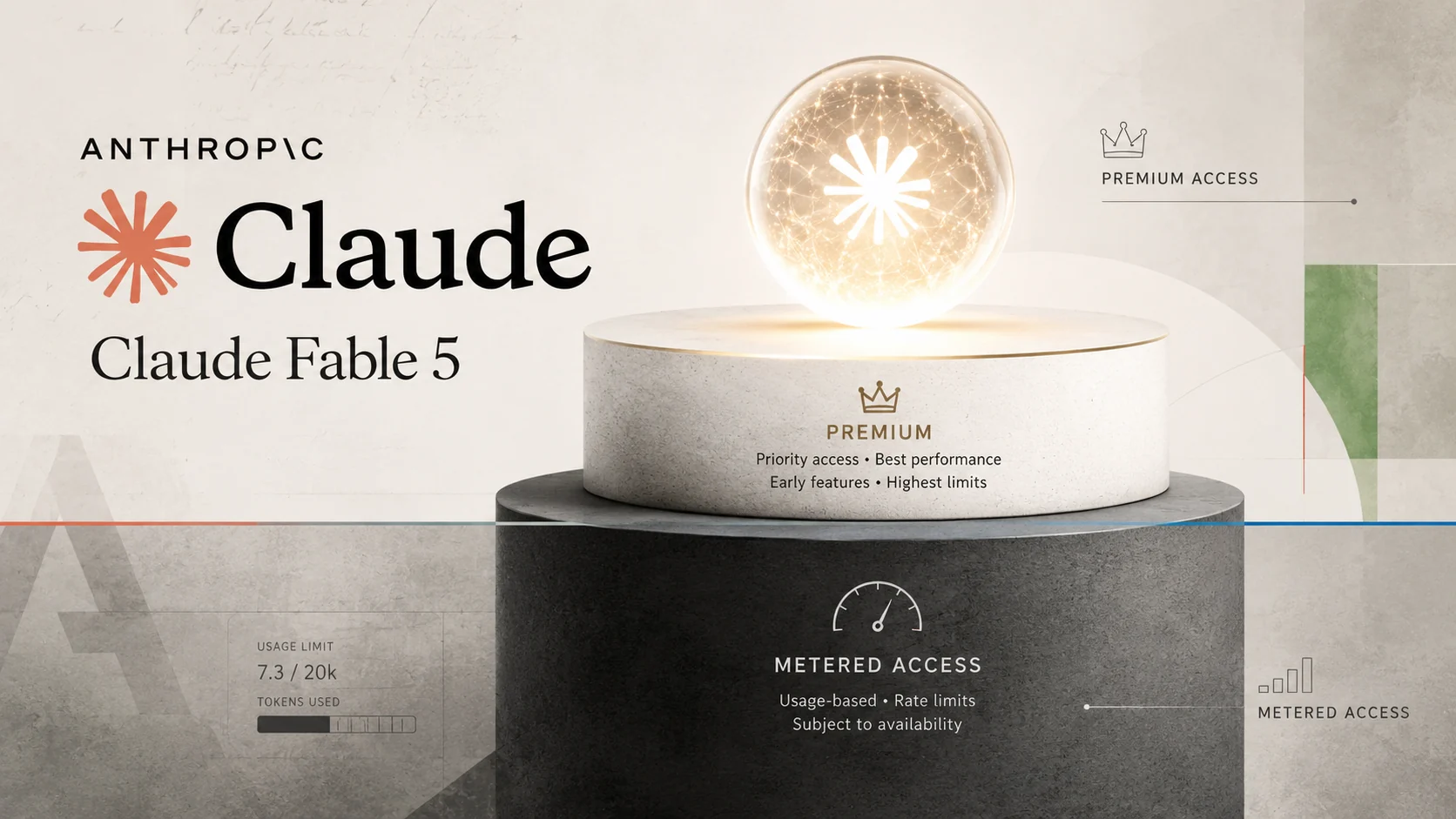
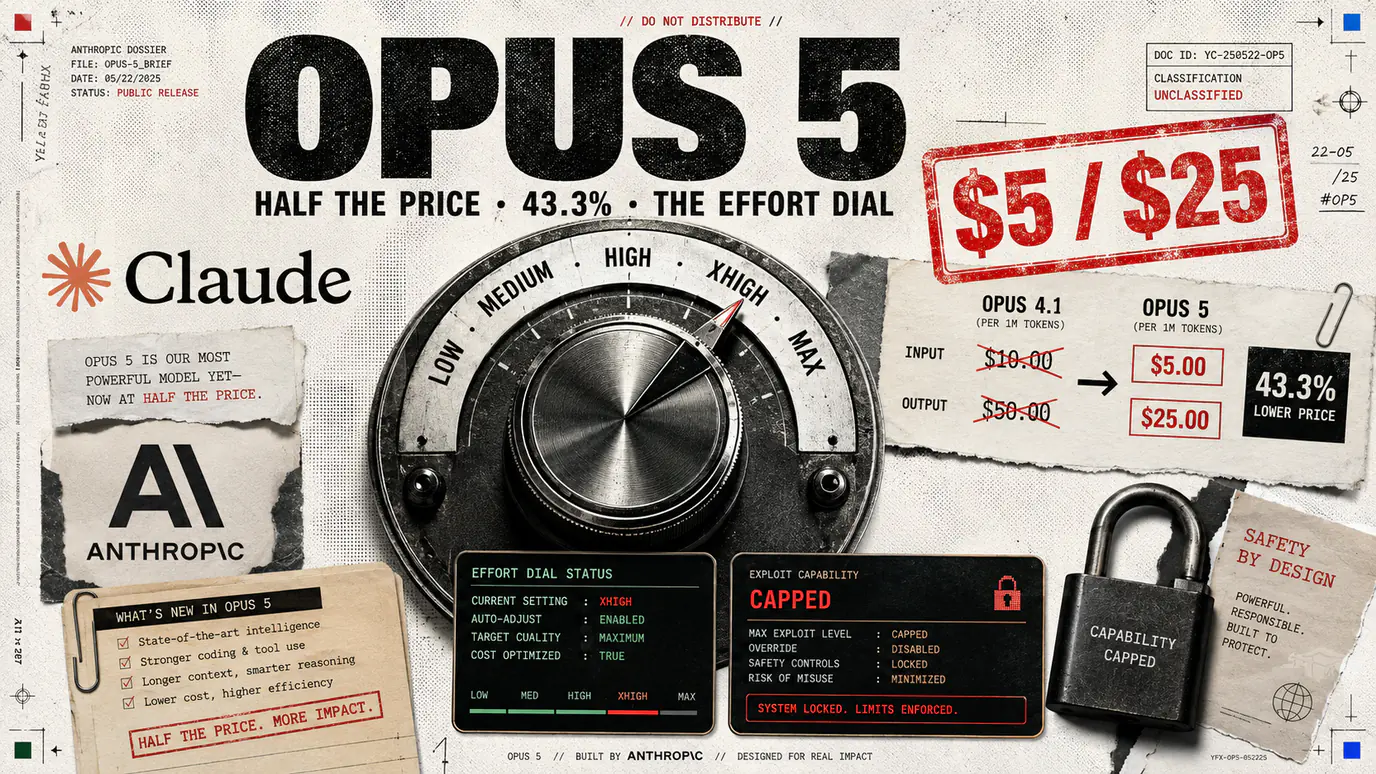
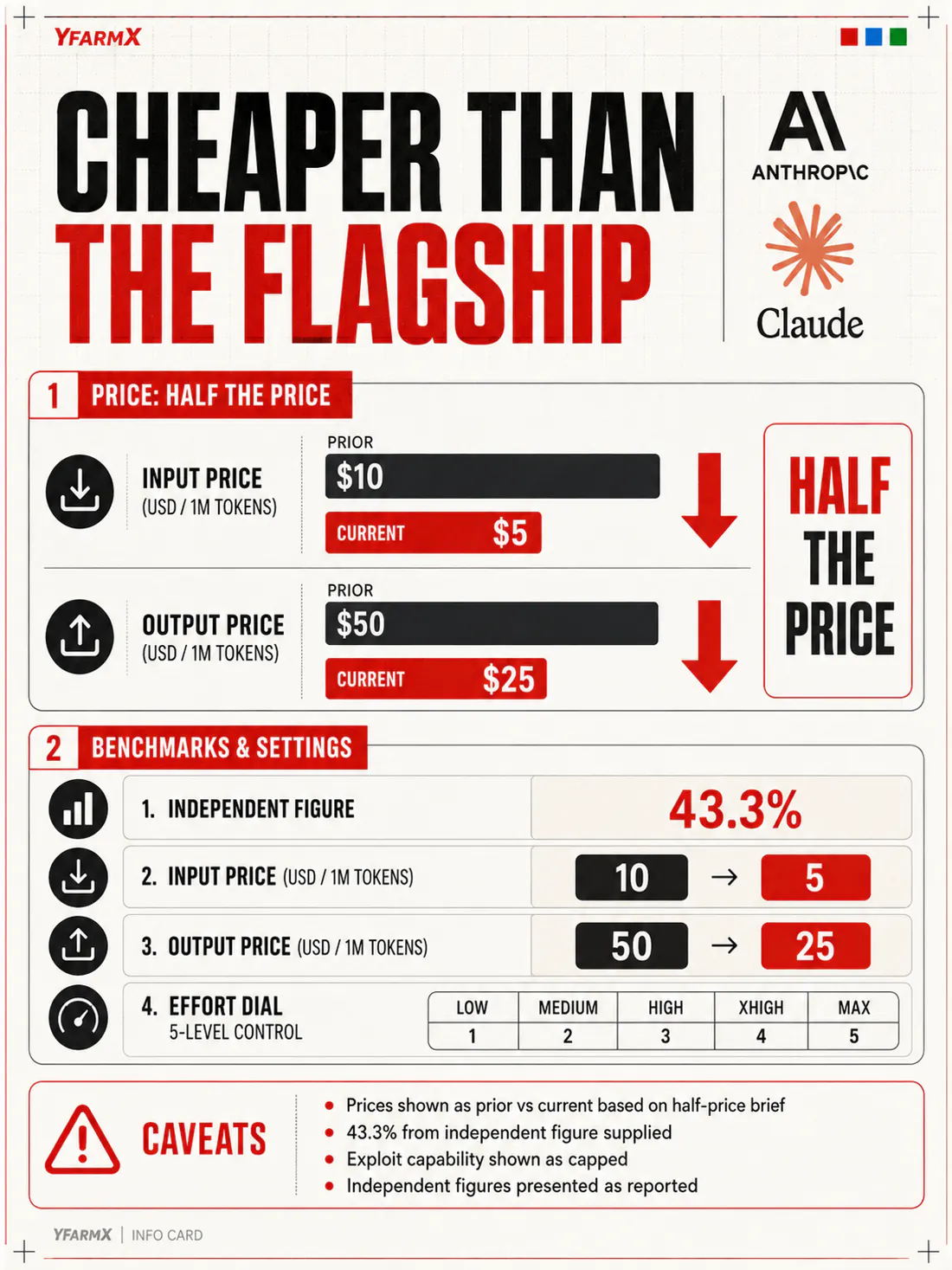
Anthropic released Claude Opus 5 on 24 July at 5 dollars per million input tokens and 25 dollars per million output tokens. That is exactly what Opus 4.8 cost, and half what the company charges for Claude Fable 5, the flagship it launched in June at 10 and 50 dollars. On Anthropic’s own comparison table, the cheaper model leads the more expensive one on most rows. A company has undercut its own frontier product on price with something its own figures put ahead on most tests. Fable 5 is still the ceiling: Anthropic’s documentation reserves it for workloads that need the highest capability available, and it keeps narrow leads on Humanity’s Last Exam without tools and on FrontierCode.
The model is available immediately across Claude.ai, the Claude API as claude-opus-5, Claude Code and Claude Cowork, plus Amazon Bedrock, Google Cloud Vertex AI and Microsoft Foundry. It becomes the default on Claude Max and the strongest model available on Claude Pro. A Fast mode runs at roughly 2.5 times the default speed for twice the price.
What the scoreboard says
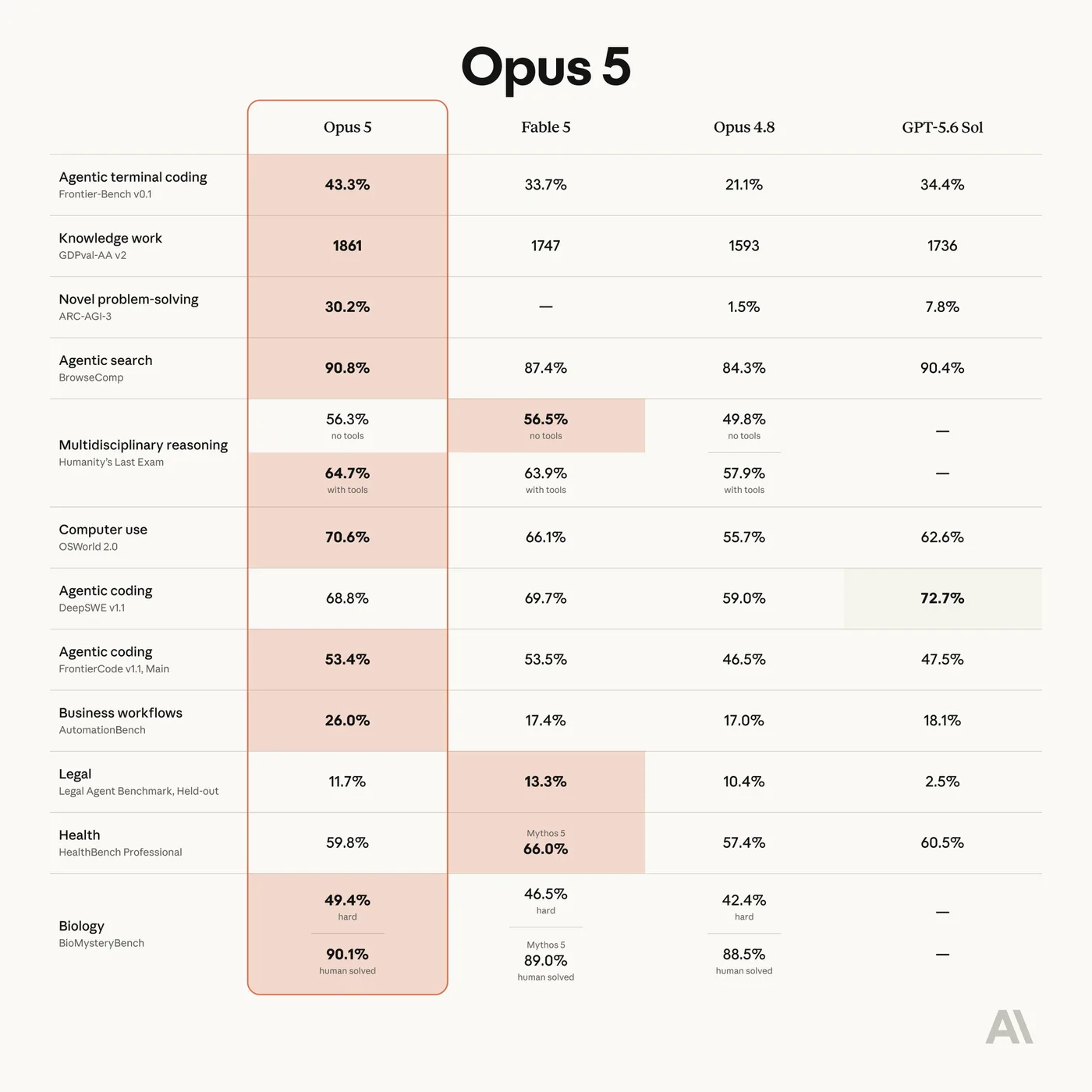
The headline gains are in agentic work, the category where a model is handed tools and left to complete a task. On Frontier-Bench v0.1, a terminal coding evaluation, Opus 5 scores 43.3 per cent against 33.7 for Fable 5 and 21.1 for Opus 4.8. On OSWorld 2.0, which measures a model driving a computer, it reaches 70.6 per cent against Fable 5’s 66.1. On AutomationBench, a set of business workflow tasks, it nearly doubles the field with 26.0 per cent against 17.4 for Fable 5 and 18.1 for OpenAI’s GPT-5.6 Sol. Anthropic puts its GDPval-AA knowledge work score at 1861, ahead of Fable 5 on 1747.
The table is worth reading for what it concedes as well as what it claims. Fable 5 stays marginally ahead on Humanity’s Last Exam without tools (56.5 against 56.3 per cent) and on the FrontierCode coding set (53.5 against 53.4), and more clearly ahead on the held-out Legal Agent Benchmark (13.3 against 11.7). GPT-5.6 Sol leads DeepSWE v1.1 on 72.7 per cent against 68.8. Anthropic’s own Mythos 5 tops the professional health set on 66.0 per cent against 59.8. These are narrow margins presented honestly, which is more than launch material usually offers.
The dial is the product
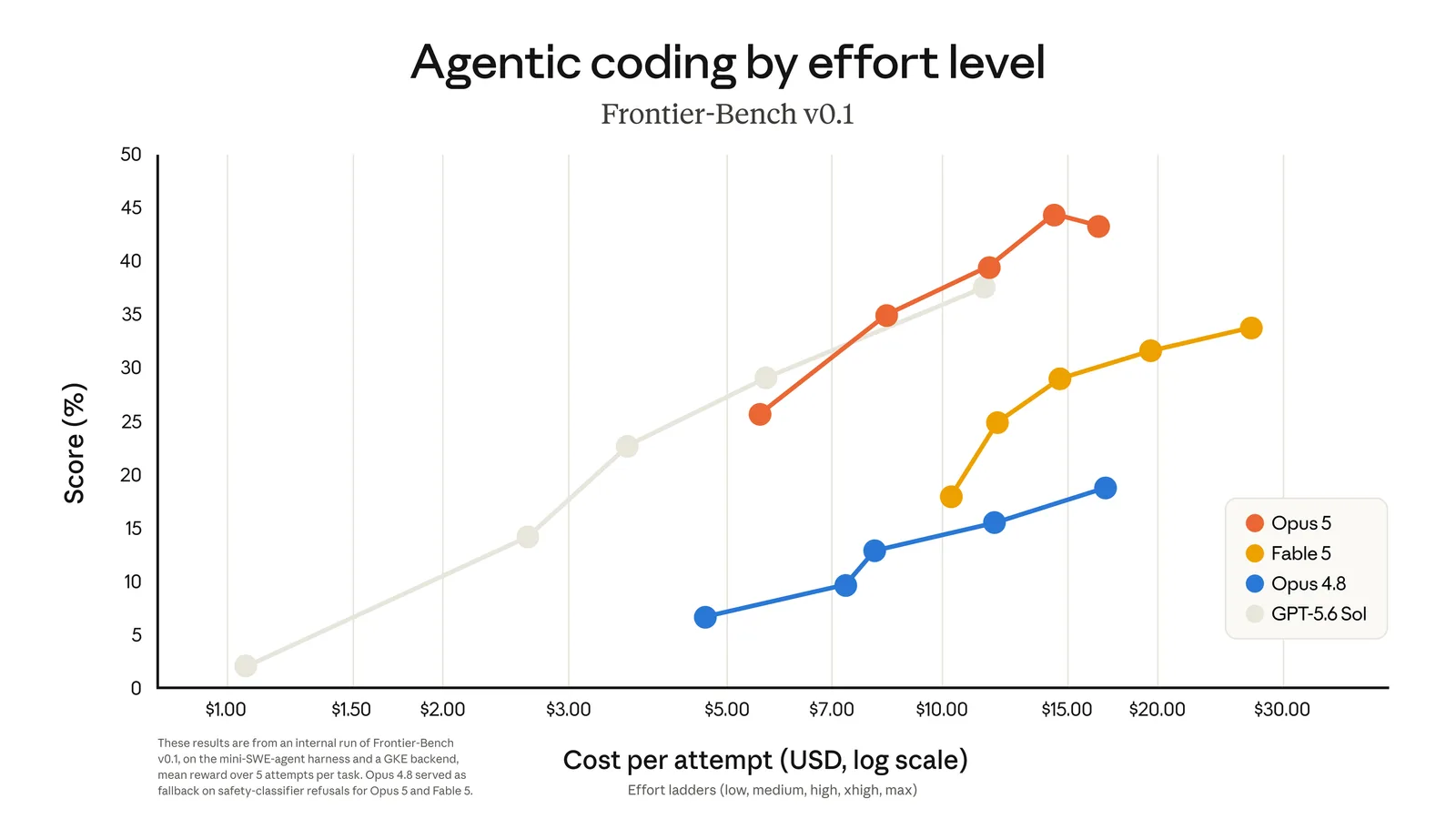
Every chart Anthropic published plots score against cost rather than score alone, because Opus 5 ships with an effort parameter running from low through medium, high and xhigh to max. High is the default. The setting governs how much the model thinks its way through a request, including the reasoning wrapped around tool calls, so a developer can buy more capability on a hard task and spend less on a routine one without switching models.
That reframes what a model release is. For years the choice has been which model to call. The choice now is how hard to make one model work, and the honest reading of these charts is that the top of each curve is expensive. On CursorBench 3.2 the company says Opus 5 at max effort lands within half a percentage point of Fable 5’s best result at half the cost per task, which is the sharpest statement of the value proposition and also a reminder that the flagship is still the ceiling.
Three times the next-best score on novel problems
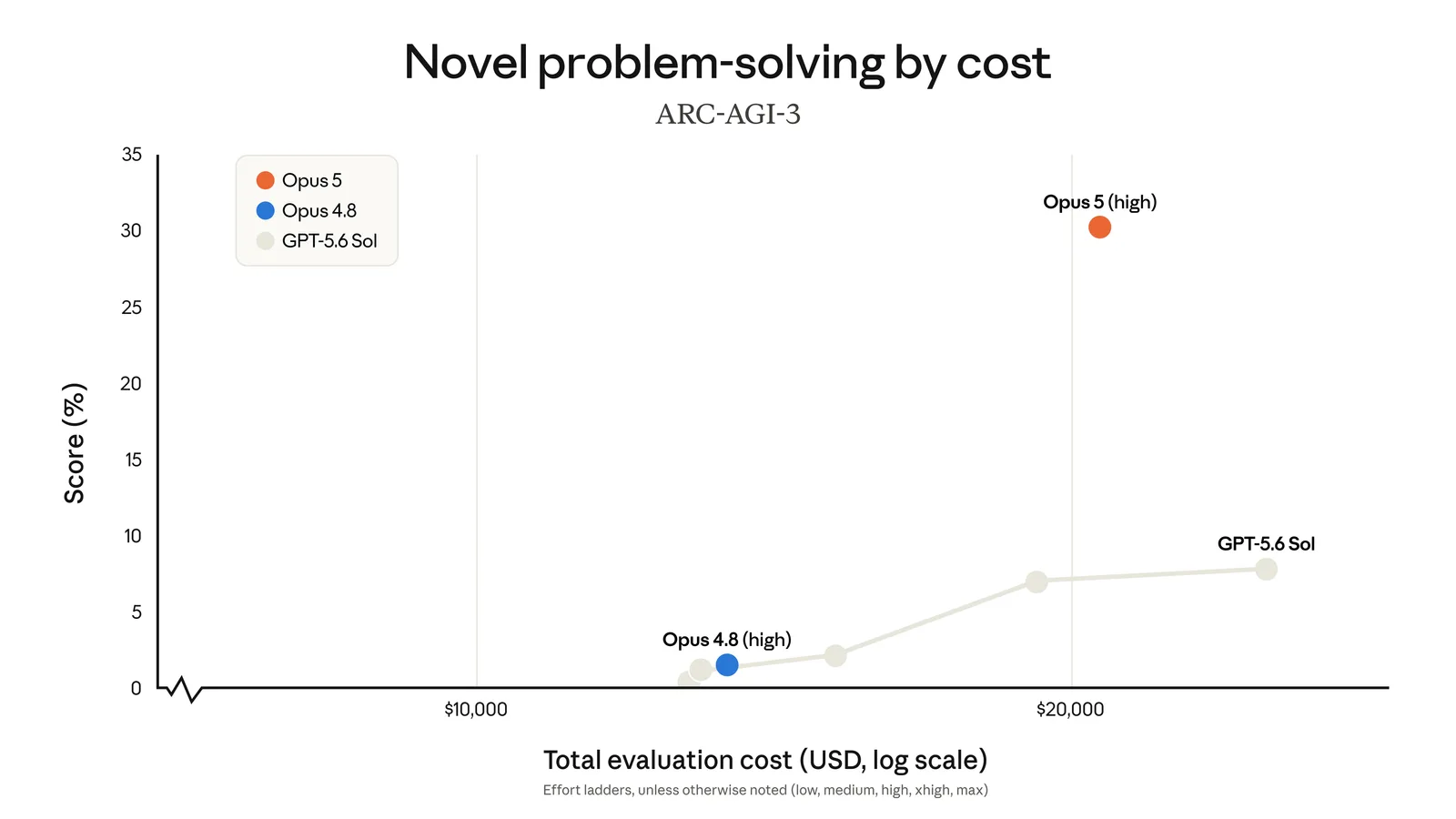
The result Anthropic is proudest of sits on ARC-AGI-3, a test built to resist memorisation by presenting problems a model cannot have seen. Opus 5 scores 30.2 per cent. Opus 4.8 managed 1.5 per cent and GPT-5.6 Sol 7.8, so the new model is roughly three times the next-best score and twenty times its own predecessor. Fable 5 has no published figure.
Treat the size of the jump with the caution it deserves. ARC-AGI-3 is one evaluation, the absolute number is still under a third, and a leap this large on a reasoning test invites the question of how much of the gain reflects general capability against tuning for the format. It is a real result and not yet a settled one.
What independent testing found
Anthropic’s charts are the company’s own. Two outside measurements arrived quickly and read differently.
Artificial Analysis ranks Opus 5 at max effort first among 191 models on its intelligence index with a score of 61, well clear of the 32 median for comparable reasoning models. The same page records the costs. Output runs at 59.8 tokens per second against a 73.6 median, the wait for the first token averages 66 seconds against a median under three, and the model produced 100 million output tokens across the evaluation suite where the average is 63 million. Leading on capability while running slower and talking more is a defensible trade, but it is a trade, and per-task bills reflect it.
The code review firm CodeRabbit ran a controlled comparison against its production reviewer and reached a more pointed conclusion. At xhigh effort, Opus 5 produced cleaner actionable comments, with precision of 39.3 per cent against 35.2, yet caught fewer of the known issues, 55.2 per cent against 61.1. It also generated about four times as many trivial comments, 92 against 23, and consumed roughly half again as many input tokens per call. Their recommendation was to run it as a second, precision-oriented reviewer, and their caution was explicit: the results “do not support using it as the only reviewer or as the primary safety net on high-risk changes.”
That is the useful counterweight to a launch table. A model can top an index and still be the wrong single point of failure.
The capability Anthropic chose not to ship
Anthropic describes Opus 5 as its most aligned model to date. On the company’s automated behavioural audit it “scores 2.3 on overall misaligned behavior, the lowest of our recent models”, against 2.85 for Opus 4.8, 2.81 for Mythos 5 and 3.35 for Sonnet 5. Lower is better on that scale.
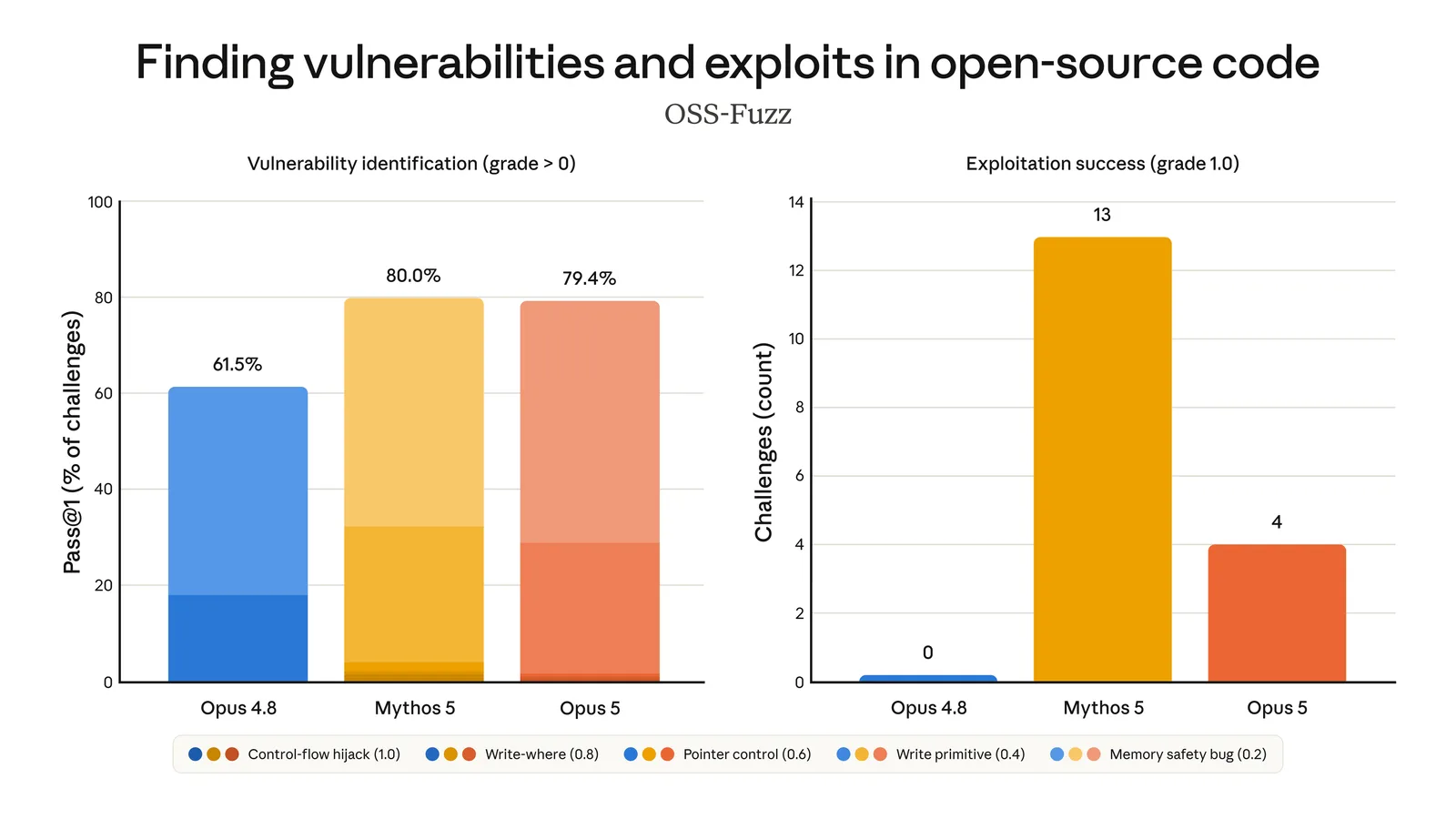
The security detail is the more interesting one. On OSS-Fuzz, which measures finding and exploiting flaws in open-source code, Opus 5 identifies vulnerabilities at close to the level of Mythos 5, 79.4 per cent against 80.0. On actually producing a working exploit it lands far behind, solving 4 challenges against 13. Anthropic states the gap is deliberate: the safeguards are built to let developers find and fix flaws in their own code while blocking the step from discovery to weaponisation, and requests that trip the classifier can fall back to Opus 4.8. The company is candid that the model remains behind Mythos 5 on both offensive cybersecurity and biology research.
A frontier lab publishing a chart of a capability it chose to cap is unusual, whatever one makes of the number.
Where this leaves the field
The competitive signal is the pricing. Anthropic has put frontier-adjacent performance at the price of its previous generation, which pressures every rival selling capability by the token and complicates its own Fable 5 proposition barely six weeks after that model’s access terms drew 27 million views. For anyone running agents at volume, the arithmetic changed on Friday.
The caution is the same one that applies to every launch table. The scores are Anthropic’s, the evaluations are young, and the first independent read already finds a model that is verbose, slow to start and strongest as one voice among several rather than the last word. Those two readings are not in conflict. They describe a genuinely strong model with a bill attached, and a dial that finally makes the bill something a developer controls.
Sources
- Anthropic, Introducing Claude Opus 5anthropic.com
- Claude Platform Docs, Effort parameterplatform.claude.com
- Artificial Analysis, Claude Opus 5artificialanalysis.ai
- CodeRabbit, Opus 5 code review evaluationcoderabbit.ai