
OpenAI
GPT-6.1 Sol
the upgraded mid-price GPT-6 model, released 29 September 2026
Key facts
- 29 Sep 2026API, ChatGPT Work, Codex
- Released
- $2 / $10per M tokens in / out
- Price
- $0.10per M tokens, half GPT-6 Sol's
- Cached input
- 1,050,000tokens
- Context
- 128,000tokens
- Max output
- 52Artificial Analysis, max effort
- Intelligence Index
GPT-6.1 Sol is an AI model from OpenAI, the company behind ChatGPT, built for coding, operating computer programs and office work such as reading long documents. Released on 29 September 2026, it upgrades GPT-6 Sol at the same $2 and $10 per million tokens and scores within one point of GPT-6 Astra, OpenAI's most capable model, which costs five times as much.
What GPT-6.1 Sol is
GPT-6.1 Sol is a large language model from OpenAI, released on 29 September 2026 as an upgrade to GPT-6 Sol, the mid-price model OpenAI had launched seven days earlier. It sits in the middle of the GPT-6 family, below GPT-6 Astra at the top and above GPT-6 Luna at the budget end. OpenAI’s announcement calls it “an upgrade to GPT‑6 Sol that nearly matches GPT‑6 Astra’s intelligence on agentic coding, computer use, and professional work at one-fifth of Astra’s standard input and output token prices”.
The model takes text and images in and writes text out. Developers call it as gpt-6.1-sol, and OpenAI’s API model page lists a 1,050,000-token context window, 128,000 tokens of output and a knowledge cut-off of 30 April 2026. OpenAI’s system card addendum, published the same day, describes GPT-6.1 as “the latest model family in the GPT-6 series”.
| Specification | GPT-6.1 Sol |
|---|---|
| API model ID | gpt-6.1-sol |
| Released | 29 September 2026 |
| Context window | 1,050,000 tokens |
| Maximum output | 128,000 tokens |
| Knowledge cut-off | 30 April 2026 |
| Input | Text, image |
| Output | Text |
| Reasoning effort | low, medium (default), high, xhigh, max |
What it costs
GPT-6.1 Sol costs $2 per million input tokens and $10 per million output tokens on OpenAI’s API, the same as GPT-6 Sol, and cached input costs $0.10 per million tokens. OpenAI’s launch post says that cached rate is “95% less than standard input pricing and 50% less than GPT‑6 Sol’s cached input pricing”. GPT-6 Astra, the flagship, costs $10 and $50.
| Per million tokens | GPT-6.1 Sol | GPT-6 Sol | GPT-6 Astra |
|---|---|---|---|
| Input | $2.00 | $2.00 | $10.00 |
| Cached input | $0.10 | $0.20 | $1.00 |
| Cache writes | $2.50 | $2.50 | $12.50 |
| Output | $10.00 | $10.00 | $50.00 |
Four pricing rules on the GPT-6.1 Sol model page change the bill. A prompt with more than 272,000 input tokens is “priced at 2x input and cache rates and 1.5x output for the full request”. Fast mode costs twice the standard rate. Batch and Flex processing cost 50% less than standard. Regional processing adds a 10% premium where it is offered.
The cheaper cache cuts the cost of long agent runs. An agent that re-reads the same codebase or document on every step pays for most of its input at the cached rate, and that rate is now half what it was. Artificial Analysis says the change makes GPT-6.1 Sol’s “overall blended price for agentic workloads” slightly lower than GPT-6 Sol’s.
What changed from GPT-6 Sol
GPT-6.1 Sol keeps GPT-6 Sol’s prices for input and output, its 1,050,000-token context and its 128,000-token output limit, and changes four things. The specifications are from OpenAI’s two API model pages and the release dates from its two launch posts, read on 2 October 2026.
| GPT-6 Sol | GPT-6.1 Sol | |
|---|---|---|
| Released | 22 September 2026 | 29 September 2026 |
| Cached input | $0.20 (10% of input) | $0.10 (5% of input) |
| Knowledge cut-off | 20 April 2026 | 30 April 2026 |
| Reasoning effort | none, low, medium, high, xhigh, max | low, medium, high, xhigh, max |
| Tool calling | Responses API; Chat Completions with effort set to none | Responses API |
The removal of the none effort setting has a practical knock-on. GPT-6 Sol could call functions through Chat Completions with reasoning switched off; for GPT-6.1 Sol, OpenAI says “Use the Responses API for tool calling. Chat Completions is supported without tool calling.” On the Responses API, the model page lists web search, file search, image generation, code interpreter, a hosted shell, apply patch, skills, computer use, MCP and tool search.
OpenAI’s launch post says the gains run across “complex professional tasks, from writing and debugging code to understanding documents and executing multi-step business workflows”. The system card addendum says GPT-6.1 Sol “uses the same types of data and training as GPT-6 Astra”.
OpenAI’s own benchmark results
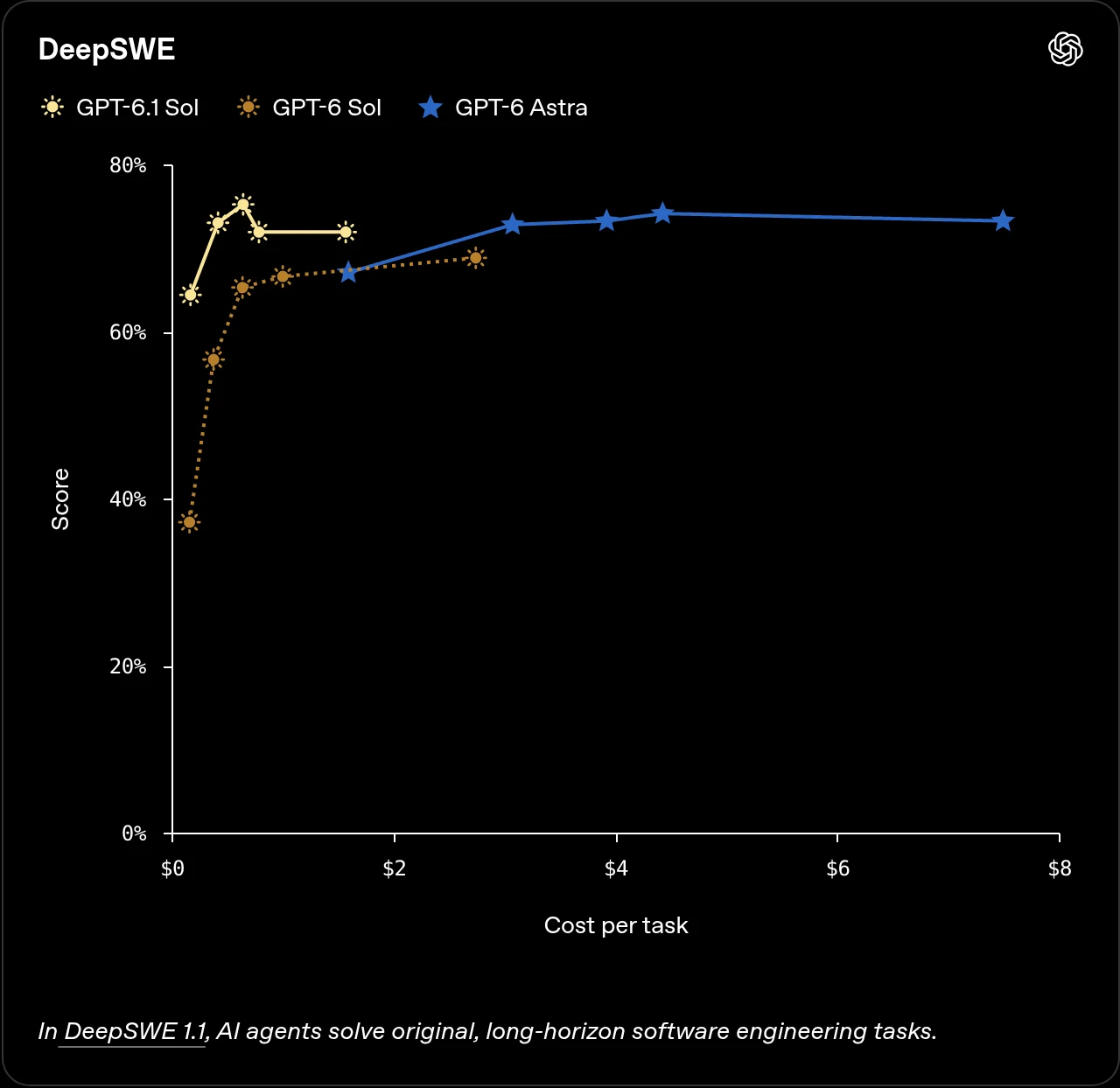
On OpenAI’s runs, GPT-6.1 Sol scores 75.2% on DeepSWE v1.1 at high effort for $0.65 a task, above GPT-6 Astra’s best of 74.1%, which cost $4.43 a task. The scores are OpenAI’s own, from its launch post of 29 September 2026: each is the model’s best across the effort settings OpenAI tested, with that run’s effort and its cost per task. OpenAI says the competitor results “were taken from publicly available reports”.
| Benchmark (OpenAI’s runs) | GPT-6.1 Sol | GPT-6 Sol | GPT-6 Astra |
|---|---|---|---|
| DeepSWE v1.1 | 75.2% (high, $0.65) | 68.8% (max, $2.74) | 74.1% (xhigh, $4.43) |
| GDP.pdf | 32.0% (high, $0.35) | 28.0% (high, $0.35) | 32.2% (xhigh, $1.91) |
| AutomationBench 1.0.6 | 36.1% (max, $0.30) | 33.2% (xhigh, $0.27) | 41.4% (max, $1.73) |
| OSWorld 2.0, offline set | 71.4% (max, $1.27) | 64.4% (max, $3.37) | 73.5% (max, $9.44) |
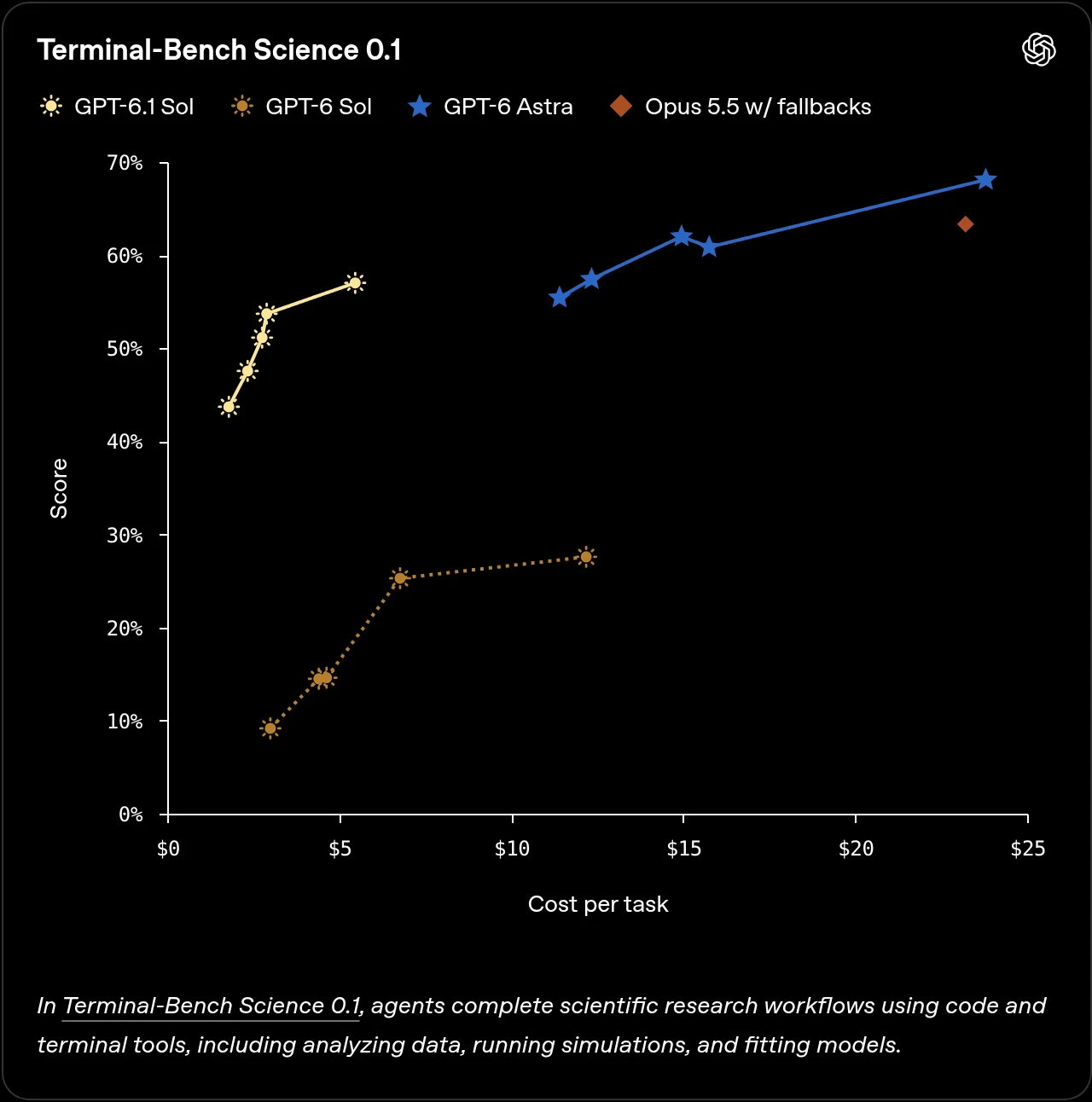
| Terminal-Bench Science 0.1 | 57.0% (max, $5.47) | 27.6% (max, $12.18) | 68.1% (max, $23.80) |
DeepSWE sets AI agents long software engineering tasks in real codebases. GDP.pdf asks professional questions about complex PDFs. AutomationBench tests multi-step business workflows across 47 tools. OSWorld 2.0 tests long computer-use workflows, and OpenAI reports the partial reward on its offline set. Terminal-Bench Science 0.1 covers scientific work such as data analysis, simulation and model fitting.
OpenAI also charted Anthropic’s Claude Opus 5.5, run with fallbacks, on three of these tests. Its best scores were 28.8% on GDP.pdf (high, $0.83 a task), 42.5% on AutomationBench (max, $1.44) and 63.3% on Terminal-Bench Science (max, $23.21).
OpenAI’s headline comparisons are made at matched settings. On AutomationBench at medium effort, GPT-6.1 Sol scores 31.7% against Claude Opus 5.5’s 29.5%, “at roughly a third of the cost”, and 4.8 points above GPT-6 Sol’s 26.9%. On OSWorld 2.0 at maximum effort it comes “within 2.1 percentage points of Astra’s score” at “roughly one-seventh the cost per task”.
Terminal-Bench Science shows the largest jump: GPT-6.1 Sol more than doubles GPT-6 Sol’s score at maximum effort, from 27.6% to 57.0%, at $5.47 a task. OpenAI’s launch post adds that “GPT‑6 Astra still achieves the highest score among the models tested at 68.1%, and should be used for the most difficult scientific research tasks.”
OpenAI also measured factual errors on deliberately difficult ChatGPT conversations where users had flagged a mistake. At low effort, GPT-6.1 Sol “reduces the share of responses containing a factual error from 11.4% to 7.7%”. OpenAI notes that these prompts “are not representative of typical usage”.
What Artificial Analysis measured
Artificial Analysis, an independent benchmarking company, scores GPT-6.1 Sol at 52 on its Intelligence Index at maximum effort, one point below GPT-6 Astra’s 53 and four points above GPT-6 Sol’s 48. Its model page, read on 2 October 2026, ranks it 11th of 224 models in its class. The index combines ten evaluations, including Terminal-Bench 4.0, Humanity’s Last Exam, GDP.pdf and AutomationBench-AA.
| Artificial Analysis, max effort | Intelligence Index | Cost per index task | Output tokens per second |
|---|---|---|---|
| GPT-6.1 Sol | 52 | $0.72 | 63.5 |
| GPT-6 Sol | 48 | $1.04 | 91.6 |
| GPT-6 Astra | 53 | $3.26 | 51.3 |
GPT-6.1 Sol costs the least of the three to run the index. Artificial Analysis says GPT-6.1 Sol “costs less than a quarter of GPT-6 Astra per Intelligence Index task”, and that “for a given level of intelligence, there is no cheaper model”. It used 67 million output tokens to run the index, which the company rates as fairly concise, and its launch analysis of 29 September 2026 says the model uses “~10-30% more output tokens than GPT-6 Sol across effort levels”.
Artificial Analysis reports three more results.
- Coding agents. At max effort GPT-6.1 Sol gains 3 points on GPT-6 Sol on the Artificial Analysis Coding Agent Index and sits 2 points below GPT-6 Astra; at xhigh effort, which beat max by 3 points, “GPT-6.1 Sol (xhigh) scores 1 point above GPT-6 Astra for less than 15% of the Cost per Task”.
- Hallucinations. On AA-Omniscience, accuracy rises 8 points and the hallucination rate falls “from 60% to 54%”.
- Office work and terminal use. GPT-6.1 Sol gains 4 points on AA-Briefcase v1.1 and 5 on GDPval-AA v2.1, and Artificial Analysis also records “a 12 point jump in Terminal-Bench 4.0”, its agentic coding and terminal-use test.
Who can use it
GPT-6.1 Sol reached ChatGPT on 29 September 2026 for Plus, Pro, Business, Enterprise and Edu users, in the ChatGPT Work and Codex modes. OpenAI’s Codex models page adds that “For Enterprise and Edu, the plan keeps GPT-6.1 Sol off by default until an administrator enables it”; the launch rollout covers those five paid plans.
On the API, every usage tier from Tier 1 up can call gpt-6.1-sol. OpenAI’s model page lists 500 requests and 500,000 tokens a minute at Tier 1, rising to 15,000 requests and 40,000,000 tokens a minute at Tier 5. In Codex, Standard and Fast modes run from launch. OpenAI says GPT-6.1 Sol Ultrafast follows “in the coming days”, with “up to 8x faster token generation compared to its standard speed in Codex”.
OpenAI’s Codex guidance sets the line between its three models: “Choose Astra when a task needs the strongest capability across steps and tools”, use GPT-6.1 Sol “for repeated, long-running work”, and Luna “for clear, repeatable tasks”.
OpenAI rates its cyber skills Critical
OpenAI treats GPT-6.1 Sol as “Critical in cybersecurity and High for Biological and Chemical capability” under its Preparedness Framework, the same rating it gave GPT-6 Astra. The system card addendum of 29 September 2026 says the model therefore “uses the same safeguards stack as GPT-6 Astra”, and it rates the model below the High threshold for AI self-improvement.
Critical, in OpenAI’s framework, covers a model that can “identify and develop functional zero-day exploits of all severity levels in many hardened real-world critical systems without human intervention”. OpenAI says it is taking a phased approach to advanced cyber work with GPT-6.1 Sol through Daybreak, its trusted-access programme, as it did with Astra.
On alignment, OpenAI’s launch post reports that GPT-6.1 Sol fails to tell a user their search tool is broken in 2.1% of deliberately hard cases at maximum effort, against 4.9% for GPT-6 Sol and 1.5% for GPT-6 Astra.
How it compares with Claude Sonnet 5.5 and Gemini 4 Argon
GPT-6.1 Sol and Claude Sonnet 5.5 cost $2 per million input tokens and $10 per million output tokens, and Google has announced the same introductory price for Gemini 4 Argon. All three were announced between 28 and 30 September 2026. Sonnet 5.5 scores highest on the Artificial Analysis Intelligence Index at 56; GPT-6.1 Sol costs the least to run it, at $0.72 a task against Sonnet 5.5’s $7.67.
| GPT-6.1 Sol | Claude Sonnet 5.5 | Gemini 4 Argon | |
|---|---|---|---|
| Maker | OpenAI | Anthropic | Google DeepMind |
| Released | 29 September 2026 | 28 September 2026 | Announced 30 September 2026 |
| Input / output, per million tokens | $2 / $10 | $2 / $10 | $2 / $10 introductory, then $4 / $20 |
| Cached input, per million tokens | $0.10 | $0.20 | 95% off input |
| Artificial Analysis Intelligence Index | 52 (max) | 56 (max effort) | 53 (high) |
| Cost per index task | $0.72 | $7.67 | $1.99 |
| Access | API, ChatGPT Work and Codex | Claude Platform, AWS, Google Cloud, Microsoft Azure | Trusted cyber defenders and testers |
Prices and dates are from Anthropic and Google; the index scores are Artificial Analysis’s for Sonnet 5.5 and Argon, read on 2 October 2026.
Sonnet 5.5 used 420 million output tokens to run the index against GPT-6.1 Sol’s 67 million, at the same $10 output price. Artificial Analysis also measures Sonnet 5.5 at 139 output tokens a second, more than twice GPT-6.1 Sol’s 63.5. Gemini 4 Argon’s introductory price matches the other two, and Google says the rate rises to “$4 per 1M input tokens and $20 per 1M output tokens” after the introductory period. Google is rolling Argon out first to cyber defenders in its Fairwind Program, then to paid API customers and Google AI Ultra subscribers.
For the model it upgrades, see GPT-6 Sol and Luna; for the flagship above it, GPT-6 Astra.
Questions people ask
- How much does GPT-6.1 Sol cost?
- OpenAI's API price for GPT-6.1 Sol is $2 per million input tokens, $0.10 per million cached input tokens and $10 per million output tokens. Writing to the cache costs $2.50 per million tokens. A prompt longer than 272,000 tokens is billed at twice the input and cache rates and 1.5 times the output rate for the whole request.
- Can I use GPT-6.1 Sol in ChatGPT?
- OpenAI made GPT-6.1 Sol available on 29 September 2026 to Plus, Pro, Business, Enterprise and Edu users in ChatGPT Work and Codex. Enterprise and Edu workspaces get it once an administrator switches it on. OpenAI's launch post says it is 'not yet available in Chat', the everyday conversation mode.
- How does GPT-6.1 Sol score on independent tests?
- Artificial Analysis scores GPT-6.1 Sol at 52 on its Intelligence Index at maximum effort, one point below GPT-6 Astra's 53, at $0.72 per index task against Astra's $3.26. GPT-6 Sol, the model it upgrades, scores 48.
More AI
All AI →
OpenAI DevDay unveils agents and GPT-6.1 Sol
OpenAI's 29 September DevDay introduced dots, GPT-6.1 Sol, new agent APIs, Codex tools, plugins and team features. This is the full announcement list and rollout status.
More in Large Language Models
All LLMs →- OpenAIGPT-6 Sol and Lunathe mid-price and budget GPT-6 models, released 22 September 2026
- OpenAIGPT-6 Astrathe new generation, rolling out from 3 September 2026
- AnthropicClaude Sonnet 5.5faster everyday coding and office work at Sonnet prices
- Google DeepMindGemini 4 Argonlonger reasoning, coding and cyber defence
- OpenAIGPT-5.6the flagship from 9 July to 3 September 2026
- AnthropicClaude Opus 5.5the first Claude 5.5 model, cheaper and faster than Opus 5