
OpenAI
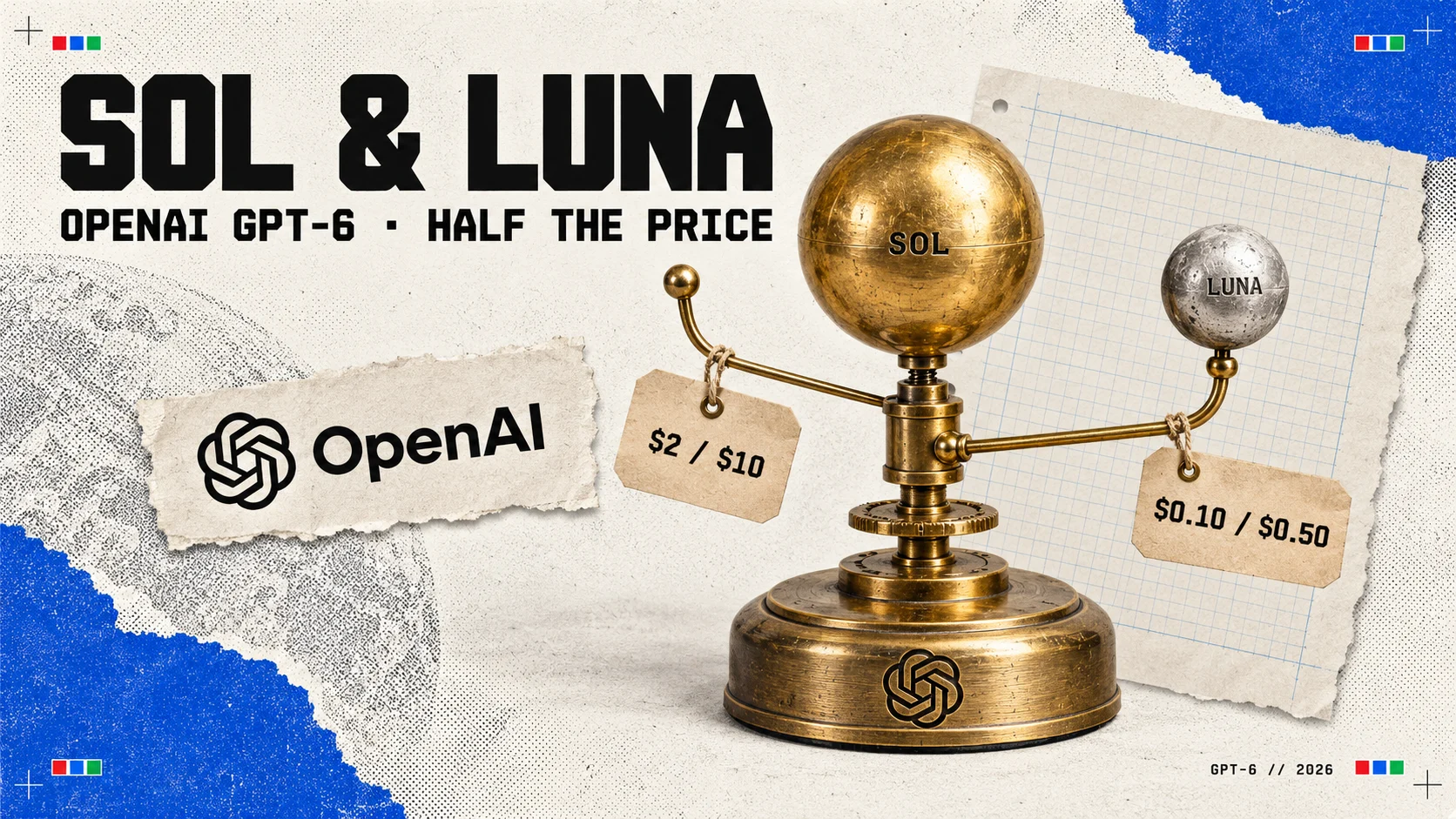
GPT-6 Sol and Luna
the mid-price and budget GPT-6 models, released 22 September 2026
Key facts
- 22 Sep 2026API, ChatGPT Work, Codex
- Released
- $2 / $10per M tokens in / out
- GPT-6 Sol
- $0.10 / $0.50per M tokens in / out
- GPT-6 Luna
- 50%against GPT-5.6
- Price cut
- 1,050,000tokens, both models
- Context
- 128,000tokens, both models
- Max output
GPT-6 Sol and GPT-6 Luna are two AI models from OpenAI, the company behind ChatGPT, released on 22 September 2026. They are the cheaper members of the GPT-6 family: Sol is the mid-price model for coding and agent work, and Luna is the budget model for fast, high-volume jobs. OpenAI trained both with the methods behind GPT-6 Astra, its flagship, and priced them at half what the GPT-5.6 versions cost.
What GPT-6 Sol and GPT-6 Luna are
GPT-6 Sol and GPT-6 Luna are two large language models from OpenAI, released on 22 September 2026, and they are the cheaper tiers of the GPT-6 family that began with GPT-6 Astra on 3 September. OpenAI’s API documentation describes Sol as “built for complex coding and agentic workflows” and Luna as “our most efficient model for focused, high-volume tasks”.
The names follow the pattern OpenAI set with GPT-5.6, where Sol, Terra and Luna ran from most capable to cheapest. In GPT-6, Astra sits at the top, Sol in the middle and Luna at the bottom. OpenAI’s announcement says it trained the two new models “with similar methods as GPT‑6 Astra”, bringing Astra’s gains in professional work, factuality, coding and computer use “to faster, more affordable models”.
GPT-5.6 Terra, at $2 and $12 per million tokens, stays on sale as the only Terra model, and GPT-6 Sol now undercuts it on output at $10.
GPT-6 Sol held the middle of the range for seven days. OpenAI released GPT-6.1 Sol on 29 September 2026 as an upgrade to it, at the same $2 in and $10 out per million tokens with cached input halved to $0.10, and OpenAI’s Codex documentation now points complex coding and agentic work at GPT-6.1 Sol. GPT-6 Sol stays available beside it in ChatGPT Work and Codex.
What they cost
GPT-6 Sol costs $2 per million input tokens and $10 per million output tokens, and GPT-6 Luna costs $0.10 and $0.50. OpenAI’s announcement of 22 September 2026 frames both as a 50% cut on the GPT-5.6 versions, measured against the promotional price GPT-5.6 Sol has carried since 21 August 2026.
| Per million tokens | Input | Cached input | Output |
|---|---|---|---|
| GPT-6 Sol | $2 | $0.20 | $10 |
| GPT-5.6 Sol | $4 | $0.40 | $20 |
| GPT-6 Luna | $0.10 | $0.01 | $0.50 |
| GPT-5.6 Luna | $0.20 | $0.02 | $1.20 |
Four pricing rules on OpenAI’s model pages apply to both models. Cached input costs a tenth of the normal input rate, and writing to the cache costs 1.25 times it. A prompt longer than 272,000 tokens is billed at twice the input rate and 1.5 times the output rate for the whole request. Batch and Flex processing cost half the standard rate, and Fast mode costs double. Regional processing adds 10%.
OpenAI also says it has improved prompt caching for GPT-6 so that more requests hit the cache by default. It quotes GitHub as reporting that caching improvements cut the share of prompt tokens needing fresh processing “by more than 50% across billions of requests to OpenAI models”.
Specifications
GPT-6 Sol and GPT-6 Luna share one specification: a 1,050,000-token context window, 128,000 tokens of output, text and image input, and text output. They differ on training cut-off, which OpenAI’s model pages list as 20 April 2026 for Sol and 18 May 2026 for Luna.
| Specification | GPT-6 Sol | GPT-6 Luna |
|---|---|---|
| API model ID | gpt-6-sol |
gpt-6-luna |
| Context window | 1,050,000 tokens | 1,050,000 tokens |
| Maximum input | 922,000 tokens | 922,000 tokens |
| Maximum output | 128,000 tokens | 128,000 tokens |
| Knowledge cut-off | 20 April 2026 | 18 May 2026 |
| Reasoning effort | none, low, medium (default), high, xhigh, max | none, low, medium (default), high, xhigh, max |
| Input | Text, image | Text, image |
Both run on the Responses API and Chat Completions, with Batch supported. On Chat Completions, function calling works only with reasoning effort set to none, so OpenAI points agent builders to the Responses API, where both models get the full tool set: web search, file search, code interpreter, a hosted shell, computer use and MCP.
Who gets them in ChatGPT
GPT-6 Sol and GPT-6 Luna rolled out on 22 September 2026 in ChatGPT Work and Codex for Plus, Pro, Business, Enterprise and Edu users, and Free and Go users can use Luna in the ChatGPT desktop app. OpenAI rolled them out to ChatGPT gradually through launch day, starting with the Work and Codex modes.
Luna is the only GPT-6 model a free ChatGPT account can reach so far.
How GPT-6 Sol scores against Claude
GPT-6 Sol beats Claude Opus 5 on OpenAI’s business workflow test at 9% of the cost per task, and comes within 1.1 points of Claude Fable 5 on a hard coding test. Every figure below is from OpenAI’s announcement of 22 September 2026, with the effort level OpenAI used for each run in brackets; OpenAI took the Claude scores from public reports.
| Benchmark | GPT-6 Sol | Compared with | What OpenAI says about cost |
|---|---|---|---|
| AutomationBench 1.0.6 | 33.2% (xhigh) | Claude Opus 5 (max) 26.9%, Claude Fable 5.1 (max) 31.4%, GPT-6 Astra (low) 30.3% | $0.27 a task; Opus 5 costs 11.1 times as much |
| Agents’ Last Exam | 56.4% (max) | Above Claude Opus 5’s best score | 60% lower cost per task than Opus 5 |
| DeepSWE v1.1 | 68.8% (max) | Claude Fable 5 (xhigh) 69.9% | About 80% lower cost per task |
| OSWorld 2.0, offline | 60.5% (xhigh) | Claude Opus 5 (medium) 60.3% | About 80% lower cost per task |
On FrontierCode, a test of whether a coding agent’s changes are ready to merge, OpenAI says Sol “is able to match Claude Fable 5.1 xhigh at much lower cost”. On factuality, measured on real ChatGPT conversations where users had flagged a mistake, OpenAI says “GPT‑6 Sol makes about half as many mistakes as its predecessor, approaching Astra-level reliability at much lower cost.”
Anthropic’s own launch table for Claude Opus 5.5, released the same day, scores Opus 5.5 at 40.0% on AutomationBench, above GPT-6 Sol’s 33.2%.
How GPT-6 Luna scores
GPT-6 Luna scores 66.6% on DeepSWE v1.1 at max effort, which OpenAI calls comparable to Claude Opus 5 and Claude Fable 5 at medium effort, while costing “93% less per task than Opus 5 and 96% less than Fable 5”. The figures are from OpenAI’s announcement of 22 September 2026.
OpenAI’s other Luna claims set it against GPT-5.6, which it replaces:
- AutomationBench. At high effort, Luna “improves on its predecessor by 5.4 percentage points at 58% lower cost per task”.
- OSWorld 2.0, offline. Luna at max effort “is able to exceed GPT‑5.6 Sol (medium) at one tenth of its cost”.
- Factuality. “At higher effort levels it matches GPT‑5.6 Sol at about a hundredth its cost.”
How they write
OpenAI says it gave Sol and Luna the writing style it introduced with GPT-6 Astra. Its announcement promises “more clarity, less jargon, fewer odd turns of phrase, fewer low-value details, and slightly shorter answers overall without losing substance”, and says the change will show most in technical and coding conversations.
On safety, OpenAI says both models improve on their GPT-5.6 counterparts in its alignment tests, “including lower rates of misleading claims about their coding work”. The announcement links to the GPT-6 Astra system card for full results, and OpenAI subsequently published an October safety card for the tuned Chat versions.
What to watch
The Chat rollout. OpenAI began rolling out tuned GPT-6 Sol in Chat on 7 October 2026 for paid plans, with GPT-6 Luna starting to reach Free and Go on 8 October. Availability depends on rollout and workspace settings. OpenAI’s release notes say the Work and Codex models are unchanged by this Chat release.
GPT-5.6 Sol’s promotional price. OpenAI’s model page says GPT-5.6 Sol keeps its $4 and $20 rate “at least through November 21, 2026”. GPT-6 Sol already costs half that.
Outside benchmarks. The scores above are OpenAI’s runs set against published Claude figures. Independent leaderboards will show where Sol and Luna land against Claude Opus 5.5, which arrived the same day at $4 and $20.
For the flagship above them, see GPT-6 Astra; for the generation they replace, GPT-5.6; and for Anthropic’s same-day release, Claude Opus 5.5.
More in Large Language Models
All LLMs →- OpenAIGPT-6 Astrathe new generation, rolling out from 3 September 2026
- OpenAIGPT-5.6the flagship from 9 July to 3 September 2026
- AnthropicClaude Opus 5.5the first Claude 5.5 model, cheaper and faster than Opus 5
- AnthropicClaude Opus 5frontier work with a dial on the bill
- AnthropicClaude Fable 5.1built for the API, hard on a subscription allowance
- Google DeepMindGemini 4 Argonlonger reasoning, coding and cyber defence