
Anthropic
Claude Opus 4.8
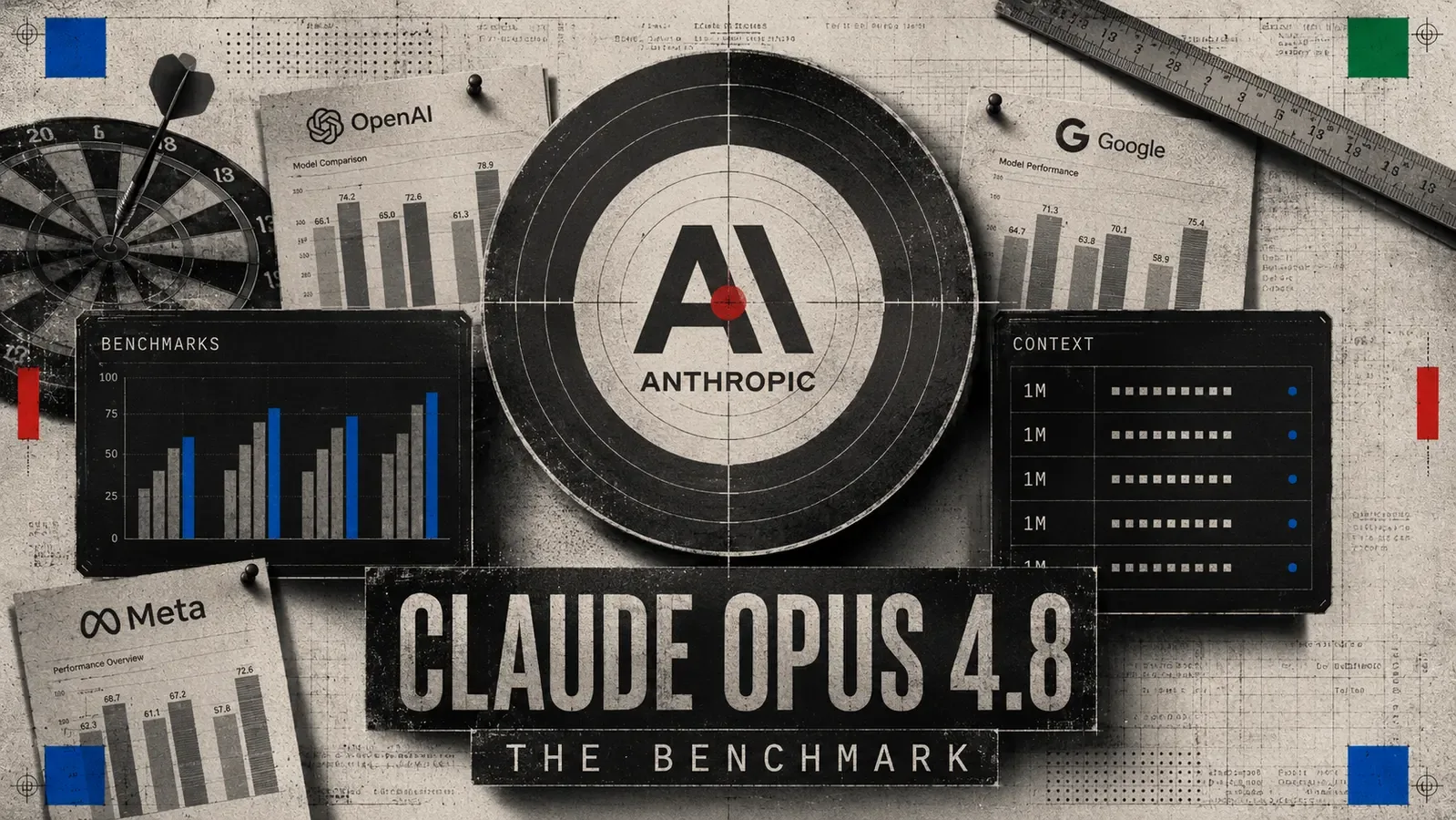
the benchmark everyone shoots at
Key facts
- Opustop tier
- Tier
- 1Mtokens
- Context
- $25per M output
- Price
- claude-opus-4-8Claude API
- Model ID
- Legacysince 24 Jul 2026
- Status
The benchmark everyone shoots at through the first half of 2026. Anthropic's previous Opus-tier model on the Claude API (model string claude-opus-4-8), moved to the legacy list on 24 July 2026 when Claude Opus 5 replaced it at the same price.
What it is
Claude Opus 4.8 was the Opus tier of Anthropic’s range, offered on the Claude API under the model string claude-opus-4-8, and through the first half of 2026 it took on a peculiar status in the industry: the benchmark everyone shoots at. When a rival lab wanted to show its newest system was competitive, claude opus 4.8 was the number it tended to put on the slide.
It is still available and still called by that model string, but it is no longer the current Opus. Anthropic released Claude Opus 5 on 24 July 2026 at exactly the same price, $5 per million input tokens and $25 per million output tokens, and moved 4.8 to the legacy list in its own documentation the same day. Requests to Opus 5 that trip its security classifier can still fall back to 4.8, so the older model retains a working role rather than a purely historical one.
That role says more than any single score. xAI has benchmarked its Grok 4.5 model against claude opus 4.8, and Moonshot has done the same with its K3 model. Choosing to measure yourself against a particular competitor is an admission of where the bar sits, and through 2026 that bar has repeatedly been Anthropic’s Opus tier. A model becomes the reference point only after enough people agree it represents the standard to beat.
How to read a benchmark
It helps to understand what a benchmark is and how to read one. A benchmark is a fixed set of tasks, from coding problems to reasoning questions, run against a model to produce a comparable score. Used honestly, benchmarks let buyers weigh one system against another on the same yardstick. The catch is that the party running the test usually has an interest in the outcome, and models can be tuned to do well on a specific set of questions without being better in general use, so a single figure on a launch slide should never be taken at face value.
Inside the Opus tier
The Opus name marks it as the largest and most capable line in Anthropic’s range, the tier reserved for the hardest reasoning, coding and analysis, where accuracy and depth are worth paying for. The model string claude-opus-4-8 is the exact identifier developers call in the Claude API, and the point-release number, 4.8, signals a mature line refined across several iterations rather than a first attempt.
Treat vendor comparisons with care
Being the target has consequences. Because rivals tune and present their results specifically to close the gap with claude opus 4.8, published comparisons tend to flatter the challenger, and readers should treat a benchmark chosen and run by the company launching a competing model with appropriate caution. The sensible course is to consult Anthropic’s own documentation for what the model is designed to do and to weigh independent testing alongside any vendor’s claims. Independent evaluations, run by parties with no stake in the result, are the proper corrective, and over time they tend to sort genuine capability from launch-day polish. That is the value of a common reference point: whatever its flaws, it at least lets buyers compare like with like.
What it signals and what to watch
The wider significance is what the pattern says about Anthropic’s position. A company does not become the industry’s yardstick by accident; it happens when its flagship is widely accepted as the one to beat. That the model fills this role for labs as different as xAI and Moonshot, one American and one Chinese, shows how far its reputation reaches. It also explains why serious challengers frame their launches around this single reference: beating the accepted leader is the quickest way to be taken seriously, and matching it is the minimum price of entry to the top tier.
What happened next answers the question this page used to leave open. The position held until Anthropic itself ended it: Opus 5 arrived on 24 July 2026 scoring 43.3 per cent on the Frontier-Bench v0.1 terminal coding evaluation against 21.1 for 4.8, and 30.2 per cent on ARC-AGI-3 against 1.5, at an identical price. The model everyone shot at was overtaken by the lab that built it rather than by a challenger, which is its own kind of answer about where the field’s pace is coming from.
For what replaced it, see Claude Opus 5. For how the range compares with the rest of the field, see our large language models hub and the broader AI section; Anthropic’s own Claude documentation sets out the current model line in detail.
More in Large Language Models
All LLMs →- Google DeepMindGemini 4 Argonlonger reasoning, coding and cyber defence
- OpenAIGPT-5.6the flagship from 9 July to 3 September 2026
- OpenAIGPT-6 Astrathe new generation, rolling out from 3 September 2026
- OpenAIGPT-6.1 Solthe upgraded mid-price GPT-6 model, released 29 September 2026
- OpenAIGPT-6 Sol and Lunathe mid-price and budget GPT-6 models, released 22 September 2026
- AnthropicClaude Opus 5.5the first Claude 5.5 model, cheaper and faster than Opus 5