
Google DeepMind
Gemini 3.5 family
Google’s May 2026 generation
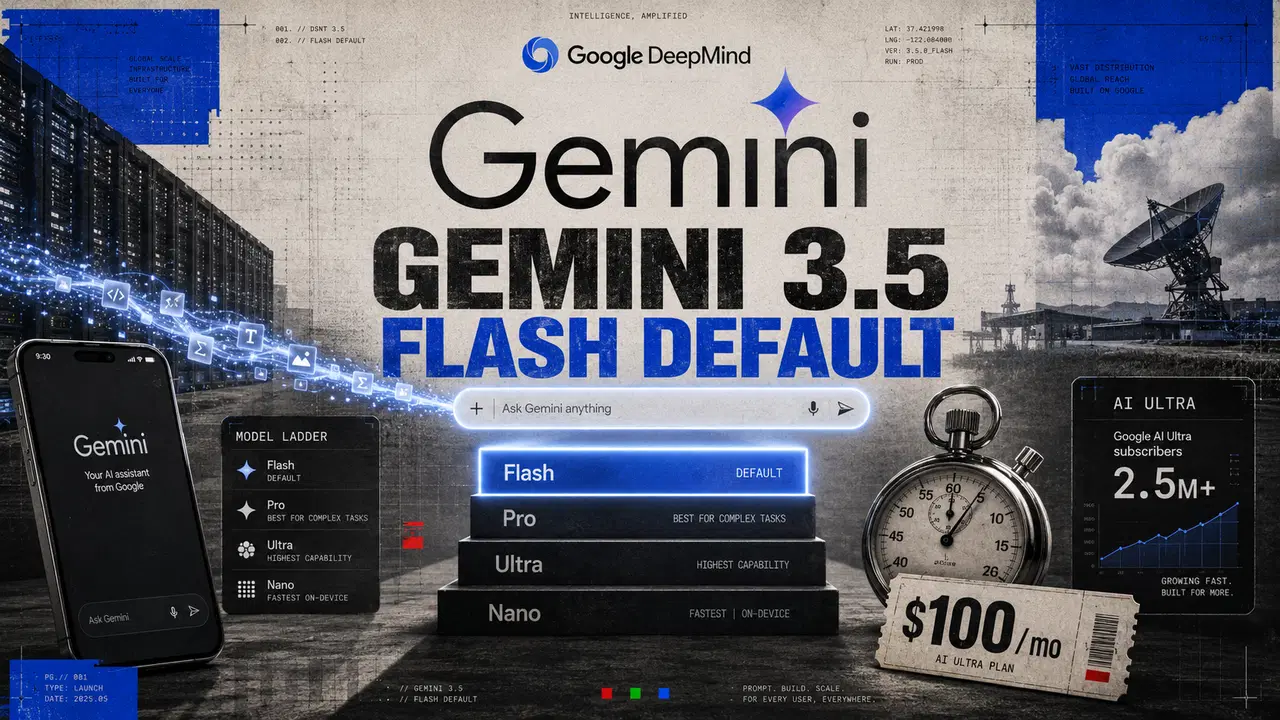
Key facts
- Google DeepMindGemini
- Lab
- 19 May 2026for I/O 2026
- Unveiled
- 3.8since 2 Sep 2026
- Flash tier
- $100per month, AI Ultra
- Top tier
Gemini 3.5, unveiled for I/O 2026 on 19 May, opened with 3.5 Flash as the default in the Gemini app and AI Mode in Search. The Flash tier has moved on to 3.6, 3.7 and 3.8 since; a 3.5 Pro is still in partner testing, and Google's next model above Flash arrived on 30 September as Gemini 4 Argon.
What it is
The Gemini 3.5 family is the generation of large language models Google DeepMind unveiled for its I/O developer conference on 19 May 2026. The generation opened with Gemini 3.5 Flash, a generally available model built for agentic and coding work, and Google moved quickly to put it at the centre of its products, making it the default model in the Gemini app and in AI Mode in Search worldwide. On 21 July 2026 the workhorse seat changed hands when Google launched Gemini 3.6 Flash, again on 13 August 2026 with Gemini 3.7 Flash, and a third time on 2 September 2026, when Gemini 3.8 Flash took the seat at 3.7 Flash’s introductory pricing. A Gemini 3.5 Pro remains in partner testing, and Google’s next model above the Flash tier arrived under a new number: Gemini 4 Argon, announced on 30 September 2026 and rolling out first to trusted cyber defenders through the Fairwind Program, at an introductory $2 in and $10 out per million tokens.
The API identifier now routes to Gemini 3.6 Flash
Google’s 8 October 2026 release notes mark Gemini 3.5 Flash as deprecated and removed from AI Studio. Requests to its API identifier route automatically to Gemini 3.6 Flash. Application developers should check the successor’s behaviour and current billing.
The family’s place in the release history
Gemini 3.5 Flash became a default in Google products at its May launch. Later Flash releases followed under the 3.6, 3.7 and 3.8 names, while Gemini 4 Argon entered restricted early access on 30 September. Model names identify releases; the app can choose between models under a separate access policy.
Tools and pricing
Google has paired the models with tooling aimed at developers building agents. Google Antigravity is an agentic development environment, a workspace for building and running software agents. Managed Agents in the Gemini API let developers hand the plumbing of an agent to Google’s infrastructure rather than wiring it up themselves. The emphasis on agentic and coding work runs through both the model design and the tools, which fits the direction the whole field has taken this year. Readers following that shift can track it on our large language models hub.
On the commercial side, Google AI Ultra, the top consumer subscription, is now available from $100 per month. That anchors the premium end of the range for individuals, while the Gemini API and the default-in-Search placement cover developers and the mass market respectively. Taken together it is a familiar three-way split: a flagship subscription, a developer API, and a free tier reaching a vast audience through Search. Charging a three-figure monthly sum for the top tier only works if the flagship reasoning and agentic features clearly justify it.
What to watch
In the wider field, the Gemini 3.5 family reads as Google’s answer to a run of frontier launches from rival labs. Its distinguishing move is distribution: by making a current-generation model the default in Search and the Gemini app, Google reaches a scale no competitor can match, whatever the benchmark tables say. The Flash seat has passed on three times since, to Gemini 3.6 Flash on 21 July 2026, Gemini 3.7 Flash on 13 August 2026 and Gemini 3.8 Flash on 2 September 2026, while Google has said a broader 3.5 Pro rollout is still in testing with partners. What to watch next is when the Pro tier catches up, and whether the agentic tooling becomes a developer default. More context sits on our main AI hub.
Gemini app access from 9 October
Google began changing personal-account access on 9 October 2026. Free users receive Auto selection: most prompts use Flash-Lite, while harder requests can use Flash or Pro. Turning smart selection off uses Flash-Lite. Usage allowances refresh every five hours and also have a weekly cap; selectable models on paid plans depend on the subscription. AI Plus changes follow the date in the subscriber’s email. These app rules are separate from developer API access. Google’s account-access guidance explains the rollout and limits.
More in Large Language Models
All LLMs →- Google DeepMindGemini 4 Argonlonger reasoning, coding and cyber defence
- OpenAIGPT-5.6the flagship from 9 July to 3 September 2026
- OpenAIGPT-6 Astrathe new generation, rolling out from 3 September 2026
- OpenAIGPT-6.1 Solthe upgraded mid-price GPT-6 model, released 29 September 2026
- OpenAIGPT-6 Sol and Lunathe mid-price and budget GPT-6 models, released 22 September 2026
- AnthropicClaude Opus 5.5the first Claude 5.5 model, cheaper and faster than Opus 5