Jeff Dean leaves Google after 27 years, and takes three more with him
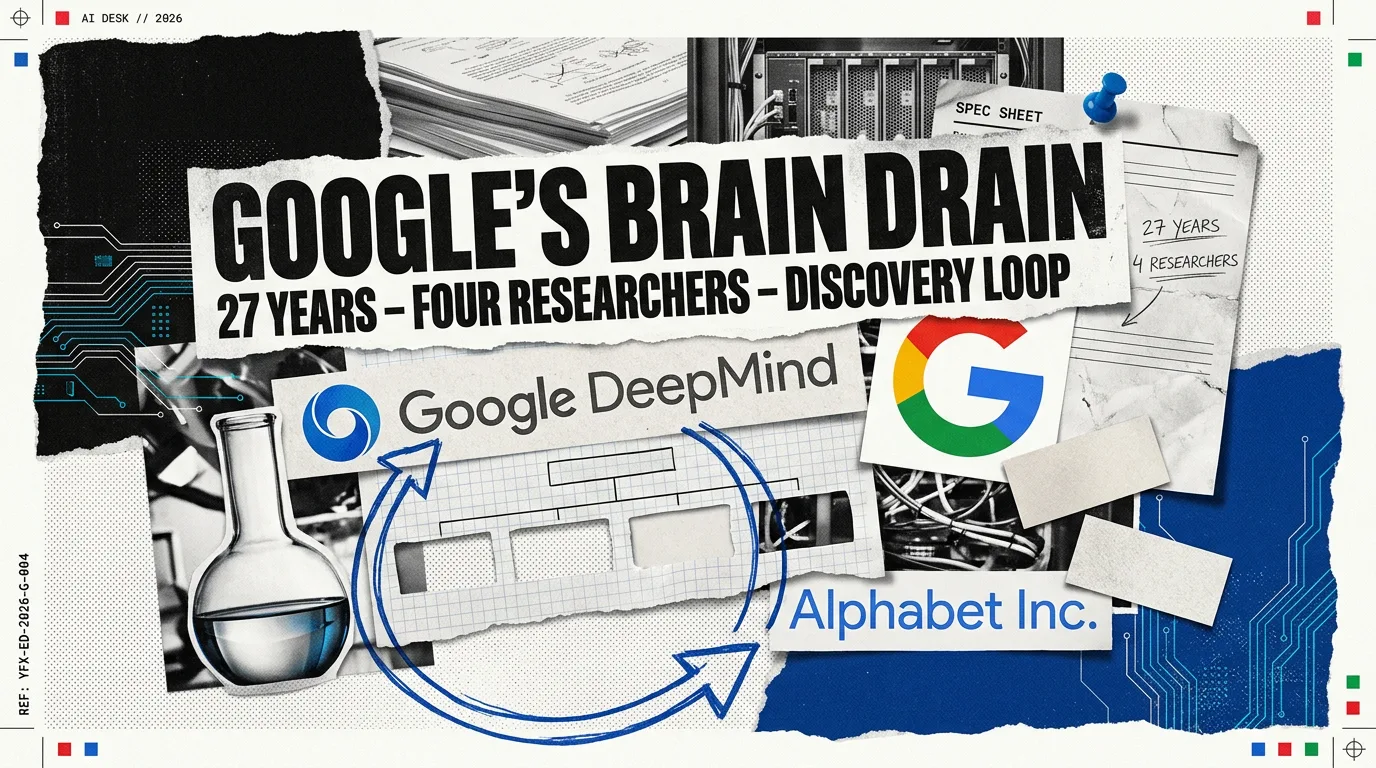
Google announced on 5 August that Demis Hassabis becomes Chair of Google DeepMind and Chief Scientist of Alphabet. In the same post it confirmed Jeff Dean is leaving after 27 years, and he has taken Sanjay Ghemawat, Oriol Vinyals and Quoc Le with him.
Listen to this articleListen
Sundar Pichai published a post on 5 August about accelerating Google’s AI work. Most of it is a promotion. The part people will remember is a departure.
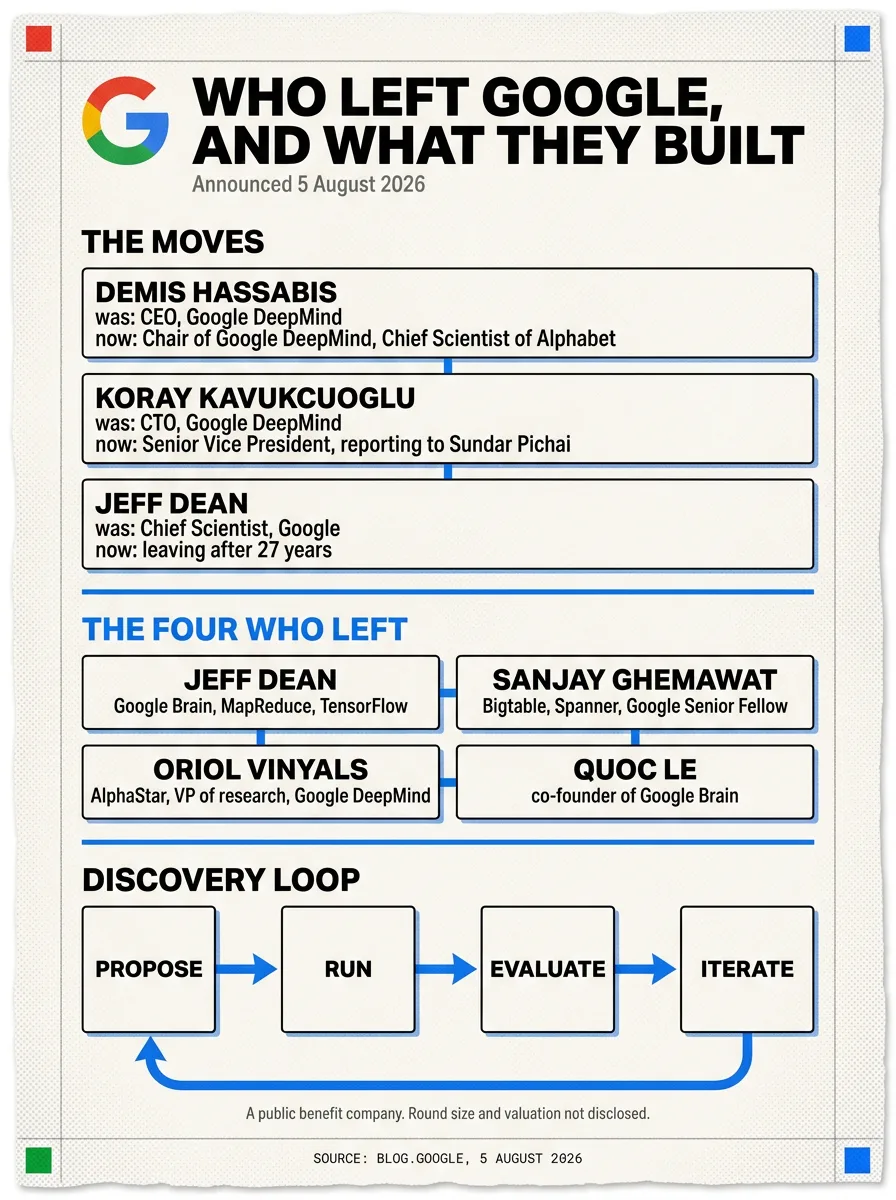
Demis Hassabis moves from chief executive of Google DeepMind to Chair of Google DeepMind and Chief Scientist of Alphabet, keeping Isomorphic Labs. Koray Kavukcuoglu, the unit’s chief technology officer, becomes a Senior Vice President reporting directly to Pichai. Pichai’s framing was that the company has to “accelerate all this work and stay focused on the AI frontier”, and on Hassabis: “It’s work that is vitally important to Alphabet and humanity, and I can’t imagine a better person than Demis to do it.”
Further down the same post, Jeff Dean is leaving after 27 years.
What walks out of the building
Dean does not go alone. Sanjay Ghemawat, a Google Senior Fellow and his collaborator of two decades, leaves with him. So do Oriol Vinyals, a vice president of research at Google DeepMind, and Quoc Le, a co-founder of Google Brain.
Read that list as infrastructure rather than as names. Dean and Ghemawat built MapReduce, Bigtable and Spanner, the systems that made Google’s index possible and that the rest of the industry copied into Hadoop and its descendants. Dean co-founded Google Brain and had a hand in TensorFlow. Le’s 2014 sequence-to-sequence work with Vinyals is one of the papers modern translation and pre-training rest on. Vinyals led AlphaStar and worked on the Gemini models.
Four people is a small number. These four are not a sample of Google’s research staff; they are a large share of the reason it has the reputation it does.
The company they left to build
The new venture is called Discovery Loop, and it is a public benefit company. Its own site states the target in one line: “Scientific discovery is bottlenecked.”
The bottleneck it names is not ideas or funding. It is that experiments run one after another, at human pace, with a person waiting at each step to read the result and decide what to try next. Discovery Loop says it is “building systems to automate these entire experimental loops”, proposing an experiment, running it, reading the outcome and iterating, with thousands running in parallel rather than in sequence. The stated scope is to “solve any learning loop with measurable outcomes within the domains of science and engineering”, which covers machine learning research itself as readily as it covers chemistry.
Radical Ventures, an investor, put the engineering requirement in a sentence: “Automating the scientific method will require developing and deploying state-of-the-art models on the largest of distributed computing infrastructure.” That is a fair description of the problem, and it is also a fair description of the four founders’ careers. Dean and Ghemawat spent twenty years building the largest distributed computing infrastructure anyone had built; Le and Vinyals spent a decade building the models that ran on it.
Neither the round size nor a valuation has been disclosed. Radical Ventures has published its investment; Khosla Ventures has been reported as an investor and the company itself names none.
An idea Google was already working on
Automating research is not an outside bet on something Google dismissed. Google DeepMind has been publishing in exactly this territory: Gemini’s co-scientist work, AlphaFold and AlphaEvolve all point the same way, and Isomorphic Labs, which Hassabis keeps, is the drug-discovery expression of it.
So the departure is not a disagreement about whether the loop can be closed. Four of the people best placed to close it decided the attempt was worth leaving for, and the structure they chose is a public benefit company rather than a research division reporting into a search business.
The measure to watch is the second cohort, not the first four
Senior researchers leaving big labs to found companies is the defining pattern of this cycle, and most of those companies are building products. Discovery Loop is proposing to automate the activity that produces the products, which is a longer bet and a harder one to show progress on. There is no model to ship, no benchmark to top, and the first honest milestone is a result that a human scientist would have taken a year to reach.
What will show whether Google has a problem is who follows. A founding team of this seniority can hire almost anyone, and the people it would most want are the ones still sitting in Google DeepMind. Pichai’s post spent its length on who is being promoted. The number worth counting over the next six months is how many more leave.
Sources
- Sundar Pichai, The next chapter of our AI momentum (5 August 2026)blog.google
- Discovery Loop, company sitediscoveryloop.com
- Radical Ventures, Our investment in Discovery Loopradical.vc