Gemini 3.5 Pro delay leaves Google chasing a moving field
The Gemini 3.5 Pro delay has become the longest running open question in frontier AI. Sundar Pichai told developers at Google I/O on 19 May to expect the model the following month. June passed.
Listen to this articleListen
The Gemini 3.5 Pro delay has become the longest running open question in frontier AI. Sundar Pichai told developers at Google I/O on 19 May to expect the model the following month. June passed. Reporting since mid July has converged on a 17 July target, but Google has confirmed no date, published no model card, released no pricing and listed no gemini-3.5-pro entry in its public API documentation. Developers planning around that date are planning around a leak.
What has firmed up is the reason for the wait, and it is more substantial than routine tuning. Google DeepMind is reported to have discarded the original base model, an evolution of the Gemini 2.5 Pro architecture, and restarted pre-training on a native Gemini 3 foundation. The decision followed internal testing that identified structural weaknesses in recursive tool calling and complex SVG scene generation, alongside gaps in multi-step mathematical reasoning. Business Insider reported in late June that Google was gathering feedback from early users on Antigravity and LMArena, concentrating on agent performance and token consumption.
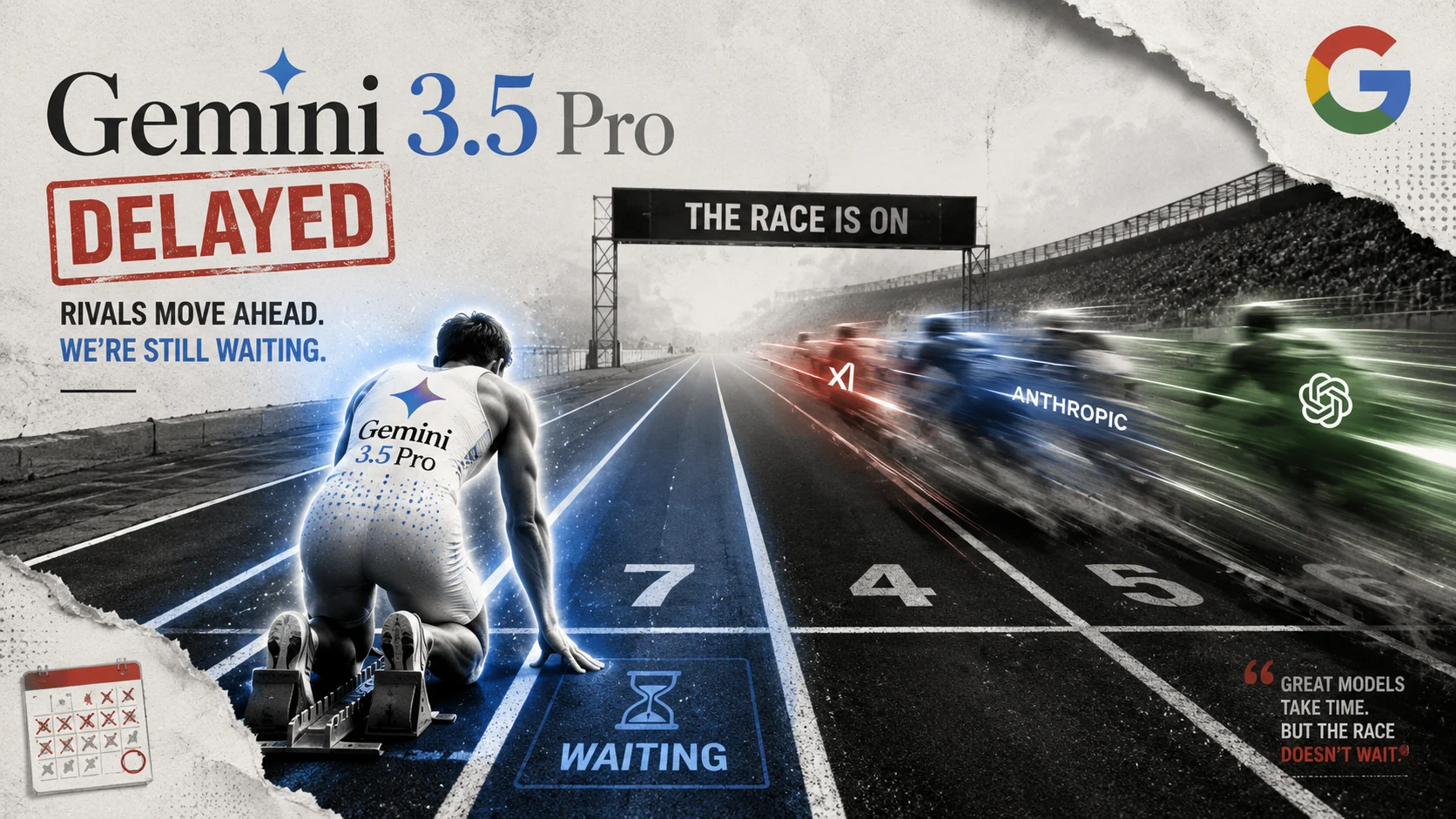
Scrapping a near complete pre-training run is an expensive decision and, on its own terms, a defensible one. It is also a decision that gets more expensive by the week. The Gemini 3.5 Pro delay has coincided with an exceptional run of competitor launches: GPT-5.6 reached general availability on 9 July, Grok 4.5 opened to the public the same week, and Moonshot’s Kimi K3 arrived on 16 July. Three of the most watched model events of the year landed inside ten days, and DeepSeek’s V4 family is due to graduate to a stable release on 24 July. A model that slipped from June into July now arrives into a field that has refreshed around it.
Leaked specifications point to a two million token context window, double that of Gemini 3.5 Flash, along with a Deep Think reasoning layer and autonomous multi-file workflow capability. None of this is confirmed. The number that will decide the reception is not the size of the context window but whether reasoning quality holds across its full range, which is precisely where Gemini 3.5 Flash users reported difficulty in extended agent runs.
The commercial position is less dire than the delay suggests. Gemini 3.5 Flash shipped on the day of the I/O keynote and remains widely deployed, anchoring high volume agent pipelines at $1.50 and $9.00 per million tokens. It also sits behind the AI answers that millions of people see in Google Search every day, which is a distribution advantage no rival can match. Google separately shipped Nano Banana 2 Lite, generating images in under four seconds from $0.034 per thousand, brought Gemini Omni Flash to public preview for multimodal video workflows, and expanded Managed Agents in the Gemini API with background tasks and remote MCP support on the free tier.
The reputational damage has been concentrated in a different place. The delay arrived alongside a run of senior departures from Google DeepMind. Noam Shazeer, co-inventor of the Transformer and a Gemini co-lead, left for OpenAI on 18 June. Nobel laureate John Jumper announced his move to Anthropic the following day, joined by Jonas Adler and Alexander Pritzel. Alphabet shares fell roughly 5 per cent on 22 June, erasing something in the order of $225 billion of market value in a single session, with the delay and the departures surfacing close enough together that neither can be cleanly isolated as the cause.
For enterprise teams the practical guidance is unglamorous. Treat 17 July as reporting and not as a commitment. Build model routing that assumes substitution, because a stack pinned to one vendor’s flagship is exposed to exactly this kind of slip. And judge the rebuilt model on agent behaviour over long sessions, since that is where the original was found wanting and where the rebuild was aimed.
If the date holds and the rebuilt model performs, Google enters a narrow window in which developers have not yet settled their stacks around the July releases. If it slips again, the Gemini 3.5 Pro delay stops being a story about engineering caution and becomes one about a laboratory that diagnosed its problem correctly and underestimated the time required to fix it.
Sources
- Google AIai.google.dev
- Googleblog.google
- Google DeepMinddeepmind.google