
Linux Foundation
Model Context Protocol
the USB-C port for AI agents
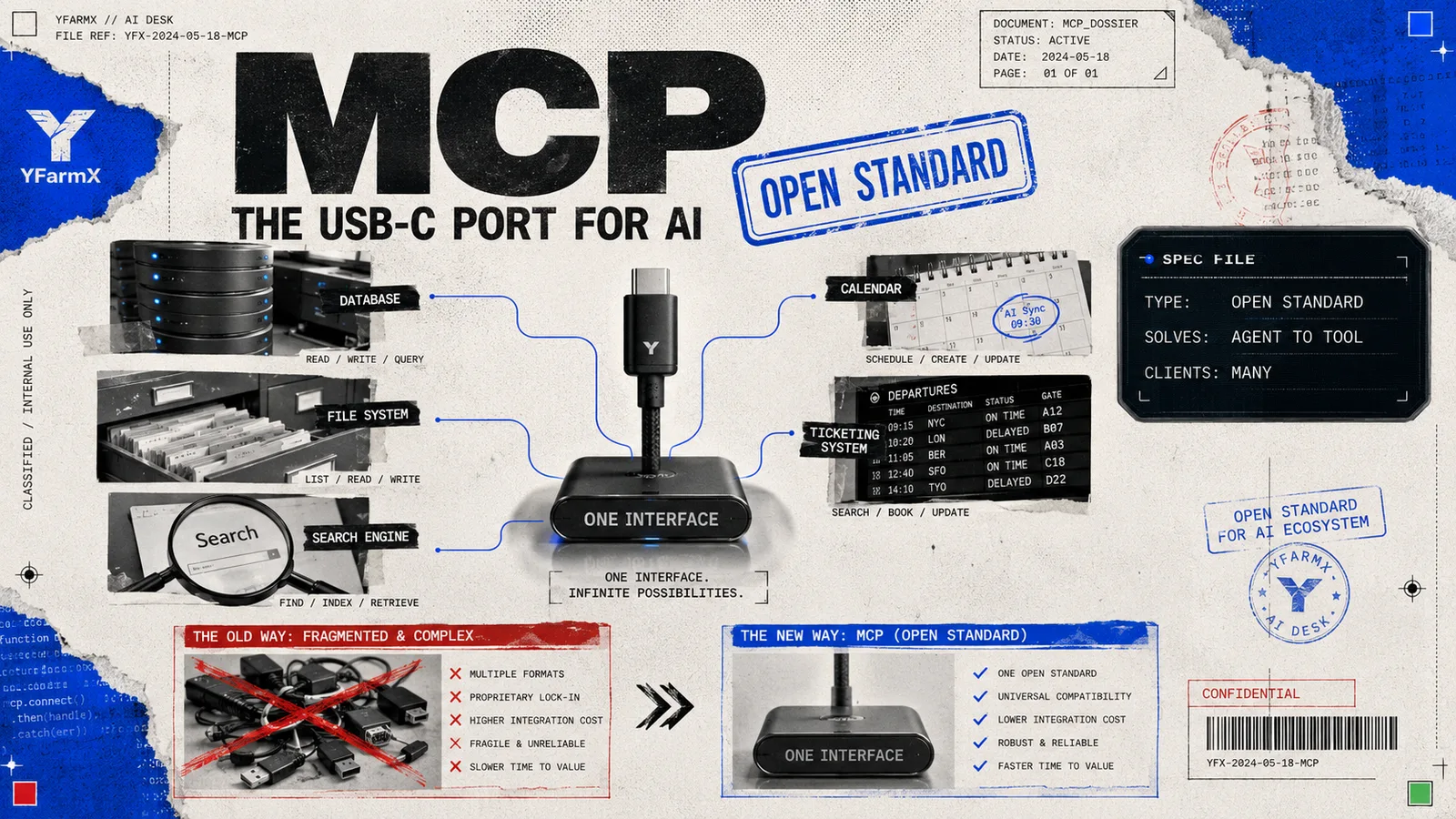
Key facts
- Open standardnot a product
- Type
- Anthropicnow at the Linux Foundation
- Origin
- Agent to toolone interface, many systems
- Solves
- Claude, ChatGPTVS Code, Cursor, more
- Clients
An agent with no hands can only talk. MCP is the standard plug that gives every agent the same set of hands, so a tool built once works in Claude, ChatGPT, Cursor and everything else that speaks it.
The Model Context Protocol is the plumbing of the agent era. It is an open standard for connecting AI applications to the systems that hold real information and do real work, and its own documentation reaches for the clearest possible comparison: MCP is a USB-C port for AI applications. Build a connector once, and every agent that speaks the protocol can use it.
What problem it solves
Before a shared standard, every pairing of an AI product and an outside system needed its own integration. Connecting an assistant to a company’s ticketing system, its document store and its database meant three bespoke pieces of work, repeated for every assistant. MCP replaces that with one interface. A team exposes its data or tools through an MCP server, and any MCP client can use it: Claude, ChatGPT, Visual Studio Code, Cursor and a growing list of others. That is why the protocol spread beyond the company that wrote it.
How it works
The architecture has two sides. An MCP server wraps something useful and describes what it offers: data sources such as local files and databases, tools such as a search engine or a calculator, and prompts for particular workflows. An MCP client, which is the AI application, discovers those capabilities and calls them when the model decides they are needed. The agent does not need to know in advance what a given server can do; it asks, and the server answers in a format the model can act on.
The practical effect is that capability becomes composable. An agent can read a design file in one service, pull the related ticket from another, and write the result to a third, without any of those services knowing the others exist.
What it enables
The examples in the official documentation are deliberately ordinary, which is the point: an assistant reaching a calendar and a notes app to become genuinely personal, a coding agent building a web app from a design file, an enterprise chatbot querying several databases so staff can analyse data by asking questions. The same mechanism is what lets a coding agent update a ticket or read a specification rather than only editing code.
Where it stands
MCP is now the default answer to agent-to-tool connection, and its governance reflects that: in December 2025 Anthropic donated the protocol to the Agentic AI Foundation at the Linux Foundation, putting it under vendor-neutral stewardship. It sits alongside rather than against the Agent2Agent protocol, which handles agent-to-agent communication. Its main open questions are security ones: an agent that can reach many systems through a standard interface is useful for the same reason it is dangerous, and prompt injection through a connected tool is an active area of concern across the field.
More in Agentic AI
All Agentic AI →- OpenClaw FoundationOpenClawthe open-source agent that took over GitHub
- Nous ResearchHermes Agentthe self-improving open-source agent
- AnthropicClaude Codethe agent that lives in your terminal
- GuideHermes Agent promptinghow to get real work out of it
- OpenAIOpenAI Codexthe agent that spans every surface
- AnysphereCursorthe editor that became an agent