
Anysphere
Cursor
the editor that became an agent
Key facts
- AnysphereCursor's developer
- Maker
- Composerpowers agent and Bugbot
- Own model
- Bugbotautomated PR review
- Reviewer
- iOSpublic beta, June 2026
- Also on
- SpaceXall-stock, effective 14 Aug 2026
- Owner
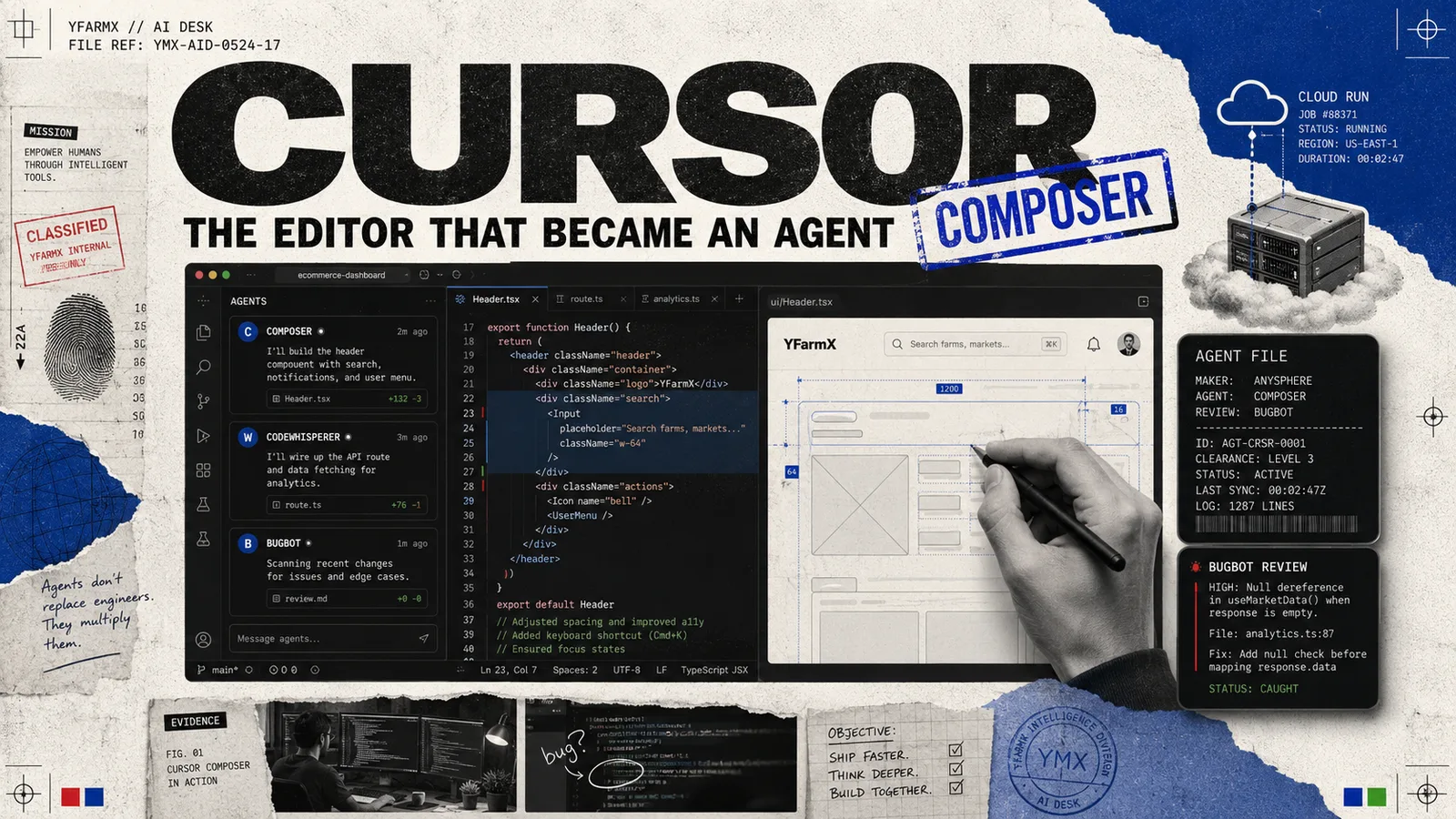
The coding agent that stayed inside the editor. You still see your code, still drive, but the work is increasingly done by agents running beside you, several at once, some of them on machines you never see.
Cursor is a code editor with an AI agent that can read a project, change files and run development tools. Developers review the resulting changes in the editor, while cloud agents can continue tasks on remote machines.
What it is
Cursor is a code editor with an AI agent built into its foundations rather than bolted on. The agent takes a task and works across the project, editing multiple files while the developer watches the changes appear as reviewable diffs, and it can run on Cursor’s own in-house model, Composer, built for long-running agent work at lower cost than frontier models. Beyond the editor sit a set of connected pieces: Bugbot for automated code review on pull requests, cloud agents that run on their own virtual machines rather than the laptop, and an SDK that lets other companies embed Cursor’s coding agent inside their own products.
Who owns it
Anysphere, the company that makes Cursor, belongs to SpaceX. SpaceX’s Form 8-K records a merger agreement between Space Exploration Technologies Corp., Merger Sub X67 Inc. and Anysphere entered on 16 June 2026 and made effective on 14 August 2026: an all-stock deal in which Cursor’s holders received 389,289,254 SpaceX Class A shares, “based on an implied equity value of Cursor of $60.0 billion”. Cursor’s own post of the same day says “Cursor has officially been acquired by SpaceX” and calls the combined AI unit SpaceXAI. The buyer is SpaceX itself; the deal is frequently attributed to xAI, whose model line the announcement now presents as SpaceXAI work.
One visible consequence sits on the price list. Grok Bot, the agent product from the SpaceXAI side, is sold through Cursor: Cursor’s pricing page lists access to it in the Ultra individual tier and the Teams Premium tier, and in none of the Hobby, Pro, Pro+ or Teams Standard plans.
How it works
Recent versions have pushed hard on doing several things at once. The agent can run tasks in parallel, and cloud agents let long jobs continue on remote machines while the developer carries on locally. Side chats and conversation search, added in version 3.11 in July 2026, exist because engineers now run enough concurrent agent conversations to need a way to find an old one.
Design Mode, shipped with Cursor 3.0 in April 2026 and expanded since, addresses a different problem. Describing a visual change in words is slow and imprecise, so Design Mode lets a developer point, draw or narrate the change they want on the interface itself while the agent edits the code underneath. Like the rest of the field, Cursor connects to outside systems through Model Context Protocol servers, which teams can share through an internal marketplace.
Where it fits
The usual comparison puts Claude Code as the deepest programmable harness and Codex as the broadest in reach, with Cursor strongest where the developer stays in the loop and wants to see the work happening. Bugbot competes in a different lane again, against automated review tools rather than coding agents; a June 2026 upgrade made it over three times faster while cutting cost and catching more bugs. On 23 September 2026 Cursor added two more bots for Teams and Enterprise plans: Rollouts, which watches a change from pull request to production, flags regressions and acts to restore a healthy state, and Security Reviewer, which finds and fixes security issues in the context of the wider codebase.
Apps and phone controls
Cursor opened its Origin App Marketplace to public submissions on 13 October 2026. It lists more than 20 integrations covering deployments, testing, review, security and project management. Submitted apps go through review.
The 6 October remote-control update lets the iOS app control an agent running on a computer. The computer must stay online, and Enterprise use depends on administrator settings.
Where it stands
Cursor’s trajectory through 2026 has been away from the single editor window: cloud agents, an iOS app in public beta since June 2026, an SDK for embedding the agent elsewhere, team features for organisations, and, since 3 August 2026, Google Workspace plugins that give agents direct access to Gmail, Drive and Calendar, so an agent can search and create files, draft mail and schedule meetings. The strategic question is whether the editor remains the centre of the workflow as more work moves to agents running somewhere else entirely.
More AI
All AI →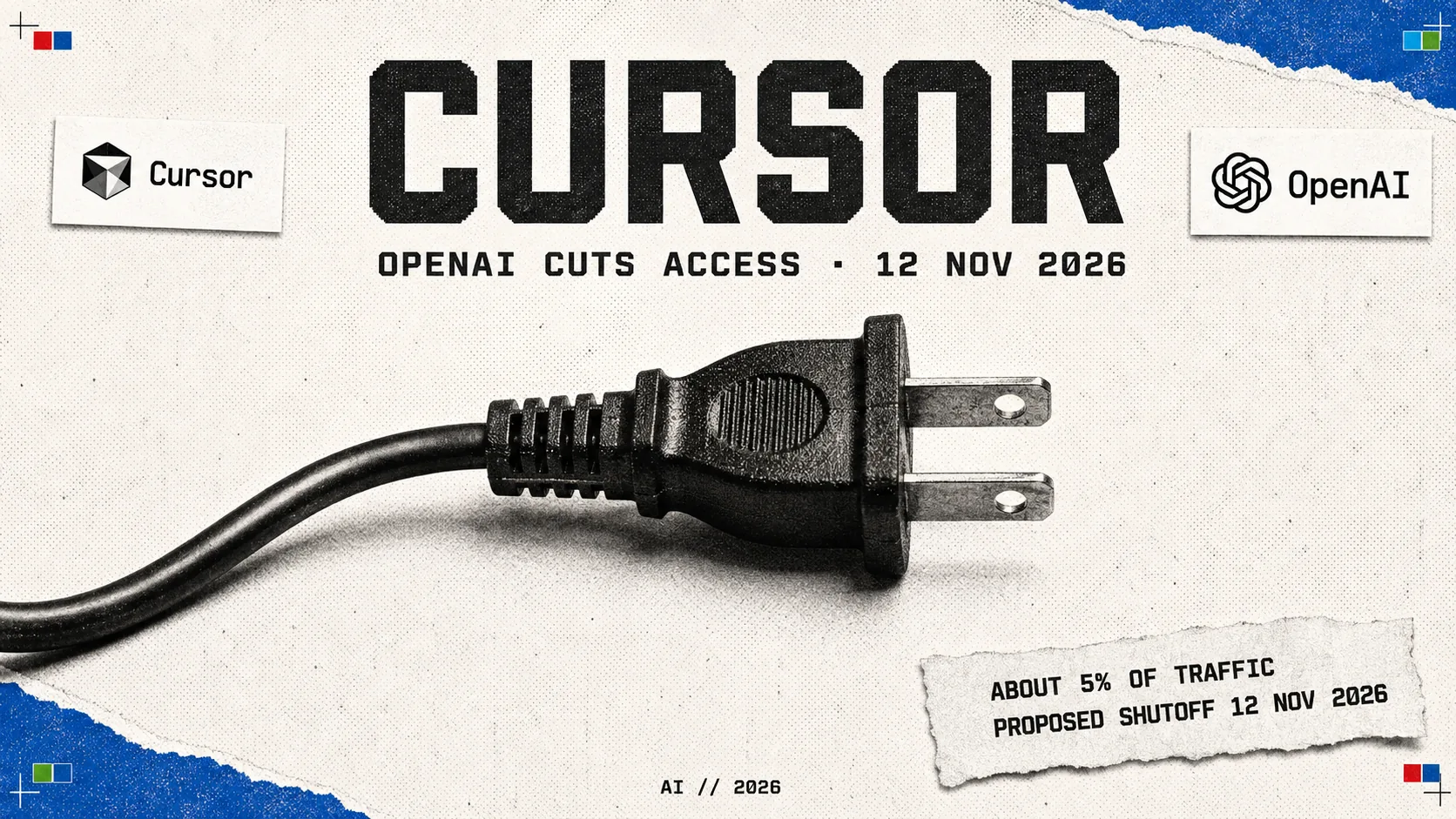
OpenAI's own help page tells Cursor users three ways to keep using its models
OpenAI is winding down the contract that supplies its models to Cursor after SpaceX bought it. The date is one OpenAI calls proposed, Cursor may end it sooner, and OpenAI's help page explains at length how developers can keep using GPT-5.6 inside Cursor.
Grok 4.5 buys its way into the coding race
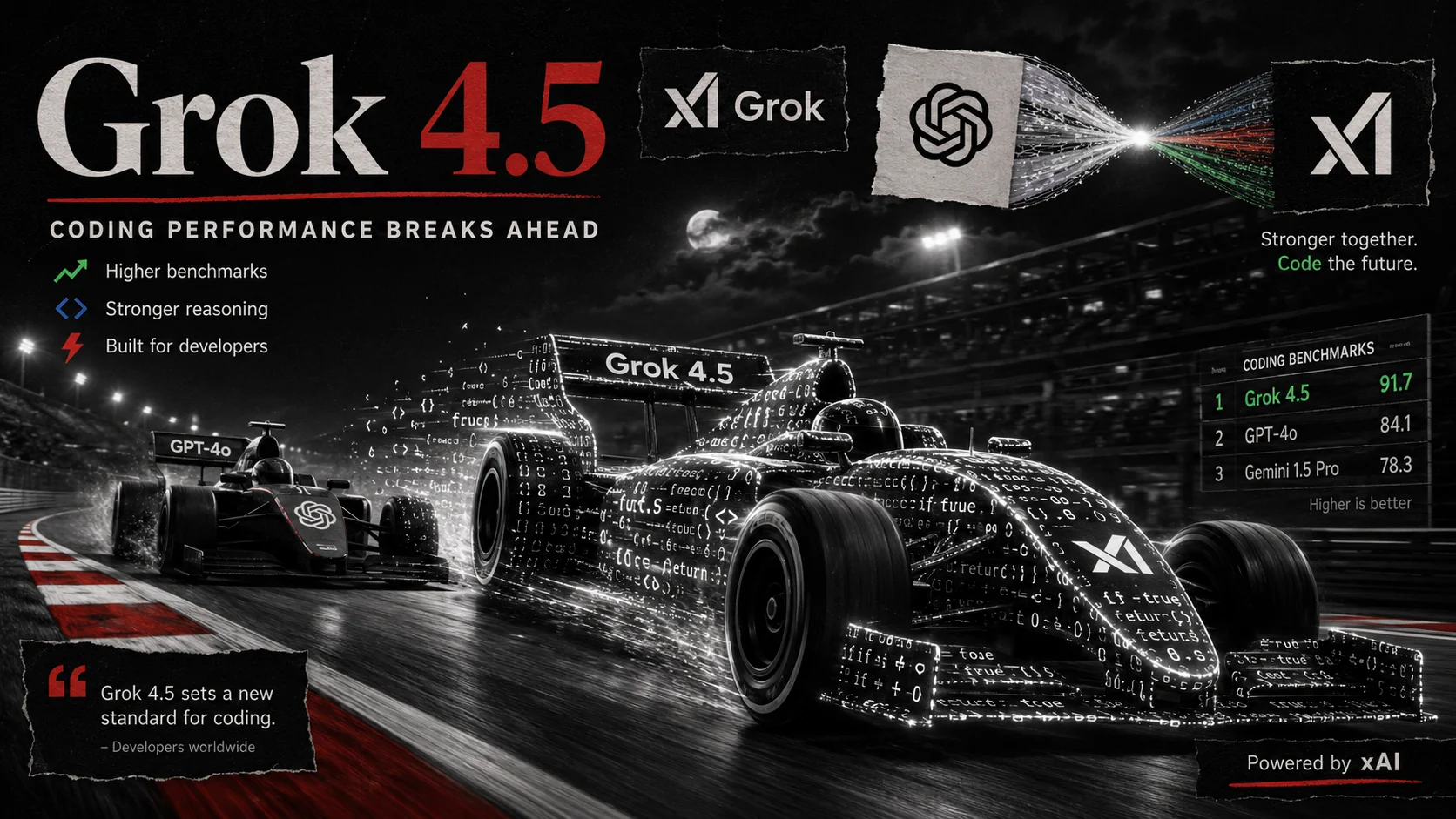
SpaceXAI released Grok 4.5 to developers on 8 July and to the public the following day, and the interesting part is not the model but how it was trained.
More in Agentic AI
All Agentic AI →- OpenClaw FoundationOpenClawthe open-source agent that took over GitHub
- Nous ResearchHermes Agentthe self-improving open-source agent
- AnthropicClaude Codethe agent that lives in your terminal
- GuideHermes Agent promptinghow to get real work out of it
- OpenAIOpenAI Codexthe agent that spans every surface
- Linux FoundationModel Context Protocolthe USB-C port for AI agents