Grok 4.5 buys its way into the coding race
SpaceXAI released Grok 4.5 to developers on 8 July and to the public the following day, and the interesting part is not the model but how it was trained.
Listen to this articleListen
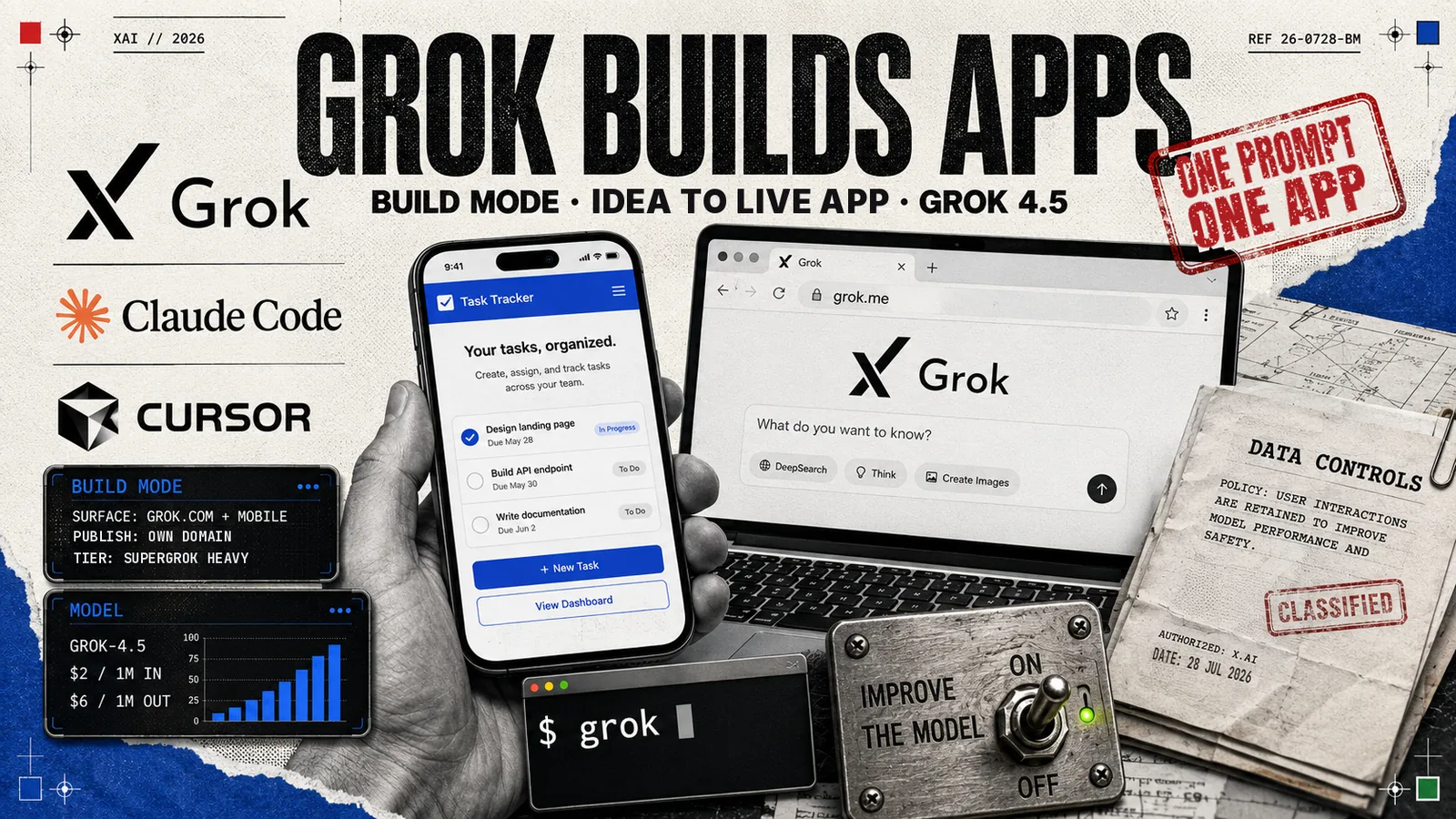
SpaceXAI released Grok 4.5 to developers on 8 July and to the public the following day, and the interesting part is not the model but how it was trained. Grok 4.5 is a mixture of experts system built on the company’s V9 foundation, and it was trained alongside Cursor using trillions of tokens of real developer agent interactions. Elon Musk’s pitch was characteristically compact: an Opus class model, faster, more token efficient and lower cost.
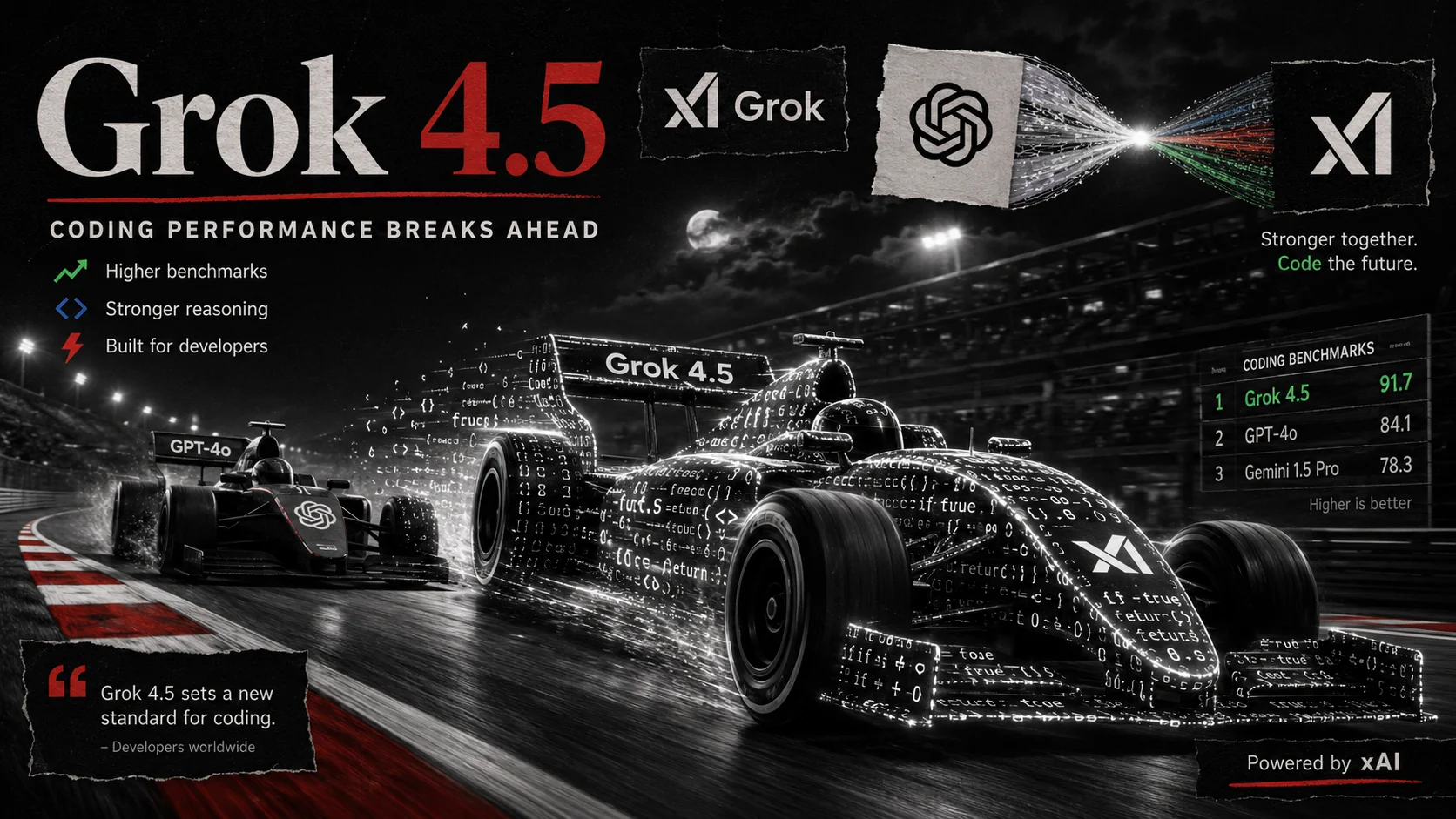
The numbers support the efficiency claim more convincingly than the capability one. Grok 4.5 is priced at $2 per million input tokens and $6 per million output tokens, with cached input at $0.50, against a 500,000 token context window. Independent testing by Artificial Analysis places it fourth of 168 models on its Intelligence Index with a score of 54, above every open weight model and every Gemini variant. It reaches 83.3 per cent on Terminal-Bench 2.1, close behind Claude Fable 5 on 84.3 per cent and GPT-5.5 on 83.4 per cent, and leads on SWE Marathon resolution at 29 per cent against Opus 4.8 on 26 per cent and Fable on 24 per cent.
Token efficiency is where the model separates itself. Grok 4.5 uses roughly 14,000 output tokens per Intelligence Index task against 67,020 for Claude Opus 4.8. On coding workloads independent benchmarks put it level with GPT-5.5 in Codex at approximately half the cost per task. For a team running agents continuously, a fivefold reduction in output tokens changes the monthly bill more than three points of benchmark score changes the output.
The training data arrangement is the strategic story. SpaceX and xAI merged into a single SpaceXAI brand two days before the launch, and the group is reported to have acquired Cursor’s parent Anysphere in an all stock transaction valued at around $60 billion in June. That places compute, model and the coding tool that generates the training signal under one owner. Cursor’s engineering blog confirmed Grok 4.5 was live in the product on launch day as the first jointly trained model.
To the company’s credit, it disclosed the obvious problem with that arrangement without being asked. Cursor stated that an earlier snapshot of its own codebase was accidentally included in training, which may have inflated Grok 4.5’s CursorBench score. The affected data has been removed for future models and CursorBench is being expanded, which is why it was excluded from the published charts. Third party scores on SWE-Bench Pro and Terminal-Bench are self reported per Cursor’s footnotes. In-IDE performance should be treated as optimistic until independently reproduced.
Musk has signalled that current serving speeds are not the ceiling. SpaceXAI has not yet deployed its internally developed C and C++ inference stack mapped directly to GB300 hardware, and expects throughput to at least double when it does. A further step change release has been flagged for the following month, which is either confidence or a hedge depending on one’s reading of the company’s history with timelines.
One constraint deserves flagging for European teams. Grok 4.5 was not available in the European Union at launch, with availability expected around mid July. Anyone building for European users should confirm current status before committing.
The competitive placement is precise. At $2 and $6, Grok 4.5 sits well below Claude Opus 4.8 at $5 and $25 and GPT-5.6 Sol at $5 and $30, while claiming rough parity with Opus 4.7 on capability. The company is not attempting to take the top of the leaderboard. It is attempting to make the top of the leaderboard look expensive, which in a month when Anthropic has been publicly negotiating with its own subscribers over the price of Fable 5 is a well chosen argument.
The flywheel is what competitors will study. A frontier laboratory that owns the coding tool millions of developers use every day collects agent interaction traces that no amount of scraped public code can substitute for. Anthropic has Claude Code, OpenAI has Codex, and now SpaceXAI has Cursor. Developer workflow data has become a strategic asset, and Grok 4.5 is the first model built explicitly on that thesis.