
OpenAI
OpenAI Codex
the agent that spans every surface
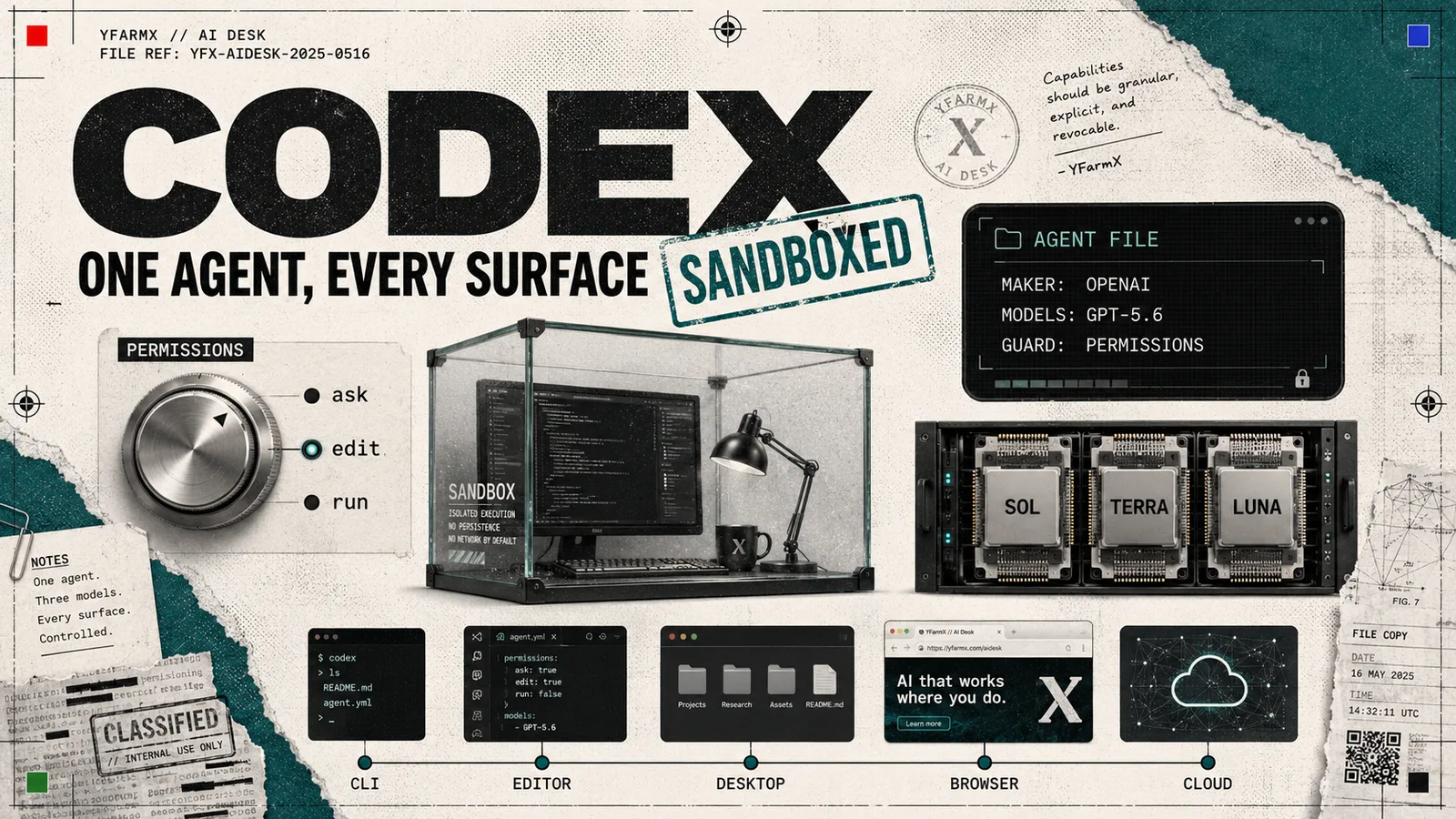
Key facts
- OpenAIthe GPT lab
- Maker
- GPT-66.1 Sol, Luna and Astra
- Model family
- 5CLI, IDE, desktop, web, cloud
- Surfaces
- Sandboxper-run permissions
- Guardrail
OpenAI's answer to the coding agent: the same agent wherever you happen to be working, with a permissions dial that decides how much it may do before it has to stop and ask you.
Codex is OpenAI’s agentic coding tool, and its defining trait is reach. The same agent runs in the terminal, inside an editor, in a desktop app, in the browser and on cloud machines, so a task started in one place can be picked up in another. It is the most widely distributed of the coding agents, and the cheapest to try.
What it is
Codex takes a goal rather than a prompt-and-response exchange. It gathers the context it needs, acts on the codebase, and produces something you can review: a set of edits, a review of a pull request, a fix with the tests already run. The command-line version inspects, edits and runs code against a local repository, so the work happens where the code already lives. Alongside the coding surfaces sit the wider assistant features, including code review of pull requests, web search, scheduled tasks and connections to GitHub, Slack and Linear.
How it works
Underneath is OpenAI’s GPT-6 generation. Since 29 September 2026 OpenAI’s Codex documentation tells developers to use GPT-6.1 Sol for complex coding and agentic workflows, Luna for focused, repeatable tasks and Astra when a task needs the strongest capability, with GPT-5.6 Sol, Terra and Luna kept available during the rollout. GPT-6.1 Sol reaches Plus, Pro, Business, Enterprise and Edu plans in the desktop app and the CLI. The model is chosen per session with a /model command, so an engineer can spend heavily on a difficult refactor and cheaply on routine edits.
The safety design is worth understanding, because it is the part users interact with most. Codex runs inside a sandbox with a defined set of writable directories, and a /permissions setting controls when it may edit files or run commands without asking first. You can inspect the active sandbox and the writable roots before letting a run continue. Like the rest of the field, it connects to outside systems through Model Context Protocol servers.
Where it fits
Codex is the generalist of the coding agents. Anthropic’s Claude Code is usually described as the deeper programmable harness, and Cursor as the stronger in-editor experience, while Codex spans the most surfaces at the lowest entry price. In practice many teams run more than one, using whichever suits the task rather than standardising on a single tool.
Where it stands
The distance between the leading agents narrowed sharply through 2026, and Codex closed most of the gap it started with. Recent additions have pushed towards continuity and parallelism: conversations now sync across devices, and the tooling has moved towards running several agent sessions at once rather than one at a time. The unresolved question is the same everywhere in this field, which is how much a team lets an agent do unsupervised, and the permissions dial is OpenAI’s answer to it.
More in Agentic AI
All Agentic AI →- OpenClaw FoundationOpenClawthe open-source agent that took over GitHub
- Nous ResearchHermes Agentthe self-improving open-source agent
- AnthropicClaude Codethe agent that lives in your terminal
- GuideHermes Agent promptinghow to get real work out of it
- Linux FoundationModel Context Protocolthe USB-C port for AI agents
- AnysphereCursorthe editor that became an agent