OpenAI's own help page tells Cursor users three ways to keep using its models
OpenAI is winding down the contract that supplies its models to Cursor after SpaceX bought it. The date is one OpenAI calls proposed, Cursor may end it sooner, and OpenAI's help page explains at length how developers can keep using GPT-5.6 inside Cursor.
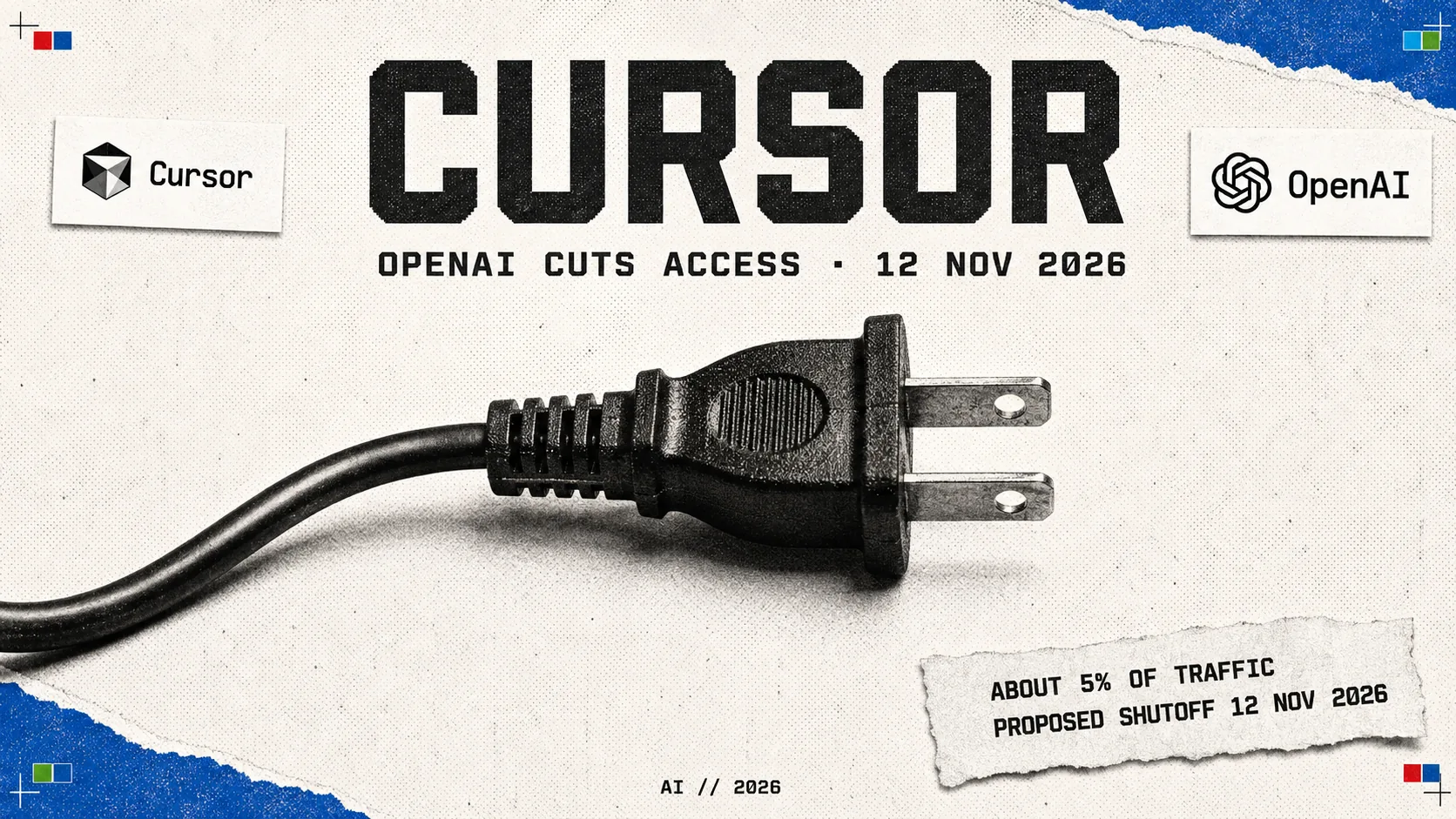
OpenAI published a post on 28 August 2026 saying it had notified SpaceX that it intends to wind down the contract supplying OpenAI models to Cursor. The reporting since has described it as a cutoff.
OpenAI’s own help-centre article, published alongside it, is a good deal less final than that. It calls 12 November a proposal, says Cursor may end access sooner, and then spends the rest of its length telling developers how to carry on using GPT-5.6 inside Cursor after the date.
What the notice actually says
The company post gives the date and the reason in its first two paragraphs:
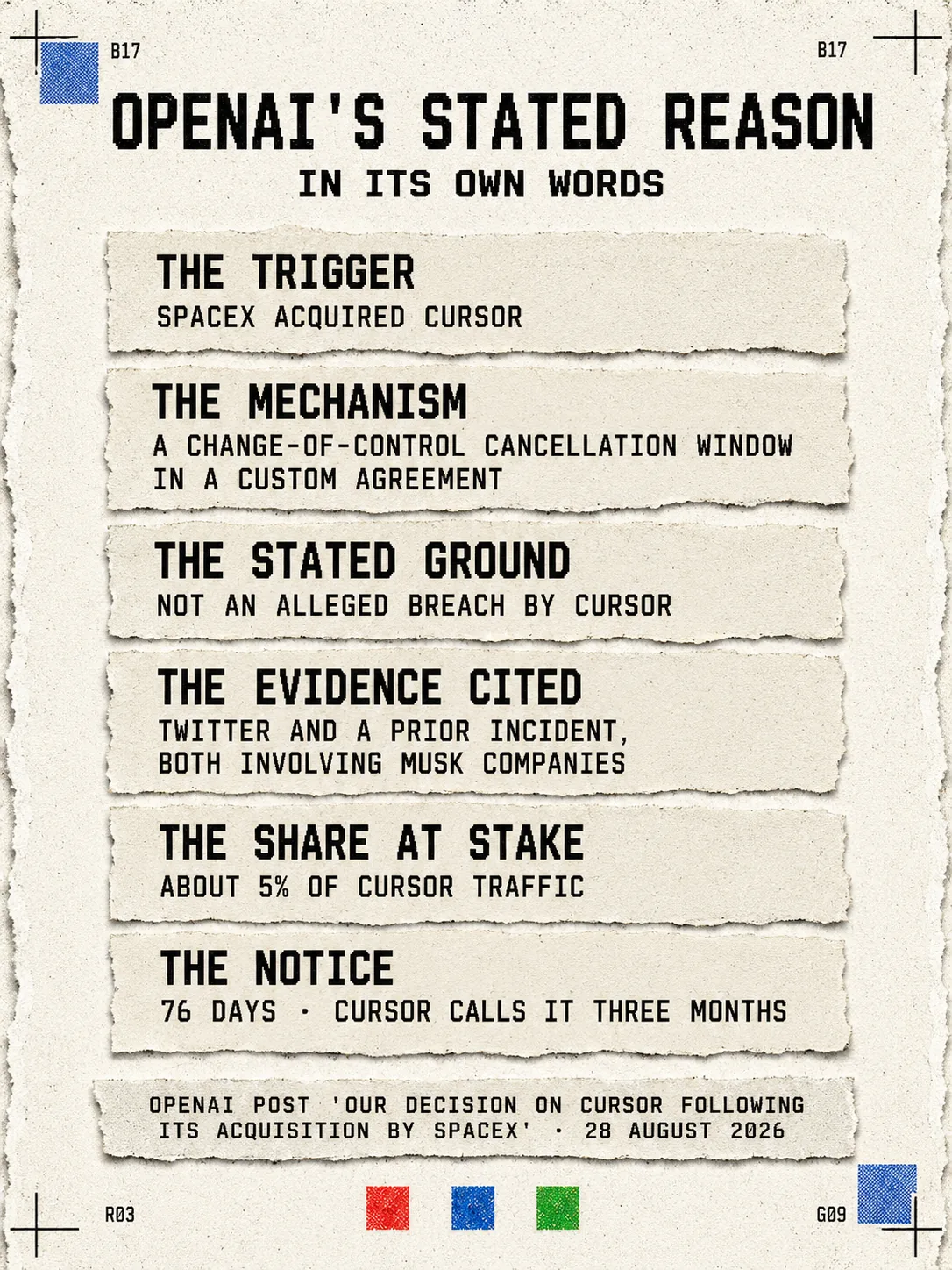
Today, we notified SpaceX that we intend to wind down our contract providing OpenAI models to Cursor, with a proposed shutoff date of November 12, 2026. To maximize the time that developers can retain access to our models through Cursor, we are giving the maximum notice provided by our contract.
Note what is absent. OpenAI never says three months. It says “the maximum notice provided by our contract”, and from 28 August to 12 November is 76 days, a little over two and a half months. “Three months” is Michael Truell’s phrase, from his reply, not OpenAI’s.
The stated ground is not that Cursor has done anything:
After Musk acquired Twitter, now part of SpaceX, the company broke the terms of our contract (alongside many others).
OpenAI’s case is about the new owner. It says it cannot be confident SpaceX will use its technology within its terms, citing Twitter after the 2022 acquisition and testimony it says Musk gave this year about xAI. Cursor’s conduct is not in dispute; OpenAI calls the team’s work over nearly four years something it has “enormous respect for”.
The clause is not in any published contract
OpenAI describes the mechanism in one sentence:
Our custom agreement with Cursor gives us a limited time window to cancel it after a change of control.
That agreement is not public. What is public is OpenAI’s standard Services Agreement, effective 1 January 2026, and the phrase “change of control” does not appear in it anywhere. Its suspension clause, 8.2, is conditioned on something happening rather than on ownership changing:
OpenAI may limit or suspend Customer’s access to the Services if: (a) it is required to do so by law; (b) Customer violates the Agreement or OpenAI Policies; or (c) doing so is necessary to prevent or terminate a Security Emergency.
None of those three is what OpenAI has invoked. The right it is using exists only in a bespoke contract nobody outside the two companies has read, which is worth stating clearly, because it is the whole basis of the decision.
Three ways to keep using the models
Here is where the framing and the documentation part company. OpenAI’s help page for affected developers recommends a personal OpenAI API key, the Codex extension running inside Cursor, or a gateway such as Amazon Bedrock or Azure. It is not a block on OpenAI models in Cursor. It is the end of Cursor buying them wholesale.
The page is also honest about where the workarounds stop:
These options cover local work in the Cursor desktop app. Cursor doesn’t support “Bring your own key” in Cursor Tab, Auto, Cloud or Background Agents, Automations, the Cursor CLI, or Cursor’s API and SDK.
Tab and Auto are the features Cursor sells on. So the practical effect is real, and narrower than a cutoff: OpenAI models keep working in Chat and Agent for anyone who brings a key, and stop working in the parts of Cursor that route models on your behalf.
Five per cent, and whose figure it is
Truell replied on X in the small hours of 29 August:
OpenAI models serve about 5% of Cursor user traffic, and we’re speaking with the OpenAI team to resolve this.
That number is his and only his. OpenAI has neither confirmed nor disputed it, neither company publishes model-mix data, and there is no way to check it from outside. Treat it as a claim by an interested party, which is not the same as false.
It is at least consistent with what Cursor sells. Its own pricing page lists a first-party pool of Cursor Grok 4.6, Grok 4.5 and Composer 2.5, and a third-party pool of Claude Fable 5, Claude Opus 5, Claude Sonnet 5, Gemini 3.1 Pro, Gemini 3.7 Flash and three OpenAI models. Grok is an xAI model, and since SpaceX now owns both companies it has become an in-house supply. Cursor’s own Composer is built on open weights: the Composer 2 technical report says the team chose Kimi K2.5, “a 1.04T parameter / 32B active parameter Mixture-of-Experts model”, as its base.
A tool with that model mix losing one of eight third-party options is a different event from a tool losing its engine.
Anthropic went the other way within hours
Cursor’s largest third-party supplier made the opposite call in public. Anthropic co-founder Tom Brown posted that the company would continue to increase compute to support Claude models in Cursor.
There is money underneath that. SpaceX’s own S-1 discloses Anthropic paying SpaceX around $1.25 billion a month through May 2029 for roughly 325,000 Nvidia GPUs. The supplier deciding to keep serving Cursor is also a customer of Cursor’s new owner.
The precedent is Anthropic’s, not OpenAI’s
A frontier lab has cut a coding tool off before, and it was not this one. In June 2025 Windsurf’s chief executive Varun Mohan said publicly that Anthropic had given his company under a week’s notice before removing nearly all of its first-party Claude 3.x capacity. We could not retrieve that post to quote it, so take the comparison as approximate. Against it, 76 days and a help page full of workarounds is a gentle exit.
The part that is about models, not Musk
One paragraph of OpenAI’s post points somewhere else entirely:
As AI capabilities advance, we also have a new level of accountability to ensure our upcoming model, Astra, is being used in accordance with our terms.
Astra is the model OpenAI said on 7 August it could not rule out reaching the Critical cybersecurity threshold under its own Preparedness Framework. Read next to that, the Cursor decision is partly a statement about which resellers OpenAI is willing to hand its next model to, and the change of ownership supplied both the reason and the contractual window.
SpaceX completed the Anysphere purchase on 14 August, an all-stock merger its Form 8-K puts at an implied equity value for Cursor of $60.0 billion. Fourteen days later OpenAI used its window. Neither SpaceX nor Anysphere issued a corporate statement, and CNBC reported that both companies did not immediately respond to its requests for comment.
Sources
- Our decision on Cursor following its acquisition by SpaceX (OpenAI)openai.com
- Using OpenAI models in Cursor (OpenAI Help Center)help.openai.com
- OpenAI Services Agreement, effective 1 January 2026openai.com
- Michael Truell's replyx.com
- SpaceX Form 8-K on completion of the Anysphere acquisitionsec.gov
- Cursor models and pricingcursor.com
- Cursor Composer 2cursor.com
- Cursor Composer 2 technical report (arXiv)arxiv.org
- Responding to the next frontier of critical cyber capabilities (OpenAI)openai.com
- OpenAI to cut off Cursor's access to its models (CNBC)cnbc.com