Brussels has designated ChatGPT a very large online search engine, on OpenAI's own count of 159.1 million users
The European Commission designated ChatGPT a Very Large Online Search Engine on 31 August 2026, alongside Reddit and Roblox as platforms. The designation rests on a user number OpenAI reported itself, and the compliance clock runs from notification.

The European Commission published the decision on 31 August 2026, and updated the page the following day: “Today, the Commission has designated ChatGPT as a Very Large Online Search Engine (VLOSE), as well as Reddit and Roblox as Very Large Online Platforms (VLOPs), under the Digital Services Act (DSA).”
The designated service is ChatGPT, whole, not a search tool inside it. The category it lands in is search engine, not platform.
Why a chatbot is a search engine
The Commission gives its reasoning in two sentences: “ChatGPT is an Artificial Intelligence (AI) system that can engage with and respond to users’ prompts and queries, including by searching the web. Hence, ChatGPT is a hybrid service that qualifies as an online search engine under the DSA.”
That is a classification with consequences, because the Digital Services Act writes different duties for platforms and for search engines, and because OpenAI itself draws a line the Commission has not. In its own DSA transparency filing, OpenAI describes “ChatGPT” as “The advanced conversational AI service” and lists “ChatGPT Search” separately as “A tool made available within ChatGPT that allows users to access real-time information from the web”.
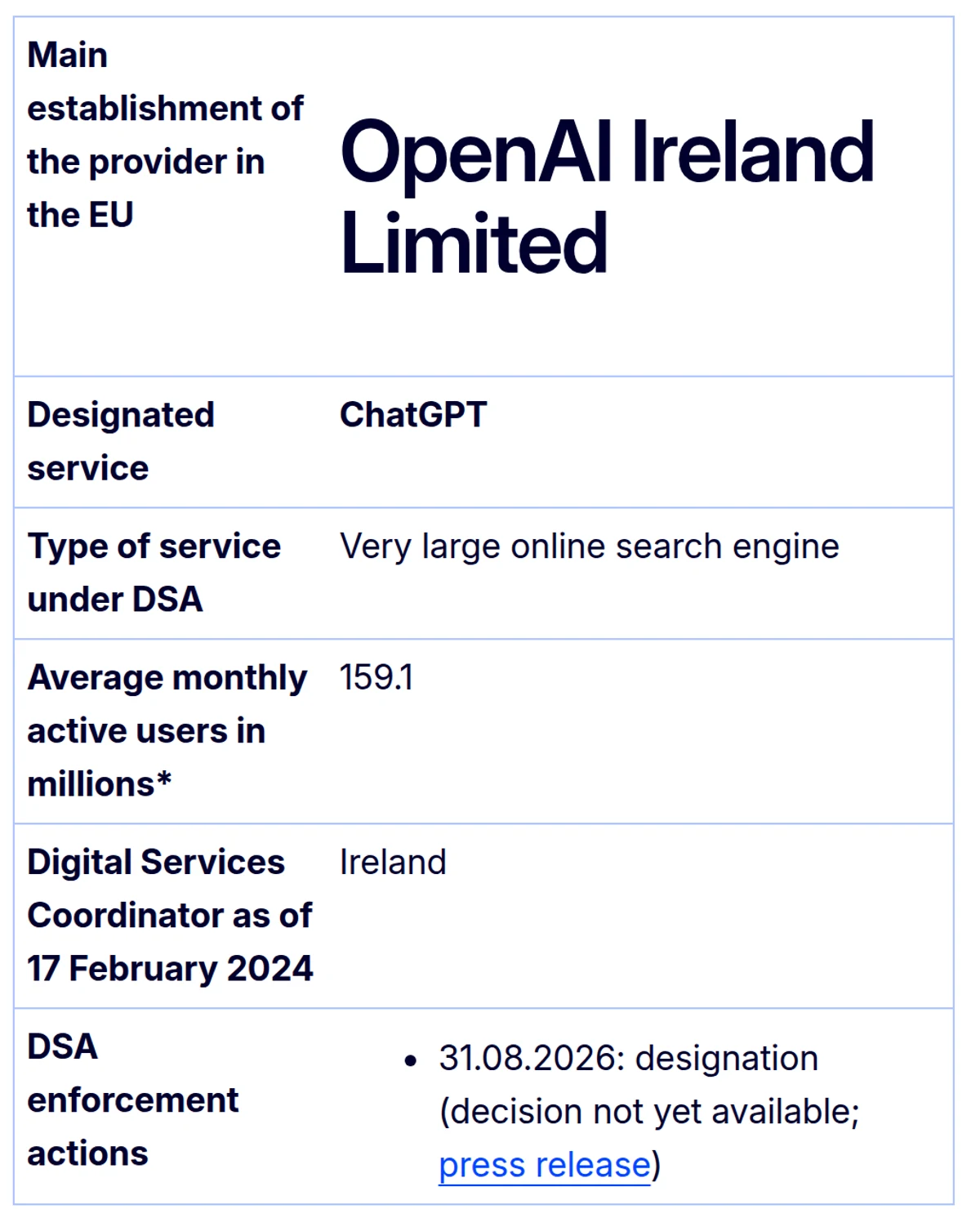
The Commission’s register records the designated service as ChatGPT and the provider as OpenAI Ireland Limited.
The number that triggered it is OpenAI’s
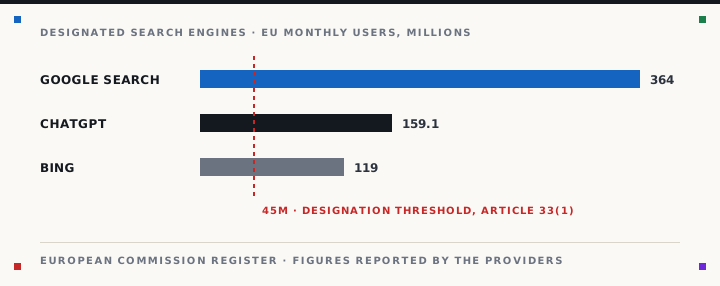
Article 33(1) of the Digital Services Act sets the threshold at 45 million average monthly active recipients in the European Union. Article 24(2) requires every online platform and search engine to publish its own figure at least once every six months.
The Commission’s register puts ChatGPT at 159.1 million, under a heading that says exactly where the figure came from: “As reported by the provider (e.g. transparency reports, website) and without prejudice to the assessment by the Commission of the methodology used to calculate the active recipients of service.” The press release says the same in plainer words: “These services declared that they reach at least 45 million average monthly users in the EU and thus meet the threshold for designation.”
So the designation rests on a self-report the Commission has reserved the right to disagree with later.
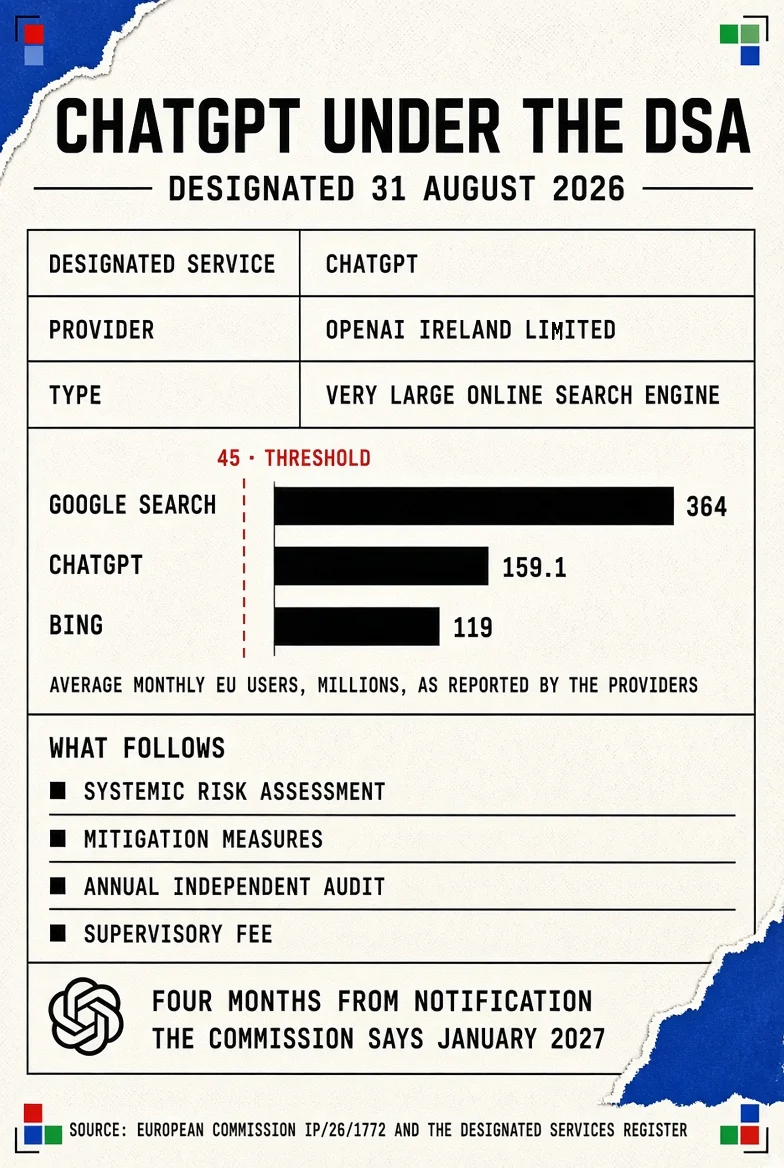
Against the two search engines already on the list, ChatGPT sits between them: Google Search at 364 million, ChatGPT at 159.1 million, Bing at 119 million.
What the designation actually requires
Designation moves a service out of the general obligations that apply to every online platform and into the systemic-risk regime in Section 5 of the DSA. In outline:
| Article | Obligation |
|---|---|
| 34 | Identify, analyse and assess systemic risks arising from the service, including its algorithmic systems |
| 35 | Put in place reasonable, proportionate and effective mitigation measures |
| 37 | Submit to an independent audit at least once a year, at the provider’s own expense |
| 40 | Give data access to the Digital Services Coordinator of establishment and to the Commission |
| 43 | Pay an annual supervisory fee |
The Commission lists what the risk assessment has to cover: “the dissemination of illegal content, the negative effects on minors, users’ physical and mental well-being, fundamental rights, electoral processes and public security”. It also gains investigative powers over the service and, in its words, “any related system”.
Supervision is shared. The Commission enforces, with Coimisiún na Meán, Ireland’s Digital Services Coordinator, as the national partner, because OpenAI’s main establishment in the EU is in Ireland.
When the clock starts, and it is not today
Article 33(6) sets the timing: the extra obligations apply “from four months after the notification to the provider concerned”. Notification, not publication, and the Commission has not said when notification happened.
Its own release gives the answer in months rather than a date: “Following the notification of the designations, these services have four months, i.e. by January 2027, to comply with the additional DSA obligations for VLOPs and VLOSEs”. Four months from 31 August lands on 31 December, so the Commission’s own arithmetic implies notification came after the announcement.
The designation decision itself is not out. The Commission’s register records, against ChatGPT, Reddit and Roblox alike: “31.08.2026: designation (decision not yet available; press release)”. For comparison, the older entries on the same page carry a downloadable Commission decision. Until this one is published, the reasoning available is the press release.
The list, and what is not on it
There are now 28 designated very large online platforms and search engines, a count the Commission states itself. Three are search engines: Google Search, Bing and ChatGPT.
No other AI assistant appears anywhere on that list as a designated service in its own right. So ChatGPT is the only AI chatbot carrying the designation, which is a fact about the register rather than a claim the Commission has made: its release does not describe the designation as a first of any kind.
Henna Virkkunen, executive vice-president for tech sovereignty, security and democracy, put the intent this way: “These new designations mean that ChatGPT, Reddit and Roblox will now be held to a higher standard of scrutiny and accountability in the European Union, in line with their large impact on our citizens and society. We continue to watch the digital landscape closely and will not hesitate to designate any platform that meets the threshold for enhanced supervision under the Digital Services Act.”
This is not the AI Act, and the dates are not the same
Two European regimes now apply to OpenAI and they are separate laws with separate triggers.
The AI Act, Regulation (EU) 2024/1689, applies generally from 2 August 2026, with Chapter V, the general-purpose AI model obligations, in force since 2 August 2025 under Article 113(b). Those duties sit on the model provider: technical documentation, training-data summaries, copyright policy, and additional systemic-risk duties for the largest models. The Digital Omnibus on AI, Regulation (EU) 2026/1744, which entered into force on 27 July 2026 and moved several high-risk deadlines, left that GPAI date untouched.
The DSA designation sits on the service instead, and it counts users rather than compute. One law asks how the model was built; the other asks what the product does to the people using it.
A search engine by function, whatever it is by design
The classification is what will be argued about. ChatGPT was not built as a search engine, is not used as one by most of the people opening it, and now carries the duties of one because it can query the web on a user’s behalf.
That reading is broad enough to reach any assistant with a browsing tool attached, which is nearly all of them. The Commission has said it “will not hesitate” to designate any service that crosses the threshold, and the only thing standing between the rest of the field and the same letter is a user count each of them publishes about itself.
Sources
- Commission designates ChatGPT, Reddit, Roblox under Digital Services Act (IP/26/1772, 31 August 2026)ec.europa.eu
- Supervision of the designated very large online platforms and search engines under the DSA (Commission list)digital-strategy.ec.europa.eu
- Commission designates ChatGPT, Reddit, Roblox under Digital Services Act (digital-strategy mirror)digital-strategy.ec.europa.eu
- Regulation (EU) 2022/2065, the Digital Services Act (EUR-Lex)eur-lex.europa.eu
- Regulation (EU) 2024/1689, the AI Act (EUR-Lex)eur-lex.europa.eu
- OpenAI DSA transparency report, qualitative information (2024, PDF)cdn.openai.com