
Linux Foundation
Agent2Agent Protocol
how agents talk to each other
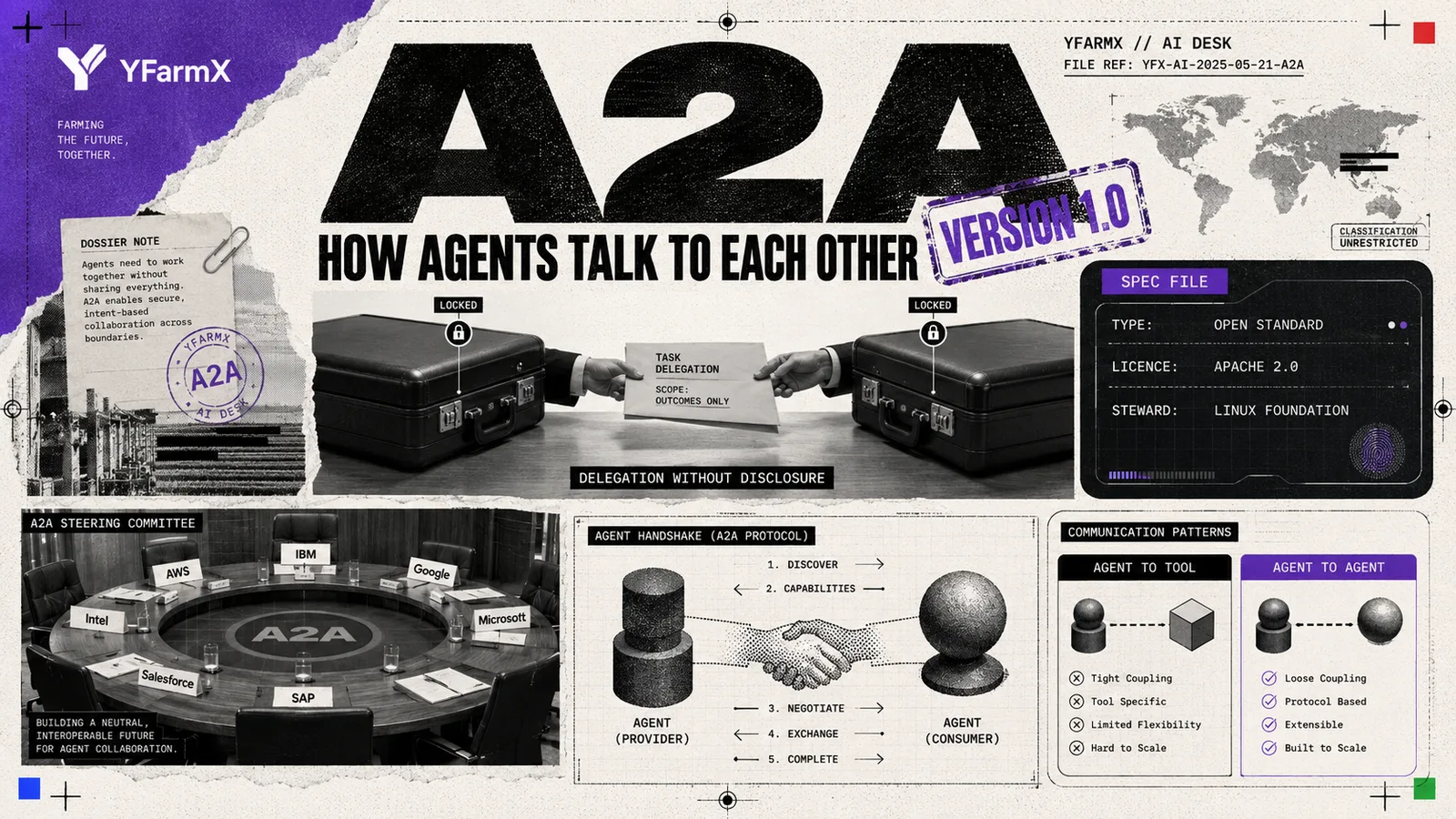
Key facts
- Open standardApache 2.0
- Type
- Googledonated to Linux Foundation
- Origin
- Agent to agentnot agent to tool
- Solves
- 8 companiesAWS, Cisco, IBM, Microsoft and more
- Steered by
MCP gave agents hands. A2A gives them colleagues. It is the standard that lets an agent built by one company hand work to an agent built by another, without either revealing how it works inside.
If the Model Context Protocol is how an agent reaches a tool, Agent2Agent is how one agent reaches another. It is an open standard for agents built on different frameworks, by different companies, to discover each other, delegate work and coordinate on a problem too large for any one of them, without either side exposing its internal logic or proprietary systems.
The problem it solves
The agent ecosystem grew up fragmented. Agents are built on LangGraph, CrewAI, Semantic Kernel and a dozen other frameworks, each with its own conventions, and a company’s agents typically cannot talk to a supplier’s. Every collaboration became a bespoke integration, which is the same trap MCP solved on the tool side.
A2A defines a common language for that conversation: how an agent advertises what it can do, how another agent asks it to do something, and how they exchange information and results securely. The design constraint is that neither side has to open up. An agent can accept a task and return a result without revealing its prompts, its models or its data.
How it differs from MCP
The two are complementary rather than competing, and the official documentation draws the line clearly: MCP is for agent-to-tool communication, A2A is for agent-to-agent communication. MCP is how an agent reads a database or calls a search engine. A2A is how a travel-planning agent hands the hotel portion of a job to a hotel company’s own agent and gets an answer back. Most serious deployments will use both.
Who governs it
Google developed A2A and donated it to the Linux Foundation, which is the same move that made Kubernetes credible to companies that would never have adopted a Google-controlled standard. A Technical Steering Committee now maintains it, with representatives from AWS, Cisco, Google, IBM Research, Microsoft, Salesforce, SAP and ServiceNow. The protocol is licensed under Apache 2.0, and version 1.0 has been released, which signals the specification is stable enough to build against.
Where it stands
A2A is earlier in its life than MCP, and standards succeed or fail on adoption rather than design. The signal worth watching is not the specification but the participant list: when the major cloud providers and enterprise software companies all sit on the same steering committee, they are agreeing that no single one of them will own the layer where agents meet. Whether that translates into agents from rival companies genuinely working together, rather than each vendor’s agents talking only among themselves, is the test to come. An early signal arrived on 3 August 2026, when Nous Research’s Hermes Agent shipped support for A2A version 1.0 in its v0.20.0 release, taking the protocol into one of the most widely run open-source agents.
More in Agentic AI
All Agentic AI →- OpenClaw FoundationOpenClawthe open-source agent that took over GitHub
- Nous ResearchHermes Agentthe self-improving open-source agent
- AnthropicClaude Codethe agent that lives in your terminal
- GuideHermes Agent promptinghow to get real work out of it
- OpenAIOpenAI Codexthe agent that spans every surface
- Linux FoundationModel Context Protocolthe USB-C port for AI agents