Claude-assisted Riemann hypothesis proof clears first independent computer checks
Levent Alpöge, a mathematician at Anthropic, posted a claimed proof of the Riemann hypothesis on 20 November 2026, found with Claude and written as Lean code. MIT's Andrew Sutherland compiled it the same day and found it rests only on Lean's three standard axioms.
Listen to this articleListen
Levent Alpöge, a mathematician at Anthropic, posted a note on 20 November 2026 claiming a proof of the Riemann hypothesis, the most famous open problem in mathematics, found working with Claude. “I believe I have, working with Claude, discovered a proof of the Riemann Hypothesis,” the four-page note says. Alpöge says the whole argument is formalised in Lean, a programming language whose checker tests every step of a proof, and has released the claimed proof in that form alone.
The note claims more than the hypothesis itself. It says the method “easily extends much further, resolving the so-called Generalized Riemann Hypothesis”, the version that covers a whole family of functions built like Riemann’s zeta function. By the end of the day, Andrew Sutherland of MIT had compiled all of the code and found it rests only on Lean’s three standard axioms, and two independently written proof checkers had accepted it. Hours after the note, Stanford’s Ravi Vakil posted a second claimed proof of the generalised hypothesis, an all-human draft by Alessandro Masullo. The Clay Mathematics Institute has offered $1 million for a proof of the Riemann hypothesis since 2000.
What has Alpöge published?
Alpöge has posted two things on alpo.ge, a personal website: the four-page note and the Lean code, split into 14 compressed archive parts. The note is an unsigned PDF written in the first person, and the Associated Press reports it as Alpöge’s announcement. “I decided to only present Lean,” it says, and “Claude and I have also formalized the arguments without assumptions.”
The archive is built on Mathlib, the community library of formalised mathematics for Lean.
| Alpöge’s Lean archive | Figure |
|---|---|
| Download | 14 parts, 239 MB in total |
| Unpacked | About 1 GB |
| Lean files | 175,187 |
| Lines of Lean | 17.4 million |
| Lean version | 4.33.1 |
The written explanation is at an early stage by the note’s own account. “The argument is incredibly long at the moment,” it says, and Alpöge intends “to do my best to understand and impart understanding of this argument”. Alpöge’s homepage lists Anthropic and a junior fellowship at Harvard’s Society of Fellows, and names a solution of Hilbert’s tenth problem over all number fields, a question posed in 1900, as the most recent paper.
What did Claude do?
Alpöge’s note gives Claude much of the credit for the claimed proof: “Claude far outpaced me near the finish line.” Alpöge describes setting the direction first: “I guided us to the right situation analogous to that toy setting, and then Claude began to leave me in awe.” The note picks out one line it says “will suffice to make fellow mathematicians fall out of their chairs”, which turns on “Claude’s suggested length of chain of theta lifts”, a construction from the theory of automorphic forms, the branch of number theory the argument runs through.
The note ends with a 20-step timeline of the work, which Alpöge says Claude compiled. Its dates run from 6 October to 16 November 2026, the date given for the last step, the generalised Riemann hypothesis.
What does the Riemann hypothesis say?
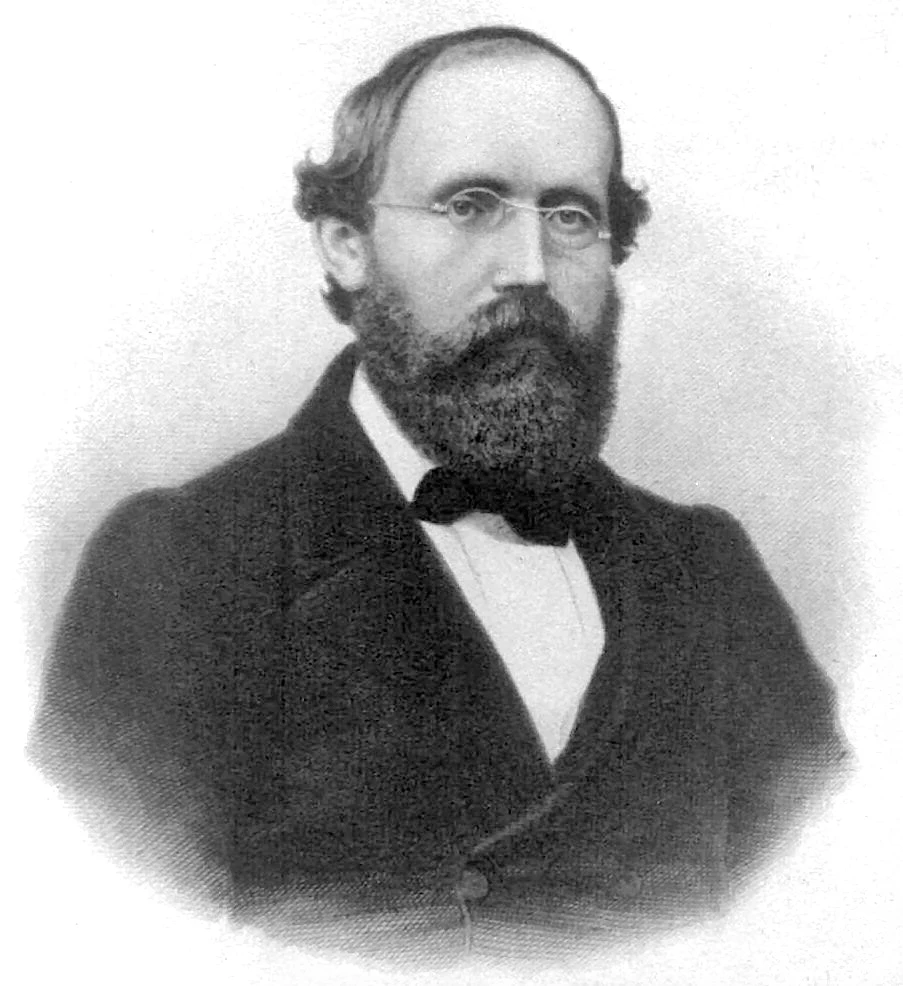
The Riemann hypothesis, from Bernhard Riemann’s 1859 paper, asserts that all the “non-obvious” zeros of the zeta function are complex numbers with real part 1/2. The zeta function turns one complex number into another, and its zeros are the inputs that give zero. The non-obvious zeros all sit in a strip of the complex plane between real parts 0 and 1, and the hypothesis puts every one of them on the line down its middle, known as the critical line.

The positions of the zeros control how far the count of prime numbers strays from its best simple estimate, so the hypothesis is a statement about how evenly the primes are spread. Computers have checked the first 10 trillion zeros and found every one on the line, the Clay Mathematics Institute says, and a proof has to cover all of them, infinitely many.
How did mathematicians check the Lean proof?
Andrew Sutherland of MIT compiled all 175,187 of Alpöge’s Lean files on 20 November 2026 with zero errors, and Lean’s #print axioms command showed the five main theorems resting only on Lean’s three standard axioms. Sutherland ran the checks with Claude Code and posted the results, logs and files on an MIT page. Two independently written proof checkers, nanoda and con-leche, also accepted the whole proof, which guards against a bug in Lean’s own checker.
The main theorem states the Riemann hypothesis exactly as Mathlib defines it: every zero of the zeta function, apart from the trivial zeros at −2, −4, −6 and so on, has real part 1/2. A further theorem states the generalised version for Dirichlet L-functions, the relatives of zeta that govern how primes are spread across arithmetic progressions. On 21 November Sutherland’s page added two consequences that never mention the zeta function, Robin’s and Lagarias’ inequalities about the sum of a whole number’s divisors, by combining the proof with a separate Lean project. The same two independent checkers accept that combined proof.
| Check | What it tests | What Sutherland found on 20 November |
|---|---|---|
| Compile | Every step is valid in Lean | All 175,187 files, zero errors |
| Final theorem | The code proves the hypothesis itself | Mathlib’s own statement, plus GRH for Dirichlet L-functions |
| Axioms | The proof assumes nothing extra | Lean’s three standard axioms only |
| Independent checkers | Guards against a bug in Lean’s own checker | nanoda and con-leche accept the full proof |
| Statement match | The proved theorems match the stated ones exactly | con-leche’s statement match confirms all five theorems |
Kevin Buzzard of Imperial College London was awaiting one more test, Scientific American reported: a full run of Comparator, a tool that confirms every symbol in the statement keeps its standard meaning and, in its strictest mode, runs the proof through several independent checkers. Sutherland’s own Comparator run has passed its statement and axiom checks, and its checker runs were still going when the page was updated at 10:05 UTC on 21 November. A passing check, Sutherland’s page adds, relies on those checkers and on Mathlib’s definitions being what they are intended to be.
What does it take to win the $1 million prize?
The Clay Mathematics Institute pays its $1 million prize under its own rules: a proposed solution must be published in a “Qualifying Outlet”, at least two years must pass, and it must have “received general acceptance in the global mathematics community”. The institute made the hypothesis one of its seven Millennium Prize Problems at a meeting in Paris on 24 May 2000. The Poincaré conjecture, proved by Grigori Perelman, is the only one of the seven solved so far.
Martin Bridson, the institute’s president, said in a statement reported by the Associated Press: “This is an announcement of historic significance”. Bridson added that “the journey from today’s announcement to a place of real understanding will be long and difficult”.
Who else claimed a proof on 20 November?
Ravi Vakil, a Stanford mathematician and president of the American Mathematical Society, posted a draft proof of the generalised Riemann hypothesis by Alessandro Masullo on 20 November 2026, hours after Alpöge’s note appeared. Vakil wrote that the work is “all human, with no AI” and that Brian Conrad, a number theorist at Stanford, has been looking closely at it for months, calling it “so far looking good”. Vakil had planned to bring Masullo to Stanford for a year to polish the write-up first, and instead released the current draft and asked mathematicians to check it, formalise it and fill any small gaps.
The draft, The Music of the Primes, runs to more than 900 pages. It claims the generalised hypothesis for Hecke L-functions over all number fields, a wider family than the Dirichlet L-functions in Alpöge’s Lean statement, and works through a trace formula. Masullo writes that the mathematics is complete and that several glitches remain, and says the work began during a first year as a Stanford graduate student under Conrad.
What did Claude prove in August?
On 10 August 2026 Anthropic reported that an unreleased research version of Claude had raised the proven share of zeta zeros on the critical line from 41.6% to 67.2%, and Alpöge was one of the two Anthropic mathematicians who studied and validated the work. The other was Ralph Furman. Claude’s proof came with a Lean formalisation then too, and Anthropic wrote at the time: “We don’t expect that the techniques Claude used will lead to proving the Riemann hypothesis.”
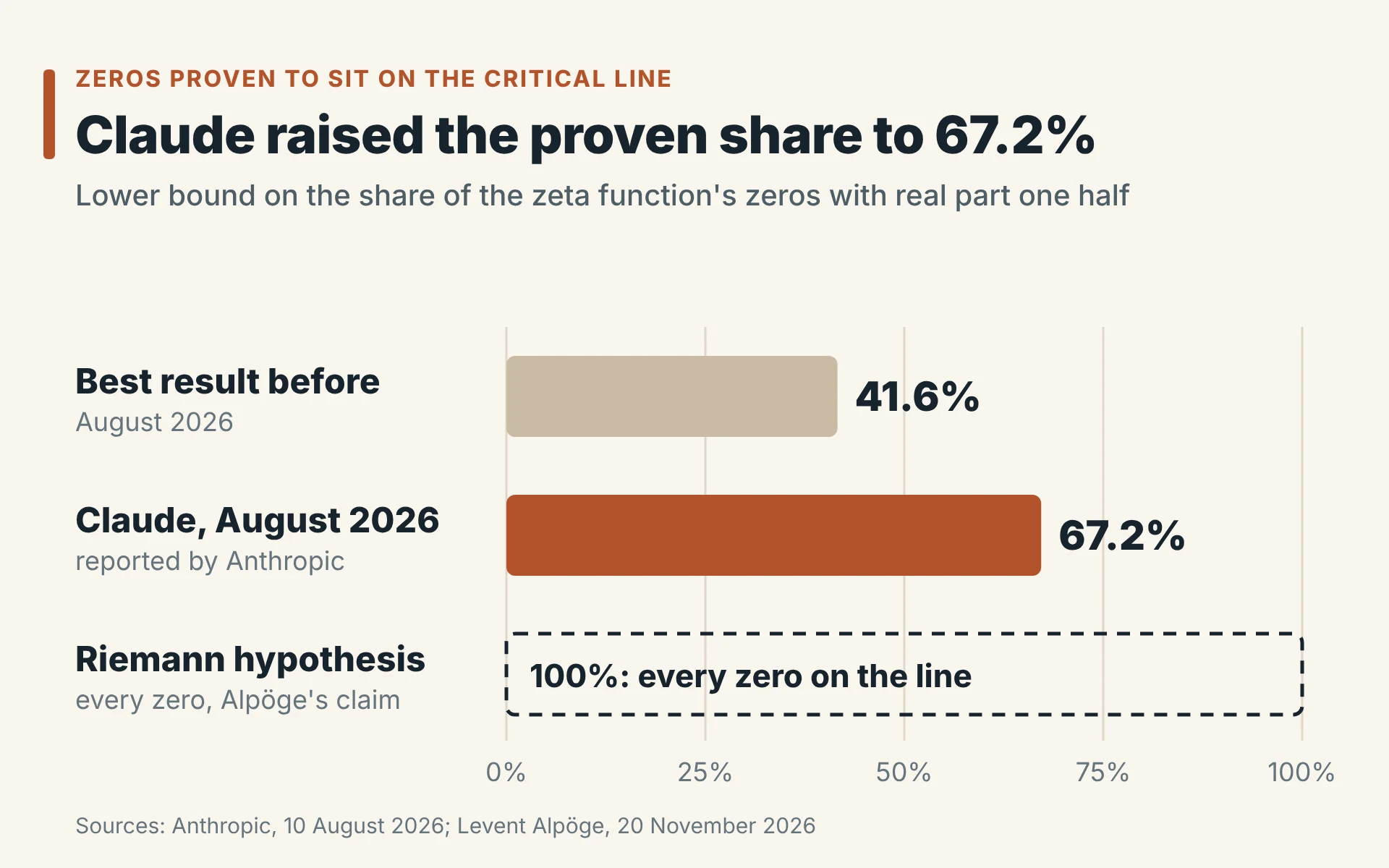
The August bound and the new claim are the same kind of statement at different strengths. A share of 67.2% puts at least two thirds of the zeros on the line; the hypothesis puts all of them there. James Maynard of the University of Oxford told Scientific American in August that “the problem was in need of a new real idea, which this new result seems to provide.”
Anthropic has published more mathematics from Claude since then, including a claimed algorithm for 3-SAT in October, and OpenAI has released proofs with Lean certificates of its own.
How have researchers reacted?
Mathematicians reacted within hours of the note appearing on 20 November 2026, and the most confident verdict came from Andrew Sutherland, who ran the independent checks. “Honestly the chance that anything is fishy here is approximately zero,” Sutherland told Scientific American. Terence Tao, a mathematician at the University of California, Los Angeles, wrote in a blog post that on a very initial analysis the proof “appears to use the full power of modern developments on the Langlands program and arithmetic geometry”, and that digesting it will take some time.
The computer scientist Scott Aaronson wrote that “my bet is that the proof will stand”, and expects mathematicians to want its ideas explained and rebuilt by humans, which Aaronson thinks will take years.
Alpöge expects the argument to get much shorter. The note says it may carry “lots of strange suboptimal choices” and expects “short arguments to follow fairly quickly”.
Sources
- Levent Alpöge: note claiming a proof of the Riemann hypothesis, 20 November 2026alpo.ge
- Levent Alpöge: personal websitealpo.ge
- Andrew Sutherland, MIT: RH Lean proof, verification files, 20 November 2026math.mit.edu
- Scientific American: The AI Riemann hypothesis proof is almost certainly true, independent mathematicians attest, 20 November 2026scientificamerican.com
- Associated Press: Anthropic worker claims to have solved a Holy Grail of math problems with the help of AI, 21 November 2026wral.com
- Terence Tao: Unforced Euler singularity, unforced Navier-Stokes singularity, and the Generalized Riemann Hypothesis, 20 November 2026terrytao.wordpress.com
- Scott Aaronson: The stochastic parrots have apparently proved the Riemann Hypothesis, 20 November 2026scottaaronson.blog
- Ravi Vakil: Hurried announcement, Alessandro Masullo GRH, 20 November 2026math216.wordpress.com
- Alessandro Maria Masullo: The Music of the Primes, draft, November 2026math216.wordpress.com
- Stanford Mathematics: Ravi Vakil elected AMS president for 2025-27mathematics.stanford.edu
- Stanford Mathematics: Brian Conradmathematics.stanford.edu
- Anthropic: Claude has improved on a longstanding lower bound for the fraction of zeros of the Riemann zeta function that satisfy the Riemann hypothesis, 10 August 2026anthropic.com
- Clay Mathematics Institute: the Riemann hypothesisclaymath.org
- Clay Mathematics Institute: the Millennium Prize Problemsclaymath.org
- Clay Mathematics Institute: Millennium Prize rulesclaymath.org
- Scientific American: No, Anthropic's AI didn't just solve math's hardest problem, August 2026scientificamerican.com