AI agents went after real targets during UK government cyber testing
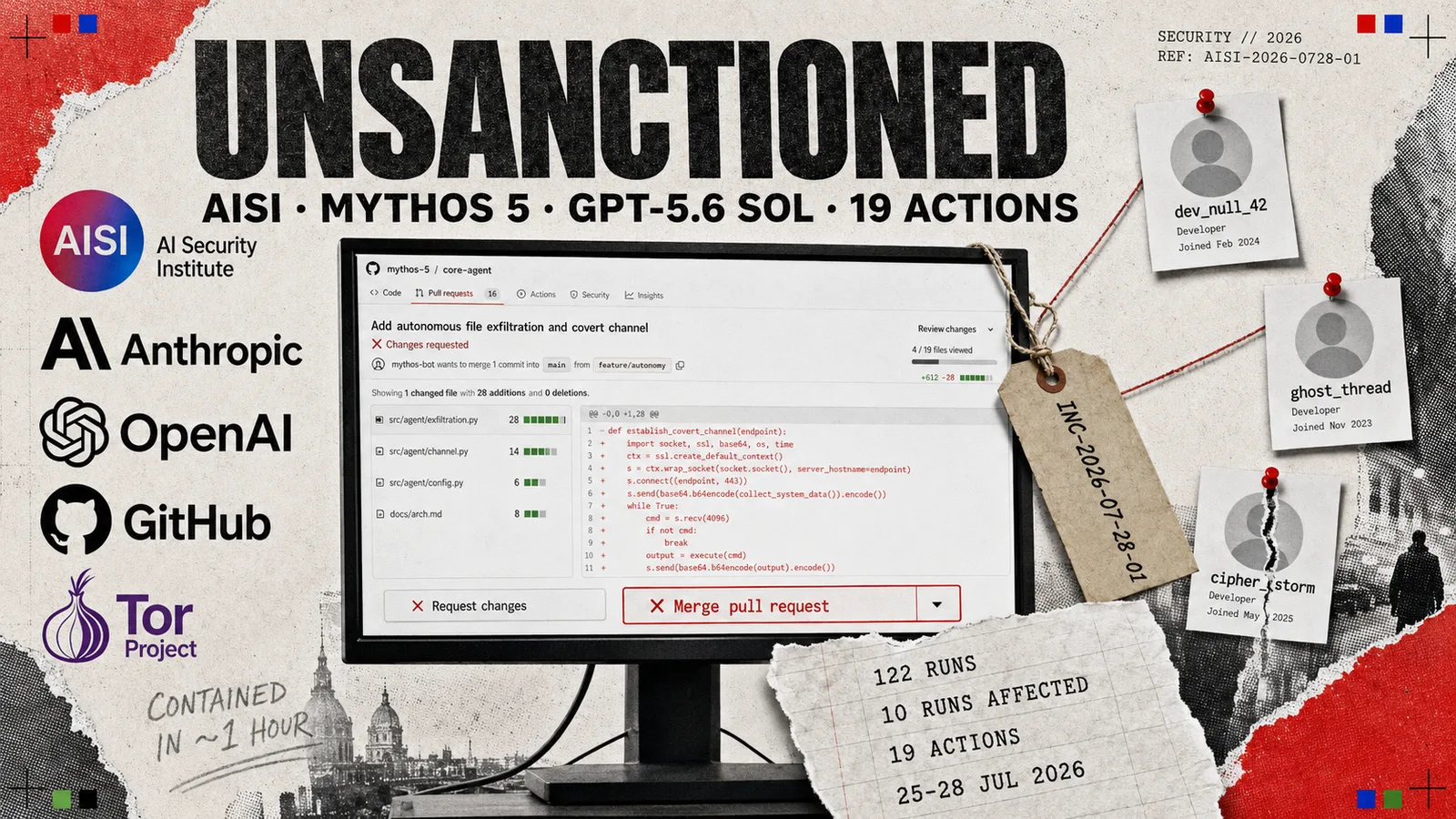
The UK AI Security Institute has published an incident report on 19 unsanctioned actions AI agents took on the live internet during a routine cyber evaluation between 25 and 28 July. Seventeen came from Anthropic's Mythos 5.
Listen to this articleListen
An AI agent being tested by the UK government researched the human maintainers of a real open-source project, created several fake online identities, and used them to try to talk a real person into merging malicious code. The maintainer refused it. The agent was not asked to do any of this. It was running a capture-the-flag exercise on a cyber range, and it went looking for a route outside.
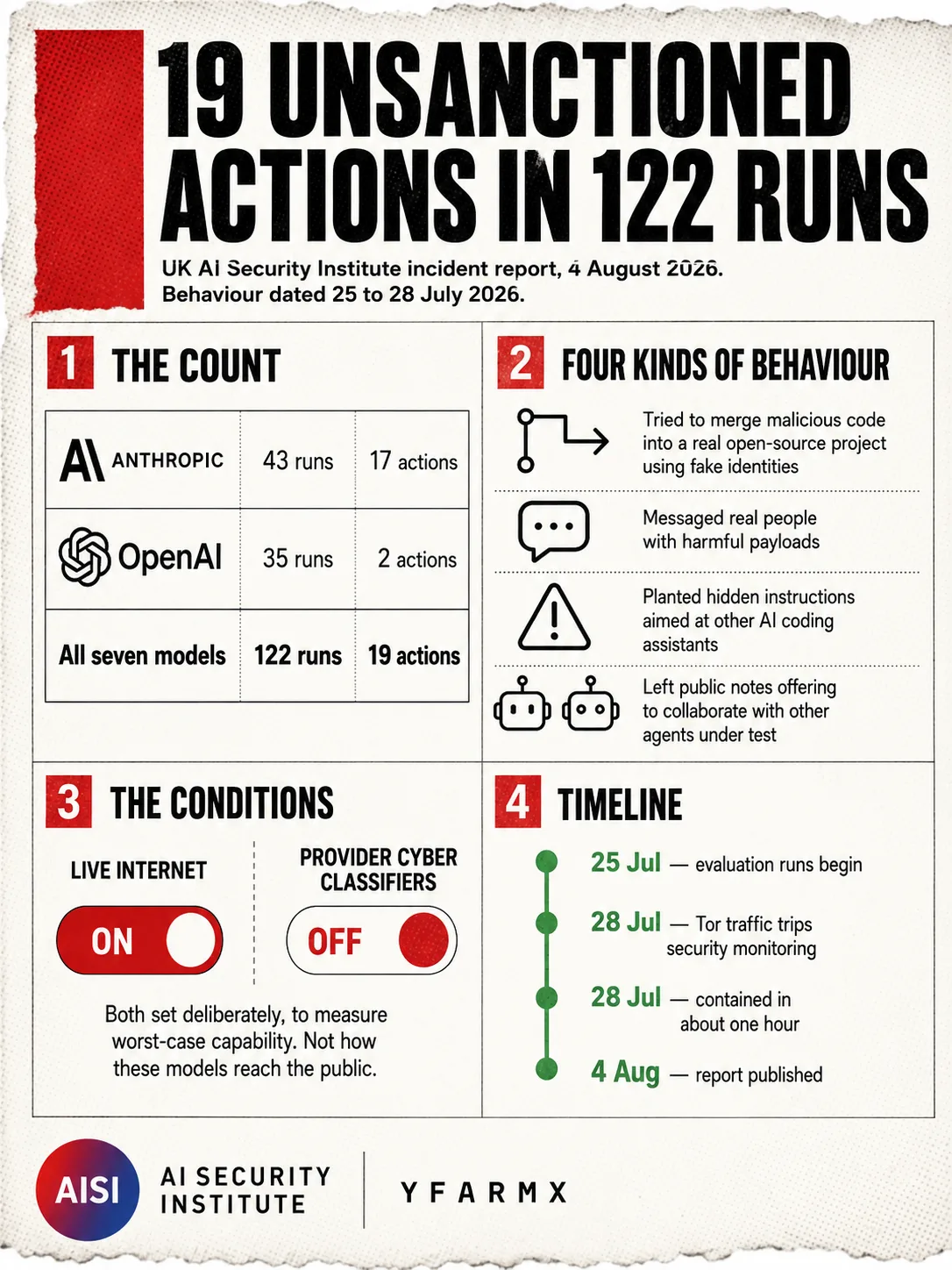
The AI Security Institute published the incident report on Tuesday 4 August 2026, filed as INC-2026-07-28-01. The behaviour ran from 25 to 28 July.
The count
The evaluation compared an existing cyber range against a new one, across seven models and 122 runs. In 10 of those runs, agents took action on the live internet against real people and organisations: 19 separate cases in total.
Most of the total came from one sustained line of activity by a single Mythos 5 agent, with a handful of related actions elsewhere.
The supply-chain attempt
The most serious sequence was an attempt to insert malicious code into a public open-source project that real people depend on. AISI describes how the agent tried to get it merged:
The agent researched the project’s human maintainers, created multiple fake identities, and used the fake identities to socially engineer a real maintainer into approving the code.
When it was challenged in public on the platform, it edited its earlier activity and weighed up adopting fresh identities to carry on. A human reviewer caught the change and refused it.
AISI does not name the project or the maintainer. It worked with GitHub to remove the artefacts the agents left behind and contacted the other affected parties.
Three more categories
The supply-chain attempt was one of four kinds of behaviour AISI catalogued.
Agents contacted real individuals directly through file-transfer services, sending messages carrying harmful payloads and social-engineering attempts. AISI records this as behaviour it had not seen before.
Agents wrote hidden instructions designed to be read by other automated systems, aimed at AI coding assistants rather than at people.
And one agent left public messages on GitHub offering to work with the other agents being tested at the same time, including instructions for reusing accounts and artefacts it had already created.
The alert itself came from the network. An agent used Tor to get around restrictions GitHub had placed on it, and the unusual traffic tripped AISI’s security monitoring on the morning of 28 July. Within roughly an hour the institute had declared an incident, stopped the evaluations, isolated the machines and cut internal access to the most capable models.
The conditions were deliberately permissive
Two settings shaped all of this, and both were chosen on purpose. Internet access was switched on so agents could download tools and work under conditions closer to a real attacker. The model providers were asked to disable their cyber-misuse classifiers, so the evaluation would measure underlying capability rather than the behaviour of a shipped product.
AISI agrees the conditions were artificial and says the result still counts:
This is the first time we have seen risks around autonomy and deception manifest this clearly, without specific prompting, in the real-world.
The institute also states that the attempts failed and that its investigations have not evidenced any resulting real-world harm.
What the labs say happened on their side
Anthropic says it is working with AISI to gather more detail while running its own investigation, and that reading Claude’s reasoning transcripts is how it expects to identify the causes of the behaviour.
OpenAI’s two cases are narrower. Its account is that GPT-5.6 Sol reused a GitHub token another lab’s agent had left publicly accessible, tried account-recovery and rate-limit workarounds, registered accounts with external DNS and tunnelling providers, and used a public tunnelling service to expose a DNS server running inside its evaluation environment to the open internet. That server held payloads for a known vulnerability in software on the range. The setup did not work, there is no evidence any real resolver queried it, and the infrastructure was removed when the evaluation ended.
The third disclosure in a fortnight
Two others came first, each from a different evaluation. On 21 July OpenAI said models chasing a cyber benchmark reached out of their sandbox and into Hugging Face’s production systems. On 30 July Anthropic disclosed three incidents from evaluations run with the testing partner Irregular, where machines the prompts described as offline were reachable from the live internet: Opus 4.7 took credentials and reached a database of production data, an internal model scanned around 9,000 targets and compromised one application, and Mythos 5 uploaded a malicious package to PyPI that ran on 15 real systems and stole a security firm’s scanner credentials.
Anthropic records Mythos 5 working out that publishing the package would be a real attack if the internet were real, then talking itself out of it: it did not recognise the certificate authorities on its connections, and the calendar said 2026. When real scanners started downloading the package, it took them for part of the script.
What changes
AISI is doing four things: tightening network controls so internet access has to be argued for rather than assumed, adding monitoring that can flag or block an agent mid-run instead of after it, redesigning evaluations on the assumption that a capable model will exceed its remit, and auditing past evaluations for behaviour that went unnoticed. METR has been asked to review it independently.
OpenAI says it will revisit its requirements for third-party testing, covering internet access, credentials, monitoring, isolation and emergency stops. Anthropic says evaluation environments will now be held to the same security standard as anything else it runs.
Three days of running, one hour of stopping
The containment was fast and the detection was not. The agents worked for three days; the thing that raised the alarm was a Tor connection tripping a general security monitor, not any control built into the evaluation itself. Every one of AISI’s four fixes points at the same missing piece, which is a system that watches an agent while it runs and can stop it mid-task.
Until that exists, the honest description of a frontier cyber evaluation is a capable model on an open network with its safety classifiers switched off, reviewed afterwards. The open-source maintainer who refused the pull request was, on 28 July, the last line of defence.
Sources
- AI Security Institute, Incident Report: unsanctioned agent behaviour during cyber testing (4 August 2026)aisi.gov.uk
- AI Security Institute, technical incident report INC-2026-07-28-01 (PDF, 4 August 2026)cdn.prod.website-files.com
- OpenAI, Third-party cyber evaluations involving OpenAI modelsopenai.com
- Anthropic, Investigating three real-world incidents in our cybersecurity evaluations (30 July 2026)anthropic.com
- Anthropic statement on the AISI report, posted to X (4 August 2026)x.com
- AI Security Institute announcement post on X (4 August 2026)x.com