OpenAI now watermarks its audio with Google's technology
Audio generated with OpenAI tools now carries a SynthID watermark, the invisible signal built by Google DeepMind. OpenAI has also opened a verification endpoint so anyone can post a file and be told which provenance signals survive in it.
Listen to this articleListen
OpenAI has extended SynthID watermarking to the audio its tools generate, and opened an endpoint that will tell you whether a file carries a provenance signal at all. SynthID is Google DeepMind’s technology. The two companies agree on very little else.
Two signals doing two different jobs
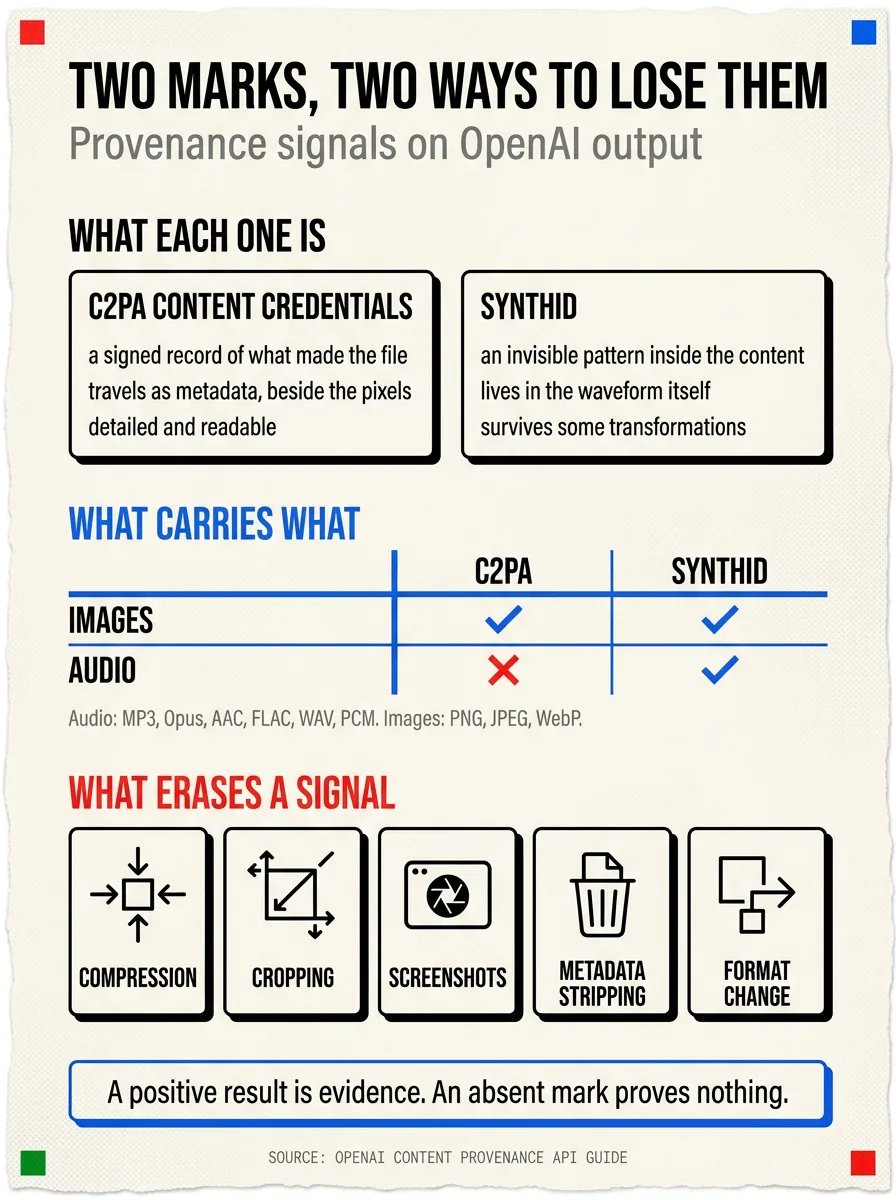
A file coming out of OpenAI’s tools can now carry two marks, and they fail in opposite ways.
Content Credentials are the C2PA standard: a signed manifest recording what made the file and what has been done to it since. It is readable, precise and detailed. It is also metadata, which means it travels alongside the pixels rather than inside them. Upload the file to almost any social platform and the metadata is stripped on the way in. OpenAI’s own documentation says it directly: “Editing, converting, or sharing a file can remove its metadata.”
SynthID is a watermark written into the content itself. In audio that means an alteration to the signal, inaudible to a listener, that a detector can recover afterwards. Because it lives in the waveform rather than beside it, it survives the things that destroy metadata. OpenAI’s wording is careful: a SynthID watermark “may survive some transformations”.
Neither is a full answer on its own. C2PA tells you a great deal and is easy to remove. SynthID tells you one thing and is hard to remove. Carrying both is the sensible position, and it is what images get.
Audio gets SynthID only. There is no C2PA manifest on an audio file, which is worth knowing before anyone builds a check around it: for audio, the invisible mark is all there is.
The endpoint
The verification route is a single call. A POST to /v1/content_provenance_checks with the file returns the completed result in the same response, with no job to queue and no polling. The reply carries a creation timestamp and a results array with one entry per applicable signal, so an image comes back with a C2PA result and a SynthID result while audio comes back with one.
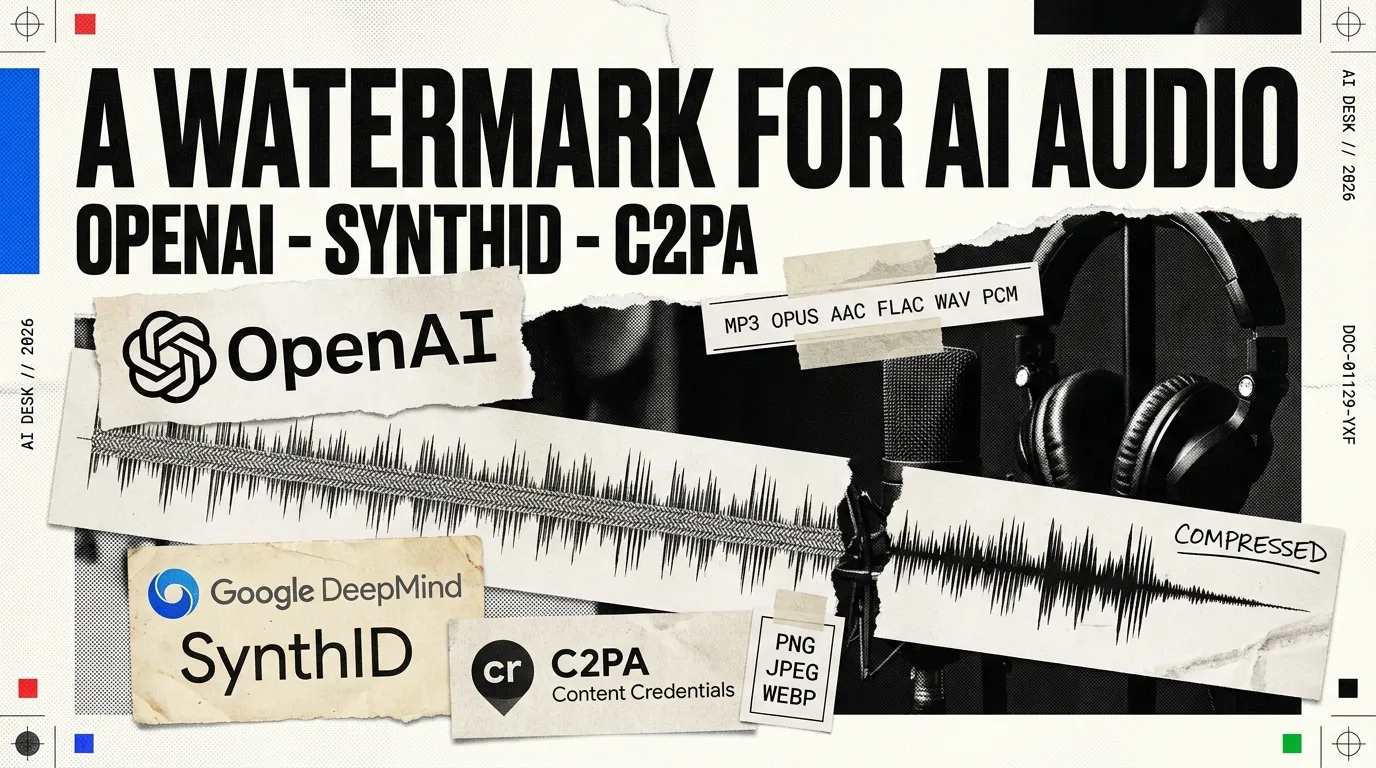
The supported formats are listed rather than implied. Audio: MP3, Opus, AAC, FLAC, WAV and PCM. Images: PNG, JPEG and WebP.
For a newsroom, a bank or a platform moderation team, a synchronous endpoint is the difference between a check that can run inside a publishing flow and one that cannot. Anything that has to be queued gets skipped.
The caveat is in OpenAI’s own documentation
The most useful sentence in the release is the one limiting it. OpenAI states that “compression, cropping, screenshots, metadata removal, and format conversions can erase or weaken a signal.”
Read that against how synthetic audio actually reaches people. A voice clone used for fraud arrives down a phone line, through a codec built to throw away everything a human ear will not miss. A fake clip on a social platform has been re-encoded at least once before anyone sees it. A screen recording of a video is a fresh file with no inheritance from the original at all.
So the system is strong exactly where the stakes are lowest, on a pristine file handled carefully, and weakest where they are highest. A negative result carries almost no information: it means the file has no recoverable signal, which is equally consistent with a real recording, a rival model’s output, and an OpenAI clip that has been through a compressor. Only a positive result says anything firm.
That is not a criticism of the engineering, which is doing something genuinely hard. It is the reason a watermark cannot be the thing a fraud check rests on.
Interoperability is the actual news
OpenAI adopting a Google detection technology is the part with consequences. Provenance only works if a detector can be pointed at a file without first knowing which company made it, and a standard adopted by one lab is a private label rather than a standard.
OpenAI joined the C2PA steering committee in 2024, alongside camera manufacturers, publishers and platforms. Adopting SynthID on top of that puts the two largest producers of synthetic media on one invisible-watermark scheme and one metadata standard. Regulation is heading the same way: the EU AI Act’s transparency duties expect providers to mark synthetic output in a machine-readable form, and a shared scheme is far easier to comply with than a per-vendor one.
A mark that proves what is synthetic cannot prove what is real
The direction of the guarantee is the thing to keep straight, because it is the opposite of what people expect from it.
Watermarking establishes that a file came from a particular generator. It never establishes that a file did not. Every model without SynthID, every open-weights checkpoint running on a laptop, and every clip that has been through one round of compression produces unmarked output that looks exactly like genuine footage to a detector.
The useful version of this technology is a positive signal on a specific file, used as one input among several. Anyone planning to treat an absent watermark as evidence of authenticity is reading it backwards, and OpenAI’s own list of things that erase the signal explains why.