An hour to fifteen seconds: AT&T puts quantum into live network operations
AT&T has signed an agreement to expand its use of D-Wave's annealing machines across network operations, after cutting one optimisation workload from about an hour to under 15 seconds. Here is what the deal covers, from outage response to technician routing.
Listen to this articleListen
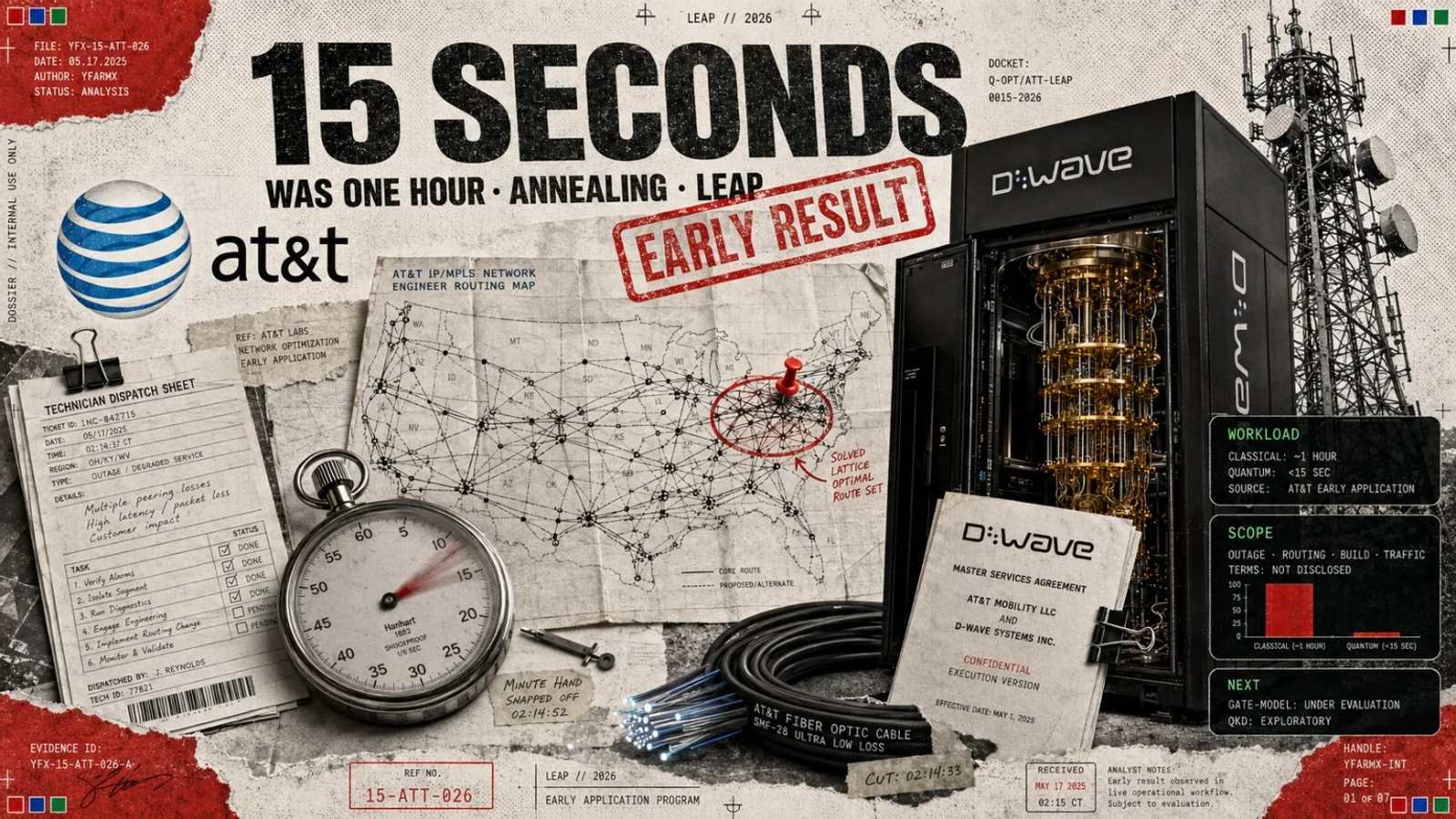
AT&T has signed an agreement to expand its use of D-Wave’s quantum computers across network operations, D-Wave announced on 27 July. The first step is to layer annealing quantum capability into the agentic AI tools AT&T already runs.
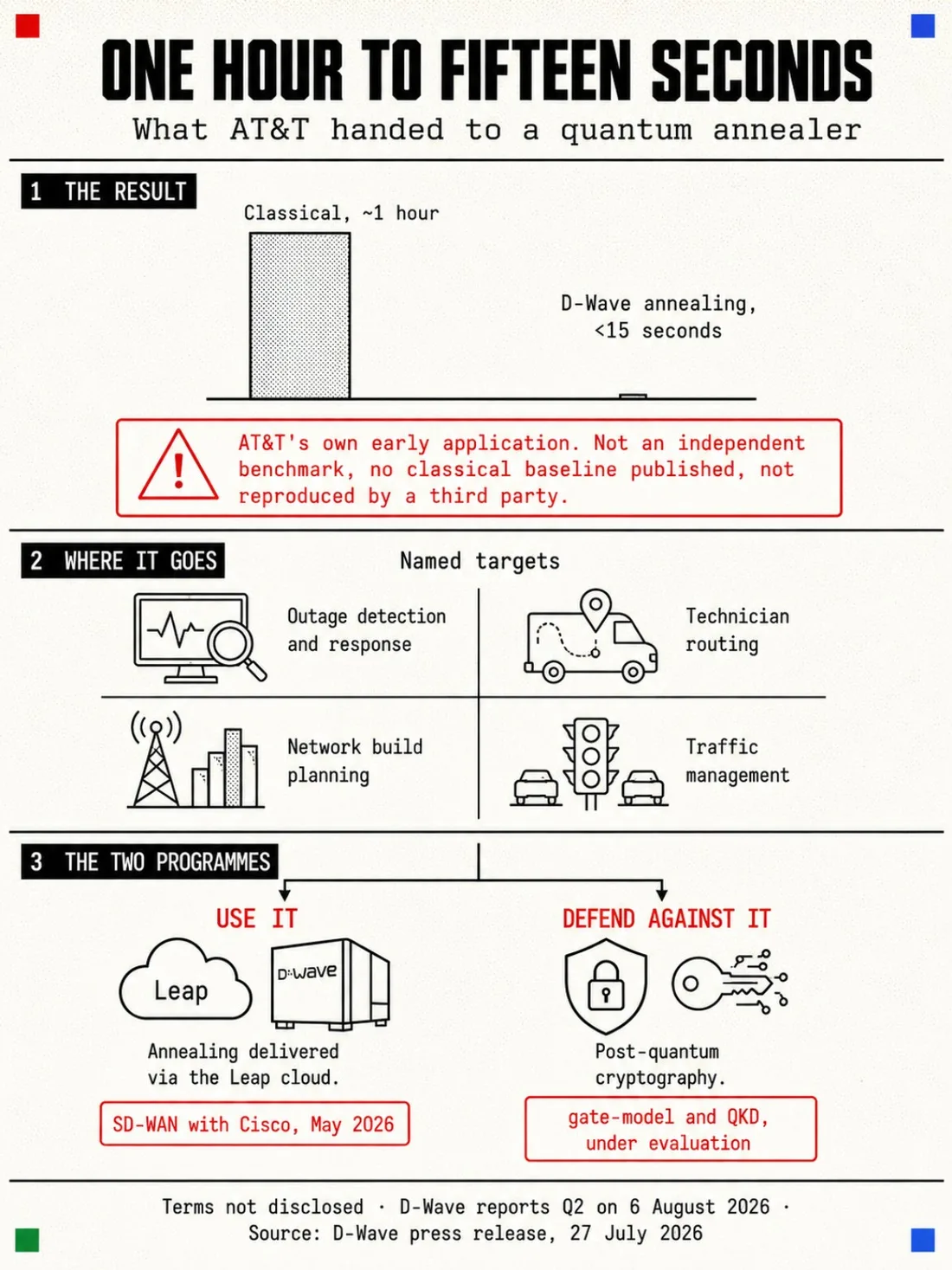
The number doing the persuading is a single early result. In one application, AT&T reduced the processing time for a network optimisation workload “from approximately one hour to less than 15 seconds”.
Lucus Haugen, Director of Data Science in AT&T’s Chief Data Office, is quoted saying: “The speed we’re seeing with D-Wave challenges what’s currently possible. It has the potential to help us optimize faster, increase efficiency and scale more real-time operations.”
The claim is potential, not delivered performance.
What annealing is good at
D-Wave does not build a general-purpose quantum computer. Its machines are annealers, and they do one category of work: finding good answers to optimisation problems where the number of possible combinations is too large to check.
That is a narrow capability, and a telecoms network is full of exactly that shape of problem. The named targets are outage detection and response, technician routing, network build planning and traffic management. Every one is a question of the form “given everything happening right now, what is the best allocation”, and every one currently gets an answer good enough to act on rather than the best answer, because the clock runs out first.
Compressing an hour into fifteen seconds changes the character of the question. An hour-long optimisation runs overnight and informs a plan. A fifteen-second one runs while an engineer is on the phone.
Access is through Leap, D-Wave’s quantum cloud service, which the company says offers 99.9% availability. AT&T is not buying a machine.
The longer play
The agreement also covers ground that has nothing to do with optimisation. AT&T is evaluating D-Wave’s forthcoming gate-model systems for quantum security and quantum communications, and its Chief Data Office is looking at how fault-tolerant machines might eventually support quantum key distribution and quantum-resilient network architecture.
That fits a pattern AT&T has been building all year. In May it became the first major North American carrier to launch a quantum-resilient SD-WAN service using post-quantum cryptography on Cisco hardware, aligned to NIST standards. It has a parallel quantum-resilient effort with Palo Alto Networks.
So AT&T is running two quantum programmes at once: using today’s quantum machines to run the network faster, and defending the network against tomorrow’s. The D-Wave agreement is the first working on the near term.
Alan Baratz, D-Wave’s chief executive, is quoted on what the customer brings: “AT&T has incredibly complex optimization problems across its network operations, understands where classical computing is challenged, and is moving quickly to explore where quantum can make an impact.”
One company announced this
No financial terms were disclosed, so the scale of the commitment is unknown, and the hour-to-fifteen-seconds figure is AT&T’s own result from an early application: not published as a benchmark, measured against a classical baseline the companies do not describe, and reproduced by no third party. It is a credible operator observation, not a proof of quantum advantage.
And the announcement came from D-Wave alone. AT&T’s newsroom, which published its Cisco and Palo Alto quantum work, carries nothing on this. For D-Wave, a named agreement with one of the largest carriers in the United States is a milestone worth announcing. For AT&T, it is an evaluation that has gone well.
D-Wave moved its listing to Nasdaq earlier this month and reports second-quarter results on 6 August, which is the next point at which any of this shows up in numbers rather than adjectives.
Sources
- D-Wave Quantum, 'AT&T Signs Agreement to Expand Use of D-Wave's Quantum Computing Technology', 27 July 2026dwavequantum.com
- AT&T, 'Preparing for The Quantum Era: AT&T Business Debuts Post-Quantum Cryptography Secure SD-WAN, Powered by Cisco', 11 May 2026about.att.com
- AT&T, 'AT&T, Palo Alto Networks Deliver Quantum-Resilient SASE Fabric'about.att.com
- D-Wave Quantum newsroomdwavequantum.com