
Google DeepMind
Gemini 3.6 Flash
the efficient workhorse
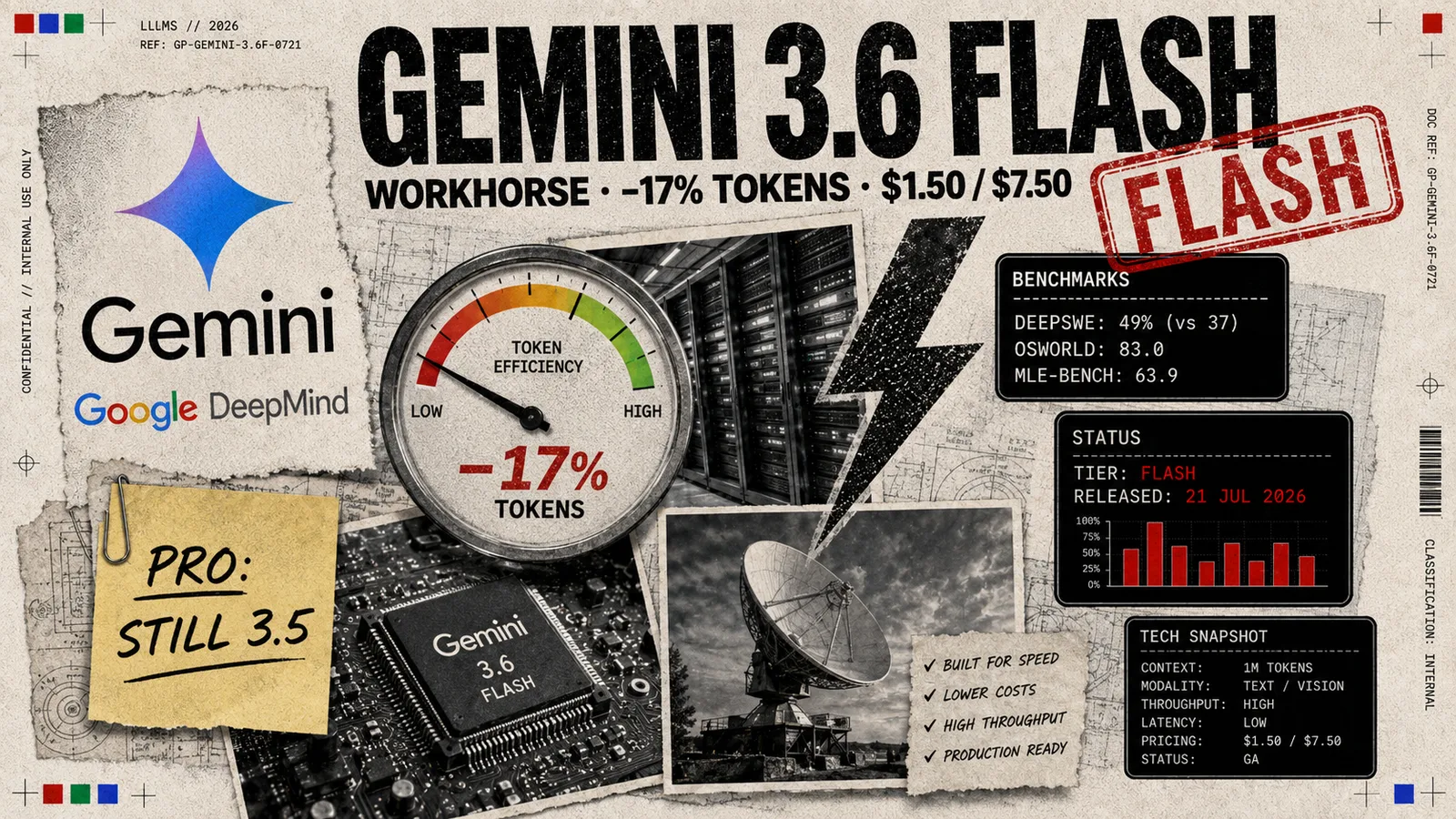
Key facts
- Google DeepMindGemini
- Lab
- 21 Jul 2026Flash tier
- Released
- -17%output tokens vs 3.5
- Efficiency
- $0.75 / $3.75per M, cut 13 Aug 2026
- Price
- none yet3.5 Pro in testing
- Pro tier
Google's Gemini 3.6 Flash, launched 21 July 2026, is the everyday workhorse tier: better coding and knowledge work using about 17 per cent fewer output tokens than 3.5 Flash. There is no 3.6 Pro; Gemini 3.5 Pro remains in partner testing.
What it is
Gemini 3.6 Flash was Google DeepMind’s workhorse model from its launch on 21 July 2026 until Gemini 3.7 Flash, built directly on it, arrived three weeks later on 13 August. Flash is the tier built for high-volume everyday work rather than the hardest reasoning, and Google describes 3.6 as delivering “better coding, knowledge work, and multimodal performance” than the version before it. The pitch is efficiency: the same class of task done for less. Google says it “reduces output token usage by 17 per cent compared to 3.5 Flash.” It launched at $1.50 per million input tokens and $7.50 per million output; with the 3.7 launch on 13 August 2026, Google’s model-card pricing shows 3.6 Flash cut to $0.75 and $3.75, the same introductory rate as its successor.
The numbers
A benchmark is a fixed set of tasks run to produce a comparable score, and the party publishing a launch benchmark has a stake in the outcome, so single figures are best weighed against independent testing. On Google’s own numbers, Gemini 3.6 Flash improves clearly on 3.5 Flash: 49 per cent against 37 on the DeepSWE coding benchmark, 63.9 against 49.7 on MLE-Bench, 83.0 against 78.4 on OSWorld-Verified for computer use, and 1421 against 1349 on the GDPval-AA measure. The pattern is a solid step up in coding and knowledge work while spending fewer tokens.
The tier that did not move
The more revealing detail is what Google did not ship. There is no Gemini 3.6 Pro, and Gemini 3.5 Pro has itself not yet reached general availability, with Google saying “Gemini 3.5 Pro is currently testing with partners and we plan to make it broadly available as soon as it’s ready.” So the 3.6 label applies to the workhorse tier, not the flagship. It is a reminder that a version number attaches to a specific model in a family, not to the whole line at once, and that reading “Gemini 3.6” as a single new flagship would be wrong.
Why it stands out
Flash is where most real traffic runs, because cost per task decides what is affordable to build. A workhorse model that does more while costing less pushes that line in the developer’s favour, which is why an efficiency-focused Flash release can be as consequential as a flashier flagship. Three weeks after this release, Gemini 3.7 Flash took over the top of the tier, built on this model. The open question about a Pro tier catching up remains. For that comparison, see our large language models hub and the wider AI section.
More AI
All AI →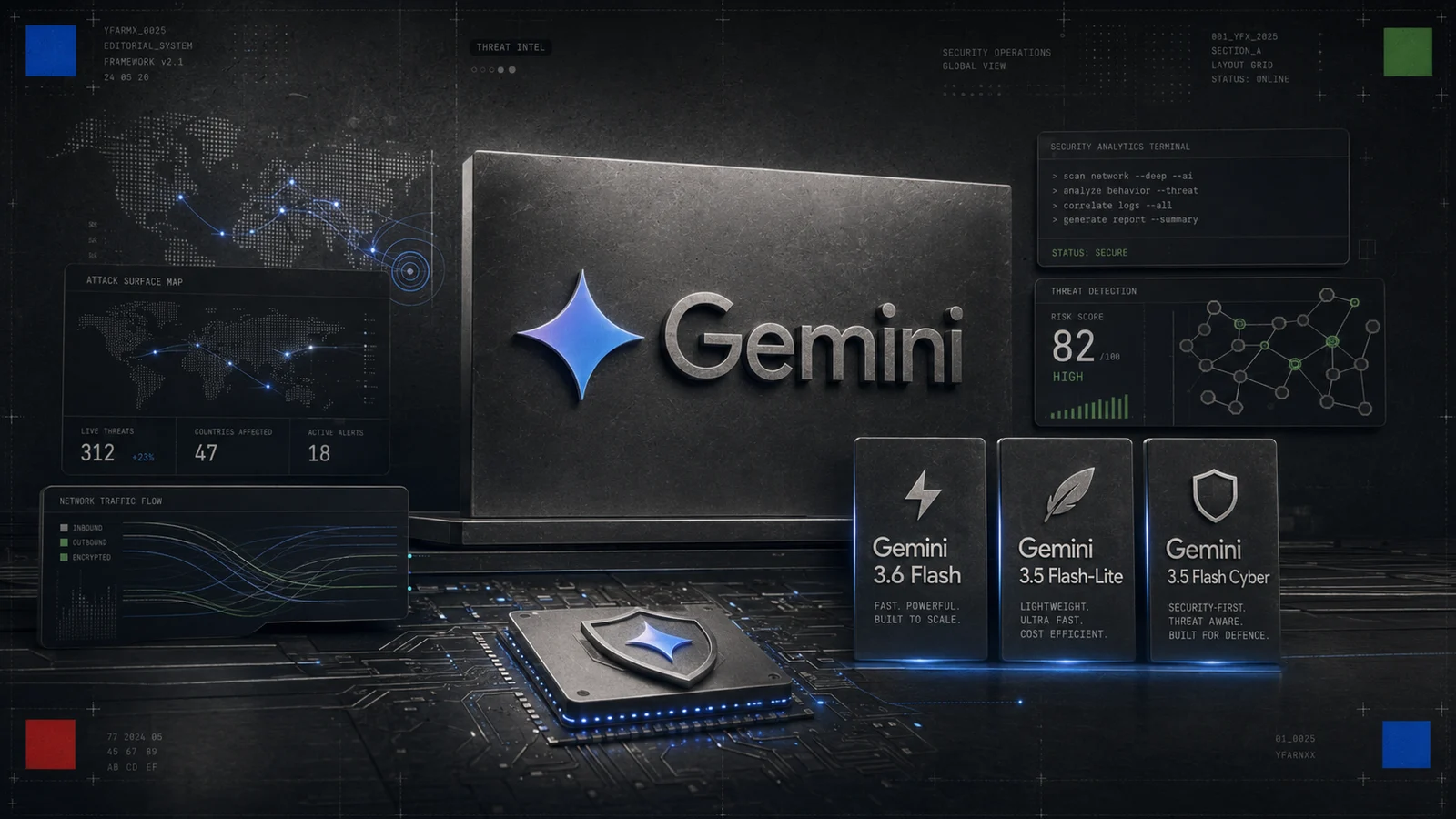
Gemini 3.6 Flash, 3.5 Flash-Lite and 3.5 Flash Cyber: Google's security model is the one to watch
Google shipped three Gemini models on 21 July 2026. The cybersecurity one is locked to governments and trusted partners. Full benchmarks, pricing and what the restriction tells you.
More in Large Language Models
All LLMs →- Google DeepMindGemini 4 Argonlonger reasoning, coding and cyber defence
- OpenAIGPT-5.6the flagship from 9 July to 3 September 2026
- OpenAIGPT-6 Astrathe new generation, rolling out from 3 September 2026
- OpenAIGPT-6.1 Solthe upgraded mid-price GPT-6 model, released 29 September 2026
- OpenAIGPT-6 Sol and Lunathe mid-price and budget GPT-6 models, released 22 September 2026
- AnthropicClaude Opus 5.5the first Claude 5.5 model, cheaper and faster than Opus 5