
Google DeepMind
Gemini 3.7 Flash
August’s Flash release and its API successor
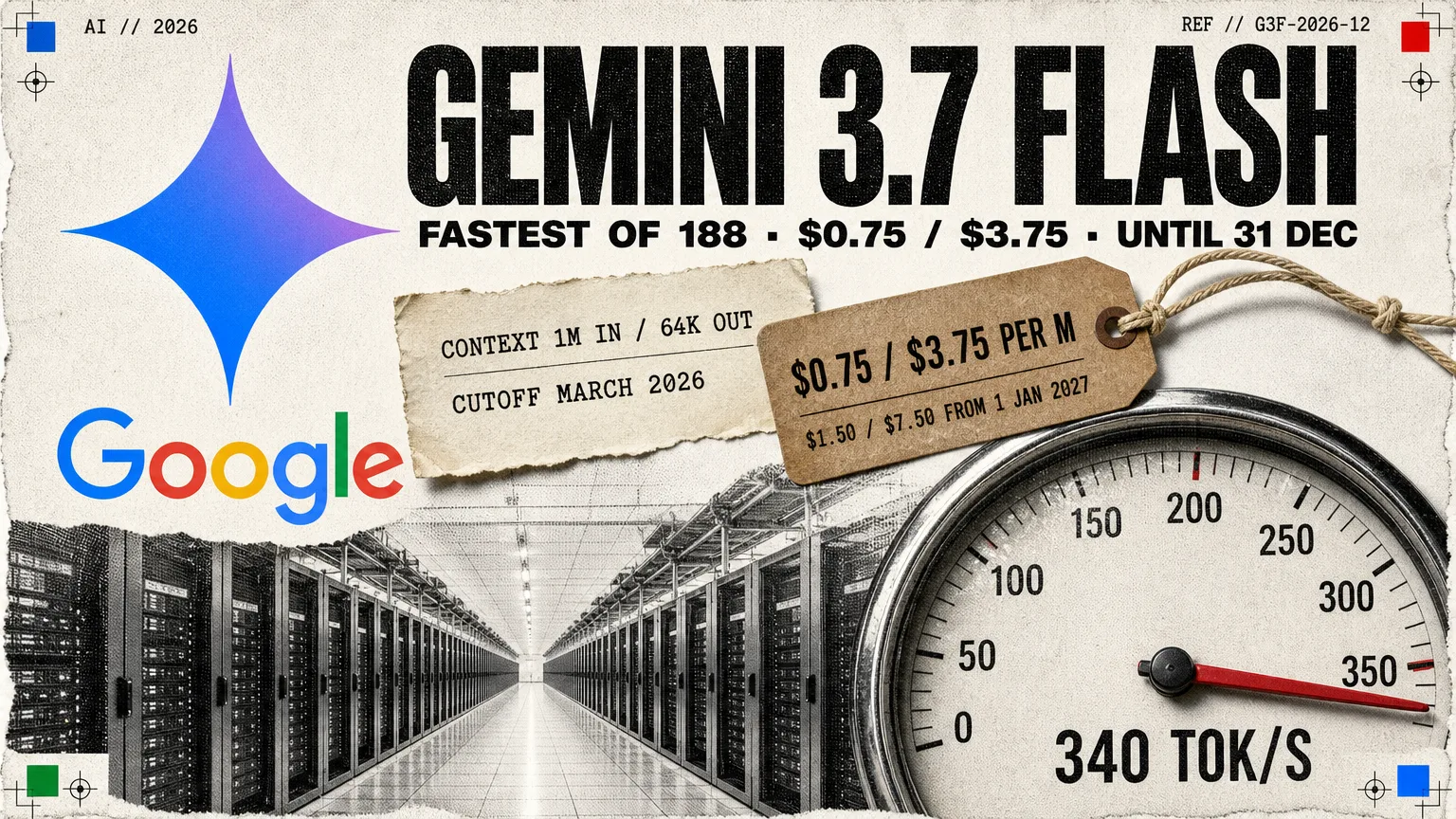
Key facts
- 13 Aug 20263 weeks after 3.6 Flash
- Released
- 1M / 64ktokens in / out
- Context
- $0.75 / $3.75original introductory rate
- Price
- $1.50 / $7.50announced at launch
- From 1 Jan 2027
- 5617th of 188, Aug 2026 reading
- AA Index
- 340 tok/s14 August 2026 observation
- Speed
Gemini 3.7 Flash was Google’s August 2026 update for coding and agent tasks. Since 8 October, its API identifier routes to Gemini 3.8 Flash. The figures below describe the original release and their stated observation dates.
What it is
Gemini 3.7 Flash is an earlier Google DeepMind workhorse model, announced on 13 August 2026, three weeks after Gemini 3.6 Flash. Flash is the tier for high-volume everyday work, and the announcement, bylined by product management director Tulsee Doshi, calls it “our most intelligent workhorse model yet for coding and agents”.
It is an iteration rather than a new foundation, and Google says so: the model card states that “Gemini 3.7 Flash is based on Gemini 3.6 Flash”, with “algorithmic improvements to its core reasoning foundation” and “customizable thinking configurations to control the mix of quality, cost and latency”. The release cadence is the striking part. This is the third new Flash model in under a month and a half, after 3.6 Flash and 3.5 Flash-Lite arrived together on 21 July.
What Google’s own table shows
Google published its comparison against 3.6 Flash, Claude Sonnet 5, GPT-5.6 Terra and Muse Spark 1.2 across twenty rows, and it rewards a close read, because it is not a clean sweep. A benchmark is a fixed set of tasks producing a comparable score, and the publisher of a launch table has a stake in it. Ten representative rows below, with the leader named:
| Benchmark | 3.7 Flash | 3.6 Flash | Leader |
|---|---|---|---|
| AA Intelligence Index | 56 | 52 | 57 GPT-5.6 Terra / Muse Spark |
| FrontierCode 1.1 Main | 43.6% | 34.4% | 3.7 Flash |
| DeepSWE v1.1 | 65.3% | 48.6% | 69.6% GPT-5.6 Terra |
| Code Arena (Elo) | 1588 | 1538 | 3.7 Flash |
| Terminal-bench 3.0 | 14.9% | 5.4% | 20.8% GPT-5.6 Terra |
| GDPVal-AA v2 (Elo) | 1525 | 1422 | 1628 Muse Spark 1.2 |
| GDP.pdf | 34.0% | 22.0% | 3.7 Flash |
| Agent’s Last Exam | 26.3% | 24.2% | 33.3% Claude Sonnet 5 |
| GDM-MRCR v2 (128k) | 97.0% | 91.8% | 3.7 Flash |
| AutomationBench* | 30.4% | 17.0% | 3.7 Flash |
* Flagged by Google itself as a private, non-reproducible test set.
Counted up, 3.7 Flash takes the best score on nine of the twenty rows, GPT-5.6 Terra on seven, Claude Sonnet 5 on two, Muse Spark 1.2 on the knowledge-work Elo plus a share of the index, and 3.6 Flash keeps one row against its own successor, tool-assisted chart reasoning. Against its own predecessor the step is large wherever code or agents are involved: DeepSWE jumps from 48.6 to 65.3 per cent, FrontierCode from 34.4 to 43.6, Terminal-bench 3.0 nearly triples. Against the field, the workhorse claims hold best on document work, long context and web development, while GPT-5.6 Terra leads most of the agentic rows and Claude Sonnet 5 takes Agent’s Last Exam by seven points. Google printed all of this itself.
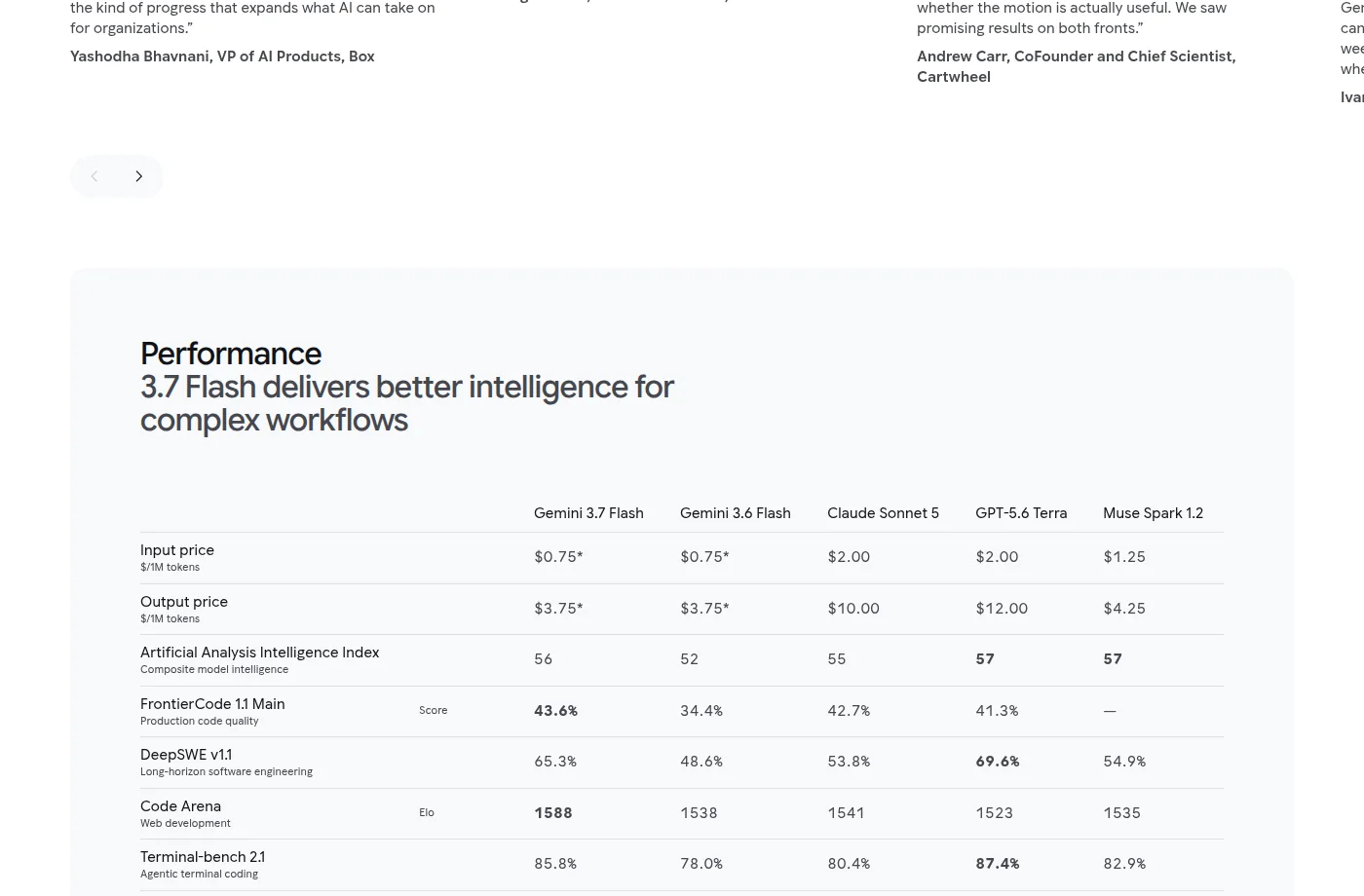
The independent reading agrees on the headline number: Artificial Analysis scored 3.7 Flash at 56 on its Intelligence Index, seventeenth of the 188 models it tracked at our 14 August 2026 check. That figure belongs to the index as it stood in August: Artificial Analysis has since rebased the index twice, most recently to v4.3 on 7 September 2026, and the v4.3 board re-scores the whole field. Where 3.7 Flash stood first of all 188 is speed, at 340.1 output tokens per second.
The original release had introductory pricing
The announced launch price was $0.75 per million input tokens and $3.75 per million output, half of what 3.6 Flash launched at three weeks earlier. The footnote is doing heavy lifting: this is an introductory rate that runs to 31 December 2026, after which the standard rate of $1.50 and $7.50 applies. Context caching, batch and the rest follow the same pattern, half price now, doubling in January.
At launch, the API had a free tier, with a difference worth knowing: on the free tier Google answers “yes” to whether prompts are “used to improve our products”, and “no” on the paid one.
The small print
The knowledge cutoff is stated as March 2026, with an unusual caveat quoted directly from the model card: in some domains “the model’s knowledge is limited to January 2025 (in line with the Gemini 3 Model Family)”. Inputs cover text, images, audio, video and PDF; output is text only, up to 64,000 tokens, with a one-million-token input window.
On safety, the model card reports no tracked or critical capability level reached under Google’s Frontier Safety Framework, while noting that CBRN and cybersecurity evaluations both “reach the alert threshold” for Level 1. The full safety report was not published at launch; the card says it “will be published shortly”.
Google’s 8 October 2026 API release notes mark Gemini 3.7 Flash as deprecated and removed from AI Studio. Requests to its API model identifier now route automatically to Gemini 3.8 Flash. The benchmark and introductory-price figures above describe the original 3.7 release; applications using the alias should check the successor’s behaviour and billing. Gemini app access follows its separate account policy below.
For the tier it replaces at the top of the Flash line, see Gemini 3.6 Flash; for the family picture, the Gemini 3.5 family.
Gemini app access from 9 October
Google began changing personal-account access on 9 October 2026. Free users receive Auto selection: most prompts use Flash-Lite, while harder requests can use Flash or Pro. Turning smart selection off uses Flash-Lite. Usage allowances refresh every five hours and also have a weekly cap; selectable models on paid plans depend on the subscription. AI Plus changes follow the date in the subscriber’s email. These app rules are separate from developer API access. Google’s account-access guidance explains the rollout and limits.
More in Large Language Models
All LLMs →- Google DeepMindGemini 3.6 Flashthe efficient workhorse
- Google DeepMindGemini 3.5 familyGoogle’s May 2026 generation
- AnthropicClaude Sonnet 5the speed and intelligence balance
- Google DeepMindGemini 4 Argonlonger reasoning, coding and cyber defence
- OpenAIGPT-5.6the flagship from 9 July to 3 September 2026
- OpenAIGPT-6 Astrathe new generation, rolling out from 3 September 2026