IBM just bought a second bet on quantum's future
IBM has agreed to buy HRL Laboratories, the Boeing- and GM-owned research lab, for its silicon-spin qubit expertise. It is a hedge: a second kind of qubit alongside the superconducting chips IBM has built its whole roadmap on.
Listen to this articleListen
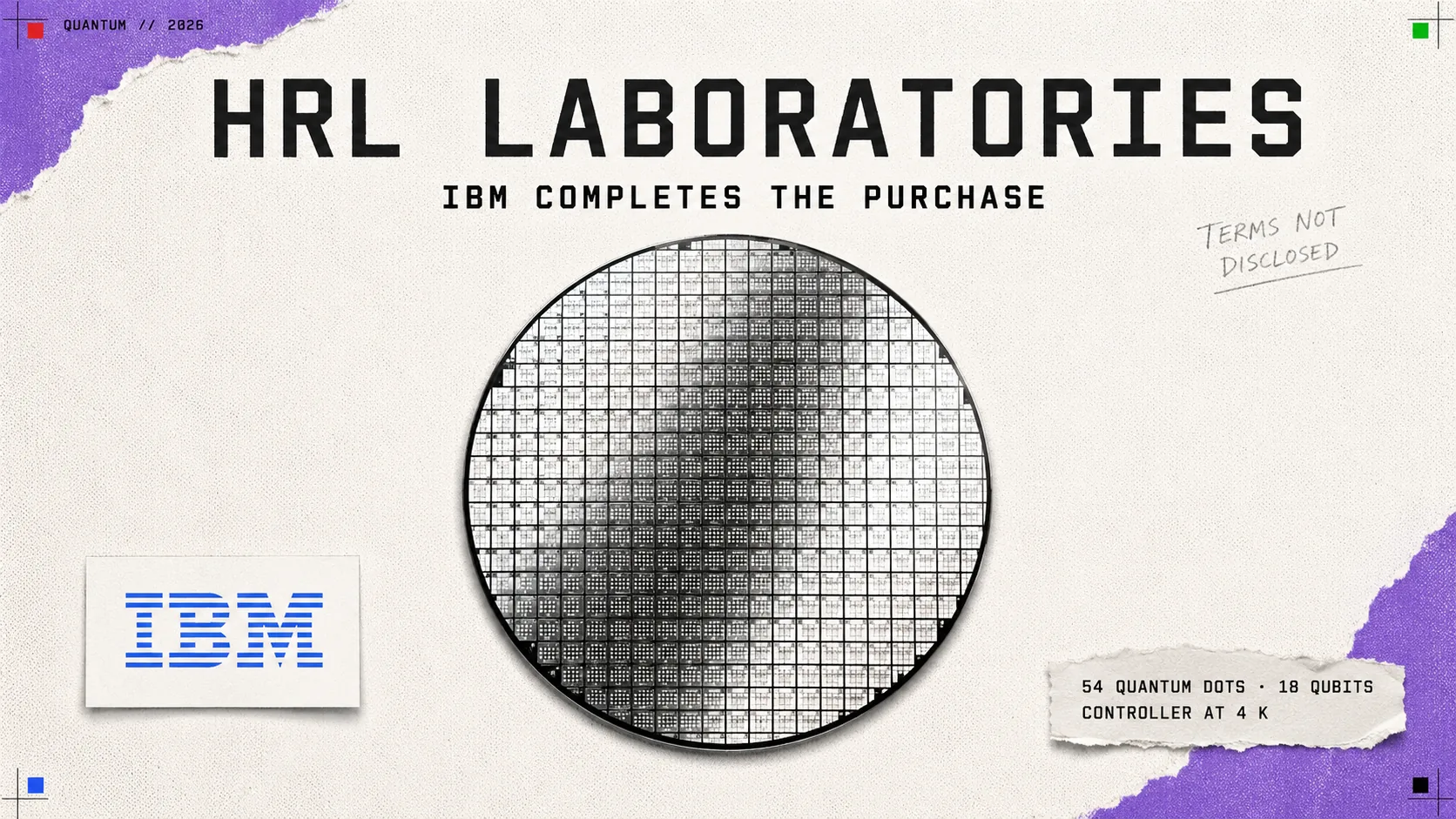
On Thursday 23 July 2026, IBM signed a definitive agreement to buy HRL Laboratories, a private research institution jointly owned by Boeing and General Motors. The company did not say what it paid. What it bought is more interesting than the price: a second, competing idea of what a quantum computer should be made of.
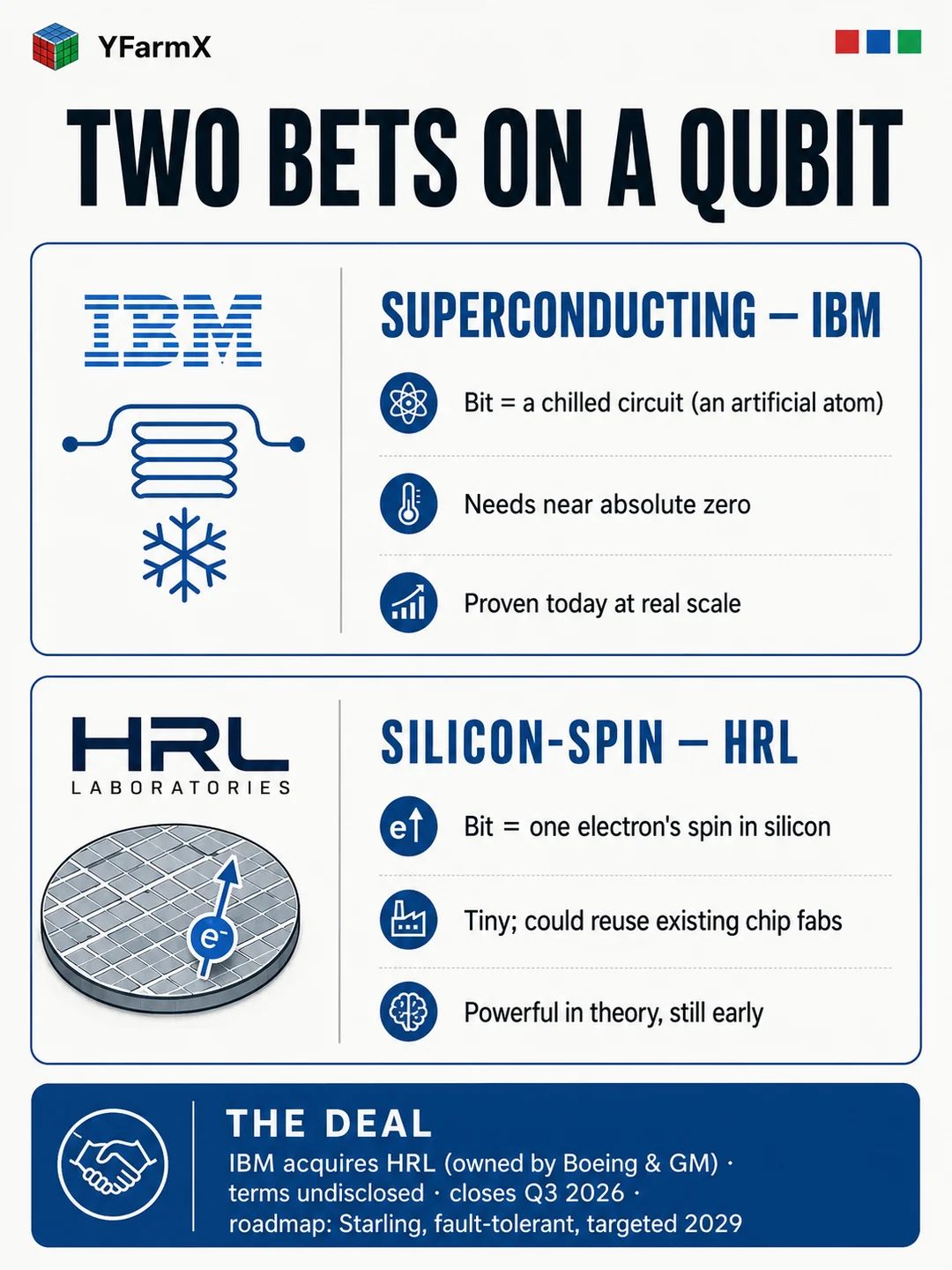
For years IBM has built its quantum programme on one bet. Its machines use superconducting qubits, tiny circuits cooled to near absolute zero, and its roadmap, its error-correction work and its flagship processors all rest on that choice. HRL builds a different kind of qubit. It engineers electron spins in silicon, the same material the entire chip industry already knows how to manufacture. Buying HRL does not swap one for the other. It puts a second horse in IBM’s own race.
What IBM actually bought
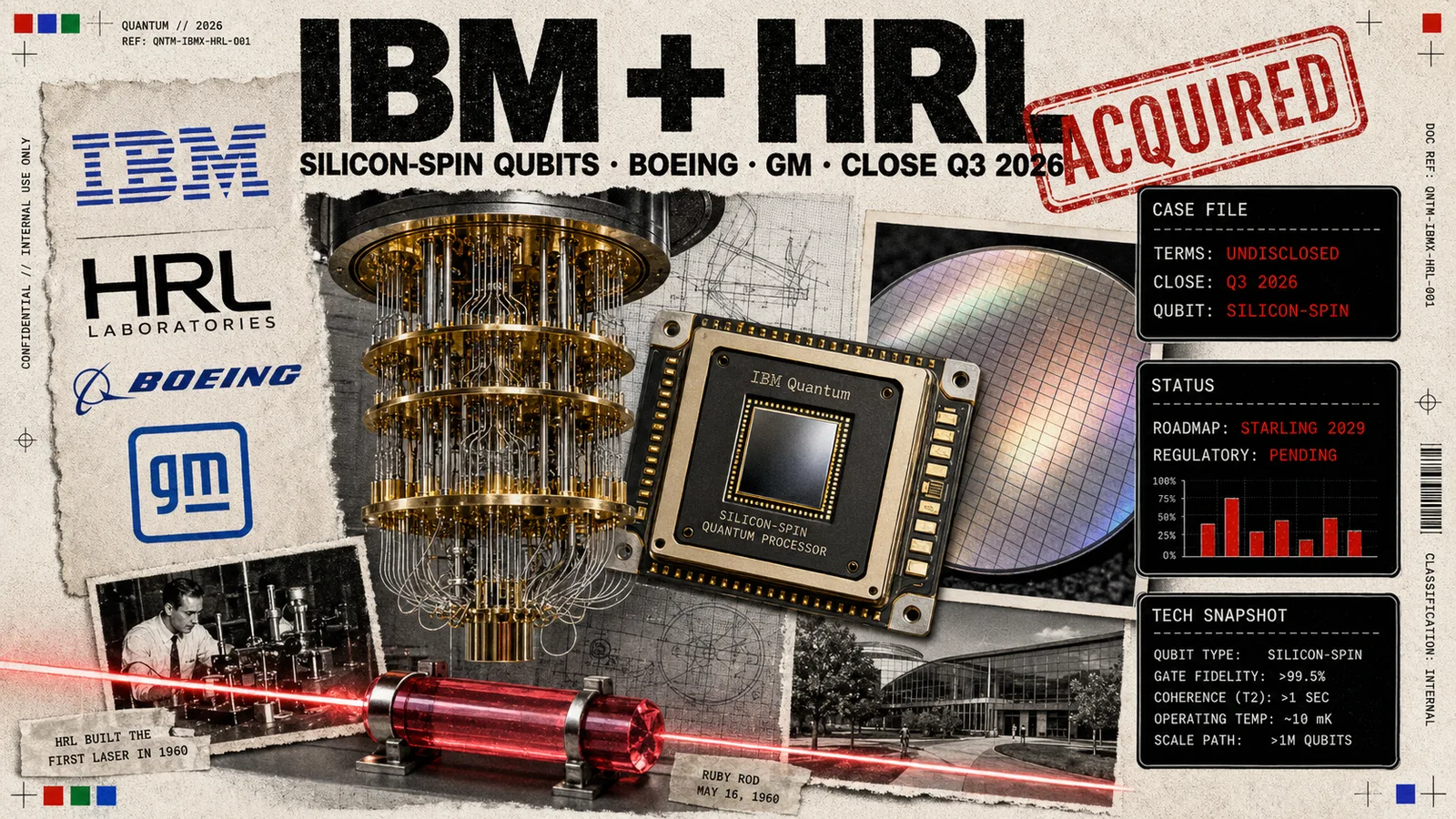
HRL Laboratories sits on a campus near Malibu in California and is owned jointly by Boeing and General Motors, two industrial giants rather than a venture fund. Both will keep partnering with IBM on quantum and advanced technology after the sale, so this is a purchase of a capability, not a clean break.
The lab has form. HRL continues the line of Hughes Research Laboratories, founded by Howard Hughes in 1948, and it is the place where the world’s first working laser was switched on, by Theodore Maiman using a synthetic ruby crystal on 16 May 1960. The institution that built the first laser is now building the electron-spin qubits IBM wants for its next machines, which is a neat piece of history but also the point: HRL’s value is deep, patient hardware engineering of exactly the kind quantum computing still needs.
That capability is silicon-spin qubit engineering. Rob Vasquez, HRL’s president and chief executive, framed the sale as continuity: “Joining IBM is the natural next chapter for what we have built at HRL.” Jay Gambetta, IBM’s director of research and an IBM Fellow, put the value in one line: “The HRL team will help IBM push even farther forward toward the frontiers of quantum innovation.” IBM’s statement also singled out HRL’s work in cryogenics, control electronics, qubit interconnects and packaging, the unglamorous plumbing that decides whether a quantum machine scales.
Financial terms were not disclosed. The transaction is expected to close by the end of the third quarter of 2026, subject to customary closing conditions and regulatory approvals, so nothing changes hands the day the press release goes out.
Two kinds of qubit, one company
Every quantum computer needs a physical thing to hold a quantum bit, and the industry has not agreed on what that thing should be. The two designs in this deal are the clearest rival answers.
A superconducting qubit, IBM’s choice, is a fabricated circuit that behaves like a controllable artificial atom when chilled to a fraction of a degree above absolute zero. It is fast and IBM has made it work at real scale, but the circuits are large and the refrigeration is demanding.
A silicon-spin qubit, HRL’s speciality, stores the bit in the spin of a single electron trapped in a silicon structure. The pitch is size and supply chain: because they live in silicon, spin qubits could one day be built on the same fabrication lines that already turn out ordinary processors by the million. IBM leaned on exactly that common ground. It called the two designs complementary, not competing, and said both “leverage state-of-the-art silicon fabrication,” a “shared foundation” that makes each “credible paths to scaling quantum technologies.” The weakness is maturity. No one has yet run a large, useful machine on spin qubits, which is the gap HRL’s engineers are meant to help close.
Why a company this committed would hedge
IBM is not a hesitant player. Its public roadmap still points at IBM Quantum Starling, a large fault-tolerant machine it aims to deliver by 2029, described as some 20,000 times more capable than today’s systems and able to run 100 million quantum operations, with a billion-operation successor called Blue Jay in the mid-2030s. That is a company confident in its superconducting path.
Buying a second qubit design anyway says something about how the field feels from the inside. Fault tolerance, the point at which a machine can correct its own errors well enough to run long useful programs, is still ahead of everyone. When the finish line is that far off and the winning technology is not settled, owning more than one way to get there is insurance. If spin qubits mature, IBM already holds the talent. If they do not, it has lost an undisclosed sum and kept its lead. For a company betting its research reputation on 2029, that is a cheap hedge.
Quantum progress is moving from papers to factories
The deal also marks a shift in how quantum progress gets made. For a decade the story was papers, qubit counts and roadmaps. Increasingly it is factories and mergers. In May 2026 IBM said it would build Anderon, which it calls the world’s first pure-play quantum wafer foundry, and flagged possible plans to make spin qubits there. Alongside the HRL purchase, the shape is clear: IBM is buying the spin-qubit talent and building the plant that could one day fabricate their work. A superconducting incumbent acquiring a spin-qubit lab from an aerospace group and a carmaker is the quantum race turning into an acquisition race, the same arc AI followed once the science looked bankable.
Two cautions belong on this. Terms were not disclosed, so the market cannot judge what IBM thought the bet was worth. And the deal still needs regulatory clearance before it closes, expected by the end of September. Until then IBM owns an agreement, not a lab. What it has already secured is optionality: a working team on the most credible alternative to its own design, bought while that design is still cheap enough to be a footnote in the roadmap rather than a rewrite of it.
Sources
- IBM newsroom, the acquisition announcementnewsroom.ibm.com
- PR Newswire, the official releaseprnewswire.com
- IBM Quantum, the development roadmapibm.com
- HRL Laboratories, its history and the 1960 first laserhrl.com