Congress returns to the crypto bill on 15 September, after both agencies moved without it
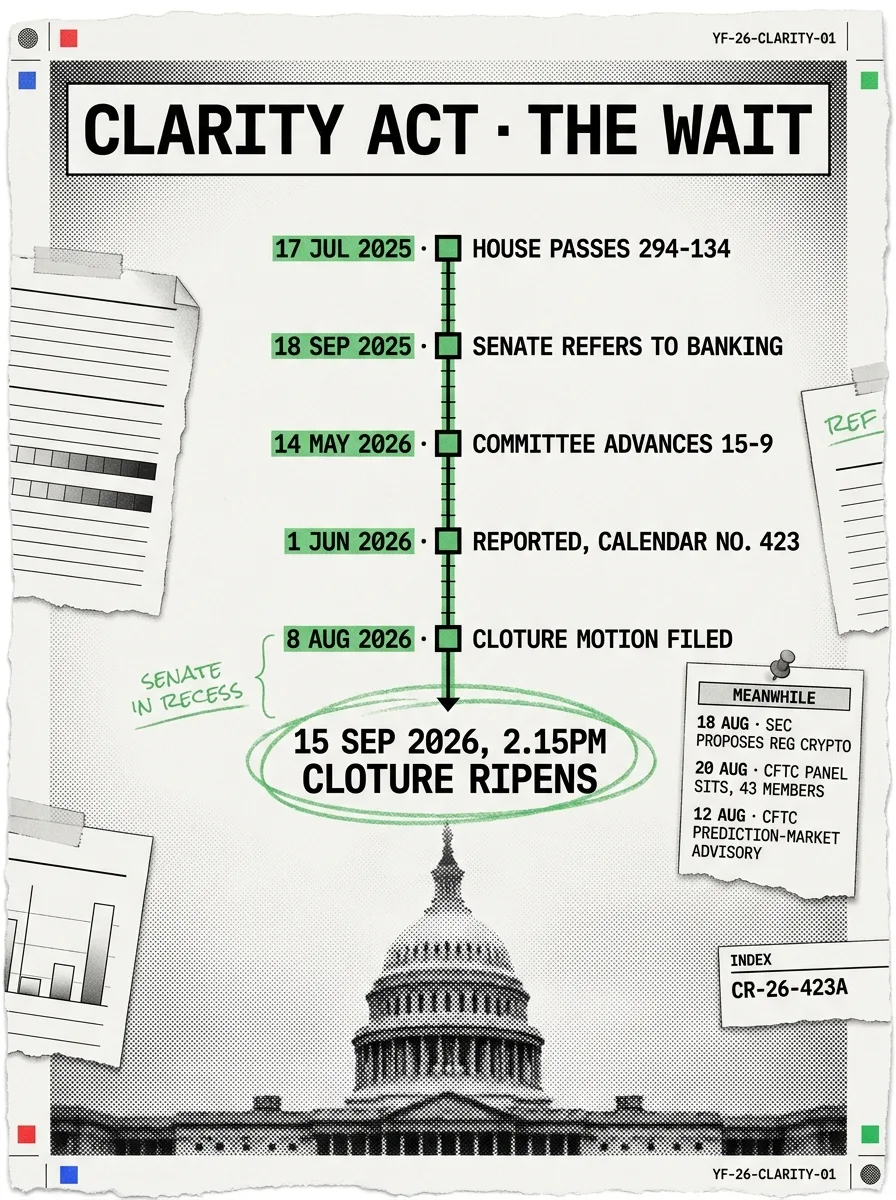
A cloture motion on the CLARITY Act ripens at 2.15pm on 15 September, the day after the Senate returns from recess. The SEC proposed its own crypto rulebook on 18 August, and the CFTC seats 43 industry figures on a new advisory committee on 20 August.
Listen to this articleListen
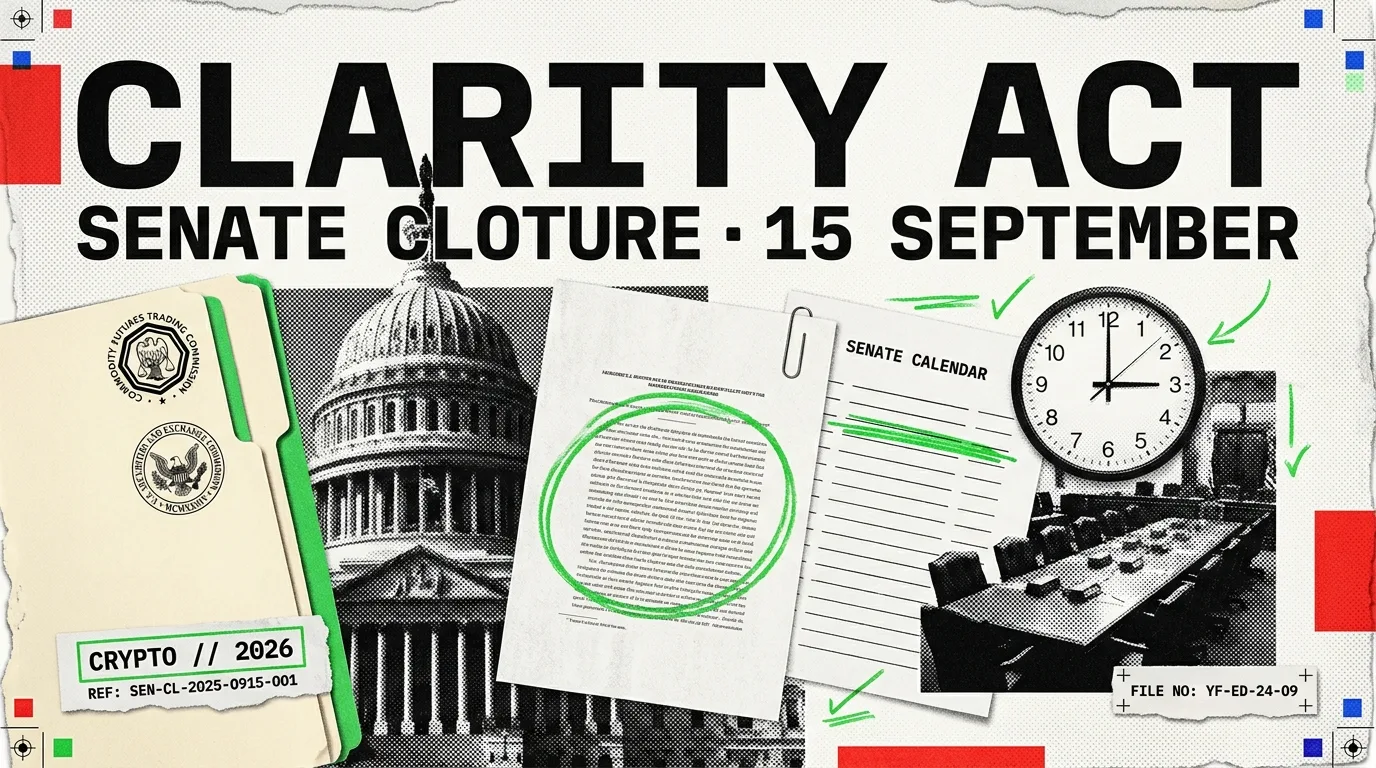
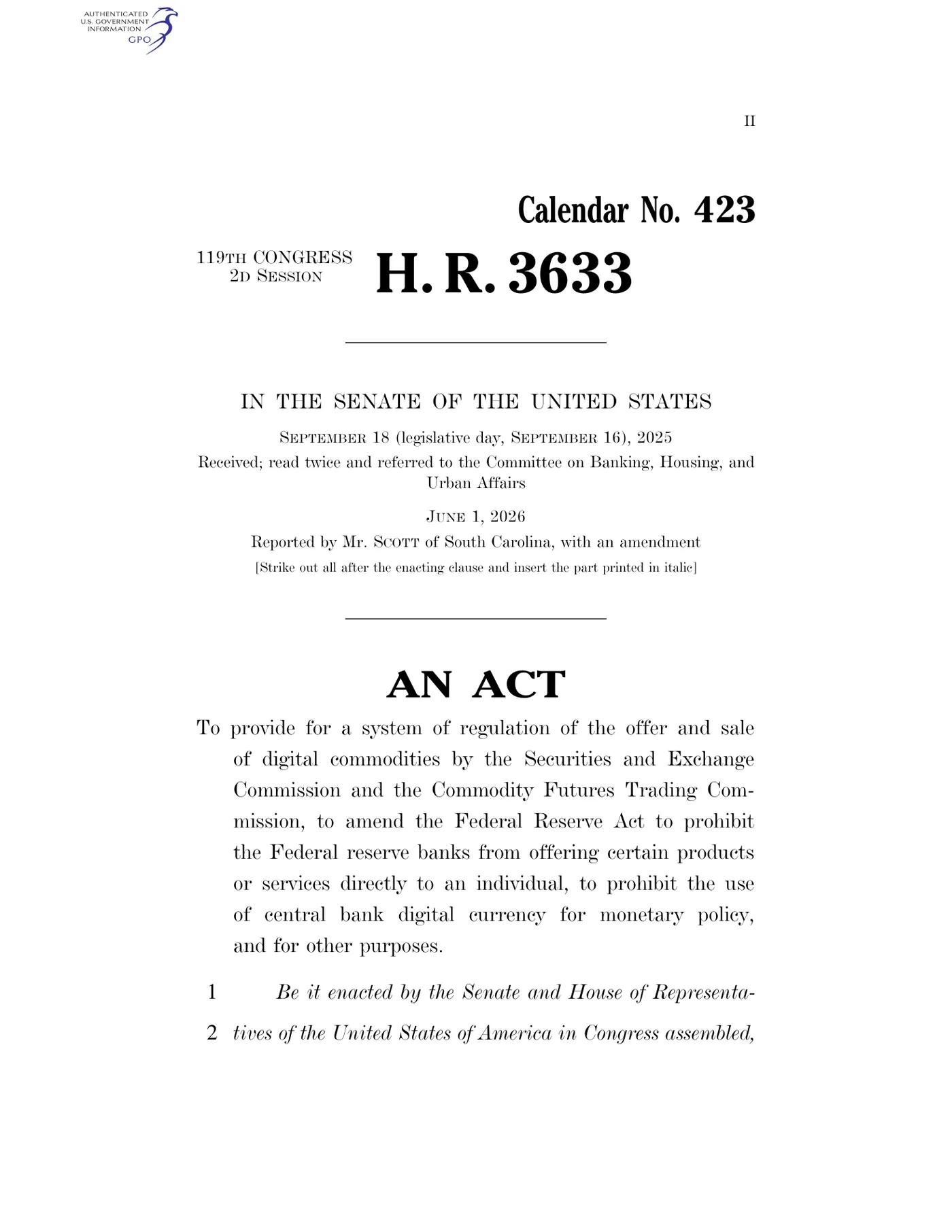
The Senate has never voted on the CLARITY Act. It has now set a time to try: by unanimous consent, the cloture motion on the motion to proceed to H.R. 3633 ripens at 2.15pm on Tuesday 15 September, the day after the chamber returns from recess. The order is printed in the Congressional Record of 7 August.
The bill itself has been waiting a while. The House passed H.R. 3633 on 17 July 2025 by 294 votes to 134, with Republicans 216 to nil in favour and Democrats splitting 78 to 134 against. The Senate received it that September, read it twice and sent it to the Banking Committee. The committee advanced it 15 to 9 on 14 May 2026, and Senator Tim Scott reported it to the floor on 1 June with an amendment striking everything after the enacting clause. It has sat on the calendar as No. 423 ever since. Majority Leader John Thune filed the cloture motion on 8 August; the Senate’s own cloture register still shows the day, vote and result columns blank.
The agencies did not wait
Two things happened this week that did not need Congress.
On 18 August the SEC proposed Regulation Crypto Assets, a 402-page offering regime approved three votes to nil. Chairman Paul Atkins was careful to say in his statement that it does not replace the bill: legislation, he wrote, “remains indispensable to enacting ‘future-proofed’ rules of the road that are durable enough to protect the work we are undertaking today from being unwound by a future rogue regulator”. He added that the commission “has and will continue to support Congress in delivering the CLARITY Act to President Trump’s desk”.
On 20 August the CFTC’s Innovation Advisory Committee sits for the first time, from 1pm to 4pm Eastern at Three Lafayette Centre in Washington, livestreamed on the agency’s own site. The agenda has three sessions: crypto regulation, artificial intelligence, and prediction markets. Walt Lukken of FIA chairs it and Chairman Michael Selig sponsors it.
The roster is the interesting part. It runs to 43 members and seats, among others, Brian Armstrong of Coinbase, Brad Garlinghouse of Ripple, Tyler Winklevoss of Gemini, Vlad Tenev of Robinhood, Shayne Coplan of Polymarket, Luana Lopes Lara of Kalshi, Sergey Nazarov of Chainlink Labs, Alana Palmedo of Paradigm and Chris Dixon of a16z crypto. The committee replaced the old Technology Advisory Committee when Selig launched it on 12 January, and its charter was amended on 3 March.
The CFTC has also been doing the unglamorous half of the job. On 12 August its Division of Market Oversight issued an advisory on self-certification of incentive programmes for prediction markets, citing Regulations 40.5 and 40.6 and warning that event contract filings are arriving with deficiencies that stop staff assessing whether customers have been given adequate notice of programme terms.
Section 404, and why the banks are unhappy
The fight that has held the bill up is one section long.
Section 404 of the Senate-reported text is headed “Prohibiting interest and yield on payment stablecoins”, and it does what the heading says: digital asset service providers may not pay interest or yield on a stablecoin balance. Then it carves out activity-based and transaction-based rewards, and expressly permits those rewards to be calculated by reference to a balance, a duration or a tenure.
That last clause is the whole argument. On 4 May the American Bankers Association, Bank Policy Institute, Consumer Bankers Association, Financial Services Forum and Independent Community Bankers of America put out a joint statement saying the drafting falls short. They accept the goal: the senators, they wrote, “are seeking to achieve the correct policy goal - prohibiting the payment of yield and interest on stablecoins”. Their objection is that the exception swallows it, letting exchanges route yield through membership programmes and tie rewards to exactly the balance and duration the section was meant to stop paying for.
The bill does not pretend the disagreement is settled. Its own sense-of-Congress language sets out both positions: that paying on stablecoin balances in a way equivalent to deposit interest could hold back depository institutions, and that activity-based rewards are critical to innovation and consumer adoption. Section 404 then hands the SEC, the CFTC and the Treasury Secretary one year from enactment to write joint rules saying which rewards are allowed.
The meeting nobody has confirmed
Reports circulating this week placed crypto and prediction-market executives at the White House on 19 August, with President Trump attending. We are not reporting that as fact, because we cannot stand it up.
As of 19 August the White House has published nothing about such a meeting on its news page, its presidential actions index, its briefings and statements index, its wire, or its crypto policy page. The most recent item on the news index is dated 18 August and concerns Canadian trade duties and violent crime. No attending company has published a statement of its own. The named guest lists in circulation closely track the CFTC advisory committee roster, which is a real, published document about a different event on a different day.
What is on the record from the administration is older and broader: Executive Order 14405, signed on 19 May, directing federal financial regulators to review rules that impede fintech firms, with digital asset and blockchain services inside the definition.
Three weeks of agency work, then a vote
The shape of the autumn is set. The SEC’s proposal is open for sixty days once it reaches the Federal Register. The CFTC’s committee starts taking evidence tomorrow afternoon. Neither of those requires the Senate to do anything.
On 15 September at quarter past two the Senate finds out whether it can get to a bill it has been holding since September 2025. Cloture on a motion to proceed is not passage; it is permission to start debating. That is the measure of where the statute actually is.
Sources
- H.R. 3633, Digital Asset Market Clarity Act, as reported in the Senate, Calendar No. 423 (full text)govinfo.gov
- US House of Representatives, Roll Call 199 on H.R. 3633, 17 July 2025clerk.house.gov
- Congressional Record, vol. 172 no. 130, 7 August 2026, p. S4596: orders for September 2026govinfo.gov
- US Senate, cloture motions of the 119th Congresssenate.gov
- US Senate, roll call votes of the 119th Congress, 2nd sessionsenate.gov
- Senate Banking Committee, 'Chairman Scott, Senate Banking Committee Advance CLARITY Act in Historic Bipartisan Vote'banking.senate.gov
- CFTC, 'Chairman Selig Announces Inaugural CFTC Innovation Advisory Committee Meeting on August 20 in Washington'cftc.gov
- CFTC, 'Chairman Selig Announces Agenda for August 20 Innovation Advisory Committee Meeting'cftc.gov
- CFTC, Innovation Advisory Committee agenda for 20 August 2026 (PDF)cftc.gov
- CFTC, Innovation Advisory Committee membership and remitcftc.gov
- CFTC, 'Releases Advisory on Self-Certification of Incentive Programs for Prediction Markets', 12 August 2026cftc.gov
- Bank Policy Institute and four other trade groups, statement on crypto market structure yield language, 4 May 2026bpi.com
- SEC Chairman Paul S. Atkins, statement on Regulation Crypto Assets, 18 August 2026sec.gov
- The White House, news index (checked 19 August 2026)whitehouse.gov